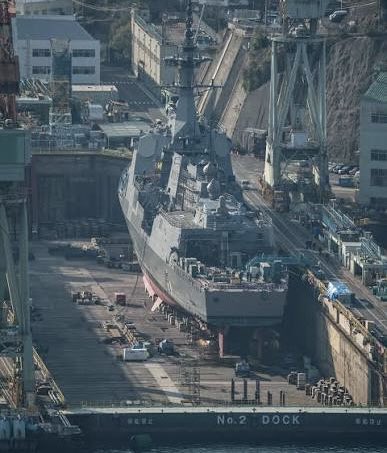
What if the US could build 30 basic, modern corvettes and 30 basic, modern, diesel submarines per year for the @USNavy and to sell and give to allies? The US should set up production lines around the country. Each would produce 10 units per year to serve as the #Navy backbone.
La Crimea sta per cadere.
I comandanti russi mettono al sicuro le famiglie oltre confine e preparano l’abbandono di Sebastopoli. Il comando della Flotta del Mar Nero trasloca a Novorossijsk. Del quartier generale restano macerie.
L’avanzata russa si è inceppata. Per la prima volta dal 2023 Mosca perde più terreno di quanto ne conquisti, e i conti li firma l’Institute for the Study of War, non la propaganda di Kiev.
I droni ucraini colpiscono ogni giorno più a fondo. Su Mosca, sulle raffinerie, a centinaia di chilometri dal fronte.
La guerra sta finendo.
Non in tre giorni ma in quattro anni.
Non con la caduta di Kiev ma con l’uscita di scena di Putin.
BREAKING | Reports circulating in the past few hours say the Russian Ambassador to the UN told the Security Council that Ukraine intends to launch drones from Latvia and other Baltic states.
Moscow has been publicly building the narrative for weeks that the Baltic states allow drone attacks from their soil against Russia.
Pattern fits how Moscow builds pretexts, first the internal narrative, then the diplomatic move, then the operational one.
What could follow: continued political destabilization, hybrid provocations on the border, or in more extreme scenarios something more direct.
@Gab__AI I asked Arya when she was last updated on information not counting web search. She said 2023. Is this true? Or has she had training/inputs since then?
My fear is that the talk of ending the Ukraine War means that Russia will try to attack what it perceives to be an easier target: a new NATO country with less experience with drones than Ukraine.
Russias post popular military blogger Rybar has shocked many of his viewers by claiming Russia no longer can use tanks in assaults and even if their army does advance in Ukraine it will not change anything, with Russian air defences not being able to do anything about drones.
How Russia Could Prepare for an Invasion of the Baltic States — and When It Might Happen.
The plan shown on the map accompanying this post is reportedly based on information from sources within the Russian Ministry of Defense. It is important to note that this appears to be a general concept rather than a fully developed operational plan.
According to these sources, a possible window for the start of the invasion is August 15–25, 2026, with the entire operation expected to last 12–14 days.
Phase One (blue arrows):
Initial strike directions framed as a “special operation” to protect Russian citizens allegedly facing persecution in Latvia.
Phase Two (red arrows):
Follow-up strikes presented as Russia’s response to supposed “aggression” from Estonia and Lithuania. These also include amphibious landing operations by the Baltic Fleet, launched from the Kaliningrad region.
Red rectangles:
Areas where Russian forces are expected to concentrate immediately before the operation begins.
Orange rectangles:
Staging areas for Belarusian forces and selected Russian units. Their role would be to divert attention from the main axis of attack and to draw Lithuanian, Estonian, and Polish forces toward the Belarusian border.
There are indications that so-called “presidential reserve call-ups” may partially take place on Belarusian territory during the summer. This would help reinforce the invasion force with reservists who have been actively recruited since December under the promise of “local service” guarding infrastructure.
According to sources within the Russian armed forces, Moscow does not intend to operate near the Polish border in order to avoid directly drawing Poland into the conflict. The broader objective is not to trigger a full-scale war with NATO, but rather to provoke a major internal crisis within the Alliance—ideally leading to its fragmentation.
Russian political leadership reportedly believes that European countries would hesitate to confront a nuclear power, especially without direct U.S. involvement. In this view, major European states would be unlikely to risk war with Russia over the Baltic states, while a direct confrontation with Poland is seen as something to avoid.
This reflects a broader mindset attributed to the Kremlin: some countries are treated as “full-fledged players,” while others—particularly former Soviet republics—are viewed as expendable.
At the same time, a potential invasion of Latvia would be framed not as aggression, but as a “protective operation.” Any attacks on Estonia and Lithuania would likely be justified as responses to “militaristic provocations” or “nationalist terrorist actions.” This narrative is designed to preserve diplomatic space for major European powers to engage in negotiations—on the premise that no formal war has taken place.
A similar approach was used in 2014–2015 in Donbas. While it was less effective in 2022, Russia still avoided a direct military response from NATO countries, facing instead sanctions.
Due to concerns that Sweden and Finland could independently support the Baltic states—and given that Estonian forces are preparing to defend the Narva region—Russia is reportedly unlikely to focus on that axis or along Estonia’s Baltic coastline.
Instead, the plan would involve bypassing Estonian defenses near Narva from the southwest, advancing through Tartu, and pushing directly toward Tallinn. Along the way, Russian forces would aim to neutralize NATO bases and training grounds, cutting off Estonian forces from supply lines and organized retreat routes.
Important:
This information remains preliminary. As far as is known, Russia’s General Staff has not yet finalized a detailed operational plan specifying units, formations, combat tasks, and movement timelines. One reason is that the required forces are still in the process of being assembled.
🇺🇸🇨🇳🇯🇵🇰🇷 The U.S. is thinking about using Japanese and South Korean shipyards and designs to quickly expand the size of the U.S. Navy.
A feasibility study worth $1.85 billion on outsourcing elements of warship design and construction to South Korea and Japan has been included in the FY2027 budget.
This initiative would examine adopting or co-producing advanced hulls such as Japan’s stealthy 5,500-ton Mogami-class frigates and South Korea’s 3,600-ton Daegu-class vessels to supplement the U.S. Navy.
Due to Chinese competition, the U.S. needs to vastly expand its navy but faces severe constraints in its domestic shipyard capacity, which has been plagued by labor shortages, aging infrastructure, cost overruns and maintenance backlogs for decades.
The Navy’s shipbuilding plans consistently fall short, with the fleet hovering below 300 ships against goals of 355 or more.
China’s shipbuilding capacity now dwarfs America’s.
China possesses roughly 232 times the shipbuilding tonnage capacity of the U.S. with one Chinese shipyard alone rivaling the combined output of all U.S. naval yards.
In recent years, China has delivered massive annual tonnage through its dual-use commercial-military shipyards, enabling its navy (PLAN) and coast guard (CCG) to surge ahead in hull numbers—now exceeding 370 warships for the PLAN alone, with projections toward 460 by 2030.
In contrast, U.S. output remains minimal, often under 0.1% of global commercial tonnage amid delays on programs like Virginia-class submarines and Constellation-class frigates.
Japan and South Korea stand ready to help bridge this gap significantly.
As the world’s second- and third-largest shipbuilders (South Korea on 28% and Japan at 15% of global output), they excel in efficient, high-quality naval construction.
Their yards deliver warships faster and at lower cost than U.S. facilities, with strong track records in modular building and technology transfer.
Partnering with Tokyo and Seoul would accelerate U.S. fleet expansion but would require legal changes, as the U.S. Navy is legally required to build its vessels in American shipyards, with only minor exceptions.
xAI is training 7 AI MODELS right now on the world's biggest AI CLUSTER Colossus 2.
The next few Grok drops are going to be INSANE.
current Grok → 0.5T parameter
Grok 5 small → 1T parameters
Grok 5 mid → 1.5T parameters
Grok 5 large → 6T parameters
Grok 5 max → 10T parameters
including Grok Imagine v2 (yes, the image model is getting a full upgrade)
Cursor x Grok team is also working together on a new frontier coding model.
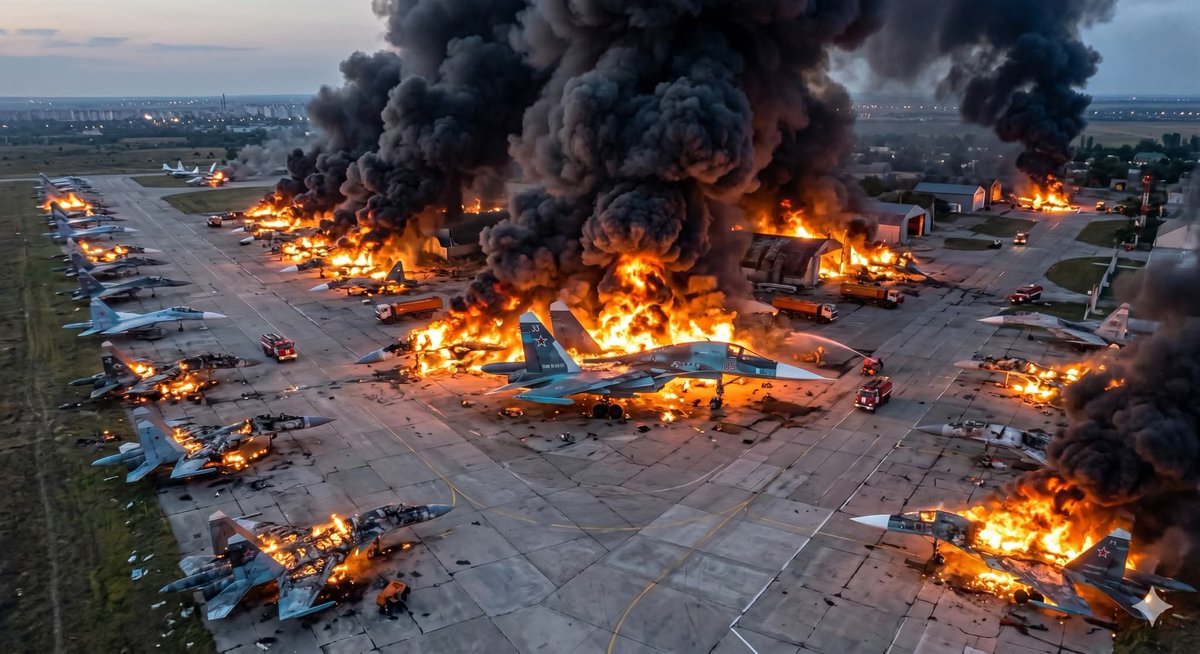
At several airfields across the Russian Federation, aircraft that had just been preparing to bomb Ukraine reportedly began exploding en masse. Fully loaded with missiles and bombs, the planes started detonating one after another, like a chain reaction.
Aircraft that were supposed to take off for Ukraine with full combat loads began exploding right on the tarmac. Su-34s, Su-35s, Tu-95s, and Tu-22M3s — all of it turned into a fiery inferno. The secondary explosions were so powerful that debris was scattered hundreds of meters. Flames engulfed entire parking areas of the airbases.
According to various estimates, more than 30–40 Russian combat aircraft were destroyed or severely damaged. This is described as one of the largest simultaneous strikes on Russian aviation during the entire war.
U.S. Navy interdictions have forced $1.05 billion worth of crude oil back to Iran, confirmed by satellite imagery.
Separately, the U.S. Coast Guard seized $380 million in Iranian crude in the Indian Ocean. The oil appears to be heading to the U.S.
@TankerTrackers