Not if you’re willing to go down in flames. At some point you just aim right down the middle and see what happens. Either your stuff is good enough to pitch in the league or it isn’t. Walks are usually a result of a pitcher subconsciously not wanting an answer to that question.
Every asset you own was partly financed in Tokyo. That funding is being withdrawn.
For thirty years Japan lent the world money for free. Zero rates. Yield curve control. A currency engineered to sink.
So capital did the obvious thing: borrow yen at nothing, sell it, buy Treasuries, Nasdaq, emerging market debt, Mexican pesos, credit, anything with a yield, add leverage, repeat until the trade became invisible. Until it was simply the water global markets swam in.
Nobody knows how large it got. Estimates run from a few hundred billion to past 10 trillion depending on what you count, which is another way of saying nobody can size the unwind until it is already running.
August 2024 was the rehearsal. The Bank of Japan raised rates fifteen basis points. The Nikkei fell 12% in a day, its worst since 1987, and the VIX printed in the 60s.
Fifteen basis points.
The policy rate is now 1%, the highest since 1995. The yen still hit a 40 year low. Tokyo has burned roughly 133 billion dollars defending it in four months, 59 billion of that in a single night last week.
On Friday the US Treasury sold euros out of its own reserve account to buy yen through the New York Fed. The last time Washington intervened for the yen was 2011, after the Fukushima earthquake.
There is no earthquake.
Underneath the currency, the collateral is repricing. Japanese gross debt sits near 256% of GDP. The 10 year JGB hit a 30 year high. The 30 year broke 4% for the first time since that bond was created in 1999. The 40 year touched 4.24%.
Which quietly flips the arithmetic for the largest pool of patient capital on earth.
A Japanese insurer buying a US 10 year at 4.7% pays away roughly 250 basis points to hedge the currency and nets about 2.2%. The domestic JGB pays 2.8% with no currency risk attached.
Japan holds 1.19 trillion dollars of Treasuries as the largest foreign owner and sold nearly 30 billion in the first quarter alone. The most reliable marginal bidder in the world has started going home, and it is going home for arithmetic reasons, which means it is not coming back when volatility calms down.
Everyone will watch the equity selloff. The equity selloff is survivable.
The bond market is where this actually breaks. Forced deleveraging and Japanese repatriation hit Treasuries simultaneously, into a market where the 30 year already sits at its highest since 2007 and the Fed just held with three members dissenting in favor of a hike.
Stocks fall, bonds fall with them, and the hedge everyone has owned since 1982 stops functioning in the same week they need it.
At which point the Fed has no good option left. Oil is driving inflation, so it cannot cut. But a disorderly Treasury market is a systemic event, so if the long end goes it has to step in and buy.
That is printing money to hold down the price of government debt while inflation runs above target, and it has a name that nobody at the podium will use.
Here is the part almost nobody models correctly. The crash is a distraction. The crash is loud, brief, and recoverable.
What follows is a decade of nominal returns that never quite keep up, of a currency that buys slightly less every year, of a central bank that keeps rates below inflation because the alternative is a fiscal crisis.
Nobody photographs that. There are no bread lines. There is a person who bought Treasuries because that was the responsible thing to do, held them for fifteen years, and ended up with two thirds of what they thought they had.
That transfer is the actual policy. It moves wealth from whoever saved to whoever borrowed, and the largest borrower in the room writes the rules and appoints the referee.
Japan built this trap over thirty years and is now walking into it in public.
US publicly held debt is at 99% of GDP, the highest since 1946, with net interest headed from roughly 1 trillion to 2.1 trillion by 2036 while the primary deficit actually shrinks. The entire deterioration is interest compounding on itself
Elon Musk avait dit un truc qui m'avait marqué sur l'allocation de ressources. En substance : passé un certain niveau de richesse, l'argent n'est plus de la consommation, c'est de l'allocation de capital.
Cette phrase change tout.
L'économie, dans le fond, c'est juste un problème d'allocation. Tu as des ressources finies et des usages infinis. Qui décide où va quoi ?
Imagine une cour de récré. 100 enfants, des paquets de cartes Pokémon distribués au hasard. Tu laisses faire. Très vite, un ordre émerge. Les bons joueurs accumulent les cartes rares, les collectionneurs trient, les négociateurs trouvent des deals. Personne n'a planifié. Et pourtant chaque carte finit dans les mains de celui qui en tire le plus de valeur. Le système maximise le bonheur total de la cour. C'est ça, la main invisible.
Maintenant fais entrer la maîtresse. Elle trouve ça injuste. Léo a 50 cartes, Tom en a 3. Elle confisque, redistribue, impose l'égalité. Trois effets immédiats. Les bons joueurs arrêtent de jouer, à quoi bon. Les mauvais n'ont plus de raison de progresser, ils auront leur part. Les échanges s'effondrent. La cour est égale, et morte. Elle a maximisé l'égalité, elle a détruit le bonheur.
Le problème de la maîtresse, c'est qu'elle ne peut pas avoir l'information que la cour avait collectivement. C'est le problème du calcul économique de Mises, formulé en 1920. L'URSS a essayé de le résoudre pendant 70 ans avec le Gosplan. Résultat : pénuries, queues, effondrement. Pas parce que les Soviétiques étaient bêtes, parce que le problème est mathématiquement insoluble en mode centralisé.
Quand Musk a 200 milliards, il ne les consomme pas, il les alloue. SpaceX, Starlink, Neuralink, xAI. Chaque dollar est un pari sur le futur. Et lui a un track record. PayPal, Tesla, SpaceX. Il a démontré qu'il sait identifier des problèmes immenses et y allouer des ressources avec un rendement spectaculaire.
L'État aussi a un track record. Hôpitaux qui s'effondrent, éducation qui décline, dette qui explose, services publics qui se dégradent malgré des budgets en hausse constante. Le marché identifie les bons allocateurs, la politique identifie les bons communicants.
Le profit n'est pas une finalité, c'est un signal. Il dit : tu as alloué des ressources rares vers un usage que les gens valorisent suffisamment pour payer. Plus le profit est gros, plus la création de valeur est grande. Quand Starlink est rentable, ça veut dire que des millions de gens dans des zones rurales ont enfin internet. Quand un ministère est en déficit, ça veut dire qu'il consomme plus qu'il ne produit. L'un crée, l'autre détruit, et on appelle ça redistribution.
Dans nos sociétés il y a deux catégories d'acteurs. Les entrepreneurs et les bureaucrates. L'entrepreneur prend un risque personnel pour identifier un problème, mobiliser des ressources, créer une solution. S'il se trompe il perd. S'il a raison, ses clients gagnent, ses employés gagnent, ses fournisseurs gagnent, l'État collecte des impôts. Il est la cellule de base du progrès humain.
Le bureaucrate ne prend aucun risque personnel. Son salaire est garanti. Au mieux il maintient une rente existante. Au pire il la détruit par excès de réglementation, mauvaise allocation forcée, incitations perverses qui découragent ceux qui produisent. Mais dans aucun cas il ne crée.
Regarde les 50 dernières années. iPhone, internet civil, SpaceX, Tesla, Google, Amazon, Stripe, mRNA, ChatGPT. Toutes des inventions privées, portées par des entrepreneurs, financées par du capital risque. Pas un seul ministère n'a inventé quoi que ce soit qui ait changé ta vie au quotidien.
La France est devenue le laboratoire mondial de la dérive bureaucratique. 57% du PIB en dépenses publiques, record absolu. Une administration tentaculaire, une fiscalité qui pénalise la création de richesse. Résultat : décrochage face aux États-Unis, à l'Allemagne, à la Suisse. Fuite des cerveaux. Désindustrialisation. Dette qui explose.
Et le pire c'est que la mauvaise allocation s'auto-renforce. Plus l'État prélève, moins les entrepreneurs créent. Moins ils créent, moins il y a de base fiscale. Plus l'État s'endette et taxe. Boucle de rétroaction négative parfaite. La maîtresse pense qu'elle aide, et chaque année la cour produit moins.
Dans nos sociétés, ce sont les entrepreneurs, toujours, qui font avancer la civilisation. Les bureaucrates au mieux maintiennent une rente, au pire la détruisent. Aucune société n'a jamais progressé en taxant ses créateurs pour subventionner ses gestionnaires.
La question n'est jamais qui a combien. C'est qui alloue le mieux la prochaine unité de ressource pour maximiser le futur de l'humanité. La réponse depuis 200 ans n'a jamais changé. Ce ne sont pas les fonctionnaires.
Trading has become trendy:
Heading into this NFL draft, there now have been 23 trades since the start of the league year, including the Dexter Lawrence deal.
From the start of the league year until night one of the draft last year, there were 15 trades.
"so you staked your ETH on the Ethereum blockchain to earn yield?"
"yes, Dave"
"except you didn't want your capital to be locked up so you actually staked it with a liquid staking protocol called Lido?"
"that's correct, Dave"
"and Lido gave you a liquid staking receipt token called stETH in return?"
"yes, Dave"
"and then you didn't think that was enough, so you juiced the yield even further by depositing your stETH receipt tokens into a restaking protocol called Eigenlayer?"
"you are correct, Dave"
"and now you didn't want to lock up your capital, so you actually restaked with a liquid restaking protocol called KelpDAO who provided you with a liquid restaking receipt token called rsETH?"
"you got it, Dave"
"and then that was surely not enough juice, so you then deposited your rsETH tokens into a lending protocol called AAVE so that you could open a leveraged looping position that borrows ETH against the rsETH collateral and restakes the ETH into rsETH which is then deposited as collateral, except it turns out rsETH used a cross-chain bridge called LayerZero whose security is held together by a 1/1 toothpick, which was obviously hacked by north koreans causing rsETH to become undercollateralized and now these looping positions are stuck and unprofitable, and everyone is pointing fingers at each other, and also DeFi is a very serious industry"
"you are 100% correct, dave"
jfc.
♦️j*wish chick tried to press Myron about the H*Iocaust and he hit her with the UNO reverse card!😭✡️🔁
“Do you think that lsraeI did a genocide?”
“That’s a complicated question..”
"You can't live in your Bitcoin." Wrong!
With Bitcoin Mortgage Insurance (BMI), you literally live in your home while your BTC stack works to erase a 30-year mortgage in under 10 years.
Buying a $500K home?
→ $0 cash down
→ Contribute 20% (~$100K BTC) to BMI escrow account.
→ Get full $500K financing
→ Pay normal P&I + BMI monthly
Like PMI but better. BMI turns dead payments into an equity engine:
Up to 50% of escrow works for you
Up to 50% goes to the lender
Timeline if BTC compounds:
15% CAGR → ~14 years debt-free
30% CAGR → ~9 years
60% CAGR → ~6 years
If BTC goes to zero? Lender eats the risk, not you.
No margin calls. No forced sales. No taxable liquidation to buy the house.
Just Bitcoin + Real Estate working together.
You get the keys today.
You HODL the upside too.
That's a Mortgage with BMI.
Bitcoin Powered Finance 🟠🏠
Build Wealth Smarter.
$14 trillion asset manager @BlackRock unveils a new ad campaign for #Bitcoin:
"There's more to the market than stocks and bonds. Get Bitcoin exposure with $IBIT."
One of the most powerful trading firms on Wall Street just got caught in the crosshairs.
Jane Street.
They don't do interviews or don't make headlines.
They move billions in silence up until now.
Two days ago, a lawsuit dropped in Manhattan federal court.
Filed by the administrator unwinding Terraform Labs, the company behind the $40 billion crypto collapse of 2022.
Insider trading, market manipulation, front-running a financial catastrophe.
The complaint alleges Jane Street had a man on the inside.
A former Terraform intern turned Jane Street trader.
They shared secrets through a private group chat called "Bryce's Secret."
When Terraform quietly pulled $150 million in liquidity from its pools, Jane Street allegedly knew.
Minutes later, they dumped $85 million in UST.
Panic spread and Luna went to zero.
$40 billion vanished and many retail investors were destroyed.
And Jane Street? They allegedly avoided $200 million in losses and then profited from the wreckage.
But here's what traders noticed this week.
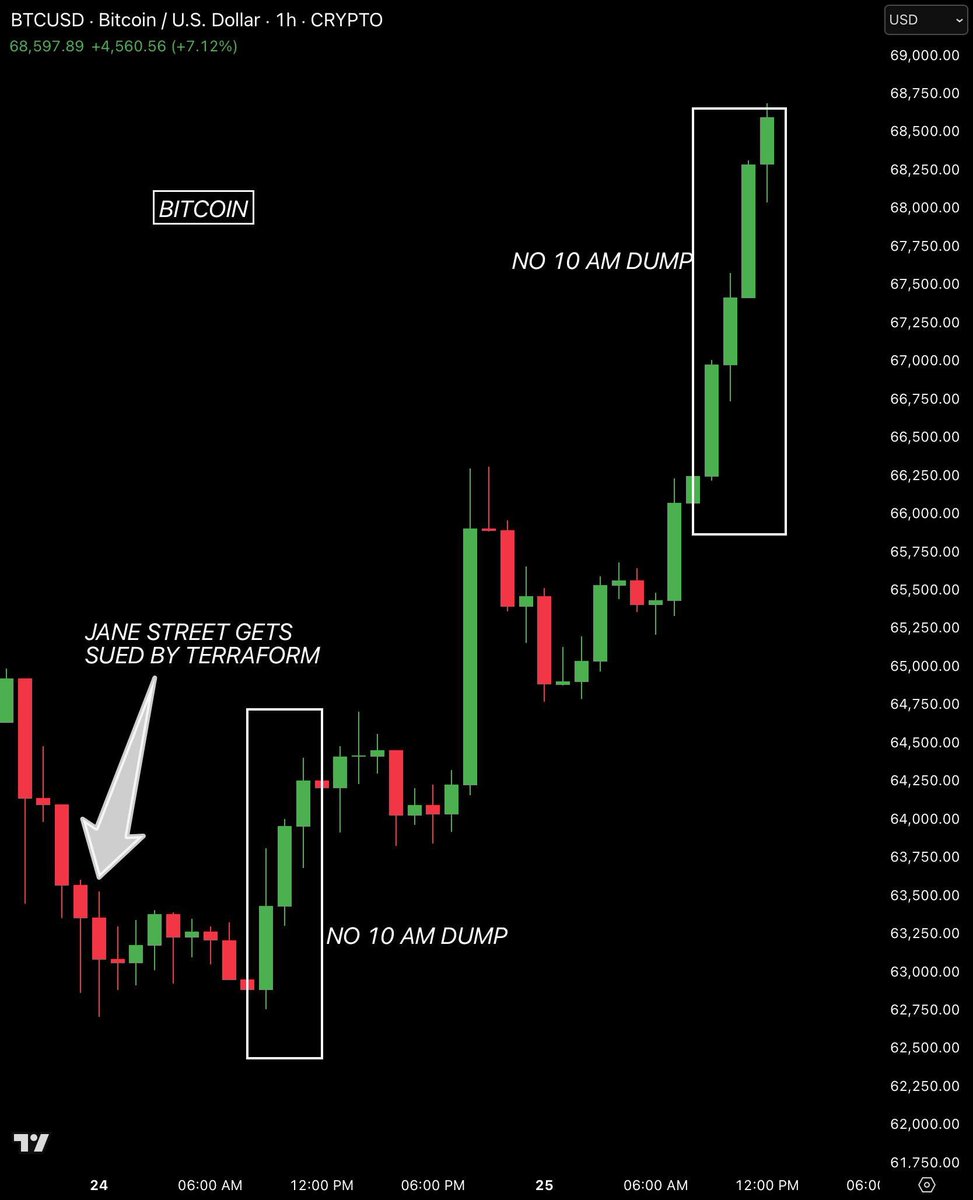
For months, Bitcoin has been getting slammed at exactly 10 AM Eastern.
Every single morning like clockwork.
Over 60% of sessions since November showed this exact pattern.
Traders called it "the 10 AM dump."
They blamed one firm.
Jane Street.
Jane Street is an authorized participant in BlackRock's Bitcoin ETF.
They can create and redeem shares directly.
They hold nearly $800 million in IBIT. They have the infrastructure to move markets.
Then the lawsuit dropped on February 23rd.
And something changed.
The 10 AM dump didn't happen Monday. It didn't happen Tuesday.
Bitcoin ripped 10% and dded $120 billion in market cap.
The weekly candle turned green after five straight red weeks.
Coincidence? Maybe.
But this isn't Jane Street's first rodeo.
Last July, India's market regulator barred Jane Street entirely.
Seized $567 million and accused them of manipulating the country's stock index through derivatives.
They allegedly made $4.3 billion doing it.
Now they're accused of helping blow up Terra.
Accused of running a daily suppression algorithm on Bitcoin. And the moment they get sued, the pattern breaks.
Jane Street says the lawsuit is "baseless."
The market says otherwise.
And now the world is watching.
Thomas Massie says he is prepared to put his life and political career on the line to prove to the world that Jeffrey Epstein’s child trafficking operation was not a hoax.
“My political career is on the line, and my own health and well-being could be too.”
“I’ve upset a lot of billionaires who obviously aren’t of high moral character.”
🚨THIS IS PROBABLY THE MOST IMPORTANT MACRO EVENT OF THIS WEEK.
And yet, almost no one is paying attention.
I’m not talking about Trump tariffs.
I’m not talking about Gold and Silver hitting new highs.
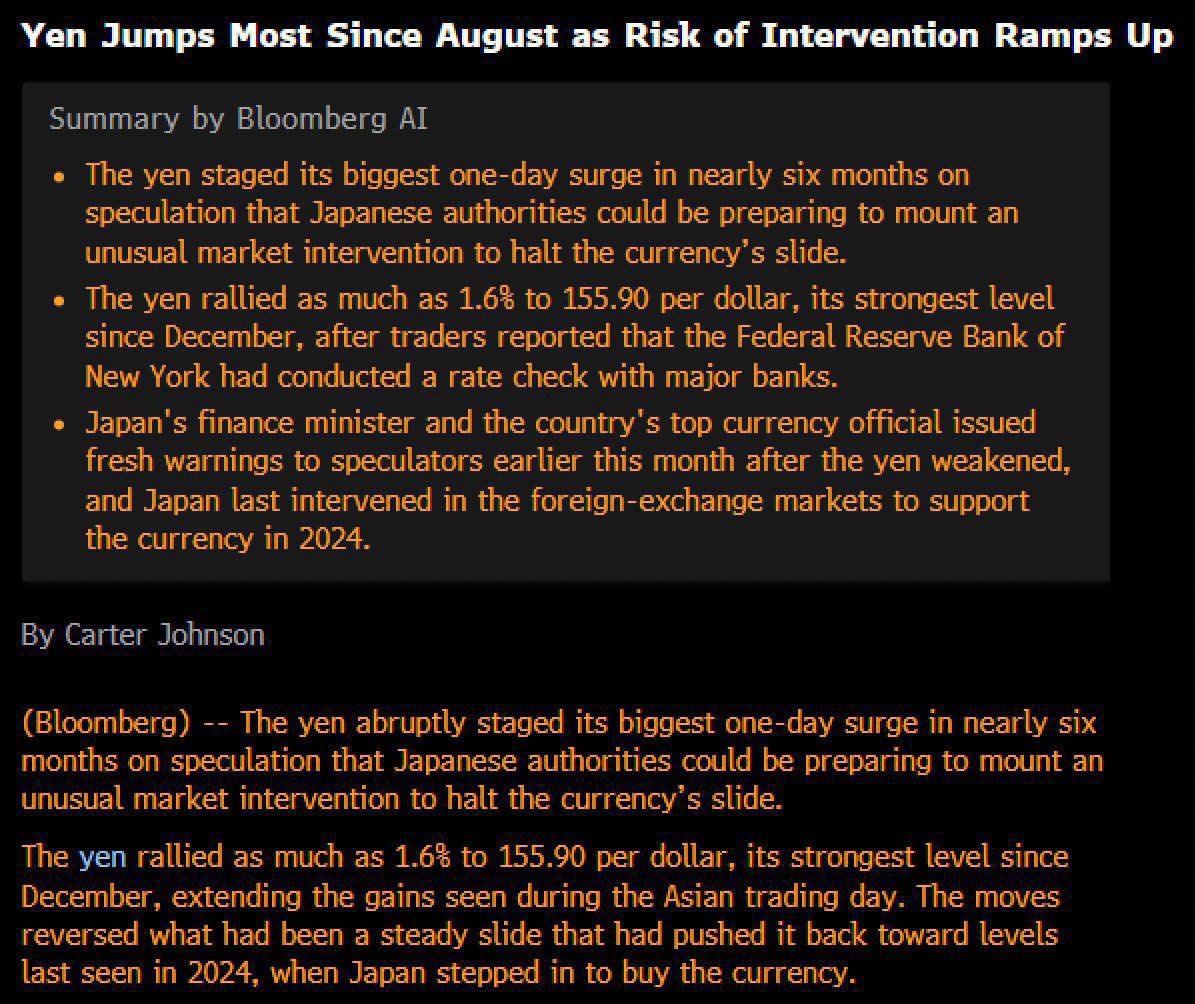
For the first time in over a decade, the New York Fed is openly signaling intervention in the Japanese yen.
That is a big deal.
Japanese government bond yields keep pushing to extreme levels.
The Bank of Japan is still in a hawkish mode.
And the yen is falling continuously.
When bond yields rise, the currency usually strengthens.
In Japan, the opposite is happening.
That is a sign something is breaking, and investors are feeling pessimistic about Japan’s economy.
As we know, Japan’s poor economic condition is horrible for the global economy.
And it looks like US policymakers are finally taking this risk seriously.
The New York Fed’s comments suggest a shift. They are now willing to step in and support the yen.
Here is how this usually works.
To support a currency, a central bank uses its own money. They create or use reserves, sell their own currency, and use that money to buy the currency they want to protect.
In simple terms:
The US would sell dollars and buy yen.
That is why markets reacted fast.
The US dollar index just printed one of its weakest weekly candles in months.
Traders are already pricing in a potential dollar devaluation and a stronger yen.
This is not just about helping Japan.
A weaker dollar actually helps the US government.
When the dollar loses value, future US debt becomes easier to deal with. The government still pays the same number of dollars, but those dollars are worth less in real terms.
A weaker dollar also makes US exports cheaper for the rest of the world, which reduces the trade deficit.
So supporting the yen while letting the dollar weaken is not a loss for the US. It is a policy choice that benefits both sides.
But the biggest winners are not governments. They are asset holders.
When a reserve currency like the dollar is devalued, assets priced in that currency usually go up.
Stocks, real estate, metals, and other financial assets rise in nominal terms.
That is already visible.
Most major asset classes are at or near all-time highs.
The only market that is still lagging is crypto.
While stocks and other assets look stretched, crypto is still far below its previous highs.
It has not fully priced in the same level of currency debasement and liquidity.
That is where the opportunity forms.
If the dollar devaluation theme continues, investors will start rotating.
They will look at markets that are trading at a big discount, and crypto will look appealing.
And this is when capital will start rotating out of crowded trades and into the crypto market, setting up one of the best catch-up trades ever.
JUST IN: Coinbase CEO Brian Armstrong tells French Central Bank Governor that Bitcoin is more independent than central banks
"Bitcoin doesn't have a money printer"
"There is no country or individual who controls it."
53 banking associations just wrote themselves a $6.6 trillion protection bill.
They called it the CLARITY Act.
Here is what they do not want you to understand.
Banks pay depositors 0.1% interest. Stablecoin issuers hold Treasury bills earning 4.5%. If stablecoins could pass that yield to users, banks lose the deposit war. They cannot compete. The math is fatal.
So they made competition illegal.
The Kansas City Fed calculated what happens if stablecoins pay competitive rates. Banks lose 25.9% of deposits. $1.5 trillion in lending capacity vanishes. The entire community banking model collapses.
Their solution was not innovation. Their solution was legislation.
The CLARITY Act everyone is celebrating contains Section 404 prohibiting yield payments through any mechanism. Not just from issuers. From exchanges. From affiliates. From partners. Every single pathway to competitive returns, closed by statute.
Brian Armstrong reviewed the 278-page draft for 48 hours. He withdrew Coinbase support at 11pm. The markup was postponed by morning. He saw what Wall Street analysts missed entirely.
This is not crypto regulation.
This is Dodd-Frank for digital assets. Incumbents writing rules that crush competitors. Regulatory capture so brazen they published the lobbying letters on their own websites.
The American Bankers Association. 52 state banking associations. The Community Bankers Council. All coordinating to eliminate an industry they cannot beat in open markets.
Meanwhile China made e-CNY interest-bearing on December 29.
America is banning stablecoin yield while Beijing is paying it.
The crypto industry spent years begging for regulatory clarity.
They got it.
Clarity that $6.6 trillion in deposits will be protected at any cost. Clarity that banks write the rules. Clarity that if you cannot win in markets, you win in Congress.
This is the largest regulatory capture event in American financial history.
And it is being sold as innovation policy.
BREAKING: 🇺🇸 MSCI just announced that it will keep Bitcoin and crypto treasury companies in its indexes.
This was the biggest reason behind the October 10th crash, which wiped out $19 billion in a single day.
This announcement will also end the $MSTR FUD about being forced to sell their Bitcoin holdings worth billions.
This is really bullish for crypto market.
₿REAKING: NVIDIA CEO Jensen Huang says, “Bitcoin mining is taking excess energy and storing it into a new form. It's called currency. And you take that currency wherever you like. So you took energy from one place and now you've transported it everywhere.”
"I'm too late to Bitcoin."
Late compared to who? Your friend? Twitter strangers? Your coworker?
Bitcoin: ~$1.7T market cap
Gold: ~$30T
Global assets: ~$300T+
Bitcoin is less than 1% of global investable wealth.
The "too late" crowd said it at $1,000. Said it at $10,000. Said it at $60,000. Saying it now.
Every cycle it ages like milk.
You're not late. You're VERY early.