🌎 Heading to #AAIC2026 in London?
Join the LAC-CD Community Gathering on July 12 to connect with colleagues across Latin America & the Caribbean working in dementia, aging, and brain health research. 🧠✨
🕑 2:00–3:00 PM
👉 Registration: https://t.co/nwgWL2dX3O
Sleep is a non-negotiable necessity and a cornerstone of whole-body health. The physical, social, and lifestyle exposome disrupts human sleep and ecosystems. We propose an #OneSleep framework that demonstrates how environmental factors influence sleep today, incorporates the sleep capital concept, and adopts a transdisciplinary lens of neuroscience, medicine, environmental sciences, and public health. Delighted to publish this @CellRepMed work with @MasoudTahmasian , Vincent Kuppers, Sarah Genon, @INM7_ISN , & @DiegoGolombek : https://t.co/8Tttoiyhej
How can we estimate chronological age and its associated gaps in disease + disparities using simple, scalable approaches? An EEG α-oscillation–based clock captures both neurodegeneration and the impact of structural inequality. This may offer an affordable and scalable approach to assessing disease and disparities. Congrats @PavelPradoG and all authors: https://t.co/mSkwmlPvR3
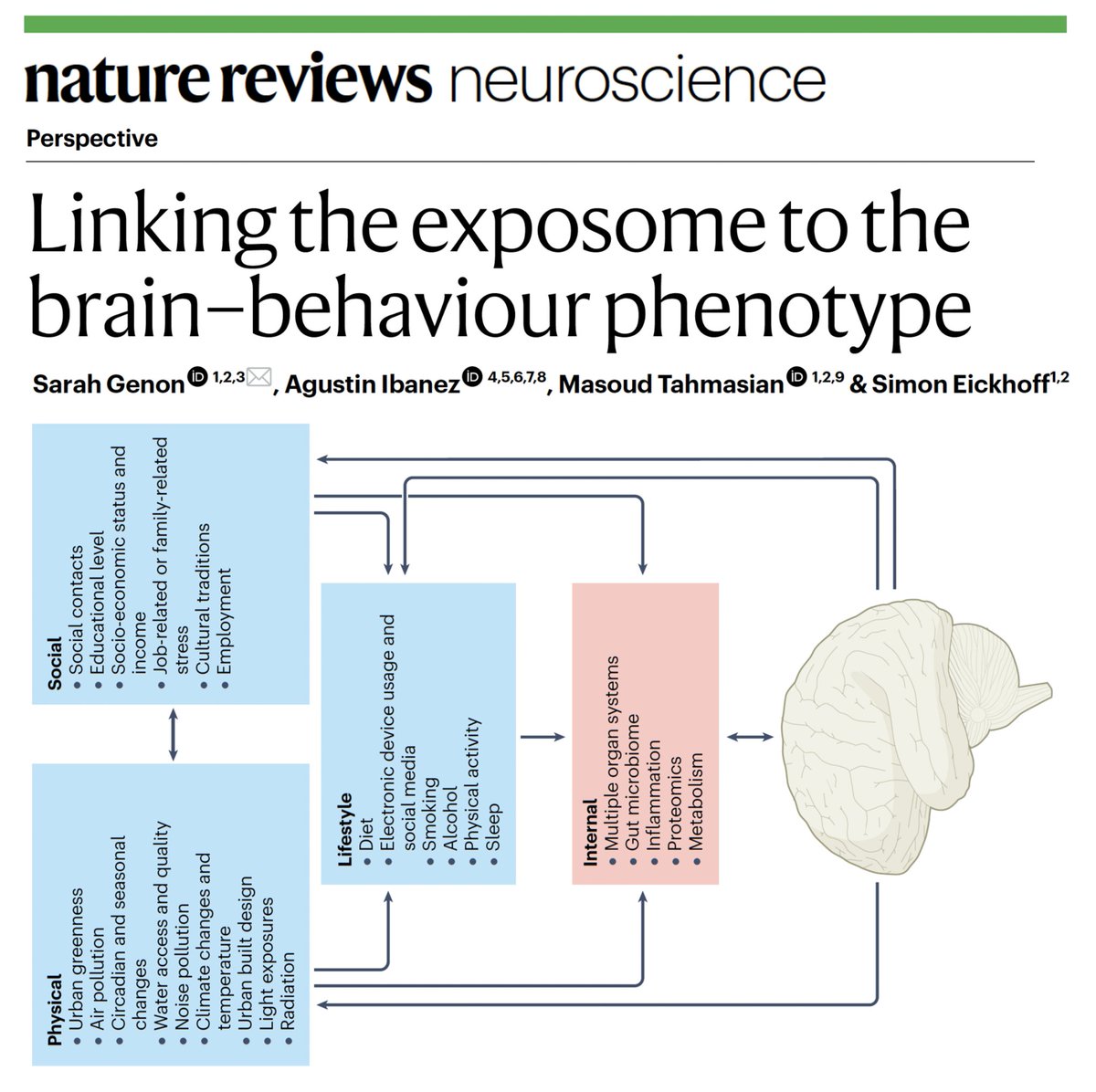
Brain–body-environment interactions must move beyond isolated exposures toward the expotype: the dynamic configuration of physical, social, lifestyle, and internal factors that jointly shape brain–behaviour phenotypes. At @NatRevNeurosci (https://t.co/FIMA1E1dxM), we propose a future agenda to assess the exposome as a complex, time-varying system that requires nonlinear models to capture interactions, thresholds, synergistic effects, and cross-domain buffering mechanisms. Although predictive machine learning can support individual risk estimation, the next frontier is to move from prediction to mechanism, from association to dynamic synergetic inference. Multivariate learning, causal machine learning, aging clocks, longitudinal designs, and generative biophysical digital twins are beginning to provide this bridge. Brain–body–environment diversity can reveal how ecology becomes biologically embedded. We call for a future exposomic neuroscience that integrates nonlinear temporal modeling, generative mechanisms, and population diversity to understand, simulate, and modify trajectories of brain aging and disease. Congrats Sarah Genon, @MasoudTahmasian & @INM7_ISN
Biophysical generative models allow us to understand mechanisms of brain dynamics grounded in empirical data. We developed a multi-frequency whole-brain model that stabilizes excitation/inhibition balance through inhibitory synaptic plasticity, enabling more realistic fMRI and M/EEG simulations. The model improves the fit to empirical connectivity data and discriminates brain macrostates, offering a mechanistic tool to investigate brain dynamics and neuromodulation, with relevance for testing in silico interventions. Robust work by @carlosmig_12 co-led by Fernando Lehue & Patricio Orio https://t.co/Oa2pJsNijZ. Congrats to all authors.
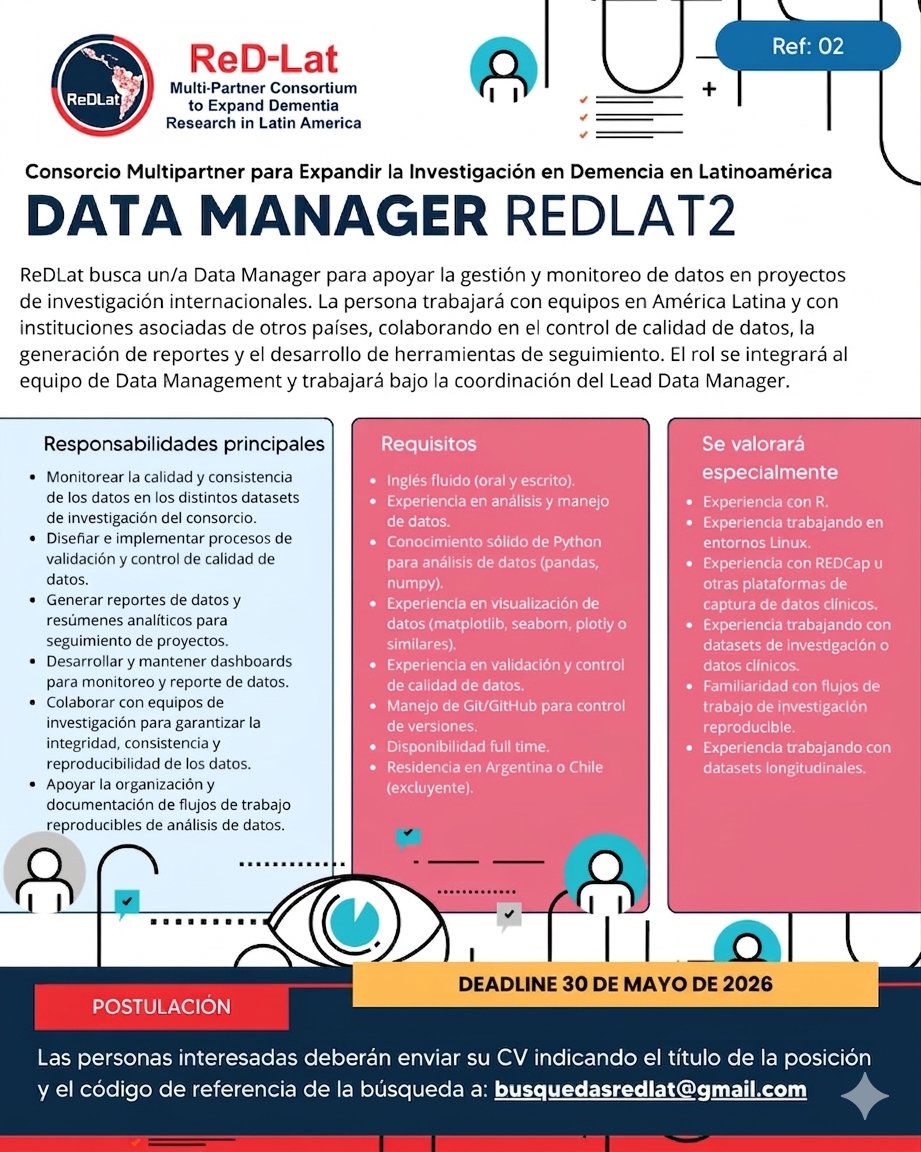
📷 Join ReDLat2 as Data Manager
We are seeking a full-time Data Manager to support a leading international dementia research initiative in Latin America.
Work with regional and global teams on data harmonization, monitoring, analysis, and visualization.
Requirements: advanced English, data experience, Python, and visualization tools. Based in Argentina or Chile.
📷 Apply by May 30, 2026: [email protected]
📢 Open Call | Exposome Postdoctoral Position
Seeking Data Science researcher for brain health models.
📅 Deadline: April 27, 2026
📩 Send CV to [email protected] (Ref: 06)
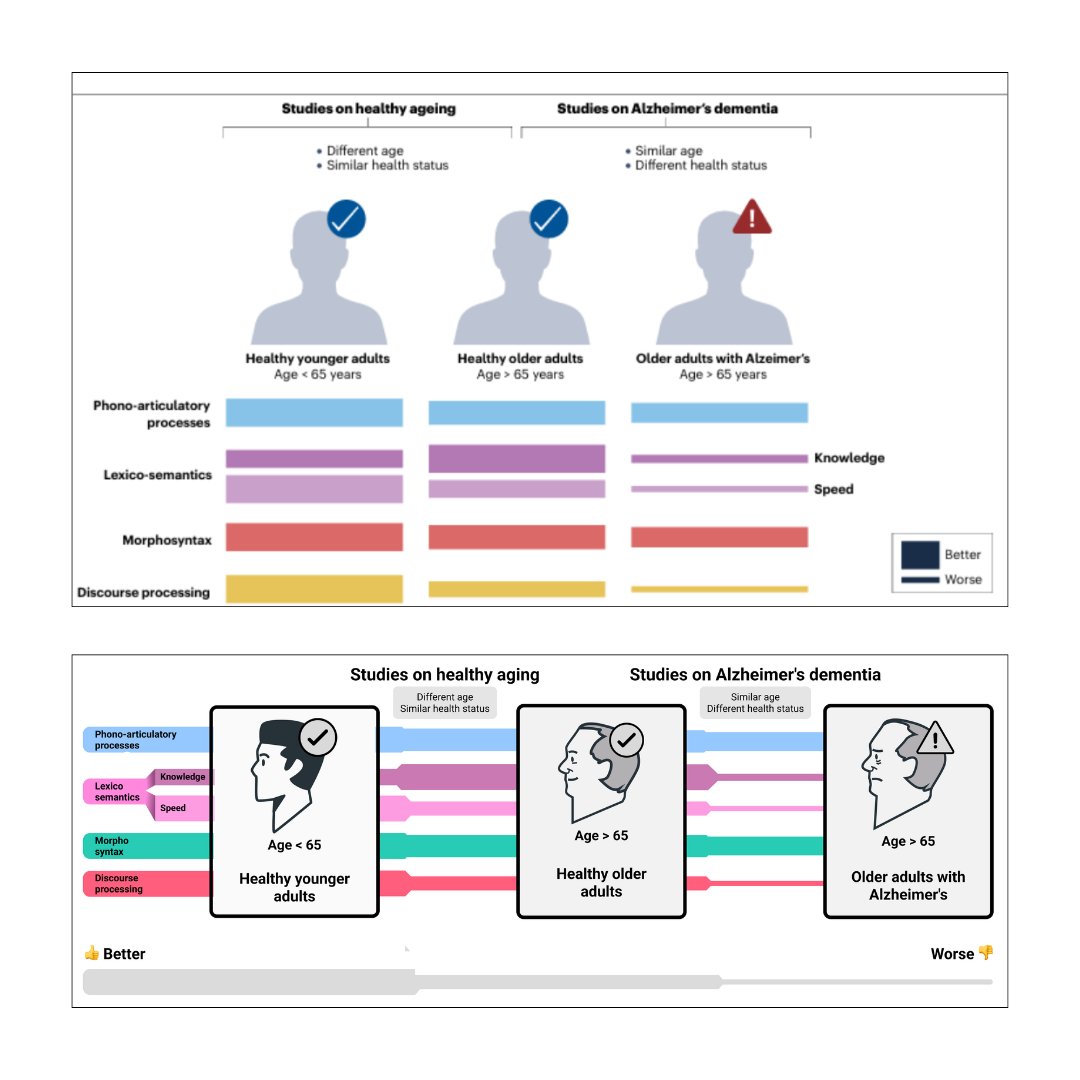
Thanks to @HuffPost for highlighting my recent Nature Reviews Psychology paper on how language changes across healthy ageing and Alzheimer's.
Read the piece here: https://t.co/zdjQjKHZFW
As words come of age, as words come undone. Check out this take on my recent Nature Reviews Psychology paper on language in healthy ageing and Alzheimer's. Out in Springer Nature Research Communities. https://t.co/K1zB7GLUTu
What is the linguistic blueprint of healthy ageing and how does it differ from that of Alzheimer's? Humbled by the invitation to share my views in Nature Reviews Psychology.
Check out the paper here: https://t.co/NalD1Z9vMp
📄NEW PUBLICATION | "The exposome of brain aging across 34 countries" in Nature Medicine with the participation of some @LACCD9 members.
Access the paper here 👉 https://t.co/vW02BsButU
What a thrill it was to give a talk on speech biomarkers of dementia at #TEDIdeaSearch in Buenos Aires a few months ago. Honored to spread the flame around this work at this massive global stage, thanks to the fantastic @TEDTalks and @TEDxRiodelaP teams. https://t.co/XqIkHNVKtm
Aging clocks may be shaped by neurosyndemics, multiple interacting physical and social real-world environments jointly influencing brain health. Out in Nature Medicine (https://t.co/h6kbJntHRV), we assessed 18,701 participants from 34 countries, showing that the combined aggregate-level exposome (73 physical, social, and political factors measured at country-level) predicts multimodal brain aging far better than isolated exposures (up to 15-fold more variance). Moving beyond single risks, we provide evidence that synergistic, nonlinear exposome burden accelerates brain clocks across health and disease, with physical exposures linking more strongly to structural brain aging and social exposures to functional brain aging. Exposome burden increased the risk of accelerated brain aging by 3.3–9.1-fold, in some cases exceeding the effects associated with dementia, and these findings held in out-of-sample, longitudinal, individual-level variation, and sensitivity analyses. Thus, the pace at which the brain ages may be shaped by syndemic environmental and societal conditions, calling for much more intersectoral policies. Congrats @AgustinaLegaz Sebastian Moguilner @HernHdezL & all coauthors. 1/5👇 @GBHI_Fellows
Hope can emerge in the most unexpected circumstances. This past year has been one of the most challenging for me, both scientifically and personally. But ReDLat2 has just been awarded by the @NIH and @NIHAging. Over the next 5 years, the project will bring together 12 sites across Latin America (Argentina, Brazil, Chile, Colombia, Mexico, and Peru) and the United States (@UCSFmac) to investigate how environmental × genetic interactions shape aging and dementia, focusing on Alzheimer’s disease and #FTLD. We will examine the role of aggregate and individual-level social exposomes (Aim 1) characterize biological signatures (genetic, epigenetic and plasma markers) across familial and sporadic presentations (Aim 2) and develop computational models of exposome × biological interactions that shape multimodal aging clocks (Aim 3) Deeply honored to lead this initiative together with @durananiotz, @YokoyamaLabUCSF, & @brucemillerucsf. Grateful to the @NIH and @NIHAging, our Program Officer @Maryam84gh, the @ReDLat_Dementia program manager @godoymeugenia and team, the @BrainlatUAI workforce and especially all the site investigators who make this collaboration possible. @lttakada@aslachevskych@AdolfoMGarcia@Elisa_Resende_@avilafunes@nanosanta@NiltonCustodio8
Many opportunities ahead for postdocs, clinicians, and scientists. Stay tuned.
March 8 | International Women’s Day
At @LACCD9 we recognize the women advancing dementia research, clinical care, and professional training across Latin America and the Caribbean. Their work helps strengthen regional responses to dementia.
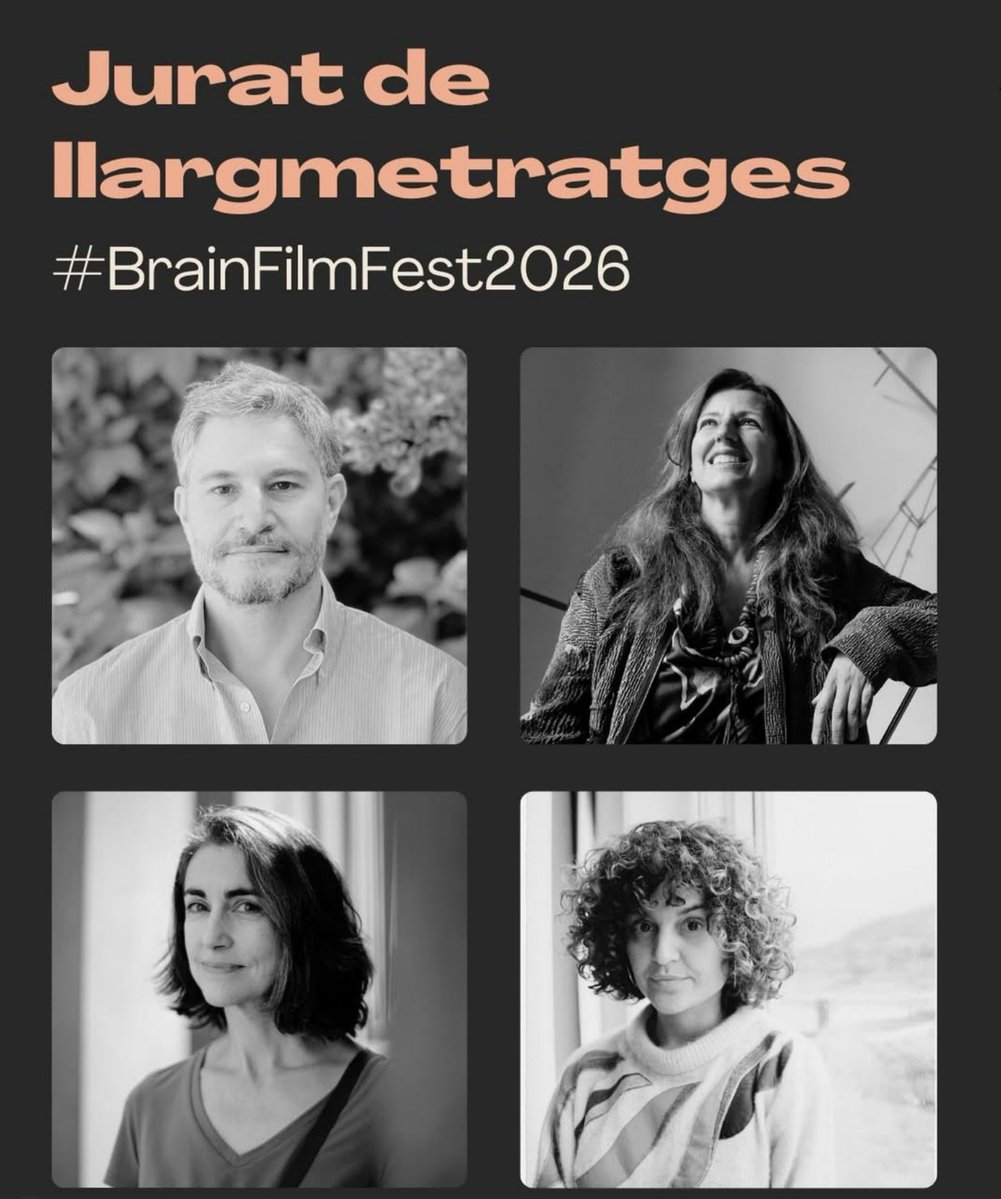
Honored to have served as a jury member at the @brainfilmfest 2026 in Barcelona. A truly inspiring experience shared with Avelina Prat, @BeneTagliabue, Elena Molina, Candela Carrera Argibay, @esubira and @crismaragall. All the films we assessed were a powerful reminder that brain health, illness, art and society are deeply connected. Cinema can illuminate the lived experience of neurological conditions in ways science alone cannot. Truly excited to celebrate the winner together at the festival next week in Barcelona: https://t.co/9ncQUJF4v2 🎬🧠
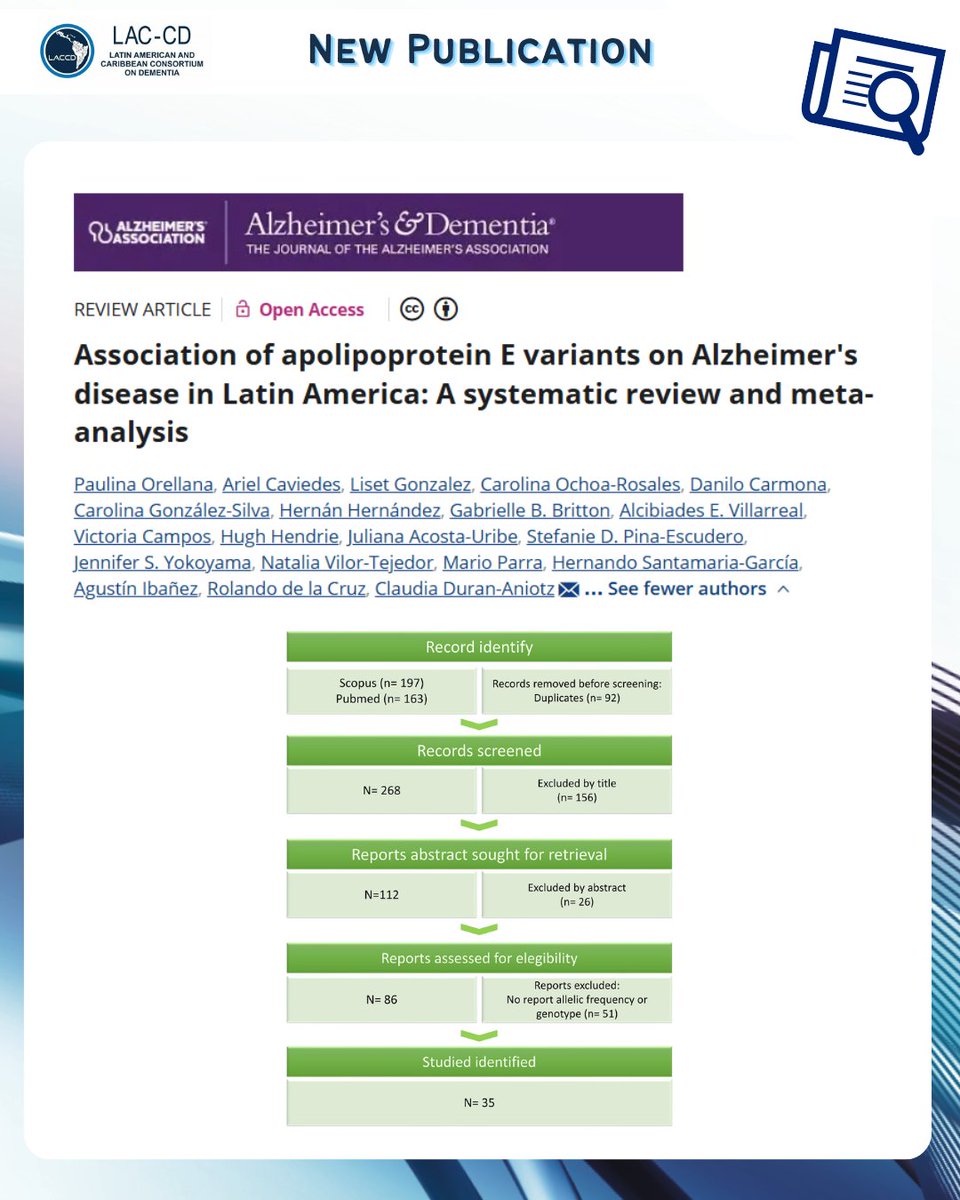
📄NEW PUBLICATION | "Association of apolipoprotein E variants on Alzheimer's disease in Latin America: A systematic review and meta-analysis" in Alzheimer's & Dementia with the participation of some @LACCD9 members.
Access the paper here 👉https://t.co/cimMCdV11H