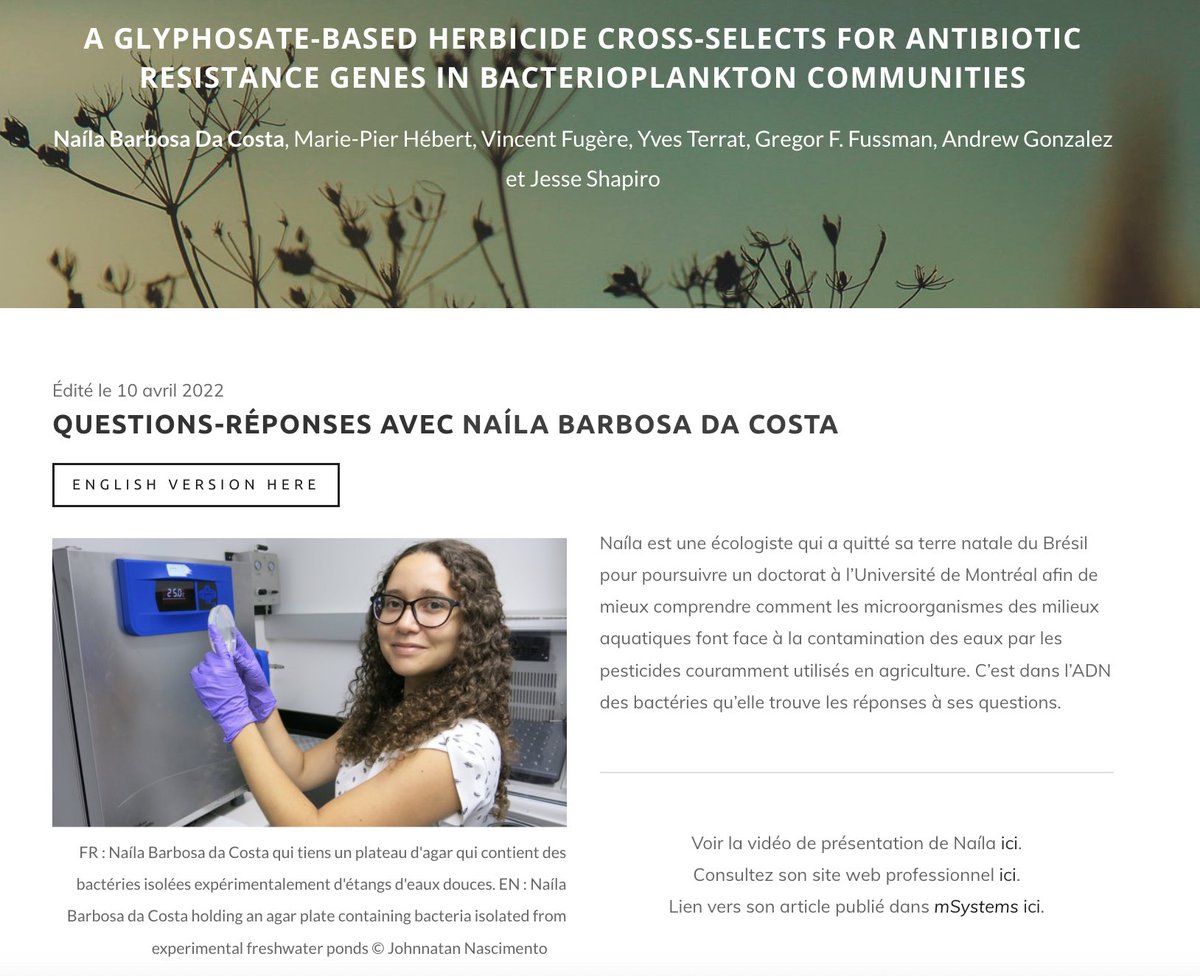
Découvrez notre entrevue avec @nbcosta, doctorante sous la direction de @bjesseshapiro, sur son article publié dans Msystems sur la résistance au glyphoste des bactéries planctoniques ! 🧫🧬
FR/EN
Sur notre site web : https://t.co/M7JqCnwvn2
@umtlSciences@MP_Heb@V_Fugere
Our research @LEAP_sci is gathering evidence that #glyphosate (aka RoundUp) impacts freshwater ecosystems - even when used according to guidelines.
Papers in Molecular Ecology and Ecological Applications led by @nbcosta@MP_Heb
https://t.co/qtAjVXruTd via @CTVMontreal
I'm so happy that this study found a home at @ESAApplications ! Special thanks to @LEAP_sci collaborators and shout outs to stellar ECR coauthors @V_Fugere and @nbcosta
The latest publications (they come twos!) from #LEAP are out! They are about the impacts of Round Up on aquatic microbes and zooplankton.
Congratulations to @nbcosta and @MP_Heb for leading such great research.
Out now in @NatureEcoEvo :
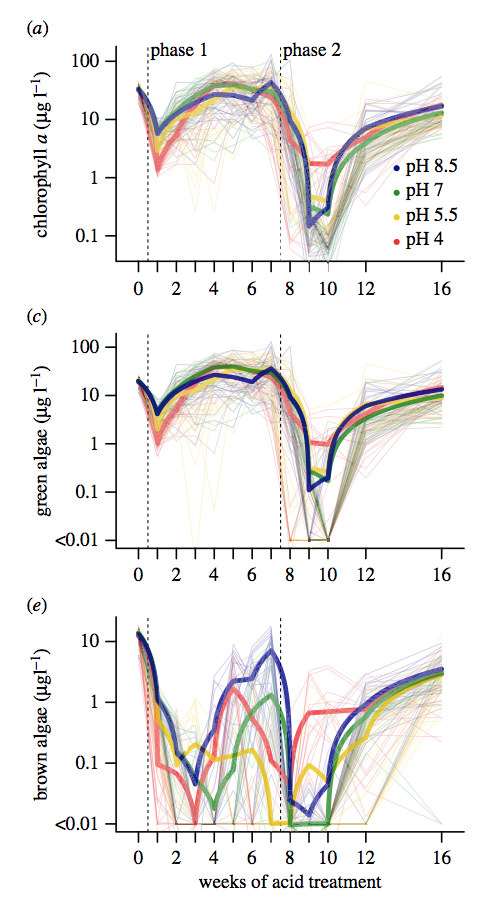
Community rescue in phytoplankton communities following severe glyphosate pollution - biomass recovered but diversity was lost.
Full-text access:
https://t.co/PYfxzwRcSA
A big experiment at @LEAP_sci lead by @V_Fugere and many collaborators.
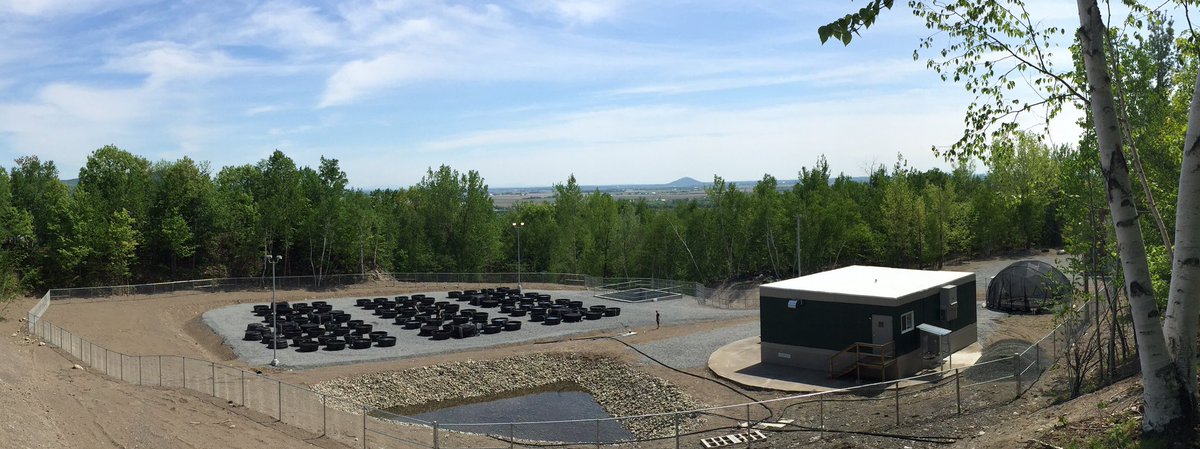
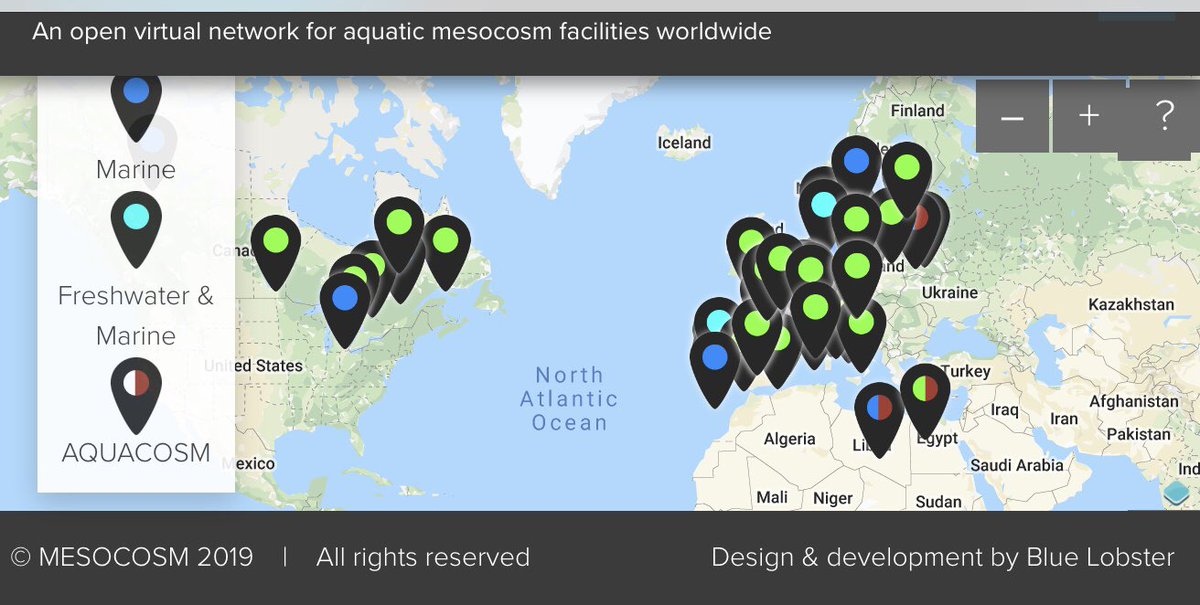
@LEAP_sci now up on “mesocosm” the open virtual network of aquatic mesocosm facilities worldwide. You can check out the others in 🇨🇦 including the in-lake mesocosm we have @info_gault
https://t.co/kBrjCQm3kJ
Our first data paper from @LEAP_sci 2017 is out in @RSocPublishing - Trophic structure modulates community rescue following acidification.
Fantastic team of scientists Graham Bell @V_Fugere@TrixieBB @bjesseshapiro @RowanBarrett Melania Cristescu Gregor Fussmann @BioMcGill
“Trophic structure modulates community rescue following acidification” our first @LEAP_sci publication led by Graham Bell and @V_Fugere out soon in @RSocPublishing
"99 percent of 68 water samples collected from the large water system contained at least one of the 10 pesticides researchers tested for and 31 percent of the samples contained neonicotinoids at levels higher than Canada allows"
https://t.co/IpZjuq69xV
@LEAP_sci just joined MESOCOSM https://t.co/VnhNphoUDb a hub for information about mesocosm facilities worldwide provided by the MESOAQUA project. As in astronomy, when telescopes are networked, we can combine forces to better study global drivers of aquatic ecosystems.
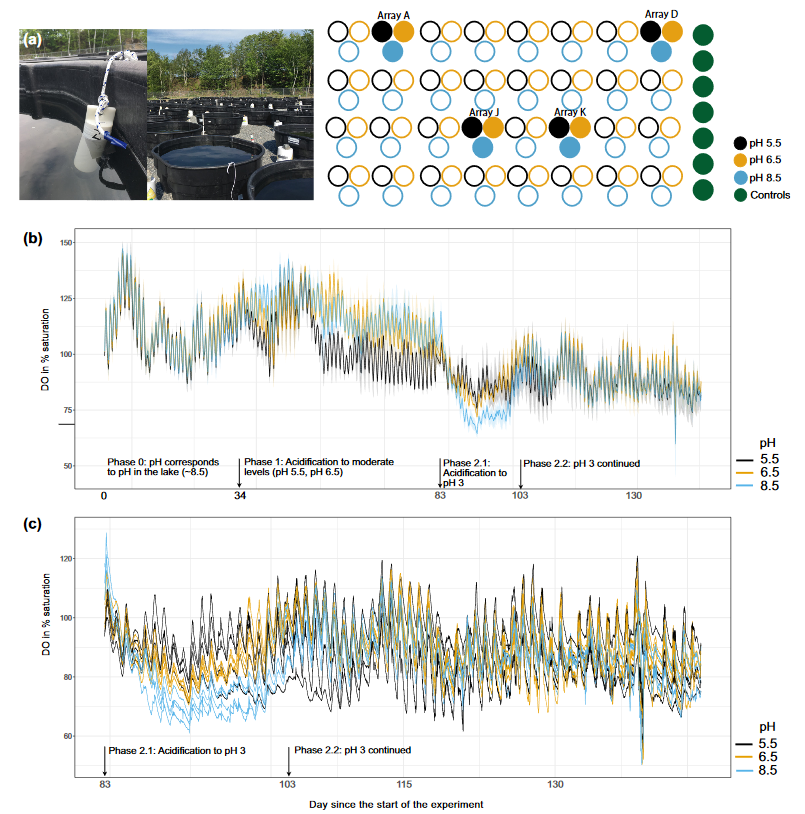
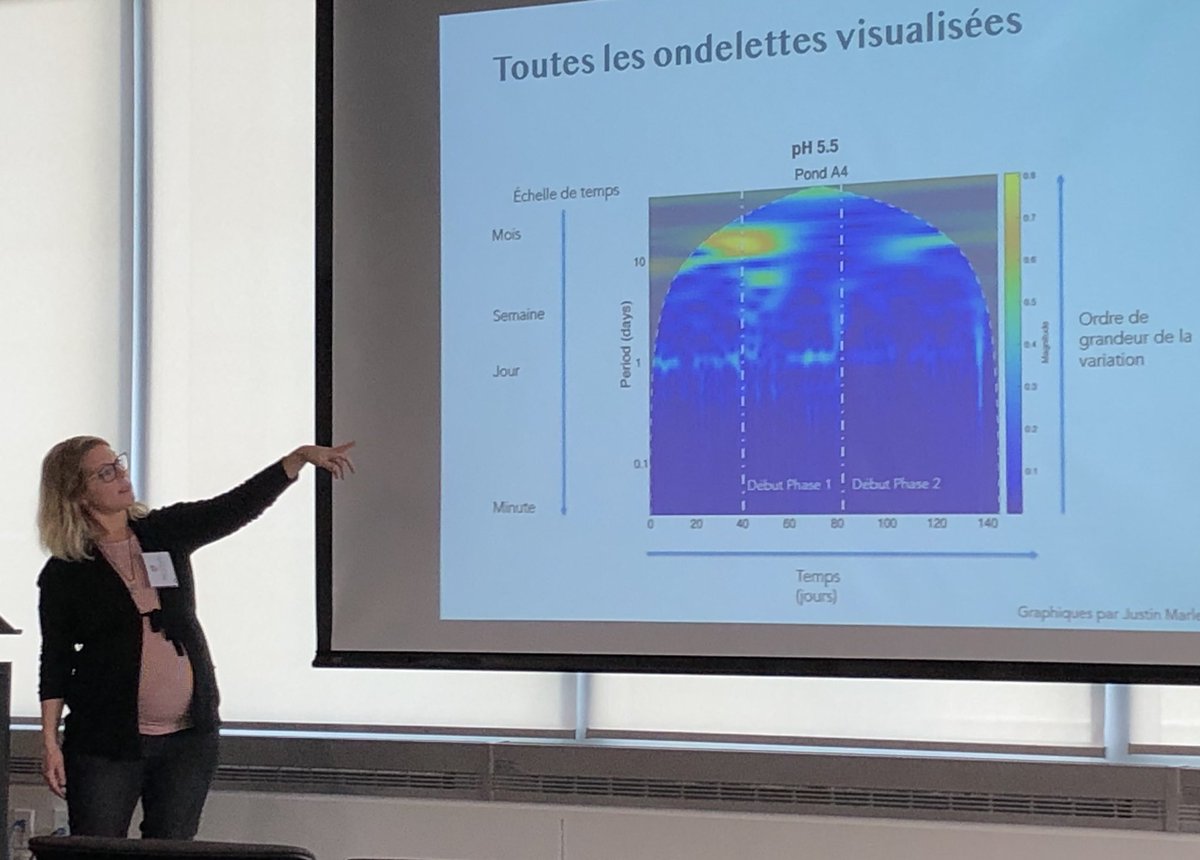
How do we assess the stability of evolving communities? @sofiavanmoorsel used wavelets on DO data from @LEAP_sci 2018 pH stress to reveal the shifting structure of multiscale variability before, during and after pH stress.
#gonzalezlab#csbq2018
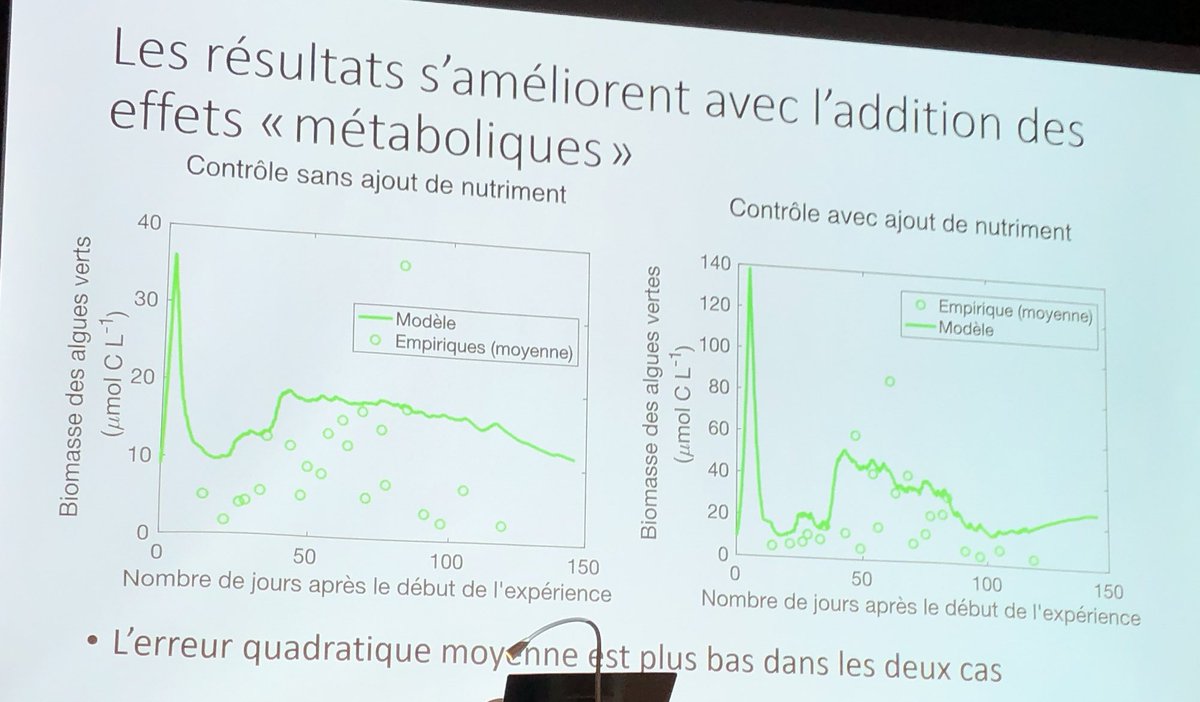
@jnmarleau#gonzalezlab shows that we CAN predict the dynamics of plankton communities in response to pH stress in @LEAP_sci if we include temperature dependence of metabolic functions AND the variability of the temperature the mesocosms experienced #CSBQ2018
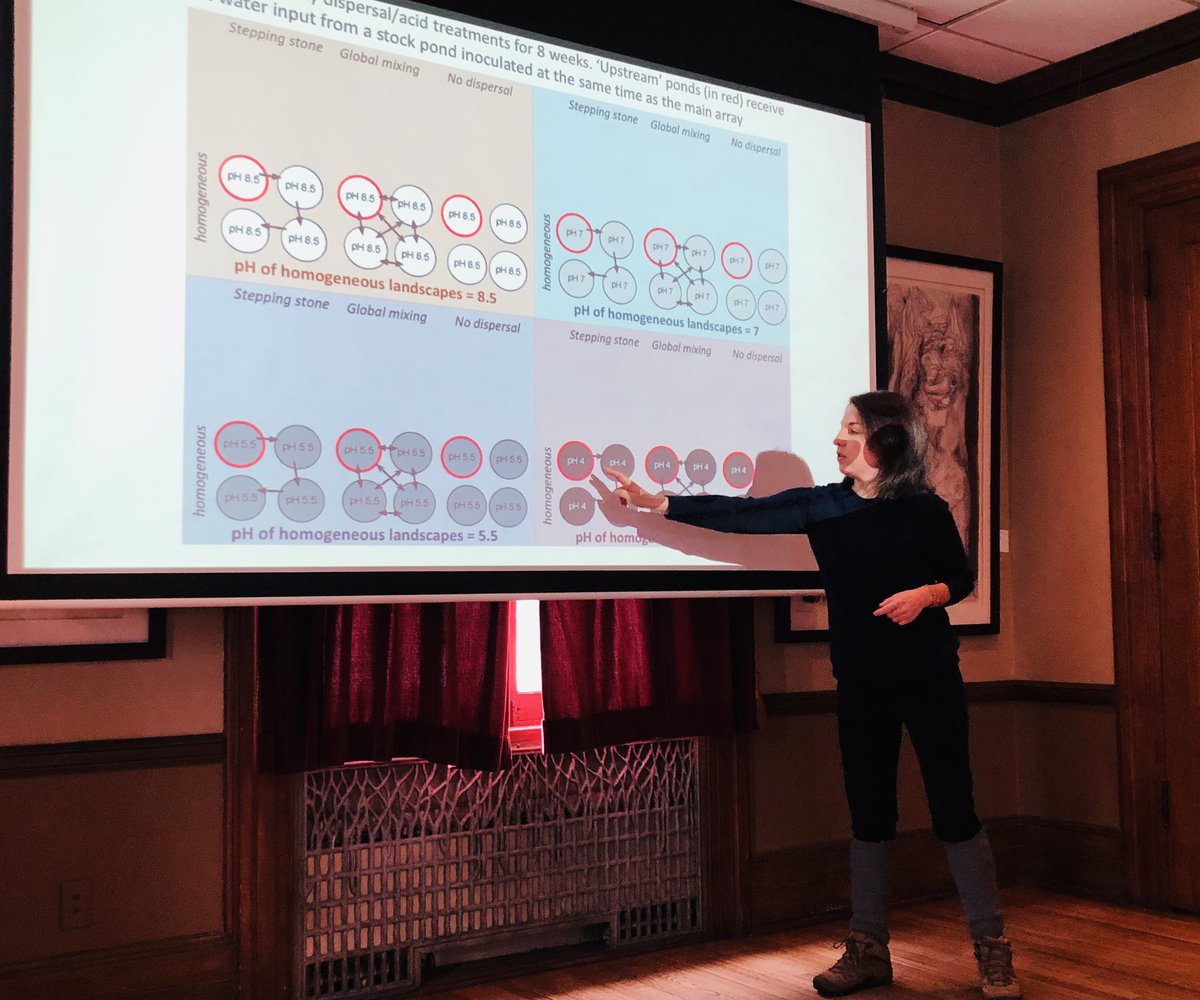
Katie Millette describes the @LEAP_sci 2017 experiment where she developed eDNA and eRNA methods to track #biodiversity change during the selection for resistance to acidification #MEES
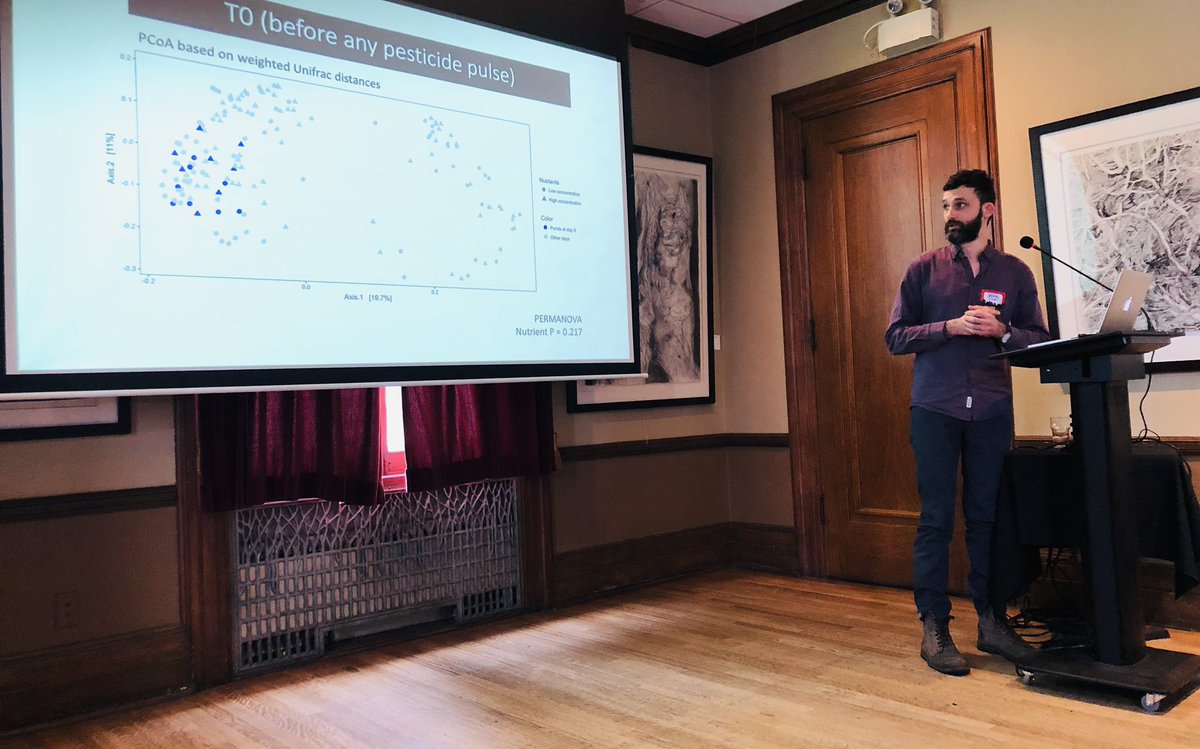
@nbcosta@LEAP_sci results shown off by @bjesseshapiro at #MEES - very cool evidence of picoplankton community reorganization in response to pesticides #neonic#glyphosate
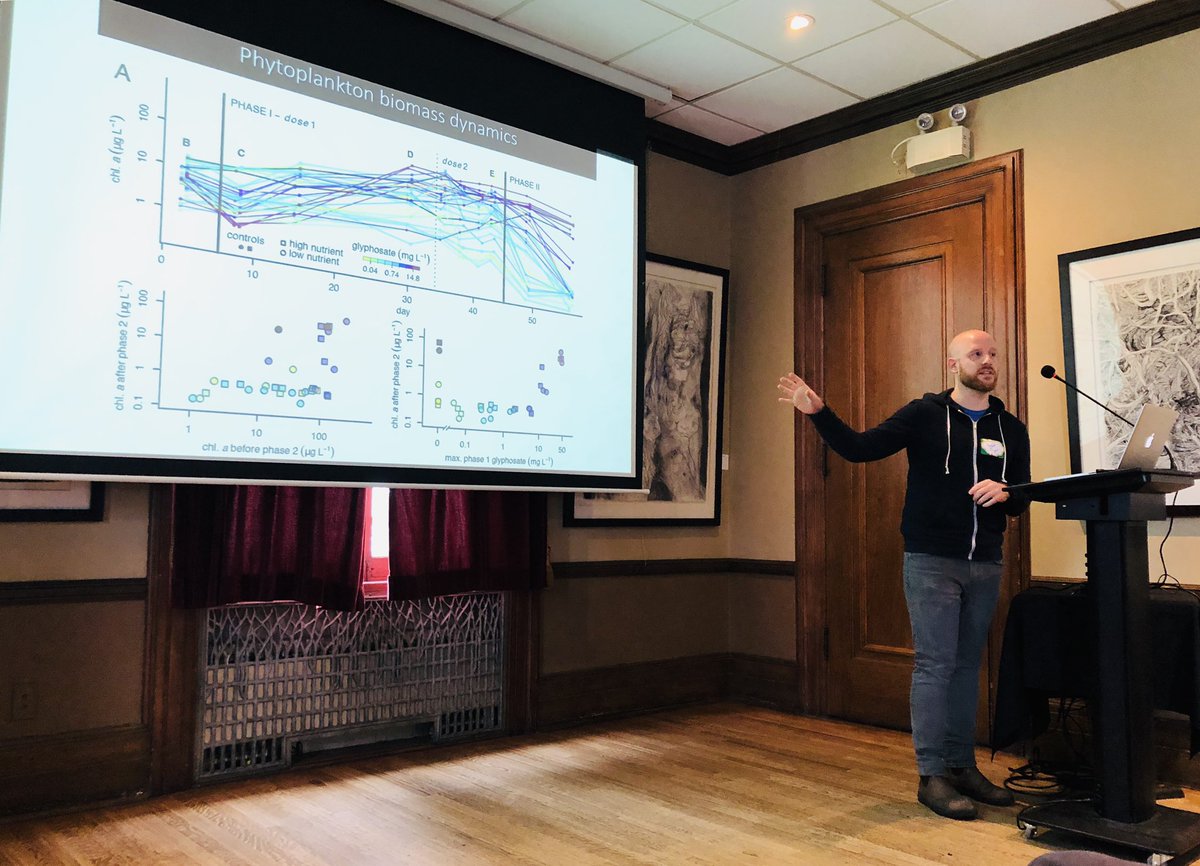
@V_Fugere tells #MEES about the first @LEAP_sci experiment where we found rapid increase in community resistance to #glyphosate selection in phytoplankton. Check out the paper on @biorxivpreprint https://t.co/HmHCJRyDml