Two more practical guides from today:
Getting a “model not found” error?
https://t.co/mtJrdBjiSZ
Not sure what “OpenAI-compatible” actually guarantees?
https://t.co/C5pmZmgkko
Useful before switching providers—or discovering the differences in production.
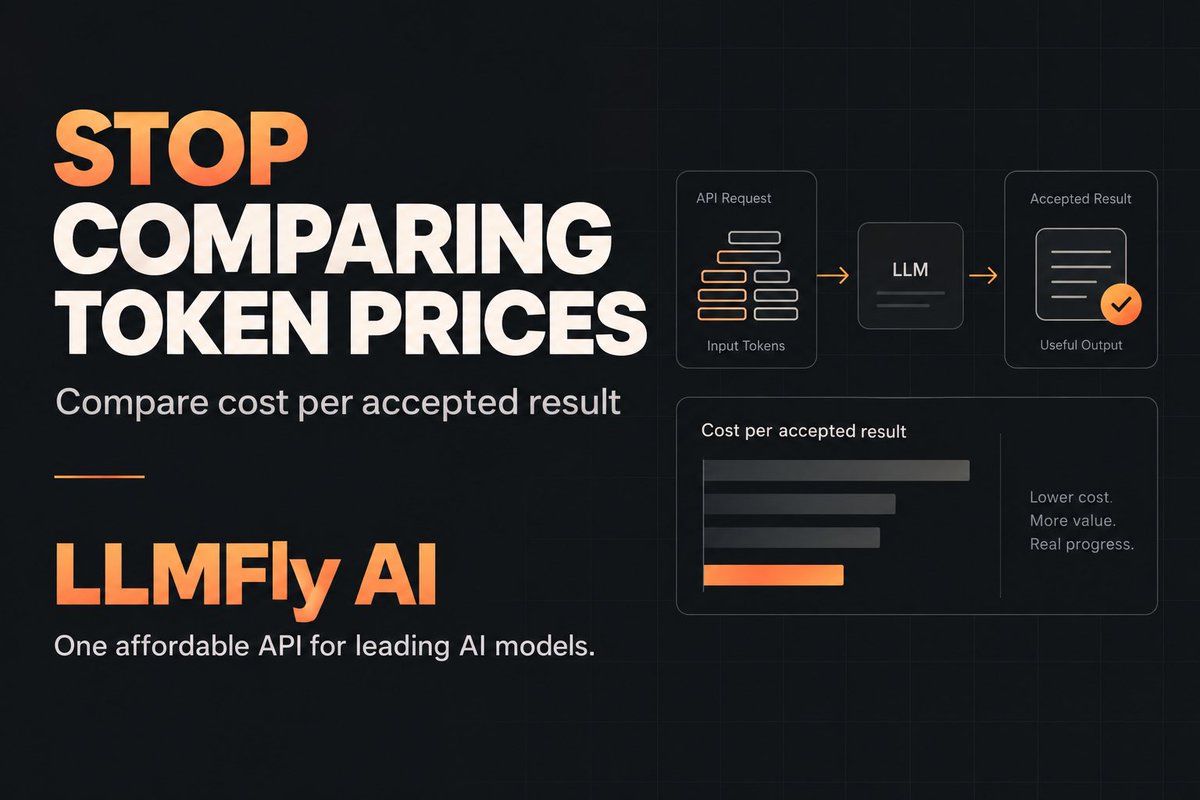
Most developers compare AI APIs by token price.
That’s rarely the real cost.
A cheaper model can cost more once you include:
• long outputs
• reasoning tokens
• cache misses
• tool calls
• retries
• failed results
The better metric: cost per accepted result.
We put together a practical 2026 comparison guide ↓
https://t.co/RPOyE9QWj3
One thing that makes this easier:
LLMFly AI gives developers access to leading GPT, Claude, Gemini and Grok models through one OpenAI-compatible API.
You can compare current prices, switch models without rebuilding the whole integration, and test which model is actually cheaper for your workload.
Model Plaza:
https://t.co/mCQk4Zg4qB
Thinking about adding Astra to an existing app?
It is not just a model-name change. Tool calling requires the Responses API, some sampling parameters are unsupported, and agent permissions need testing.
Our practical migration checklist:
https://t.co/pTZoDc1XmF
GPT-6 Astra is now available on LLMFly AI.
What is LLMFly AI? A multi-model AI API platform: one account and one API for GPT, Claude, Gemini and Grok models, often at discounted rates.
You choose the model. We simplify access and cost.
https://t.co/mP52LHvtiZ
For long-context apps, one Astra pricing rule matters.
On OpenAI’s Standard API (uncached; no tool fees):
250K input + 20K output ≈ $3.50
280K input + 20K output ≈ $7.10
Only 12% more input, but over 2× the cost. Codex now has a separate exception.
https://t.co/SS2gbZqZOg
GPT-6 Astra is now available on https://t.co/Asu8vjN3a8
One OpenAI-compatible API. Discounted access.
Built for developers evaluating Astra in real production workflows.
We went beyond the launch benchmarks and broke down the two questions that matter most ↓
1/ Is GPT-6 Astra worth 2.5× GPT-5.6 Sol’s list price?
We compare agent reliability, computer use, token costs—and explain when Astra should be an escalation model instead of your default.
Full comparison: https://t.co/8exmRFl7wa
GPT-5.6 Sol or Claude Sonnet 5?
A simple way to choose:
GPT-5.6 Sol
→ complex repository work
→ deep research
→ difficult reasoning
→ high-value tasks where capability ceiling matters
Claude Sonnet 5
→ everyday coding
→ code review
→ production agents
→ workloads where speed + cost balance matters
Don’t ask which model is “better.”
Ask which model is better for this workload.
Getting this Fable 5.1 error?
thinking block is bound to a different conversation
Retrying the request won’t fix it.
The usual cause:
You changed the conversation prefix after the thinking block was created — system prompt, tools, earlier messages, or referenced content.
The durable fix:
→ keep conversation history append-only
→ replay assistant blocks exactly as returned
→ don’t rewrite system/tools mid-session
This is a conversation-state problem, not a random API outage.
The cheapest AI model isn’t the one with the lowest token price.
It’s the one that completes the task with:
fewer retries
less unnecessary reasoning
fewer tool calls
less duplicated context
AI pricing is moving from:
cost per token
to:
cost per successful task
Fable 5.1 is cheaper than it looks.
The headline pricing hasn’t changed:
$10/M input
$50/M output
But cache reads dropped to $0.25/M — 75% lower than Fable 5.
That matters a lot for long-running agents repeatedly reading the same context.
The lesson:
Don’t compare #AI models by token price alone.
Compare cost per task — especially cache usage, reasoning tokens, retries, and tool calls.