Very few on the left have agreed with me over the last decade. But a major reason for 40 years of increasingly dysfunctional politics in this country is because of the puerility of the BBC.
When you have 80% market share, and think this is informed debate, of course the country has problems.
More than 100 homes on estates of King Charles and Prince William fail to meet the legal minimum energy standards for landlords.
Many have black mould, draughty single-glazed windows.
Gaps in the regulations exploited to continue letting properties out.
https://t.co/WzfxHwhDKD
Excellent report from #C4News comparing other countries social care
"England is something of an outlier amongst wealthy nations when it comes to social care"
I wholeheartedly endorse this piece. It annoys the hell out of me that there's an entire cottage industry of business "journalism" that consists of taking some outlandish claim made by a tech CEO -- often in a tweet or offhand comment -- and then crafting
https://t.co/gjctqdvfUU
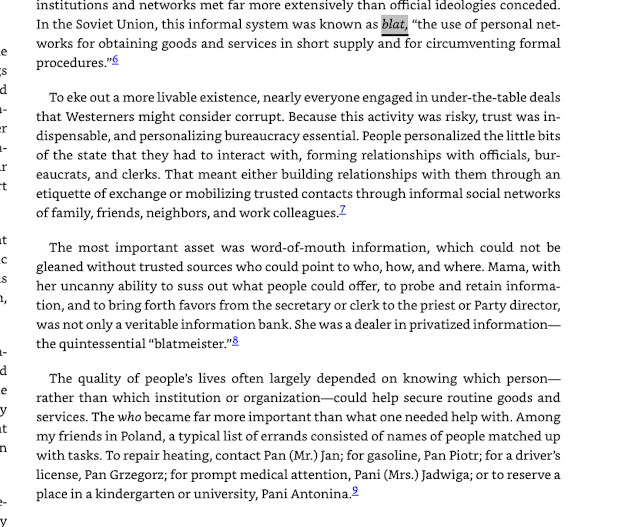
The Jeff Epstein saga isn't a scandal about pedophilia, it's about a Russian word called 'blat,' a Soviet-era word meaning 'the use of personal networks for obtaining goods and services in short supply and for circumventing formal procedures.' It's about a kind of government.
As with the large number of 'blatniks' in the Soviet era who made sure their factories got what they needed outside the formal state procurement process, Epstein greased the wheels for the neoliberal state. His job was governance.
What does that mean? Well it's clear that Epstein was an entrepreneurial broker across multiple public and private bureaucracies, helping organize 'under-the-table' deals among the legal, business, intelligence, and political elites to allow them to escape the rule of law and traditional conflict of interest restrictions. It's statecraft to allow a superclass to systemically escape the formalized rules.
The pedophilia and prostitution were part of it - that is obviously violating the rule of law - but so are the random favors Epstein bestowed. Like Epstein sending Senator Joe Manchin's request for a yacht, a request which came from the First lady of the Virginia Islands, to a random NY financier who might have one. Or working with Joi Ito at MIT and billionaire Reid Hoffman to restructure the Bitcoin Foundation. It's all about matching capital and talent and inputs outside of the restrictions ordinary people are subject to.
This kind of governance is particularly important in Soviet-style states, where everyone knows the rules are fake, where skirting the system IS the system. Epstein and his affiliates thrived because of the weakened institutions of the United States, institutions enfeebled in many cases by the men in his network, like Larry Summers. These men adopted multiple roles - advisor, businessman, academic, board member, regulator - and put on the hat that best maximized their self-interest and the self-interest of their narrow network at that moment.
The old world, where handing someone your business card meant you represented that institution, disappeared in the 1980s. Over the course of the 1990s, neoconservatives, neoliberals, bankers - ultimately Epstein's network - built this new social order. It was one where you couldn't succeed through the formal rules, but if you were let into the networks of trust by blatniks, you could do anything you wanted.
While all the specifics of Epstein's network are not known, and while conspiracy theorists often have crazy views, they have correctly fingered that the world of meritocracy and formalized systems is increasingly a fraud. And that the real government lies elsewhere.
In short, when formal democratic institutions like Congress stop governing, the networks of men like Epstein fill the power vacuum. Epstein built what Roy Cohn always wanted to have, but never achieved, because the then-institutions were too strong for him to break.
Here's a passage from sociologist Janine Wedel's Shadow Elite on how this form of governance works.
Spanish PM Pedro Sánchez:
Starting next week, my government will implement the following actions:
First, we will change the law in Spain to hold platform executives legally accountable for many infringements taking place on their sites.
Second, we will turn algorithmic manipulation and amplification of illegal content into a new criminal offense.
Third, we will implement a hate and polarization footprint system to track, quantify, and expose how digital platforms fuel division and amplify hate.
Fourth, Spain will ban access to social media for minors under the age of 16. Platforms will be required to implement effective age verification systems — not just checkboxes, but real barriers that work.
Fifth and last, my government will work with our public prosecutor to investigate and pursue the infringement committed by Grok, TikTok, and Instagram.
David Ricardo showed in 1817 that if each country produces according to its comparative advantage, global output is maximized. Many analysts argue today that China's trade surplus reflects its comparative advantage in producing everything, and so its trade surplus is good for global growth.
But that's not true, and that is certainly not what Ricardo showed. China has a competitive advantage, not a comparative advantage, largely for the same reason that it has such weak consumption – large direct and indirect transfers from the household sector, in the form of an undervalued currency, cheap credit, restricted labor, overspending on infrastructure, land and other subsidies, etc., subsidize production across the board at the expense of household consumption.
The point is that these lower production costs give China a competitive advantage in producing most things, but this not the same as a comparative advantage. The former means you are able to produce more cheaply than your trade partners. The latter means that the relative "cheapness" with which you produce some goods is greater than the relative "cheapness" with which you produce other goods, so that you can only have a comparative advantage in roughly half the goods you produce. This is because comparative advantage is about relative costs, not absolute costs, and while you can have lower absolute costs in most or even all things, by definition you cannot have lower relative costs in more than half of what you produce.
Ricardo's example shows this very clearly. In his model. Portugal produced both textiles and wine more cheaply than England, which meant that Portugal had a competitive advantage in all goods, and England a competitive disadvantage in all goods.
But Ricardo did not argue that the world would benefit if Portugal produced both wine and textiles, with England producing neither and acquiring them by running trade deficits with Portugal. Instead he showed that because the relative "cheapness" with which Portugal produced wine was greater than the relative "cheapness" with which it produced textiles, Portugal only had a comparative advantage in producing wine, and England had a comparative advantage in producing textiles.
He showed that if Portugal only produced wine, and exported some of it to England to buy textiles, and if England only produced textiles, and exported some of it to Portugal to buy wine, trade would be balanced and total output would be maximized even with Portugal's competitive advantage in both.
If you do the math in Ricardo's model, you quickly see that global output is maximized only when global trade is balanced. For global production to be maximized, countries should not be net exporters of all goods in which they have a competitive advantage. They should be net exporters only of those goods in which they have a comparative advantage, and they should use the proceeds of those export revenues to import those goods in which they have a comparative disadvantage.
Once you allow trade to become persistently unbalanced, you run into the problem that Keynes identified in the 1930s – trade imbalances allow countries that have become more competitive by suppressing domestic demand to export weak domestic demand to the rest of the world. When that happens, either total global production is reduced and unemployment rises, or debt must rise in the deficit country to make up for the weak demand in the surplus country and to prevent unemployment from rising.
Economists often cite David Ricardo's model of comparative advantage as one of the few, great, non-trivial models in economics, and so it is worrying that so few academic economists understand the math behind the model. Ricardo's whole point was to make the unintuitive point that competitive advantage is not the same as comparative advantage, and that the world benefits from balanced trade even when one country can produce everything more cheaply.
This becomes more obvious when you realize that just by changing the value of the currency you can shift competitive advantage from one country to another, whereas comparative advantage is structural, and does not shift so easily. The main point, which surprisingly few academic economists understand, is that Ricardo's model of comparative advantage is a model of balanced trade.