@dwarkesh_sp@geochurch I'd be curious about his thoughts on Eroom's law. What are the major bottlenecks right now? How can we make sure that cell/gene/mRNA therapies actually help us break the trend?
Announcing Biomni — the first general-purpose biomedical AI agent. Biomni is a free web platform where biomedical scientists can immediately delegate their tasks to Biomni, starting today!
Biomni automates literature reviews, hypothesis generation, protocol design, bioinformatics analysis, clinical reasoning, and much more — scaling biomedical expertise for 100× the number of discoveries.
Key results:
➡️ Designed a cloning experiment with real-world wet-lab validation; on par with 5+ year expert in a blind test
➡️ Ran 458-file wearable bioinformatics analysis in 35 minutes vs. 3 weeks (800x faster) for human expert
➡️ Uncovered novel hypothesis: new TFs regulating skeletal lineages on a large scRNA+scATAC data
➡️ Human-level performance on LAB-bench DbQA and SeqQA, with SOTA at Humanity’s Last Exam and across 8 new biomedical tasks—ranging from GWAS and rare disease diagnosis to microbiology and drug repurposingPowered by:
➡️ Biomni-E1 – the first unified environment designed for a biomedical agent—encompassing 150 tools, 59 databases, 106 software—systematically curated from 2,500+ bioRxiv papers
➡️ Biomni-A1 – a generalist agent with retrieval, planning, and code as action
Biomni is an open-source initiative: we invite the community to build on it and advance biomedical research at scale.
- Try it now: https://t.co/GyZdCKEKYN
- Paper: https://t.co/lgtyUEGfEy
- Code: https://t.co/vqq9W6Zkv3
- Join the community: https://t.co/2C7rWOPp2z
Amazing team and collaborators @StanfordAILab@StanfordMed@StanfordCancer@genentech@arcinstitute@UCSF@UW@PrincetonAInews@KexinHuang5@serena2z@hcwww_@YuanhaoQ@mintaylu@yusufroohani @RyanLi0802 @LinQiu0128 Gavin Junze Di Shruti Jennefer Xin Zhou @MWheelerMD Jon Bernstein @MengdiWang10@PengHeAtlas@SnyderShot@lecong Aviv Regev
The way we develop new drugs is broken.
The process costs too much, takes too long, and far too often it simply doesn't work.
I sat down with five leaders in the field—from industry, VC, academia, and government—to hear their takes on how, and why, and what we can do about it.
What if the path to slowing aging wasn’t a drug, but replacing worn out parts?
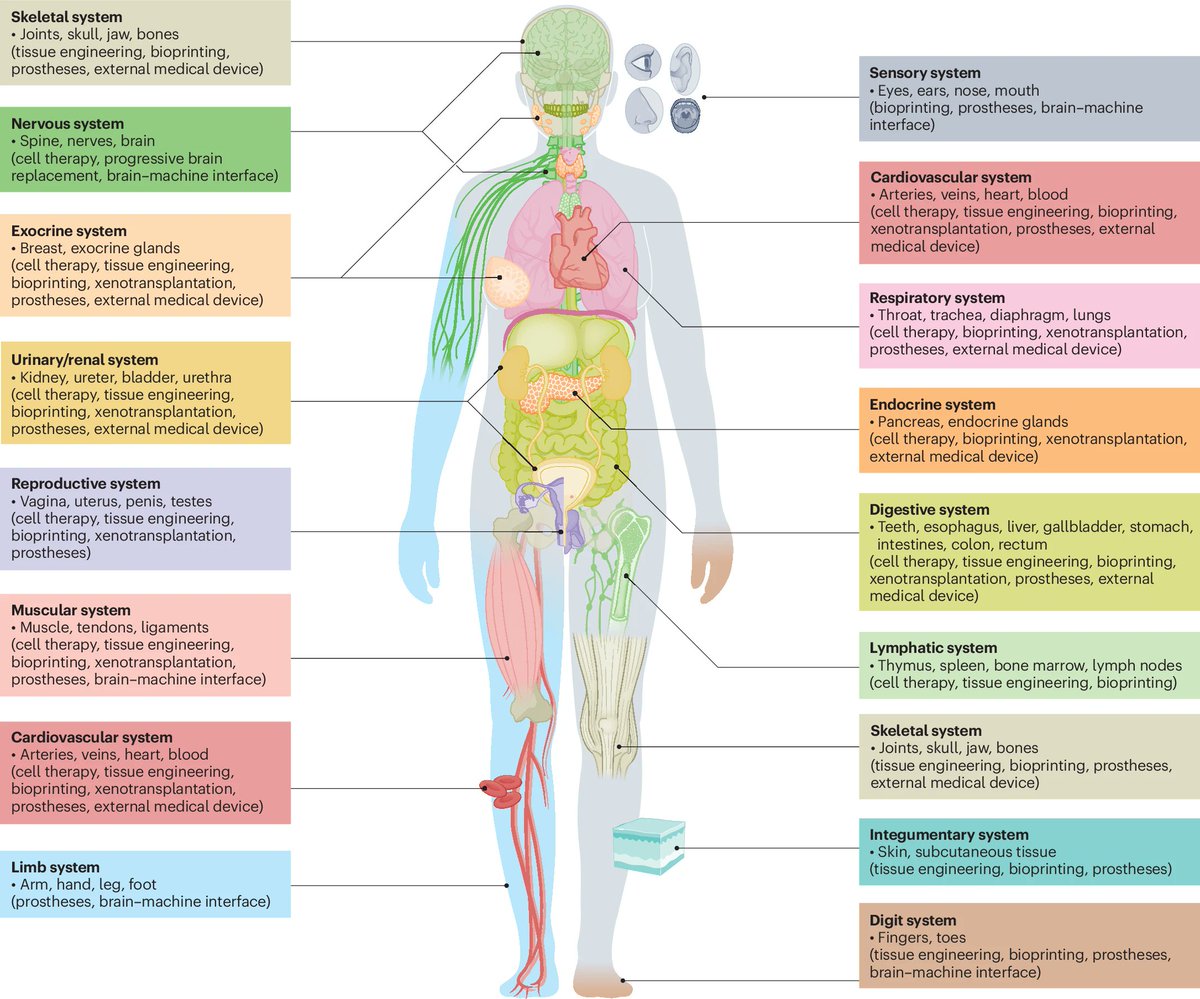
Our new paper out today in @NatureAging shows how this could one day work. We map a unified framework—from scaffolds & bioprinted tissues to pacemakers, xenotransplants & brain machine interfaces—for extending healthy lifespan through replacement-based approaches. Read the thread to learn more about what replacement means for the aging field! https://t.co/eqWdJEPBU4 🧵👇(1/10)
Applying our results should be straightforward for anyone trying to use endogenous miRNA for SynBio applications, so I hope it proves useful to people (or maybe inspires someone to try or go back to using miRNA for SynBio?).
Just put my first postdoc publication on bioRxiv – designing cell type-specific gene and mRNA therapy from microRNA expression data! Good timing with the recent Nobel Prize, I guess. In essence: You have to use the right type of expression data. https://t.co/ZQlh2FK7IZ
Naturally, there’s more work to be done – better prediction of the impact of secondary structure and estimating miRNA-independent stability variation, for example.