How many people on your team have prod access right now that they haven't touched in weeks? It just sits there. That's the access that gets used by someone else….
Four out of five teams have AI agents in production now, but only about one in five treat them as identities of their own. The rest are running on borrowed logins and shared keys, so whose access is it when something goes wrong?
“Set Up a Password Manager. No, Really. Now.”
That’s the headline of a @nytimes Opinion essay.
When you build software for a living, that advice can feel basic.
But how many accounts could someone reach through your most reused password? 🧵
A chatbot can help you write the game night invite. An agent can send it out and order the pizza too.
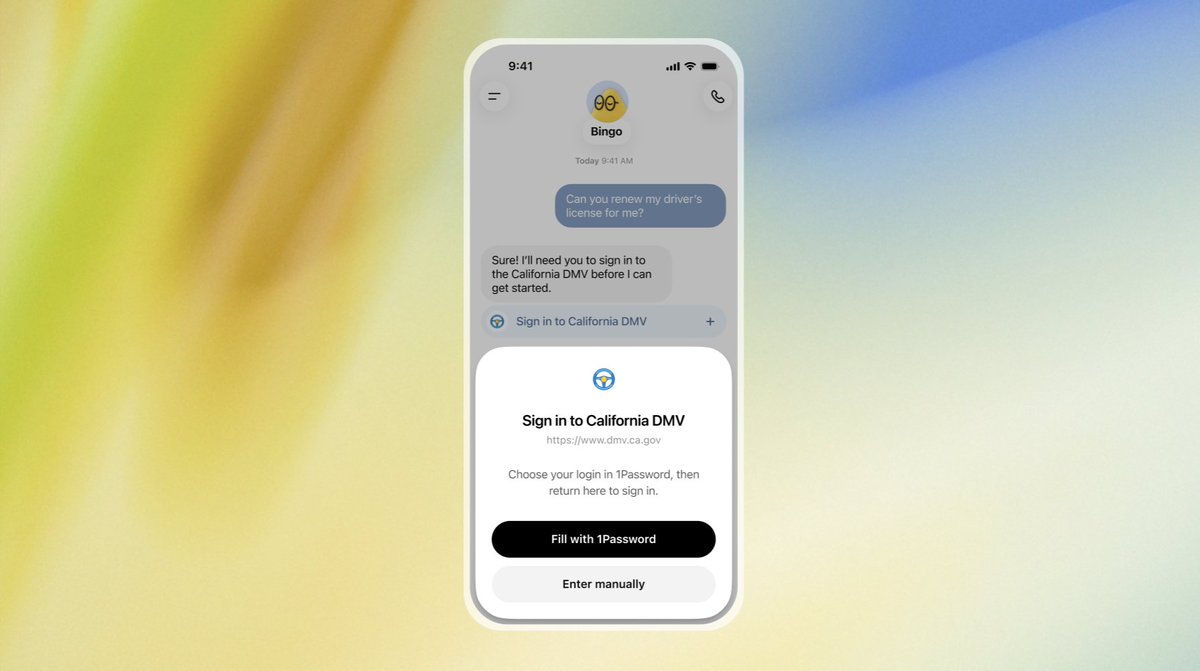
The jump from answering to acting is a big one, and because acting means signing in to real accounts, how an agent gets that access matters a lot. With 1Password you approve the login and we fill it in, and the agent never sees your password.
If you’re still getting your head around agents and using them safely, this blog is a great place to start! 🙂
We’re starting to test 1password in dots!
Our goal is to make it easy for your dot to do tasks that require a login, while keeping your credentials secure. Excited to roll this out more broadly soon.
Let us know what you think.
1Password’s Developer Watchtower is a BIG deal: find and vault secrets on dev machines without breaking workflows.
Then it get better, after vaulting you can work with your agents and give them access without sharing the secrets themselves.
Most security incidents don’t start with sophisticated hacks. They start with credentials that have too much access.
Here are 5 practical steps every developer can take to secure their apps, tools, and AI agents. � https://t.co/cQ9tRqqGiF
New episode of Random but Memorable is live 🎙️
KC Li, senior director of product management, joins to talk about 1Password for Agents: how agents sign in for you without ever seeing your passwords.
Watch now:
https://t.co/PCgoNfWXH9
New episode of Random but Memorable is live 🎙️
KC Li, senior director of product management, joins to talk about 1Password for Agents: how agents sign in for you without ever seeing your passwords.
Watch now:
https://t.co/PCgoNfWXH9
Most security incidents don’t start with sophisticated hacks. They start with credentials that have too much access.
Here are 5 practical steps every developer can take to secure their apps, tools, and AI agents. � https://t.co/cQ9tRqqGiF
Your AI co-pilot runs with your credentials: same prod access, same push rights, and no separate identity.
Here’s why that’s a real risk, and how to scope agent access without slowing your team down. 🧵 1/5
AI agents need access to your accounts. But how can you let them use your credentials without putting your security and privacy at risk?
1Password for Agents’ security model gives agents a secure, seamless way to request access and sign in, while making sure that you always stay in control of your information.
🔗Read more here: https://t.co/ZGqpczHNjA
Every day now seemingly brings another breach, and the postmortem almost always ends the same way. A credential was compromised, and it could reach far more than it should have.
We spend enormous energy trying to prevent the breach. Prevention matters, but I think we ask the wrong question afterward. The question is not only how did they get in. It is why did one stolen credential open so much.
Breaches are inevitable. Blast radius is a choice.
Every standing credential in your environment is pre-authorized damage. The API key on a hard drive that never expires. The token sitting in a config file. The agent running with persistent access to systems it touches once a month. When one of them leaks, and one of them will, the damage was decided by choices made months earlier.
So what can we do? Secure exposed credentials. Give every identity, human or agent, only the access it needs, only for as long as it needs it. Know where every credential lives, who owns it, and how to revoke it.
Agents make this urgent. Handing an agent your credentials is not automation. It is delegation without accountability.
You cannot shrink a blast radius you cannot see. Start by looking. How much standing access do you have? Most teams I speak with cannot answer that today. That gap is the risk.
Breaches are inevitable. What happens next is up to us.
@ivandemigoal@MarkJCarney fix this, keep money in Canada, stimulate the country. Why would I go to Toronto from Vancouver when Portugal is the same price. I’d travel in Canada so much more if flights were like the USA. Unlock Canada!!
Engineers should not be handing their over-privileged (standing) access to their agents. Allowing engineers to work with agents requires agent access to be JIT scoped to the task and removed after completion.
How much standing access is attached to your people and AI agents?
1Password Privileged Access provides just-in-time, just-enough access for cloud environments. Access is granted only when requested, scoped to the exact task, and removed automatically when the work is complete.
See how just-in-time access can secure cloud and agentic AI workflows.
🔗 Register for the webinar here: https://t.co/WFkh1XFWQO