@rockman011@LatinXChem@RickyTQChen@chemuoft@VectorInst Hey Rodrigo! Nice poster man. I was wondering, in your method, do you have to worry about the non-uniqueness of steady state solutions? What could happen, if for instance, the system exhibits more than one steady state due to instabilities?
My first paper in grad school 🤩 Thanks for being a wonderful advisor @ucsd_yuen! I learned a lot from you @JorgeACamGA and @LamQ310.
Our first paper together @ShubhamSinha029 ❤️
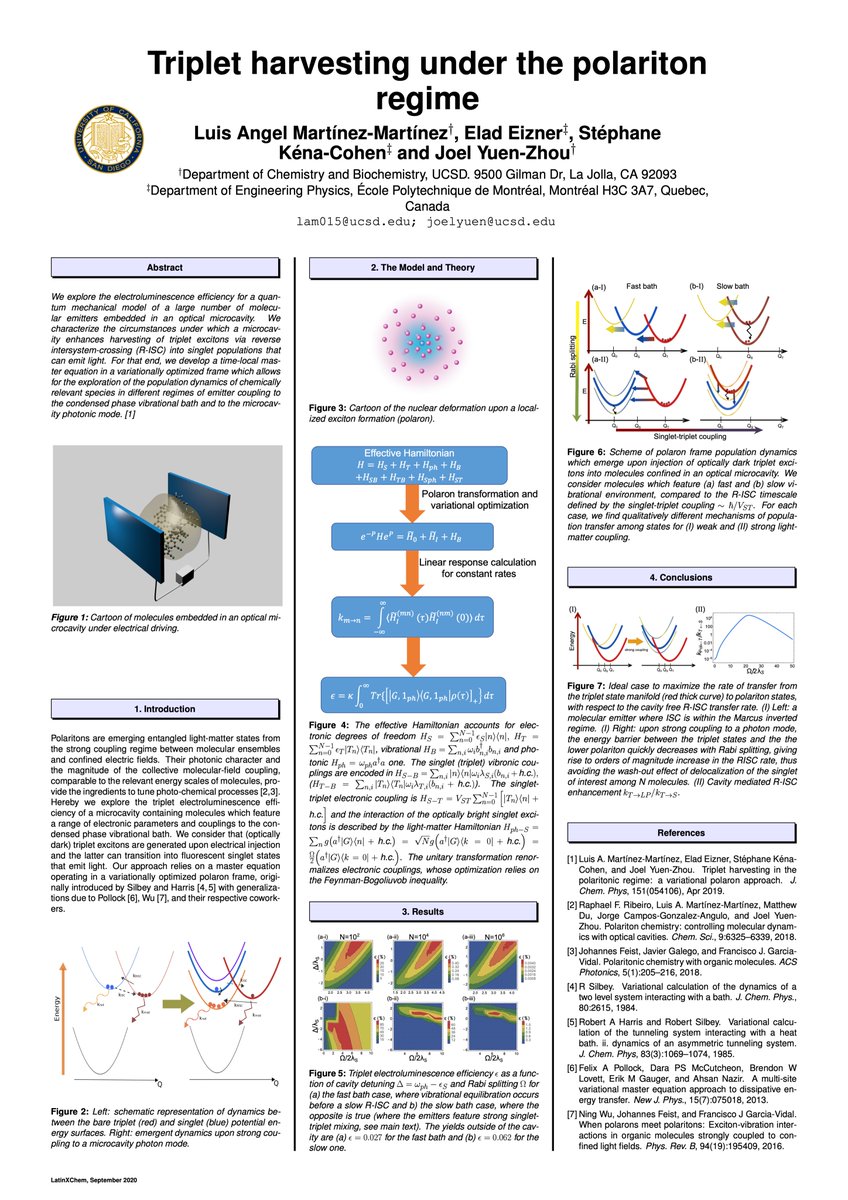
We find that polariton condensation can change reaction yields and rates.
https://t.co/dwO4t48sTK
Un Conacyt de la 4T:
“... contradice también a la ciencia, en tanto que el suyo es un hacer cuya naturaleza carece de propietario (o propietaria), un hacer que, de ser expropiado por un interés político, pierde como ciencia al subordinarse a una ideología” https://t.co/wP2XO60ETL
The science Nobel announcements begin tomorrow, and this piece from 2017 remains all I have to say about them. If anything, this year, several laureates have strengthened the arguments herein.
https://t.co/WwzzC2hcIb
Our next Webinar will be on Wednesday, September 30th at 9 a.m. PST with guest speaker Prof. Chris Giebink from @penn_state. Register at https://t.co/n1F1gTKq3F.
Renormalization is “arguably the single most important advance in theoretical physics in the past 50 years.” — David Tong, a theoretical physicist at the University of Cambridge https://t.co/ZiOZIkHQD0
Very exciting piece by Katrina Kramer about cavity controlled chemistry.
She features pioneering work by the Ebbesen group and also leading theorists, including us.
Thanks for reaching out .@ChemistryWorld!
@FisicaUsach@miroptics#QuantumLeap
https://t.co/H7TLOXCGDN
@faherreraur In the sense that, the gain in the T->polariton rate through energy gap lowering outcompetes the delocalization factor. In fact, the plot (ratio polariton assisted/ bare rate) shows the existence of a sweet spot where that is the case.
@faherreraur Thanks for your continued interest Professor. Probably this idea can be conveyed more clearly with the image below. If we consider a very bad TADF material where the T->S transition is prohibitively high, the lowering of triplet-polariton energy gap may be advantageous.
@faherreraur@LatinXChem That is because in this regime the very high thermal energy barrier for the triplet-> singlet transition can be suppressed with the aid of polariton modes, and the accomplished exponential increase in the rate could outcompete the 1/N suppression
@faherreraur@LatinXChem Hi Prof. Felipe, thanks for your interest. You raised a very good point. We conjecture that molecules which exhibit very low reorganization energies such that the transition triplet-> singlet is within the inverted Marcus regime offer possibilities to beat this limit.
@SolmarVarela Ah, entonces sólo para confirmar si entendí, los experimentos de transmisión los modelan con este potencial, el cual está parametrizado de acuerdo a los acoplamientos SO. ¿Es correcto? Gracias por las respuestas!
@SolmarVarela !Hola Solmar! Muy interesante tu trabajo. Tengo dos preguntas, ¿Podrías elaborar brevemente sobre la relación entre los enlaces de hidrógeno, y el alto acoplamiento SO?
¿Cuál es la coordenada en el potencial de doble pozo?
@GustavMondragon@LatinXChem Hi Gustavo! Interesting work. I am curious, do you have evidence on whether SF could outcompete other hopping channels such as Forster energy transfer? How fast is the non radiative relaxation of the system you are considering?
@GustavMondragon@LatinXChem We are able to model the rates of transition between triplet and singlet states in both regimes of weak localization (weak light-matter coupling) and large delocalization (strong light-matter coupling)
@GustavMondragon@LatinXChem Hi Gustavo! Thanks for the interest. In our model, delocalization of (singlet) excitons is afforded by the photon field of the cavity.