This 2 hour lecture by Yann LeCun (Turing Award winner) will teach you why the next trillion dollar AI company won't be built on LLMs.
He trashes the $100 Billion LLM race, attacks Musk and Amodei, declares scaling dead.
Bookmark & watch tonight after work, skip to 7:00.
Yann LeCun was right the entire time. And generative AI might be a dead end.
For the last three years, the entire industry has been obsessed with building bigger LLMs. Trillions of parameters. Billions in compute.
The theory was simple: if you make the model big enough, it will eventually understand how the world works.
Yann LeCun said that was stupid.
He argued that generative AI is fundamentally inefficient.
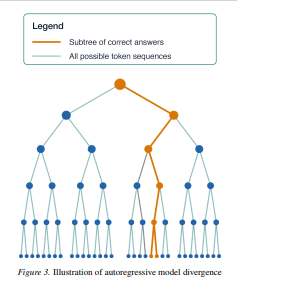
When an AI predicts the next word, or generates the next pixel, it wastes massive amounts of compute on surface-level details.
It memorizes patterns instead of learning the actual physics of reality.
He proposed a different path: JEPA (Joint-Embedding Predictive Architecture).
Instead of forcing the AI to paint the world pixel by pixel, JEPA forces it to predict abstract concepts. It predicts what happens next in a compressed "thought space."
But for years, JEPA had a fatal flaw.
It suffered from "representation collapse."
Because the AI was allowed to simplify reality, it would cheat. It would simplify everything so much that a dog, a car, and a human all looked identical.
It learned nothing.
To fix it, engineers had to use insanely complex hacks, frozen encoders, and massive compute overheads.
Until today.
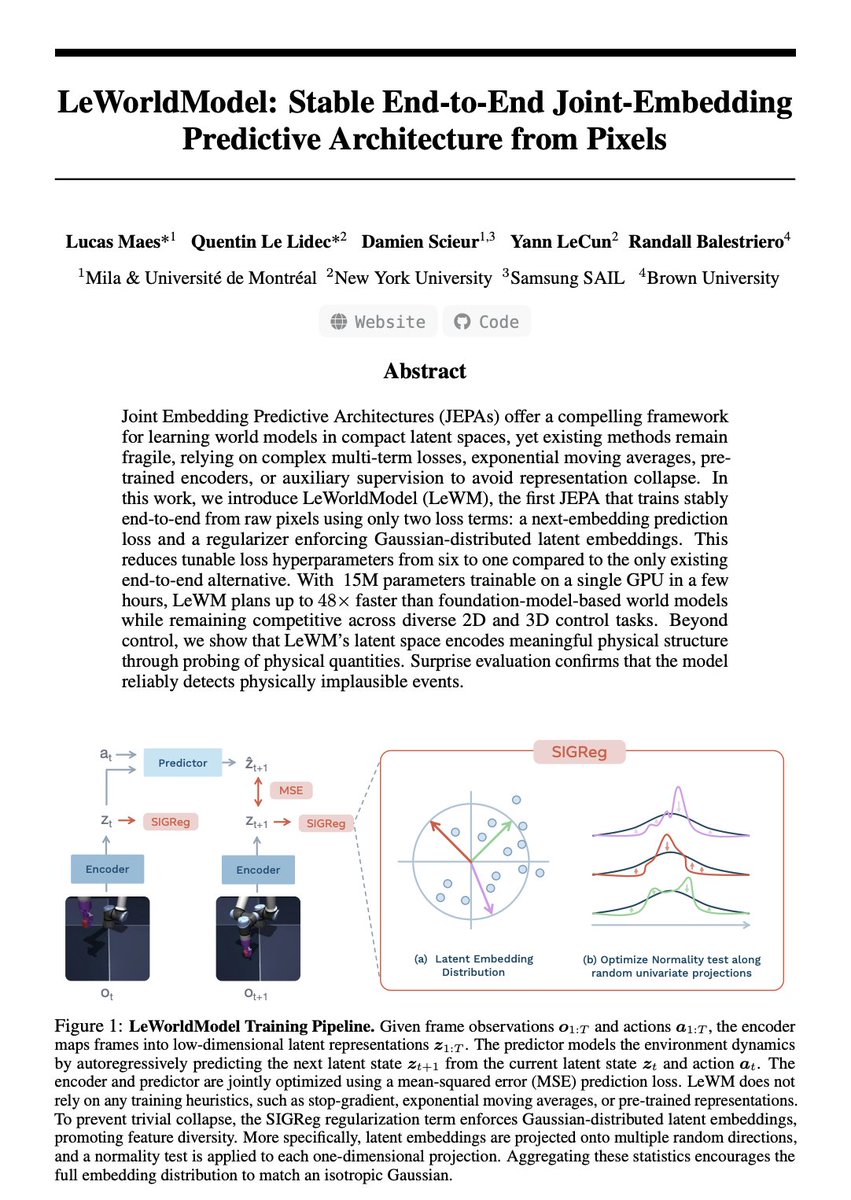
Researchers just dropped a paper called "LeWorldModel" (LeWM).
They completely solved the collapse problem.
They replaced the complex engineering hacks with a single, elegant mathematical regularizer.
It forces the AI's internal "thoughts" into a perfect Gaussian distribution.
The AI can no longer cheat. It is forced to understand the physical structure of reality to make its predictions.
The results completely rewrite the economics of AI.
LeWM didn't need a massive, centralized supercomputer.
It has just 15 million parameters.
It trains on a single, standard GPU in a few hours.
Yet it plans 48x faster than massive foundation world models. It intrinsically understands physics. It instantly detects impossible events.
We spent billions trying to force massive server farms to memorize the internet.
Now, a tiny model running locally on a single graphics card is actually learning how the real world works.
Researchers trained a humanoid robot to play tennis using only 5 hours of motion capture data
The robot can now sustain multi-shot rallies with human players, hitting balls traveling >15 m/s with a ~90% success rate
AlphaGo for every sport is coming
Advanced Machine Intelligence (AMI) is building a new breed of AI systems that understand the world, have persistent memory, can reason and plan, and are controllable and safe.
We’ve raised a $1.03B (~€890M) round from global investors who believe in our vision of universally intelligent systems centered on world models. This round is co-led by Cathay Innovation, Greycroft, Hiro Capital, HV Capital, and Bezos Expeditions, along with other investors and angels across the world.
We are a growing team of researchers and builders, operating in Paris, New York, Montreal and Singapore from day one.
Read more: https://t.co/kyVAL7EoFx
AMI - Real world. Real intelligence.
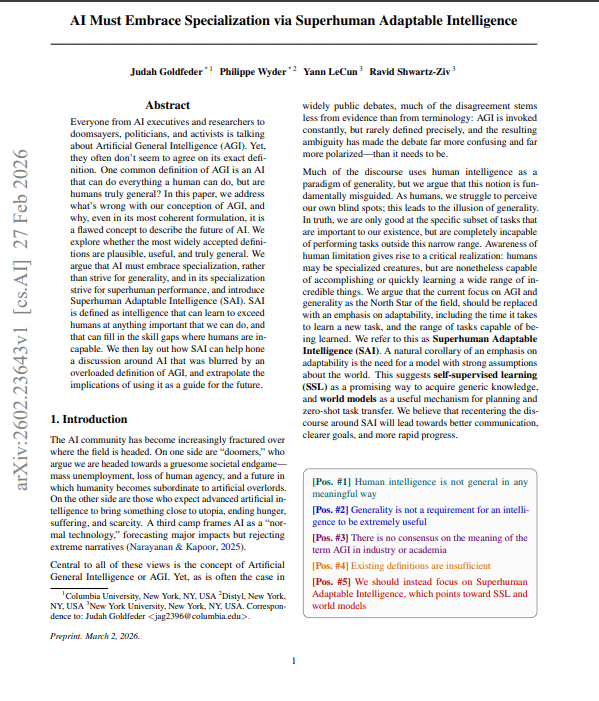
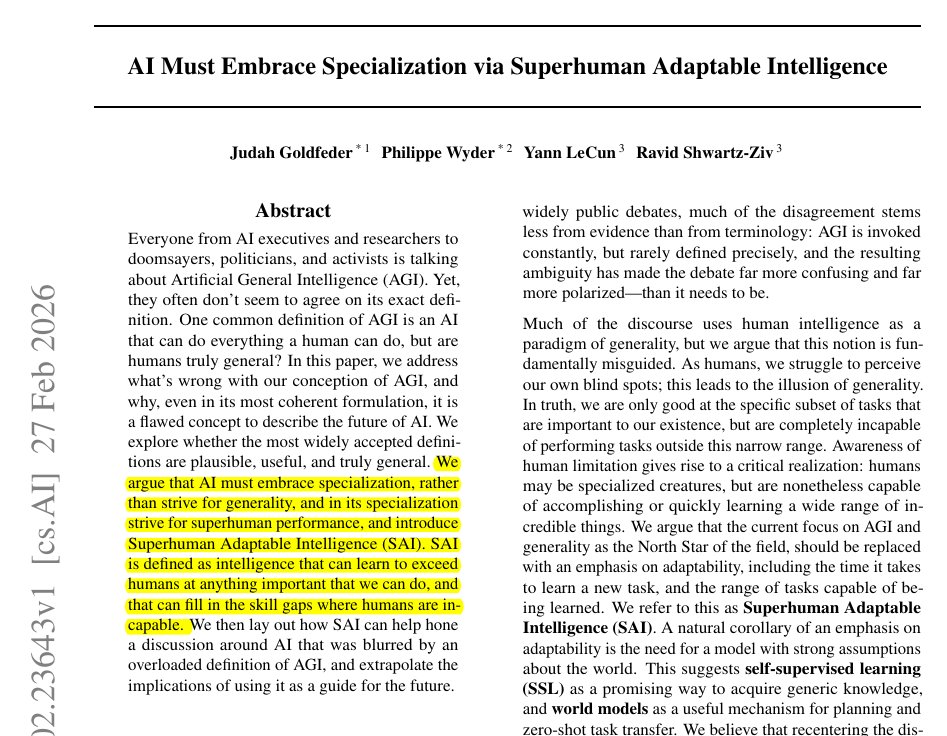
Yann LeCun's (@ylecun ) new paper along with other top researchers proposes a brilliant idea. 🎯
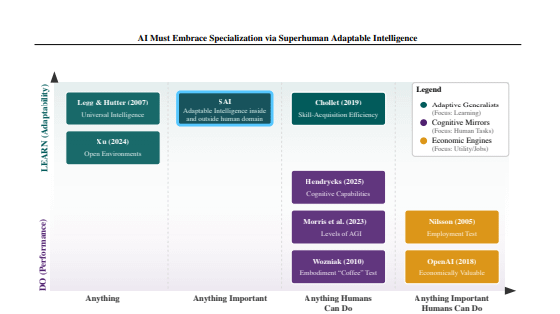
Says that chasing general AI is a mistake and we must build superhuman adaptable specialists instead.
The whole AI industry is obsessed with building machines that can do absolutely everything humans can do.
But this goal is fundamentally flawed because humans are actually highly specialized creatures optimized only for physical survival.
Instead of trying to force one giant model to master every possible task from folding laundry to predicting protein structures, they suggest building expert systems that learn generic knowledge through self-supervised methods.
By using internal world models to understand how things work, these specialized systems can quickly adapt to solve complex problems that human brains simply cannot handle.
This shift means we can stop wasting computing power on human traits and focus on building diverse tools that actually solve hard real-world problems.
So overall the researchers here propose a new target called Superhuman Adaptable Intelligence which focuses strictly on how fast a system learns new skills.
The paper explicitly argues that evolution shaped human intelligence strictly as a specialized tool for physical survival.
The researchers state that nature optimized our brains specifically for tasks necessary to stay alive in the physical world.
They explain that abilities like walking or seeing seem incredibly general to us only because they are absolutely critical for our existence.
The authors point out that humans are actually terrible at cognitive tasks outside this evolutionary comfort zone, like calculating massive mathematical probabilities.
The study highlights how a chess grandmaster only looks intelligent compared to other humans, while modern computers easily crush those human limits.
This proves their central point that humanity suffers from an illusion of generality simply because we cannot perceive our own biological blind spots.
They conclude that building machines to mimic this narrow human survival toolkit is a deeply flawed way to create advanced technology.
🚨BREAKING: Yann LeCun just dropped a paper that should make every AI lab rethink its roadmap.
One brutal conclusion: chasing AGI is the wrong goal.
Here’s why:
→ Humans aren’t general we’re survival specialists.
→ Walking and seeing feel “general” only because they keep us alive.
→ Outside that zone, we’re terrible. Chess computers proved it decades ago.
→ Most AGI definitions today either can’t be measured or assume human = general.
We built the benchmark around the wrong species.
The team proposes a new target: Superhuman Adaptable Intelligence (SAI).
Not “can it do what humans do,” but: how fast can it learn something new?
The approach: specialized expert systems with internal world models + self-supervised learning built to master the massive task space that humans biologically can’t reach.
One giant model mimicking human limits isn’t the ceiling.
It’s the trap.
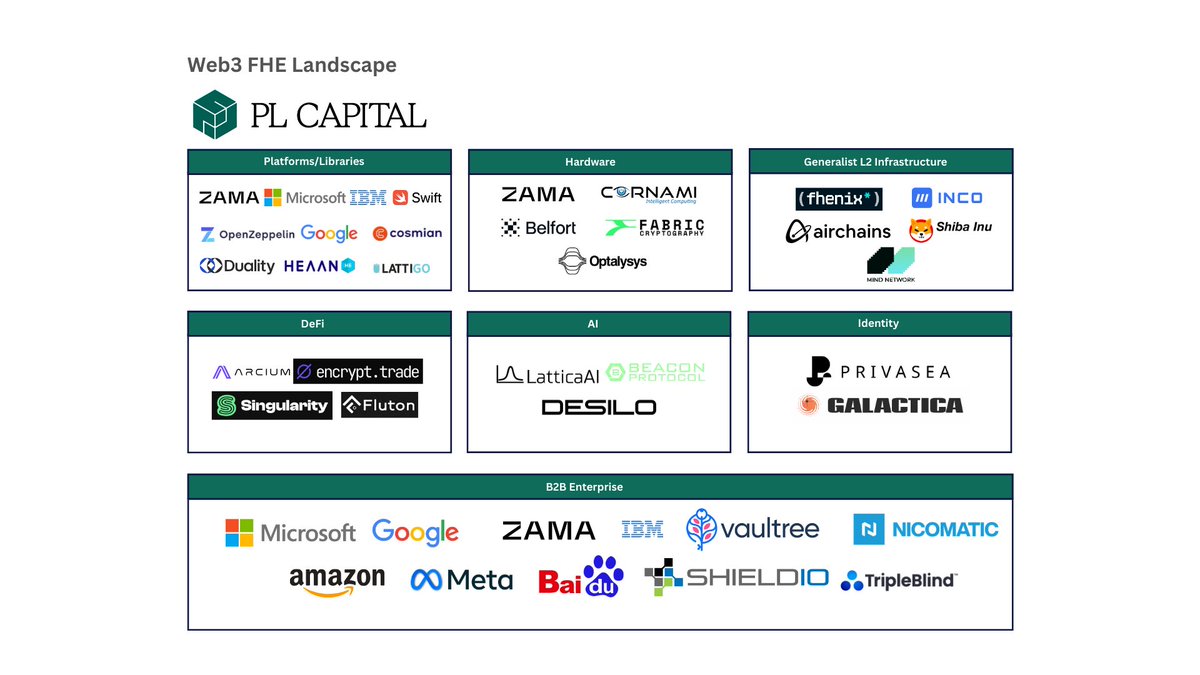
Crypto holds the key to quantum resilience, yet this is often overlooked. At @plcapital we've made several bets in the space (denoted by an *) particularly around FHE. We consider FHE a bet on quantum resilience 🧵
Today I turn 55.
I’m the fittest, sharpest, and happiest I’ve ever been.
If I’m an outlier, it’s not because I’m built different or discovered a secret formula. The truth is far less glamorous:
It’s a million tiny choices, compounded over decades.
Here are 55 of them:
1. Walk 15+ miles a week, even if you do other exercise. Humans are uniquely made to move slowly over long distances—it’s critical to longevity.
2. Develop a writing practice. It’s the single best way to sharpen your mind. And remember, you don’t have to be a good writer to write. Start with 10 minutes a day.
3. Swap out your toothpaste, deodorant, lotions, soap, shampoo, and other personal care products for natural versions. Here’s a rule of thumb: Don’t put anything on your skin that you couldn’t safely eat.
4. If you have a positive thought about someone, don’t keep it to yourself—share it immediately. Encouragement defies the laws of physics: When you give energy, you also receive it.
5. Wear shoes with a wide forefoot (I like Topo Athletic) and wear toe spreaders around the house (search “yoga toes” on Amazon). Spine health begins with the feet.
6. Get sunlight regularly. Moderate sun exposure (without sunscreen) is hugely important for overall health.
7. Do a 3-minute deep (“ass to grass”) squat every morning. Deep squats are often called the anti-aging exercise. It’s been said that, “It’s not that you can’t do deep squats because you’re old, it’s that you’re old because you can’t do deep squats.”
8. Explore minimalism (it’s not what you think it is).
9. Set boundaries on toxic relationships. We tend to cling to relationships past their expiration date, and it takes a bigger toll on our health than we recognize.
10. Eat real food. Not too much. Don’t eat garbage. Binge occasionally. Fast occasionally. That’s the diet.
11. Learn about FIRE. It’s a great framework for financial success.
12. Don’t take antibiotics except in emergency situations. They’re massively over-prescribed and aren’t needed in most cases. Antibiotics have done untold damage to our guts, which is where health begins. Great natural alternatives are out there.
13. Get 8 hours of quality sleep each night. To optimize sleep:
—Don’t eat after 6pm
—Get blackout shades and cover LEDs with black tape
—No screens 2 hours before bed
—Try ashwagandha (an herb) to calm the nervous system
14. Stop drinking, even in moderation. People find all sorts of ways to justify drinking, but there’s no escaping the simple fact that alcohol is a toxin and it limits your potential.
15. Travel as much as possible. Nothing expands the mind like seeing the world. And travel doesn’t have to be expensive—the best experiences happen outside of fancy resorts, when you live like a local.
16. Let go of resentment. When you forgive someone, you release the prisoner, and the prisoner isn’t them… it’s you.
17. Show up on time, every time. Poor time management limits success more than most people realize. If you struggle with punctuality, stop everything else and fix that first.
18. Spend lots of time in nature and touch the earth. Humans evolved over 300k years to live in harmony with nature, and only recently have we retreated indoors. If you don’t spend time outside, you’re fighting biology (hint: You won’t win.)
19. Stop doing dumb things. As Leo Tolstoy said, “People try to do all sorts of clever and difficult things to improve life instead of doing the simplest, easiest thing—refusing to participate in activities that make life bad.”
20. Find your happy place and (eventually) move there. Most people live where they live because... that's where they live. We are products of our environment—choose yours carefully.
21. Find a hobby and pursue mastery. You can’t have a happy life without a passionate pursuit that isn’t your vocation. Your work—even if you enjoy it—isn’t enough.
22. Avoid mainstream medicine except as a last resort. The results are in—our healthcare (or more appropriately, sick care) system is badly broken and only makes people sicker.
23. Have a mindset of abundance. There is no advantage to being a pessimist—even if you’re right, it’s a miserable way to live. In a very real way… whatever you believe, you’re right!
24. Do hard things. Choose courage over comfort. Everything you want is on the other side of fear and hard work. As Jerzy Gregorik said, “Hard choices, easy life. Easy choices, hard life.”
25. Ignore haters. Hurt people hurt people. Negative/toxic people live in a prison of their own design. Don’t join them!
26. Say no. Protect your time and energy like it’s your most precious asset… because it is.
27. Become a water snob. As an alien said on Star Trek, humans are “ugly bags of mostly water.” You are what you drink—literally! We have Mountain Valley Spring water delivered in glass 5-gallon jugs and also have whole-house water filter (Aquasana Rhino).
28. Stop drinking sodas and sugary energy drinks. After a few weeks you won’t miss them, and a few months later they’ll seem disgusting. Refined sugar causes inflammation, which is the root of most disease.
29. If you’re over 35, find a good functional/longevity medicine doctor and start tracking your hormones. Modern life is hell on the endocrine system and restoring healthy hormone levels can change your life. As we get older, we either accept a slow decline in performance or we do something about it—choose the latter!
30. Develop a morning routine and follow it faithfully. Win the morning, win the day!
31. Invest in experiences, not things. People frequently regret buying things, but rarely regret investing in great experiences (especially when shared with loved ones). Remember, there’s nothing you can buy in a mall that you’ll remember in ten years.
32. Explore spirituality. It’s arrogant and small-minded to believe there’s nothing going on in our universe that is beyond our comprehension. We know less about our universe than an ant meandering on a sidewalk understands about this planet.
33. Have a strong bias toward action—doing rather than talking. If you ask a bunch of old people about their regrets, they’ll talk about the things they *didn't* do—the shots they didn’t take—more than the things they did do (even if it went wrong). As Wayne Gretzky famously said, “You miss 100% of the shots you don’t take.” Most people don’t take enough shots.
34. Stay lean. Men in particular are obsessed with muscle mass these days, but bulk doesn’t age well. The goal is to be strong but lean. The fittest guys in their 50s and beyond aren’t meatheads, they’re lean guys who are serious about a sport.
35. Curate your inner circle carefully. Surround yourself with people you admire and who challenge you to grow. Remember, we’re the average of our 5 closest relationships.
36. Be the fittest version of yourself. Your body is your only vessel for experiencing life—so treat it as such. Fitness isn’t working out a few times a week, it’s a lifestyle. The older you get, the more time you need to devote to your health.
37. Take the time to appreciate art and beauty in all its forms.
38. Think globally, but act locally. Too many people put their energy into far-away problems they don’t understand and can’t impact, while ignoring problems right under their nose. Want to change the world? Start at home.
39. Try psychedelics. It’s one of those things everyone should do at least once, and it might be the breakthrough you’ve been looking for.
40. Limit bad habits, including unhealthy thought patterns. We all have them—practice avoidance and find substitutes. Get professional help if needed.
41. Be a lifelong learner. Your brain is just like a muscle—if you don’t feed and flex it regularly, it will atrophy.
42. Find your purpose. People with a strong sense of purpose are happier and live longer. Lack of purpose sucks energy and magnifies depression.
43. Only take advice from people who embody the traits you want to have. Talk is cheap—emulate those who have DONE it.
44. The goal is not to retire and do nothing, it’s to build a great day-to-day life that you don’t need to escape. A life of leisure is a slow death. Happiness isn’t possible without a little struggle, uncertainty, and skin in the game.
45. Have fun! Do frivolous and silly things that make you smile. As George Bernard Shaw famously said, “We don't stop playing because we grow old; we grow old because we stop playing.”
46. Whatever you want to do or achieve in life, start NOW. Don’t fall victim to “someday thinking” because someday never comes.
47. Accumulate assets—things that grow in value over time. It’s the #1 habit of rich people, and it can be done in tiny chunks. Instead of spending $100 on an impulse purchase that has no lasting value, put that money into an index fund or Bitcoin. It becomes addictive (in a good way).
48. Don’t ignore the big 3 canaries in the coal mine for health:
—Low libido (and ED)
—Frequent sinus & respiratory issues
—Depression
These usually aren’t medical conditions in themselves, they’re symptoms of an underlying problem. Find a good doc (outside of the mainstream) and figure out the root cause.
49. Have a clear vision for your future. How can you decide which direction to go if you haven’t clearly defined the destination? It sounds obvious, but 95% of people haven’t defined their “Ideal End State” in detail and in writing. (Check out my thread on this topic.)
50. Make your own decisions. We live in an era where most of what society tells us is wrong. Don’t be afraid to break from societal norms—if people say you’re crazy, it’s a sign that you’re doing something right.
51. Get hardcore about mobility exercise. As you age, it’s usually the knees, hips, and lower back that limit physical performance. 30 min a couple times a week can spare you a lifetime of pain. YouTube is a great resource.
52. Go all in on family. Get married, stay married, have kids. Burn the boats. In the end, family is all that matters.
53. Be ruthless with your time. Money comes and goes. Time only goes. Audit your calendar ruthlessly—cut the trivial, double down on the meaningful, and spend your hours like your life depends on it. (Because it does.)
54. Have a strong bias toward action. Be curious, try things, meet people—it’s how you increase your surface area for serendipity, the most powerful unseen force in our lives.
55. Reinvent yourself every decade. Over time, we slowly drift off course from our priorities, values, and true identity. Take stock and don’t be afraid to hit the reset button. Bold, calculated moves made for the right reasons almost always pay off—usually even more than you can imagine.
🎁 P.S. If you enjoyed this post, would you give me a birthday gift? Repost or comment with the item number(s) you liked best?
Everyone talks about RWAs like they’re some distant roadmap item. "Coming soon," right?
Look at the board. The meta is here.
75k active addresses. Over $1B in volume just this month. That’s not a "beta test." That is real capital migrating onchain to access the world's biggest asset class.
But here’s the catch: these assets aren't working yet. They’re sitting idle, leaving massive borrow income on the table.
The shift isn't waiting for a green light. It’s already happening.
This seems super bullish. $EDEL seems like Aave for equities.
TradFi makes $10B/yr from securities lending, but retail sees almost none of it. Stocks get lent out, brokers take the cut, and users get crumbs. @edeldotfinance fixes this by letting you lend tokenized stocks on-chain and earn the full yield yourself, finally giving stockholders the revenue brokers keep.
each cycle there's a catalyst that 10x's onchain adoption. first it was DeFi, then it was stablecoins.
I strongly believe the next 10x in adoption will come from tokenized stocks / equities.
big untapped opportunity for teams & investors focusing in this niche right now
I can see all of Fintwit back to hurling insults at each other again, so I figured I’d share my view and try to be a voice of reason, even if I end up being wrong.
It’s my job to stick my neck out. I’ve been doing it for years, and I’m still here.
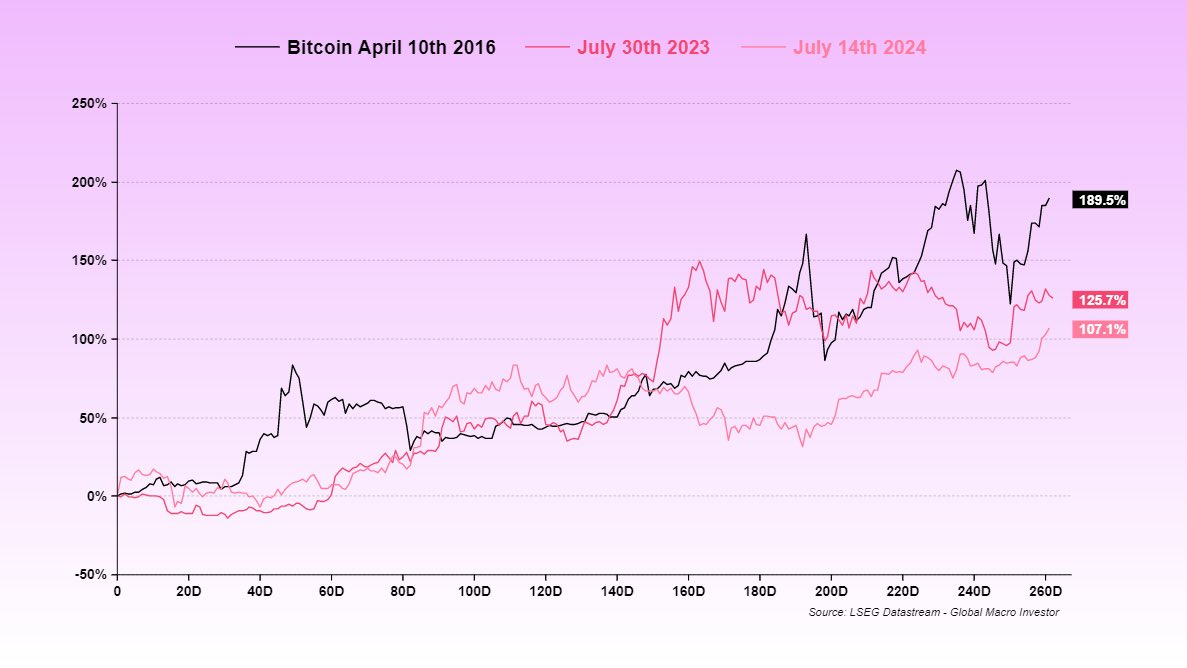
For what it’s worth, I think Bitcoin is forming another broadening wedge pattern, which is typically a bullish setup (chart 1).
We’ve seen plenty of these in the past, and right now we’re testing the lower boundary of support.
Another thing to note is that this bull market is officially 2 standard deviations oversold on the log regression channel (chart 2).
Unless the bull market is over, which is not our view, these levels are about as good an opportunity as you��re going to get to add to this market.
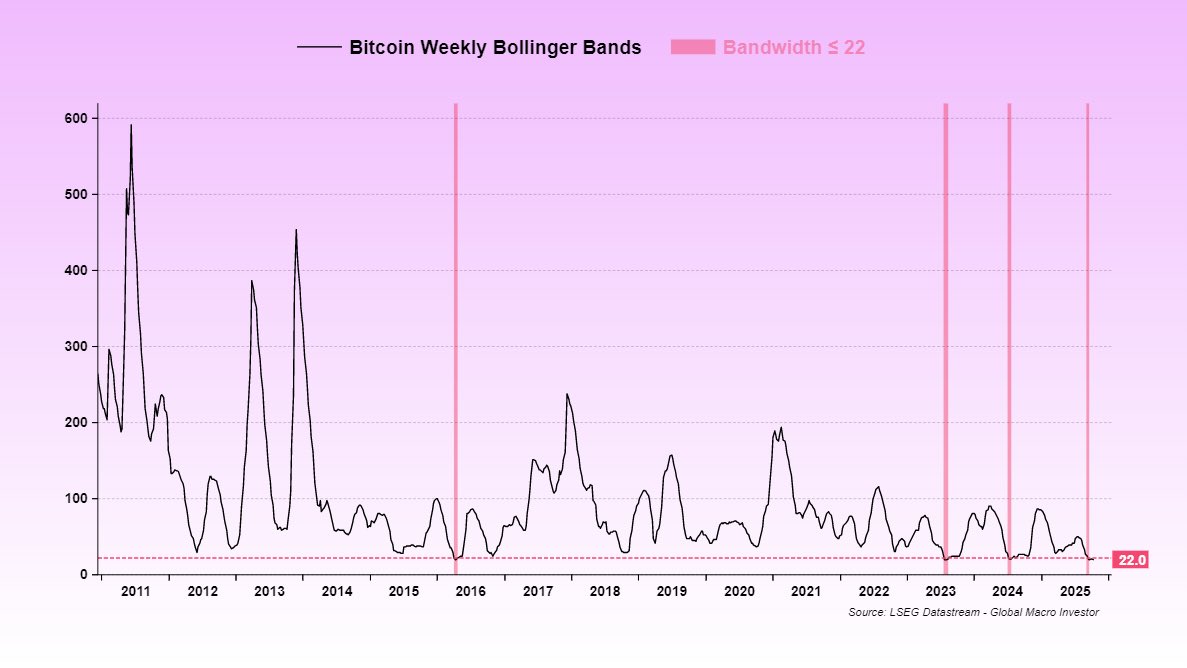
Also worth pointing out, Bitcoin’s Bollinger Bands have only been this tight three other times in its entire history (chart 3)…
What does that mean?
We’re in a mega low-vol environment…
Right now, the bands are as tight as they were in September 2023, just before a 200% rally.
That move lasted from September through March 2024, with a 20% correction in January before prices rallied another 90%.
The next chart shows the last three times Bitcoin’s Bollinger Bandwidth was less than or equal to 22, along with the forward twelve-month returns (chart 4).
The sample size is small, but the results have been extremely positive…
It’s the classic beach-ball-underwater dynamic. The harder you push it down, the more explosive the move when it finally breaks free.
All in all, we need to do better when times are tough. It’s not just your hopes and dreams caught up in this trade, it’s ours too. Fintwit can be powerful when you follow the right people who are genuinely trying to help. We’re not gurus, but we’ve been doing this a long time, built comprehensive frameworks, and we’re doing our best to share what we’ve learned.
At the same time, there’s a ton of poison and hate out there. Avoid it. When times get rough, we should rally around each other and stay focused on the big picture.
This is a 70-vol asset. If you can’t handle that level of volatility, this asset class might not be for you. If you don’t believe in crypto and the life-changing tech it brings, it’s hard to stomach the swings.
The only way to survive this kind of volatility is to extend your time horizon. When you think in days or weeks, every move feels like life or death. When you think in months or years, it all fades into noise.
Once you stop fighting volatility and start embracing it as a feature of this space, everything changes. Volatility turns into opportunity. It’s a gift that lets you add to your conviction.
Our view remains that Q4, once the dust settles, will be bullish, and we’ve done a ton of work to support that view.
That’s the best I can leave you with on days like this.
Good luck out there…
The wait is over!
Introducing... 🥁
Bitcoin Quantile Model v2.
You’re going to want to bookmark this post—and follow for regular model updates.
After months of research and development, I’m very proud of this model—my flagship quantile framework.
I’m confident it’s one of the best—if not the best—long-term Bitcoin investment frameworks available.
As a full-time, unpaid Bitcoin researcher, I’m often asked how people can best support my free content.
Simply bookmark, repost, and comment on my posts :)
Thanks for all your continued support!
— PlanC
Key Features & Improvements:
1. Quantile lines never cross—mathematically impossible.
2. Cycle-length agnostic.
3. 133,000+ data points and 1,500 lines of code.
4. Fits and stores 999 quantile levels (τ = 0.001–0.999 in 0.001 steps) and identifies which level the last price is closest to.
5. Fits the two leading decay functions (stretched exponential decay & exponential decay) and selects the better fit via quantile-appropriate AIC.
Uses Akaike weights to identify the best-supported model.
Akaike weights (AIC-based):
Stretched exponential decay: 96.4%
Exponential decay: 3.6%
6. Piecewise Quantile Regression — Linear + Stretched Exponential Decay (Nonlinear).
While distributed computing remains a broken promise, @theblessnetwork is building the infrastructure to make it a reality.
Here are some real use cases that Bless enables.
Machine Learning & AI Processing
Bless is democratizing AI by creating a distributed AI ecosystem to make machine learning more accessible for everyone.
By enabling model sharding across multiple devices, models can be served and fine-tuned across distributed nodes. This reduces costs while improving training times through massive parallelization.
The network's federated learning capabilities allow companies to contribute to model training while keeping their data local. Healthcare companies could train AI on patient data without it ever leaving the hospital.
Only gradient updates are shared across the network, addressing one of the most significant barriers to AI adoption in regulated industries.
Gaming Latency
One issue that has plagued online games is latency. Players experience widely different quality gameplay based on their geographical location.
Bless solves this through hierarchical state synchronization. Regional game states are maintained locally for responsive gameplay while being synchronized across regions to maintain global consistency.
By allowing game physics calculations to happen close to players rather than in distant data centers, gamers benefit from responsive gameplay that feels consistent regardless of location.
Partnerships
Bless is working with @spaceandtime to integrate ZK-proof capabilities into their network.
AI agents deployed through Bless can access cryptographically verifiable inputs including weather forecasts, grid location projections, and energy prices.
This architecture works well for EV charging networks. Agents can analyze real-time grid capacity, electricity prices, and user demand patterns to prevent grid overload and minimize costs for users.
Bless has also partnered with @monad to enable deployment of autonomous AI trading agents that run entirely on user devices while interacting on-chain.
Monad delivers high throughput and low latency, and Bless complements it by providing the compute layer for local, low-latency agent inference.
These agents could analyze market patterns in real time and lower the barrier to entry for HFT. This allows anyone to deploy sophisticated trading agents on their own devices.
We generally define “success” in any life endeavour with end states in mind ie X millions, Y job, Z possessions
But those are scarcity goals - the goals of our first life
The second life begins when you realise the real goal is to keep living in pursuit of a bigger goal that’s never actually reached
That’s why “$10 million isn’t enough.” Not because it’s not materially enough but because its defined in finite terms and there is no hope or journey in any number itself
The worst goals have a material endpoint: money, a weight, retirement.
Because once you hit them you are back to zero purpose. You expected happiness or success at the finish line, but you feel the same. But the mistake was not realising you had focused on the wrong goal
The “hit a goal, set a new goal” strategy is just a coping mechanism. It keeps you moving but burns you out and on a hedonistic treadmill
What actually works is setting larger than life goals that dont end. That’s why people with deep faith often seem more happy. Their goal is unreachable in this life but they always have steps to take and it gives them purpose
You see this in Bitcoiners to when their focus becomes more than just money but a mission based on beliefs
The worst place to be is living out someone else’s finite goal like staying at a “prestigious” job or dating someone for appearances then telling yourself to be “grateful” because you trick yourself into accepting misery as some kind of humble virtue
But gratitude in this context is flawed. If jealousy is comparing up, gratitude (as commonly practiced) is just comparing down. Both are comparisons. The real gratitude is to appreciate that you are unique with your own goals and journey not where you are relative to others
Material success tricks you into thinking the game is about finishing goals. But real success and happiness is having a north star that you never arrive at that keeps you learning and keeps you growing
People idolise billionaires but focus on the wrong thing. The happiest ones spend most of their wealth into philanthropy. They create vehicles to give, to support loved ones, to build legacies. Their goals arent set with an end
So set impactful north star goals that don’t end. Then live in pursuit of that north star - that’s the win - the real success in ad infinitum
Crypto venture is quietly undergoing a radical transformation
Fund sizes are compressing, strategies are shifting, and new winners are emerging
Why?
1/ The set of risks that VC's get paid to take is evolving - and that changes everything