Millions of everyday consumer devices, especially knockoffs that you buy online, are being infected by a malware known as residential proxy software. Watch WSJ’s Jack Gillum test a few. https://t.co/aem6PBFjvd
"There is an alternative to top-down digital sovereignty. A more decentralized, interoperable and pro-social online ecosystem designed to bridge political and geographic divides rather than amplify them does not have to choose between democratic accountability and online safety"
In 2012 the UN unanimously affirmed that rights enjoyed offline must be protected online, especially free speech. Fourteen years later, the democracies that championed that principle are racing to gut it. My piece on "Digital Sovereignty" in @ForeignAffairs
An old, but apt fable:
A scorpion wants to cross a river but cannot swim, so it asks a frog to carry it across. The frog hesitates, afraid that the scorpion might sting it, but the scorpion promises not to, pointing out that it would drown if it killed the frog in the middle of the river. The frog considers this argument sensible and agrees to transport the scorpion. Midway across the river, the scorpion stings the frog anyway, dooming them both. The dying frog asks the scorpion why it stung despite knowing the consequence, to which the scorpion replies: "I am sorry, but I couldn't help myself. It's my character." @Wikipedia
The @Wikimedia Foundation is celebrating a new milestone in its mission to champion open knowledge! 🎉
We recently joined the @DPGAlliance, an initiative endorsed by the United Nations.
Learn more➡️: https://t.co/JhFZvzdUeI
#DigitalPublicGoods
“This is my generation’s culture, our zeitgeist, and it’s not written down like the psychedelic era or whatever was happening in previous generations. It almost feels like people wanna write it off. I want really peripheral shit like vampjerk to be logged for fucking history bro”
Digital platforms have long thrived by capturing attention, data, and transactions—but that model is starting to crack. As consumers hand off decisions to AI agents, the rules of platform economics are changing fast. These agents compare options, choose the best value, and complete purchases without ever opening an app. The result is “zero-click commerce,” which puts pressure on advertising, weakens lock-in, and makes fees and subscriptions harder to sustain. Even personalization is being outdone by AI that understands users across contexts.
In this new landscape, success will depend less on controlling the interface and more on being selected by the agent. What this shift means for your business: https://t.co/yP4uvPq8Zv
If we chip away at Section 230, we’re shutting the door on the next generation of tech competitors.
Big Tech can survive these lawsuits. Startups can’t.
“That means removing layers of approval so people can move fast, take risks and experiment, and putting trust in the young staff members who grew up using these platforms and understand culture sometimes better than politics.”
Hong Kong: On March 23, 2026, the Hong Kong government changed the implementing rules relating to the National Security Law. It is now a criminal offense to refuse to give the Hong Kong police the passwords or decryption assistance to access all personal electronic devices including cellphones and laptops. This legal change applies to everyone, including U.S. citizens, in Hong Kong, arriving or just transiting Hong Kong International Airport. In addition, the Hong Kong government also has more authority to take and keep any personal devices, as evidence, that they claim are linked to national security offenses. Read more: https://t.co/K5w2tETFu5
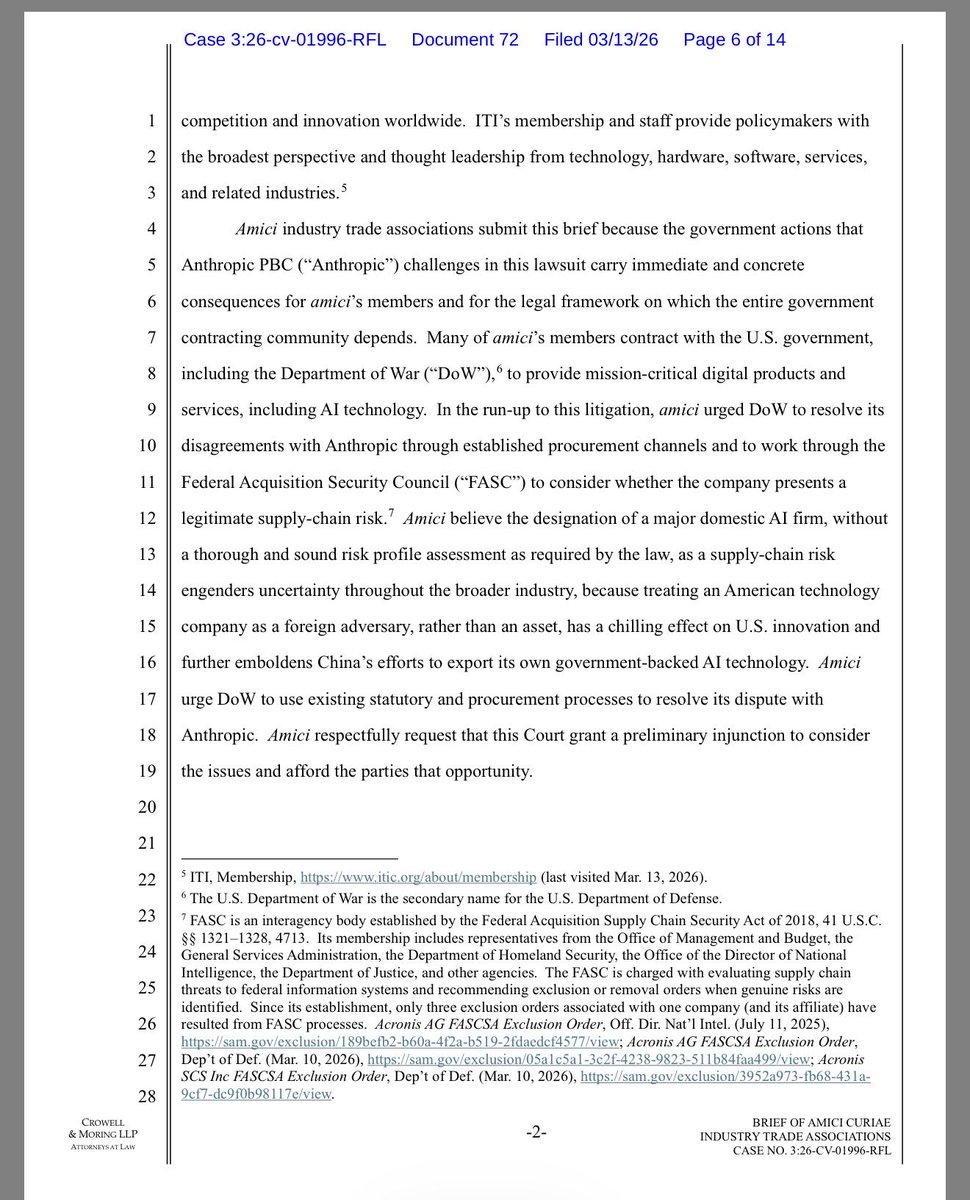
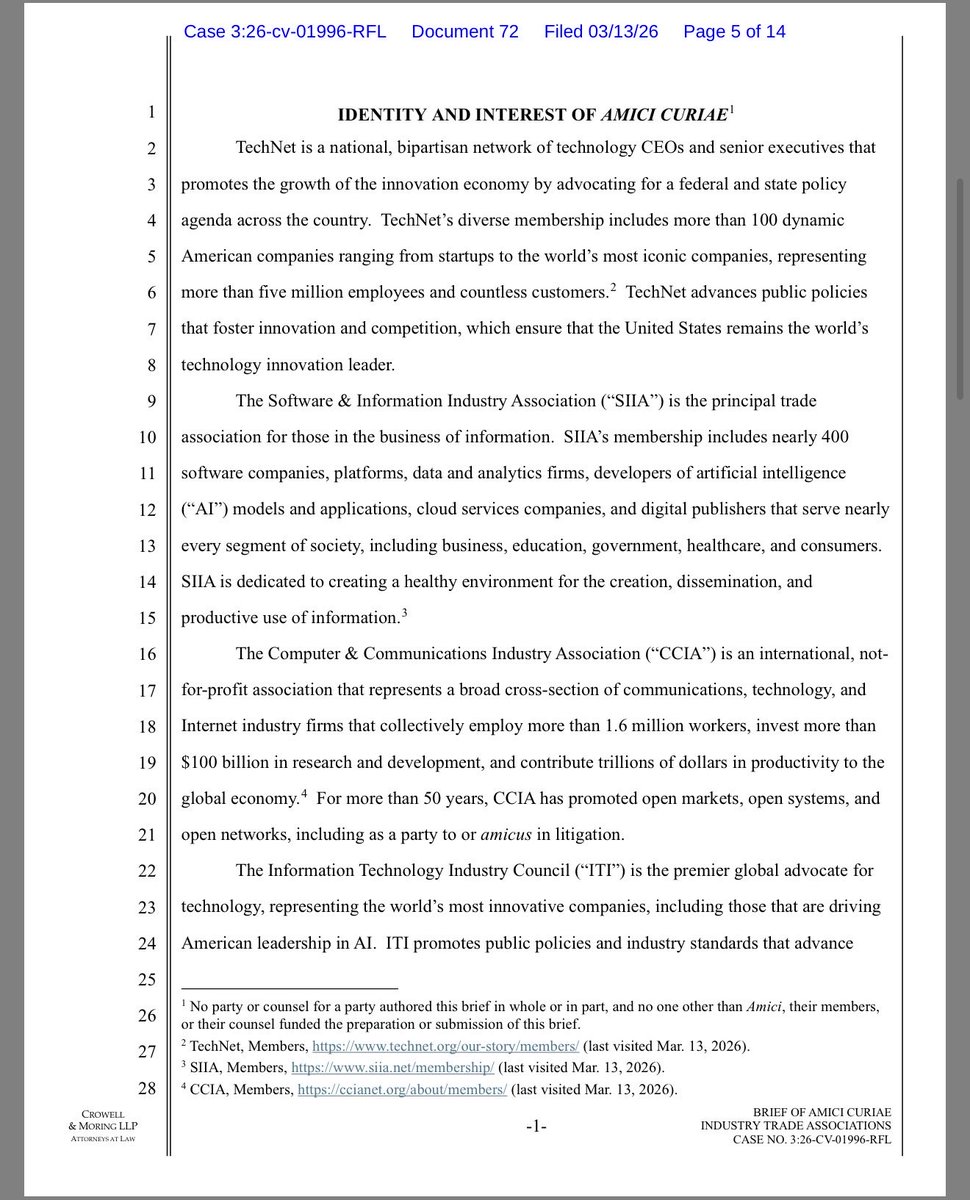
Hundreds of companies across the entire tech sector are now supporting Anthropic in its lawsuit against the Pentagon.
Blacklisting a company in such a way would make procurement "contingent on political favor" rather than the rule of law, industry groups argue.