@weisbergaj@SachsLab congrats on your paper - haven't given it a good read yet, but I like the T3SS classification and mapping to Bradyrhizobium diversity.
It's just a bit sad to see it fails to cite relevant recent papers in the field...
https://t.co/0KiJ9MKwn2
Are you looking for a postdoc position? And are you a bioinformatician / computational biologist with an interest in microbiology, metagenomics? Then I may have an opportunity for you @QueensUBio! Application deadline May 1st. @OpenPlastic@CSM_SCM@queensuResearch
@FunkAndSoulWKND@SisterSledge_@CCfunkandsoul what's the festival policy on babies (<1y old) ?
we bought tickets for this back in 2020 but now have a little one who would like to see George Clinton too!
1/9 I'm excited to share our study refining genera in the family Rhizobiaceae - including the contentious Ensifer and Sinorhizobium genera - is now online at IJSEM @MicrobioSoc. Great collab with @N_Kuzmanovic, @LassalleFlo, @CamillaFagorzi, @alessiome73. https://t.co/SpYpEcZhwI
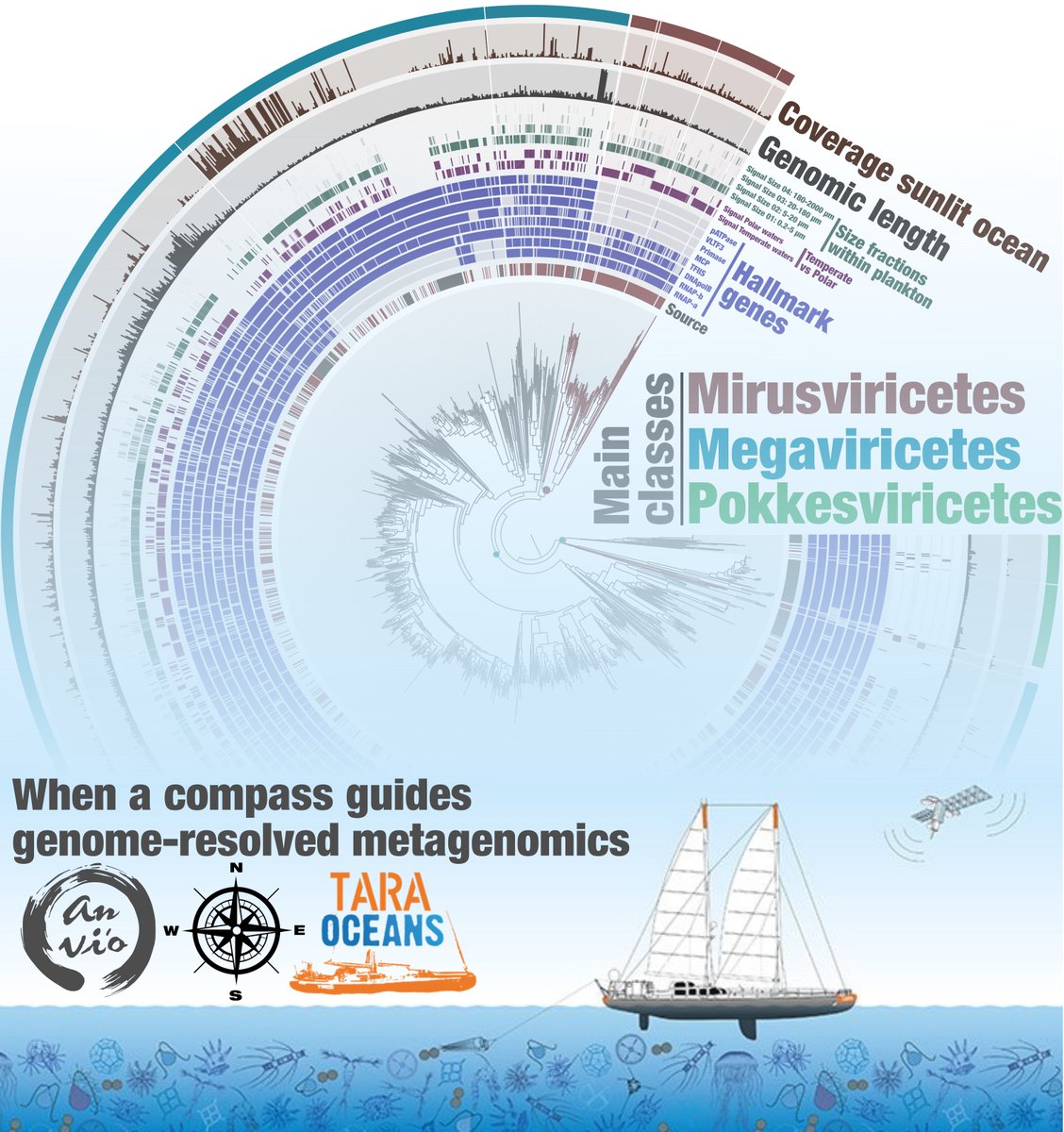
We explored uncharted phylogenetic signal within plankton (#TaraOceans+#anvio+#CompassBinning) and found something unexpected: a third class of #GiantVirus relatives with unusual functional traits and prevalent in the oceans: the **Mirusviricetes** https://t.co/BdQra69UHx More 👇
@rmcolq Great paper! I was wondering how much does your method rely on prior definition of loci i.e. gene annotation of ref genomes? if independent from annotation, could you use your PanRG as a raw sequence to annotate? as a way to annotate the many genomes summarised in graph at once
3/ Comparative genomics revealed species-specific traits including secretion of putative adhesins and exopolysaccharide that may explain exceptional sturdiness of these agrobacteria. Based on our polyphasic taxonomy results we propose the name A. tomkonis for Agrobacterium G3.
Glad to see the fruit of this international collaboration out, showing the presence - and quirkiness! - of agrobacteria in space! 🚀🦠
https://t.co/xJCp5g82gn
2/ we found a clone of Agrobacterium G3 in the #ISS, leading us to investigate the specific properties of this species that has been more often isolated from inhospitable environments - an eosin flask, a cave wall, an ultraclean surface in the space station, ... - than from soil.
We are pleased to see our preprint out on @medrxivpreprint reporting 𝗮𝗻 𝗶𝗺𝗽𝗼𝗿𝘁𝗮𝗻𝘁 𝗽𝗻𝗲𝘂𝗺𝗼𝗰𝗼𝗰𝗰𝗮𝗹 𝗹𝗶𝗻𝗲𝗮𝗴𝗲 𝗚𝗣𝗦𝗖𝟭𝟬. This lineage alone is a great challenge for current serotype-based vaccine and antibiotic treatment (1/5).
https://t.co/xC4dxz1qM8
Our newest preprint is now live, a great collaboration with @N_Kuzmanovic@LassalleFlo@CamillaFagorzi @alessiome73 in which we propose a new framework for genus demarcation in the bacterial family Rhizobiaceae. https://t.co/pI8ZhFa447
@ConsulFranceUK je compte me rendre en France depuis le RU en juillet avec ma concubine qui est britannique. doit-elle fournir a la frontiere les preuves de fonds, certificat d'hébergement sur place et tickets de retour, ou bien son statut de concubin d'un citoyen français suffit? merci d'avance
kmtricks: Efficient construction of Bloom filters for large sequencing data collections.
https://t.co/TFoIvxvReY
With @RayanChikhi@pashadag@p_peterlongo
@RafalMostowy Congrats Rafal! This is the crowning of a long effort, it's well deserved - good to see science can be rewarding at times! and awesome phage picture by the way!!
What's in a bacterial pan-genome? @GalHoresh uses an approach taking the underlying population structure into account, which enabled us to describe different evolutionary trends and levels of conservation, disentangling the 'accessory genome'. https://t.co/GbPoORbywz
4/ we hope that this approach will inspire members of prokaryotic systematics community, to go beyond the marker genes phylogenies and ANI thresholds when defining taxa, hopefully to gain insight into the biology and ecology of the organisms we describe