🚨 Another major scandal is coming out of NVIDIA.
And this one has nothing to do with Jensen Huang's affairs.
According to a Wall Street Journal report, Nvidia was offering billions in financial guarantees to AI companies that could not afford its chips, so they could keep buying them.
Some of these deals were being pushed by Jensen's own son-in-law, Nico Caprez, who became a vice president in January. His team was telling small cloud companies and data center builders that Nvidia could arrange credit support for them within a couple of weeks.
The goal was simple: turn them into long term buyers of Nvidia GPUs.
And the size of Nvidia's commitments has exploded. Its own filing shows $530 BILLION in commitments and guarantees, up from $184 billion just one quarter earlier.
Inside the company, CFO Colette Kress was raising concerns. She kept asking how these guarantees were priced and what Nvidia was really getting back.
In an August meeting, Jensen cut her off and called her "a deer in the headlights."
She was also the one who cut Nvidia's guarantee on OpenAI's Ohio data center from $250 billion to $105 billion.
Now Jensen is gone, and the CFO who questioned these deals is running Nvidia.
To understand why this is a big deal, you need to understand the AI funding loop.
Here is how it works:
1. Nvidia puts money into an AI company, or guarantees its loans and leases.
2. That company uses the money and credit to build a data center.
3. The data center is filled with Nvidia GPUs.
4. Nvidia reports those GPU sales as revenue.
5. If the company cannot rent out all its computing power, Nvidia agrees to buy the unused part.
SO NVIDIA IS THE INVESTOR, THE LENDER, THE SUPPLIER AND THE BACKUP CUSTOMER, ALL IN THE SAME DEAL.
The money goes out of Nvidia and comes back to Nvidia as sales.
CoreWeave is the clearest example. Nvidia owns a stake in it, sells it chips, and agreed to buy up to $6.3 billion of its unused computing capacity through 2032.
OpenAI is the biggest. Nvidia is guaranteeing up to $105 billion for its Ohio data center, supplying all the chips inside it, and invested $1.5 billion in the company building it.
Nvidia's own filing for the quarter ending July 26 shows where the money is tied up:
• Supply commitments for memory and chip wafers: $279 BILLION, up from $119 billion.
• Guarantee on the OpenAI Ohio data center: up to $105 BILLION.
• Deals to buy unused cloud capacity from neoclouds: $36 BILLION.
Nvidia's actual liabilities on its balance sheet: $91 BILLION.
That means the commitments outside the balance sheet are almost 6 times bigger than the debts on it.
Nvidia does not lose this money unless something breaks. A guarantee only costs Nvidia if a customer cannot pay.
But this is where it gets uncomfortable.
The WSJ says Jensen himself had started to panic. He warned executives that the biggest cloud companies were moving to their own chips to depend less on Nvidia.
At the same time, the wafers and memory Nvidia had committed to buy were coming at him like an "avalanche."
So the biggest customers were trying to leave, Nvidia was locked into buying huge amounts of supply, and smaller customers were being kept alive with Nvidia's credit.
And things were already starting to crack:
• Nvidia paused some of its financing deals in August.
• Nearly half of the $80 billion in data center bonds issued this year were rated junk.
• Neocloud stocks crashed this week, with Nebius down over 20% and CoreWeave down 17% at the lows.
• OpenAI raised less than it wanted, at a lower valuation.
And now Kress is the one deciding whether this continues.
If she pulls back on the financing, the companies that depended on Nvidia's money will have to borrow elsewhere, in a debt market that is already nervous.
If they cannot, they stop buying chips.
And if they stop buying chips, Nvidia's revenue drops.
That is the risk of a loop. It works perfectly when money keeps flowing, and it hurts on the way down.
Never seen a worse case of refs having money on a side,
@NRL was an unbelievable opener with NQL v NEW
The dragons v bulldogs game was more rigged than I’ve ever seen
I’m sure the refs made bank on that one
Was actually embarrassing
@jczuleta In the last few sessions instos have taken some of the largest positions in history on $ALB so there’s a good chance of a meaningful bounce here…
AI bubble popped?
If the DeepSeek results are truly real, NVIDIA could find itself in a situation eerily similar to what Cisco faced after the dot-com bubble burst in the early 2000s.
During the bubble, Cisco was a dominant supplier of networking equipment, riding a wave of massive demand as startups and tech companies scrambled to build internet infrastructure.
When the bubble burst, many of these companies went bankrupt, and the market was flooded with second-hand Cisco equipment. Demand for new hardware evaporated, and Cisco’s meteoric growth stalled for years.
In NVIDIA’s case, the booming AI industry has created a gold rush for its GPUs, with startups and tech giants investing billions into its hardware.
Many AI startups, flush with venture capital, have purchased thousands of NVIDIA GPUs to train models and operate their businesses. If DeepSeek disrupts the need for such hardware or leads to widespread failures in these startups, a flood of second-hand NVIDIA GPUs could hit the market, mimicking the post-bubble scenario Cisco endured.
Key Impacts of DeepSeek on NVIDIA
•Bankrupt Startups Flooding the Market: Many AI startups with large NVIDIA GPU inventories may collapse, forcing them to liquidate their hardware, which would drive down the value of new GPUs.
•Startups operating datacenters renting NVIDIA GPUs, may be unable to generate sufficient returns on their investments, further saturating the market with unused GPUs.
•Slowdown from the “Magnificent 7”: Major tech companies, who have driven much of NVIDIA’s growth, may slow or even halt GPU purchases, with thousands of existing GPUs already underutilized and sitting idle in warehouses.
This potential chain reaction could create a perfect storm for NVIDIA, similar to how Cisco’s core business unraveled.
Why This Parallels Cisco
1. Overproduction and Oversupply:
Both companies thrived during speculative booms, producing hardware at unprecedented levels to meet demand. When that demand collapsed, they faced oversaturated markets.
2. Dependence on Startups:
Just as Cisco relied on dot-com companies, NVIDIA is tied to the success of AI startups, which are inherently high-risk.
3. Market Flooding:
For Cisco, bankrupt companies flooded the market with second-hand equipment. For NVIDIA, a similar flood of GPUs could drastically reduce the demand for new hardware.
4. Growth Stagnation:
Cisco’s dominance was followed by years of slow growth due to declining orders. NVIDIA could face a similar fate if demand from both startups and tech giants weakens.
Broader Implications for the Industry
Companies relying on expensive GPUs might pivot to new AI paradigms, leaving NVIDIA with reduced relevance in a transformed market.
NVIDIA’s current valuation, buoyed by AI hype, could face significant correction if growth slows and the second-hand market undercuts new sales.
Other companies in the AI hardware ecosystem could also face fallout, especially those directly dependent on NVIDIA’s dominance.
NVIDIA has been at the forefront of the AI boom, much like Cisco was for the internet revolution. However, history has shown that overreliance on speculative demand and an oversaturated market can challenge even the most dominant companies.
DeepSeek’s potential to shift the AI landscape could mark the beginning of NVIDIA’s own “post-bubble” reckoning.
The decline is accelerating:
Nasdaq 100 futures are now down -330 POINTS since the market opened just hours ago as DeepSeek takes #1 on the App Store.
This is how you know DeepSeek has become a major threat to US large cap tech.
The stock market does not lie.
(a thread)
@jdmarkman Instos getting very busy up here on $XLF
Any other time in history you’d put your house on positioning for a heavy reversal
However the way banks have been trading who the hell knows…
Positioning first, news comes next.
$XLF
@jdmarkman Instos getting very busy up here on $XLF
Any other time in history you’d put your house on positioning for a heavy reversal
However the way banks have been trading who the hell knows…
Positioning first, news comes next.
$XLF
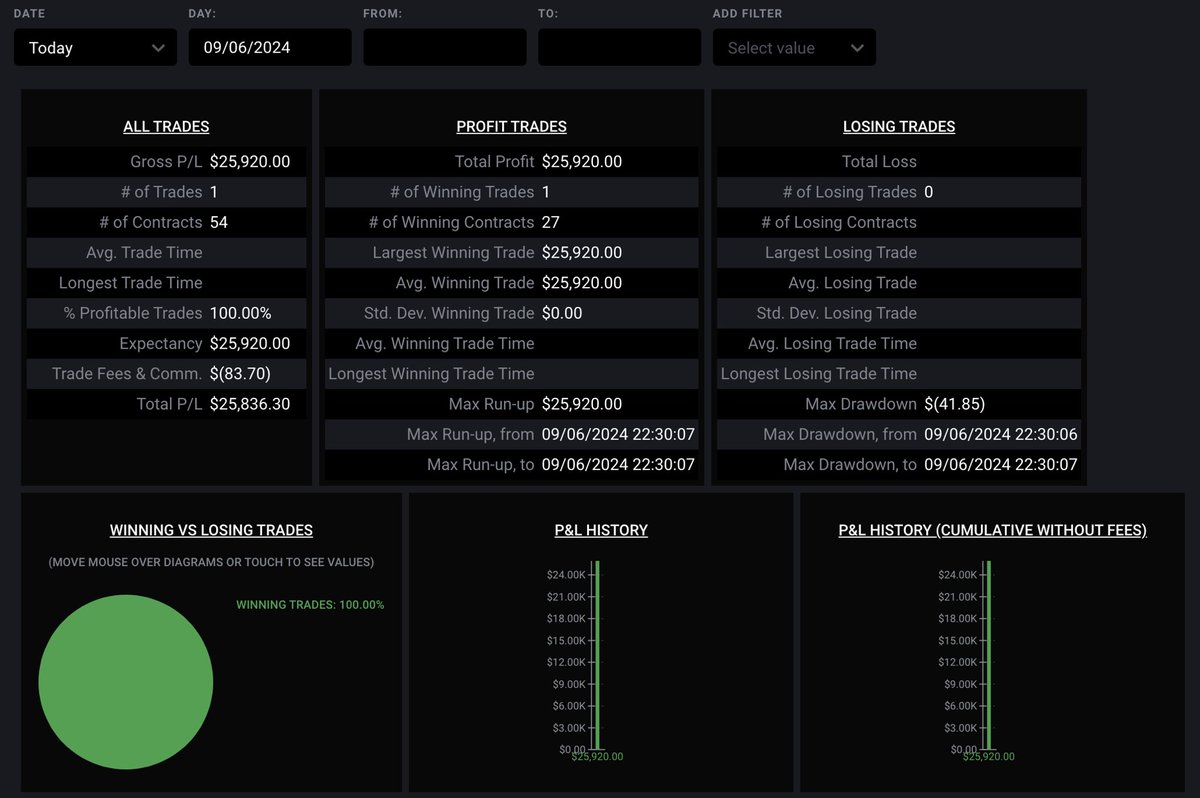
NFP never disappoints.
Passed $250k eval in under 1sec!
Gotta be a record 😝
*only needed $15k but $25k will do 😉
APEX 80% sale & 1 day to pass (obviously)
Coupon code : CYWMHMMN
https://t.co/ZLVnbG3LbW