Looking forward to meet everybody and enjoy the science once again this #SfN24 ! The lab is presenting several posters, most of them on Sunday afternoon. Stop by to chat, check out what we have been up to this year and meet our amazing students and postdocs 🤩
How does the hippocampus moderate reactivation following learning?
We identified a hippocampal circuit mechanism which seems to play this role- and it’s driven by CA2!
Check below for a summary of our recent results from this week's @ScienceMagazine
https://t.co/Ix8yESH8Ng
1/
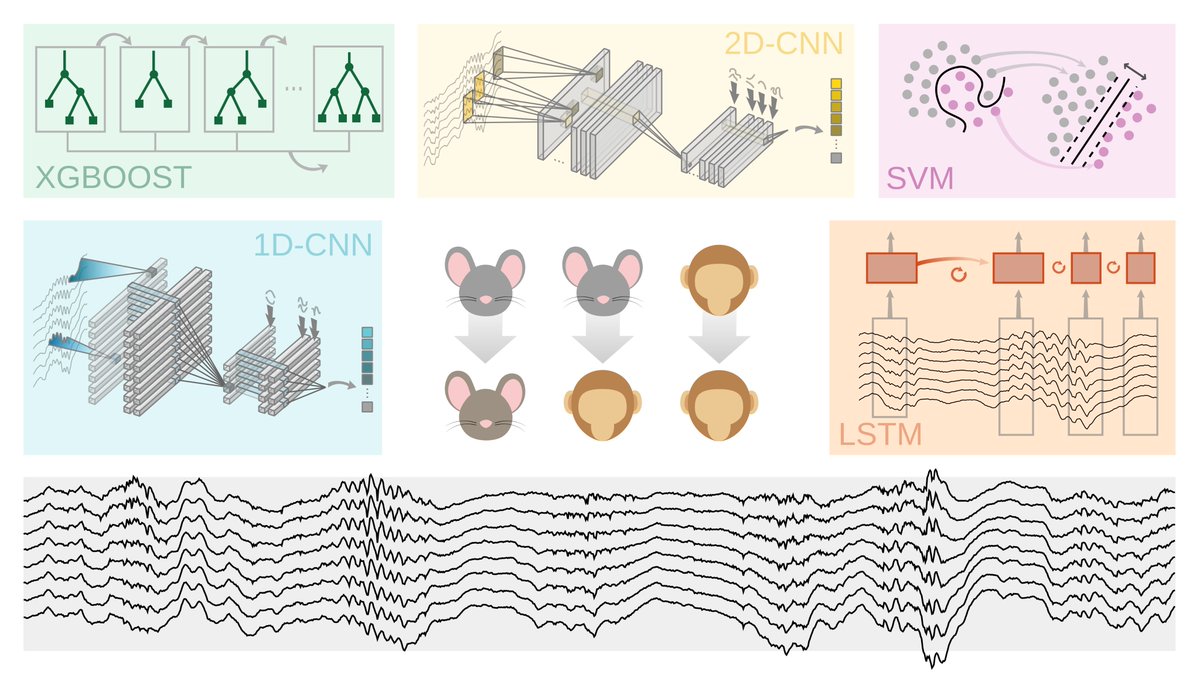
My last work of my PhD is today out at @CommsBio! 🥳😍 @adrubio1999@LMPrida & me built a ML toolbox for #SWRs detection, ready to be applied/re-trained for your own data! We intuitively analyse how different ML algorithms work & show that can be applied to different species!⬇️🧵
🚨New paper from the lab!🚨
Since Hebb, we know that precise sequences of neuronal firing must be the backbone of computation in the brain. For long, we’ve believed it must be related to connectivity, right? And what if it was not (entirely)?
Preprint👇
https://t.co/fTRXrbhxUq
It's an unspoken fact that freely moving lab mice are not really freely moving. We came up with a method to change this. See the preprint: https://t.co/9oNUWBjZo2 (1/3)
Get ready to discuss the latest CA2 insights with us! @Serenadudette and I are thrilled to invite you to a virtual symposium on May 19th, celebrating the Hippocampus Special Issue on CA2! It's FREE of charge. More info at https://t.co/oukwuO3myO and below.
Do you know advanced Ph.D. students or postdocs who are Computational Neuroscience or Deep Learning experts?
Please tell them to apply as Teaching Assistants (TAs)! We are looking for senior TAs for project and lead TAs roles!
Duties are described here: https://t.co/MkzwlHoee6
Instead of funding 1 serial abuser, $25 million could have launched the careers of:
👉 3,333 @SCglobalbrain undergrad fellows
👉 170 @NSF grad fellows
👉 25 @NIH K99/R00 awardees
If you're as interested in ensemble dynamics as I am, be sure to check out @azayhara's review of ensembles in social memory: https://t.co/lSyq6lKDOH. Coincidentally, our reviews are back-to-back in the journal volume!
Major update on our "dual" feature encoding by excitatory and inhibitory cortical cells, now including simulations and super cool theoretical work by @PierreOrhan.
And again, kudos to @AdrianDu_ for all the hard work!
https://t.co/6NCyZHnfry
Now with a DIY guide on how to make your own interneuron tuning curve!
Big thanks to @PierreOrhan for putting tons of effort to make sense of our observations 🙌
I wrote a review in Trends in Neurosciences:
"Entorhinal Cortex Dysfunction in Alzheimer's Disease"
https://t.co/5O5BAvKOve
Cell Press gives a 50-day free access link - if you are interested, please download within this period!
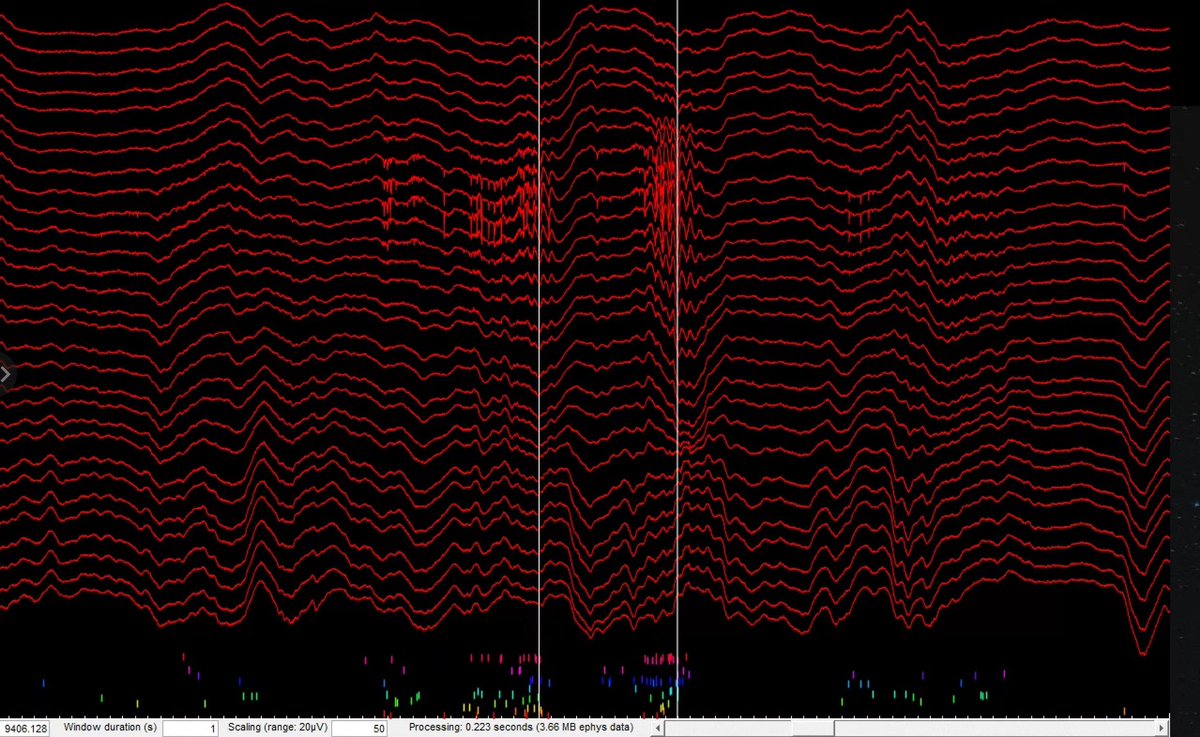
@ElDuvelle @AdrianDu_ Hmm I don’t see up-flat and the frequency looks fairly typical to me 🤔. It’s also looking like typical duration. The bottom channels are lower amplitude and seeing those nested spikes along with oscillation are what makes me think ‘yes ripple’
@ElDuvelle @AdrianDu_ Yeah absolutely. Looks like his channels are more deep given the deflection is upwards but you can see spikes in the trough of the oscillation.
@AdrianDu_ @ElDuvelle Beautiful ripples, Adrian! @ElDuvelle here are a few ripples from my CA1 recordings. Raster below to show recruitment in ripple. The hippocampus is lovely ☺️
New perspective paper, in which I suggest that sleep replay is part of a process that train encoders/decoders between the cortex and the hippocampus, queried by low-level inputs.
Stay tuned for more studies on this soon...
https://t.co/kRkr8lJb9a
I’m finally ready to talk about the experience of appalling mistreatment we had with peer review of one of our papers.
This was by no means the only time I’ve had to contend with bias in academic publishing, but it definitely is the worst thus far.
A 🧵 (1/n)