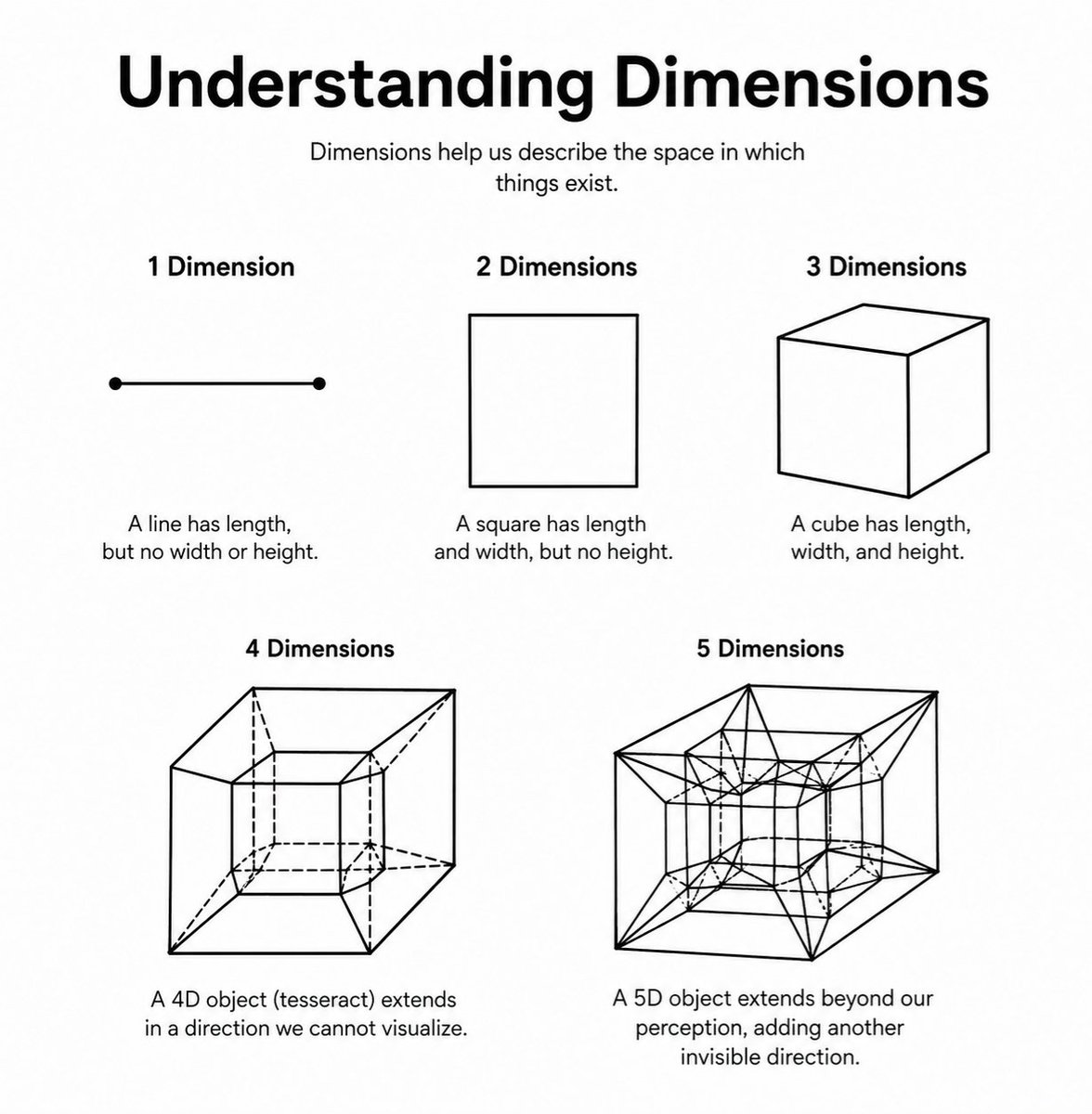
Every dimension adds a completely new direction. That's what makes higher dimensions so hard to imagine.
• 1D: A line with only length. No width or height.
• 2D: A flat shape with length and width. Think of a square drawn on paper.
• 3D: An object with length, width, and height. Everything we see and interact with exists in three spatial dimensions.
• 4D: Represented mathematically by a tesseract, the four dimensional analogue of a cube. It adds a fourth spatial dimension beyond what humans can directly visualize.
• 5D: A five dimensional hypercube (5 cube or penteract) extends the same pattern by adding yet another spatial dimension. Like 4D, it can only be represented through lower dimensional projections.
Every new dimension is created by extending the previous one in a direction perpendicular to all the dimensions before it. Mathematics allows us to study these higher dimensions even though we cannot directly see them.
Un desarrollador ucraniano creó un agujero negro en su terminal para obligarse a tomar descansos.
Cuanto más trabajas sin parar, más crece y deforma tu código con su lente gravitacional. Descansas y se encoge.
@Keystone_K07@SportPesa I see ...well, maybe this round itaenda adi 5*m coz nitasonga pamoja na hiyo policy nikiinunua..hmm😅.
Asante,lakini👍🏾 @Keystone_K07
In 1924, Albert Einstein and Marie Skłodowska Curie were photographed together beside a peaceful lake. Behind that calm moment was a friendship shaped by one of the most difficult periods in Curie's life.
Everything changed for Curie in 1906 when her husband and research partner, Pierre Curie, was killed in a tragic street accident in Paris after being struck by a horse-drawn cart. She was left to raise their daughters alone while continuing the scientific work they had built together.
Several years later, Curie became involved with physicist Paul Langevin, who was separated from his wife. When the relationship became public, Langevin's estranged wife obtained private letters between them, which were leaked to newspapers. The French press seized on the story, turning Curie into the target of intense public criticism. Angry crowds even gathered outside her home, forcing her and her daughters to stay with friends for safety.
Langevin challenged one of the newspaper editors to a duel in defense of Curie's honor. The two men met, but neither fired, and the encounter ended peacefully.
As the controversy reached its peak, Einstein sent Curie a heartfelt letter. He condemned the sensationalist treatment she was receiving, praised her intelligence, determination, and character, and urged her not to waste a moment worrying about those attacking her.
The scandal did not stop Curie's scientific achievements. In 1911, she received her second Nobel Prize in Chemistry, becoming the first person to win two Nobel Prizes and the first to receive them in two different scientific disciplines.
Einstein's letter has since become a lasting reminder that, even in the face of public hostility, respect from one's peers can be far more meaningful than the judgment of the crowd.
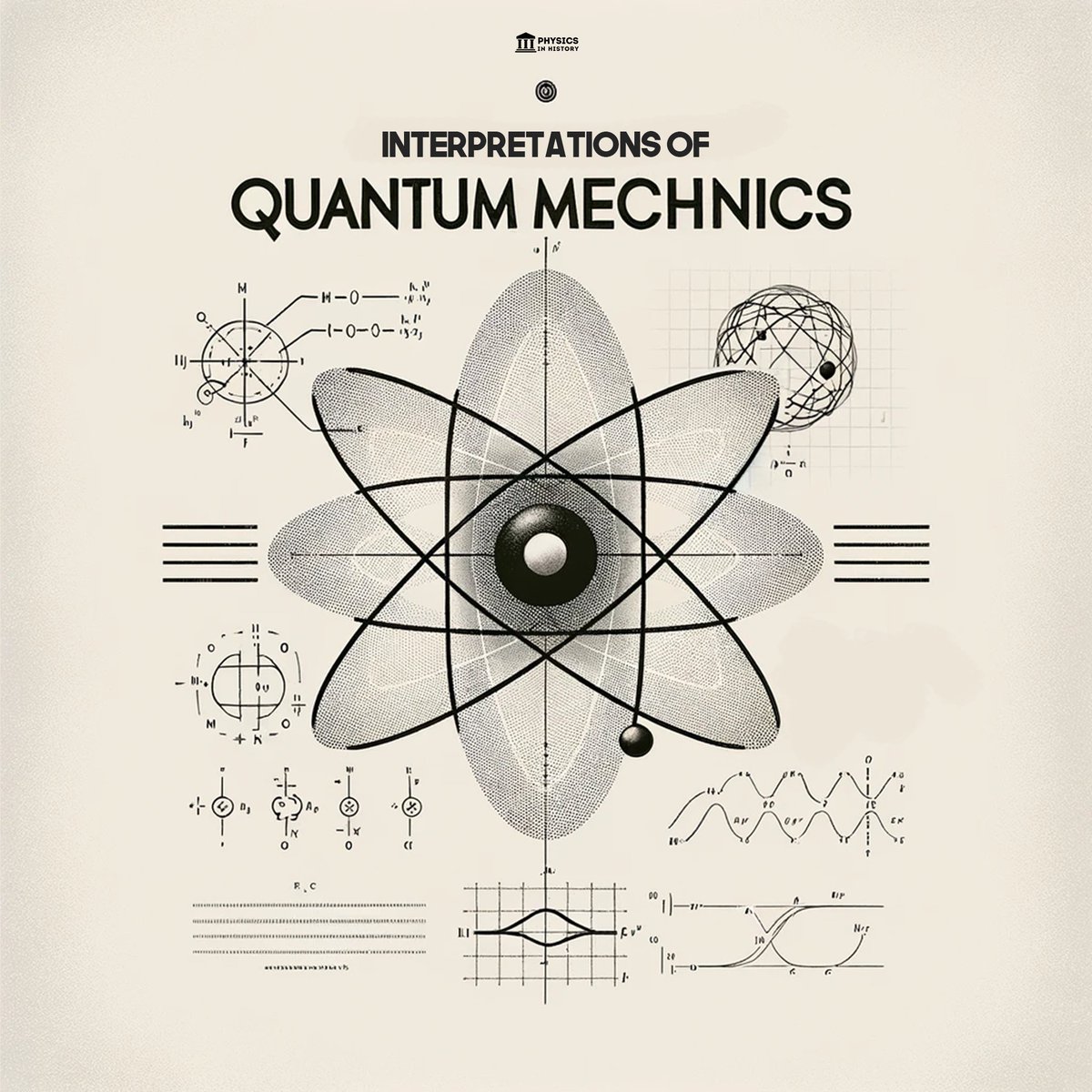
11 different interpretations of Quantum mechanics explained in brief ✍️
1. Copenhagen Interpretation: The "standard" interpretation where quantum systems exist in superpositions until measured, at which point they "collapse" to a definite state.
2. Many-Worlds Interpretation (MWI): Every quantum event spawns countless parallel universes, with each possible outcome actually occurring in a different universe.
3. De Broglie-Bohm (Pilot Wave) Theory: Quantum systems are guided by "pilot waves" that determine their behavior, implying that particles have definite positions at all times.
4. Objective Collapse Theories: Quantum systems spontaneously collapse to definite states over time, without requiring a measurement.
5. Quantum Bayesianism (QBism): Quantum states are subjective beliefs about the outcomes of experiments, emphasizing a Bayesian approach to probability.
6. Relational Quantum Mechanics: The properties of a quantum system are relative to the observer and do not exist absolutely.
7. Transactional Interpretation: Quantum events involve a time-symmetric exchange of "offer waves" and "confirmation waves" between source and detector.
8. Ensemble Interpretation: Quantum mechanics only applies to ensembles of systems, not individual systems, emphasizing statistical outcomes.
9. Consistent Histories: Focuses on establishing a consistent framework to discuss sequences or "histories" of quantum events over time.
10. Quantum Logic: Proposes a modification of classical logic to account for quantum phenomena.
11. Participatory Anthropic Principle (PAP): Observers play a role in bringing the universe into existence through quantum processes.
None of these interpretations alter the core mathematical formalism of quantum mechanics, but they provide different perspectives on what's "really" happening beneath the calculations. The debate over which interpretation, if any, correctly describes nature is ongoing and remains one of the central philosophical questions in the foundations of quantum theory.
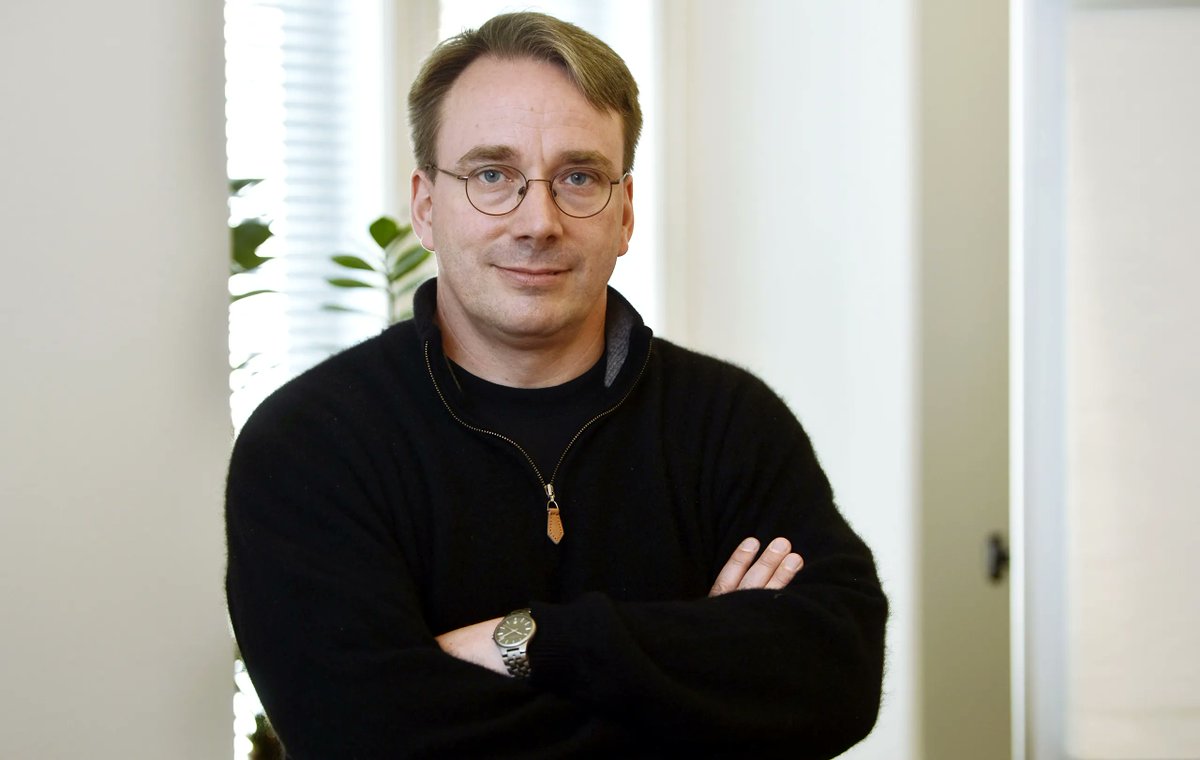
Linus Torvalds created Linux at 21 without Claude or any other AI.
- He didn't have a co-founder.
- No VC funding. No office.
- No team.
- Just a personal project
he posted to a mailing list:
"I'm doing a free OS."
33 years later,
it runs 97% of the world's servers, all smartphones, and the International Space Station.
The most important software in history started as someone's side project.
Absolute legend.
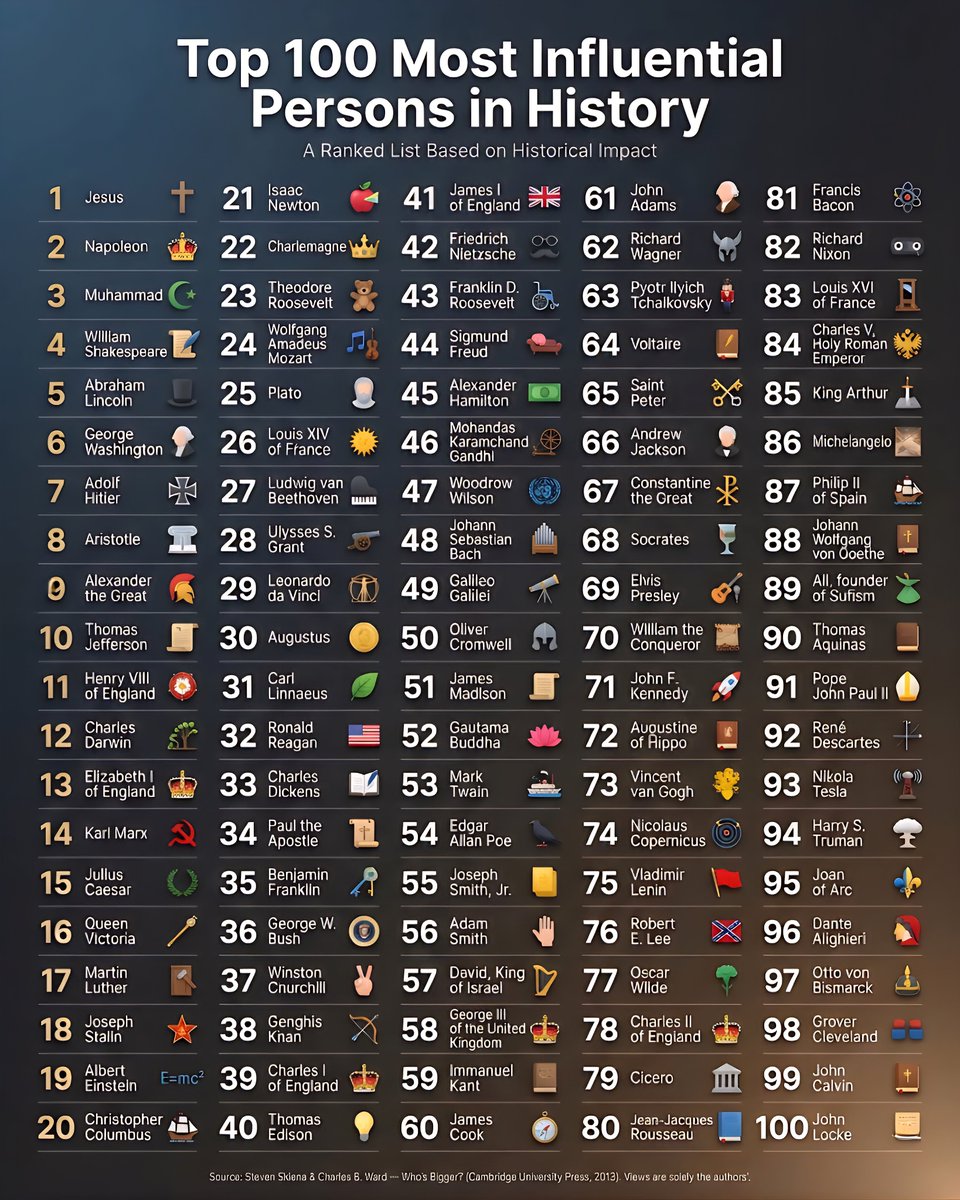
Top 100 Most Influential Persons in History
1. Jesus
2. Napoleon
3. Muhammad
4. William Shakespeare
5. Abraham Lincoln
6. George Washington
7. Adolf Hitler
8. Aristotle
9. Alexander the Great
10. Thomas Jefferson
11. Henry VIII of England
12. Charles Darwin
13. Elizabeth I of England
14. Karl Marx
15. Julius Caesar
16. Queen Victoria
17. Martin Luther
18. Joseph Stalin
19. Albert Einstein
20. Christopher Columbus
21. Isaac Newton
22. Charlemagne
23. Theodore Roosevelt
24. Wolfgang Amadeus Mozart
25. Plato
26. Louis XIV of France
27. Ludwig van Beethoven
28. Ulysses S. Grant
29. Leonardo da Vinci
30. Augustus
31. Carl Linnaeus
32. Ronald Reagan
33. Charles Dickens
34. Paul the Apostle
35. Benjamin Franklin
36. George W. Bush
37. Winston Churchill
38. Genghis Khan
39. Charles I of England
40. Thomas Edison
41. James I of England
42. Friedrich Nietzsche
43. Franklin D. Roosevelt
44. Sigmund Freud
45. Alexander Hamilton
46. Mohandas Karamchand Gandhi
47. Woodrow Wilson
48. Johann Sebastian Bach
49. Galileo Galilei
50. Oliver Cromwell
51. James Madison
52. Gautama Buddha
53. Mark Twain
54. Edgar Allan Poe
55. Joseph Smith, Jr.
56. Adam Smith
57. David, King of Israel
58. George III of the United Kingdom
59. Immanuel Kant
60. James Cook
61. John Adams
62. Richard Wagner
63. Pyotr Ilyich Tchaikovsky
64. Voltaire
65. Saint Peter
66. Andrew Jackson
67. Constantine the Great
68. Socrates
69. Elvis Presley
70. William the Conqueror
71. John F. Kennedy
72. Augustine of Hippo
73. Vincent van Gogh
74. Nicolaus Copernicus
75. Vladimir Lenin
76. Robert E. Lee
77. Oscar Wilde
78. Charles II of England
79. Cicero
80. Jean-Jacques Rousseau
81. Francis Bacon
82. Richard Nixon
83. Louis XVI of France
84. Charles V, Holy Roman Emperor
85. King Arthur
86. Michelangelo
87. Philip II of Spain
88. Johann Wolfgang von Goethe
89. Ali, founder of Sufism
90. Thomas Aquinas
91. Pope John Paul II
92. René Descartes
93. Nikola Tesla
94. Harry S. Truman
95. Joan of Arc
96. Dante Alighieri
97. Otto von Bismarck
98. Grover Cleveland
99. John Calvin
100. John Locke
Source: Steven Skiena and Charles B. Ward are the authors of Who’s Bigger? Where Historical Figures Really Rank, Cambridge University Press, 2013.
Disclaimer: The views expressed are solely their own.
how to become a modern polymath:
1. build strong foundations
math
physics
computation
systems thinking
these are the meta-tools.
2. learn how to learn
reading
note systems
self-study
experimentation
knowledge compounds only if you can absorb it fast.
3. work across domains
biology
engineering
economics
history
design
innovation happens at the borders.
4. build things
code
hardware
models
tools
thinking becomes real only when it meets reality.
5. integrate knowledge
connect ideas from different fields into systems.
a polymath is not someone who knows everything.
it is someone who can connect everything.



![KirkDBorne's tweet photo. [Download 634-page PDF eBook]
Game Theory: https://t.co/7yiOwDdYcF by Giacomo Bonanno
—————
#GameTheory #Gamification #Mathematics #Economics #ExperimentalEconomics #Statistics #Probability https://t.co/Ue1FklQmaQ](https://pbs.twimg.com/media/HDSsCMGW8AAtDVo.jpg)