Ready to make DeFi fun & rewarding?
@TeaFi_Official blends NFTs, GameFi, & Liquidity Mining into a vibrant Web3 ecosystem.
➺ Stake assets, earn $TEA, & boost rewards with “Tea Leaves” NFTs
WHAT HAPPENS WHEN AI MEETS BLOCKCHAIN INFRASTRUCTURE?
House Party Protocol @aergo_io is building toward a future where AI, data, and blockchain are not separate systems, but connected parts of a more verifiable digital economy.
And the idea goes deeper than simply putting AI on a blockchain.
The official HPP whitepaper presents a vision for connecting AI-native applications, decentralized infrastructure, enterprise systems, and verifiable data.
Here’s why that matters. 🧵👇
1. AI needs more than computing power. It needs trust.
AI can generate answers, analyze information, and automate complex tasks. But when those outputs influence financial decisions, smart contracts, or business operations, we need ways to establish where the information came from and how it was used.
This is where verifiable AI becomes important.
HPP's vision centers on making AI and data services work alongside blockchain infrastructure, creating opportunities for applications where outputs and actions can be checked rather than simply accepted on trust.
2. Blockchain can provide the foundation for verification.
Blockchains offer a shared environment for recording transactions and executing predefined rules.
When AI services connect with that infrastructure, developers can explore applications that combine off-chain computation with on-chain requests, records, and settlement.
The goal isn't to force every AI calculation onto a blockchain. It's to connect the two environments in a way that makes useful AI capabilities accessible to decentralized applications.
3. Interoperability matters.
The digital economy isn't built on a single network or technology stack.
Enterprises have existing systems. Developers use different tools. Data and applications operate across multiple environments.
HPP's whitepaper describes a connected infrastructure vision that brings enterprise capabilities and open Web3 systems closer together.
Its current architecture builds on an EVM-compatible Layer 2 using Arbitrum Orbit, with Ethereum-related infrastructure and data availability designed to support scalable applications.
This gives developers a foundation for exploring AI-powered and data-centric use cases without abandoning familiar blockchain development workflows.
4. The infrastructure must serve real applications.
Technology becomes meaningful when people can actually use it.
HPP is developing an ecosystem that includes tools for building applications, accessing AI models, running AI agents, and facilitating on-chain payments.
These components address different parts of the same challenge: helping developers move from an idea to an application that can interact with AI services and blockchain infrastructure.
5. The bigger picture is verifiable digital activity.
Imagine applications that can request AI-powered analysis, use external computation, and interact with smart contracts through a connected infrastructure.
For these systems to become more useful, developers need more than intelligent outputs. They need reliable execution, transparent records, and ways to verify important operations.
That is the direction HPP is working toward: bringing AI capabilities and blockchain-based verification into a more connected ecosystem.
The long-term opportunity isn't just AI becoming smarter or blockchains becoming faster.
It's building infrastructure that allows intelligent systems to operate with greater transparency, accountability, and practical utility.
That's the bigger idea behind House Party Protocol.
AI-native infrastructure. Verifiable activity. A more connected Web3 ecosystem.
Explore the official HPP whitepaper and documentation to learn more.
Documentation: https://t.co/7MR6lsiZE4
#HPP #HousePartyProtocol #AI #Blockchain #Web3 #VerifiableAI #AIAgents
𝐎𝐧𝐞 𝐨𝐟 𝐭𝐡𝐞 𝐢𝐧𝐭𝐞𝐫𝐞𝐬𝐭𝐢𝐧𝐠 𝐢𝐝𝐞𝐚𝐬 𝐢𝐧 𝐭𝐡𝐞 @tezos 𝐰𝐡𝐢𝐭𝐞𝐩𝐚𝐩𝐞𝐫 𝐢𝐬 𝐭𝐡𝐚𝐭 𝐚 𝐛𝐥𝐨𝐜𝐤𝐜𝐡𝐚𝐢𝐧 𝐝𝐨𝐞𝐬𝐧'𝐭 𝐡𝐚𝐯𝐞 𝐭𝐨 𝐭𝐫𝐞𝐚𝐭 𝐞𝐯𝐞𝐫𝐲 𝐫𝐞𝐬𝐩𝐨𝐧𝐬𝐢𝐛𝐢𝐥𝐢𝐭𝐲 𝐚𝐬 𝐨𝐧𝐞 𝐢𝐧𝐬𝐞𝐩𝐚𝐫𝐚𝐛𝐥𝐞 𝐜𝐨𝐦𝐩𝐨𝐧𝐞𝐧𝐭.
The Tezos design separates three key parts of the system:
1. The network protocol
2. The transaction protocol
3. The consensus protocol
Understanding the difference helps explain the thinking behind Tezos.
1. 𝐓𝐡𝐞 𝐧𝐞𝐭𝐰𝐨𝐫𝐤 𝐩𝐫𝐨𝐭𝐨𝐜𝐨𝐥
This part handles communication between participants, including discovering blocks and broadcasting transactions across the network.
Without reliable communication, participants cannot efficiently share the information needed to maintain the blockchain.
2. 𝐓𝐡𝐞 𝐭𝐫𝐚𝐧𝐬𝐚𝐜𝐭𝐢𝐨𝐧 𝐩𝐫𝐨𝐭𝐨𝐜𝐨𝐥
This defines the rules for determining whether transactions and blocks are valid.
It establishes the logic that the system uses to interpret and verify blockchain activity.
3. 𝐓𝐡𝐞 𝐜𝐨𝐧𝐬𝐞𝐧𝐬𝐮𝐬 𝐩𝐫𝐨𝐭𝐨𝐜𝐨𝐥
This is responsible for helping network participants agree on a single chain.
Agreement matters because a decentralized network needs a shared understanding of the blockchain's history rather than multiple conflicting versions.
𝐖𝐡𝐲 𝐬𝐞𝐩𝐚𝐫𝐚𝐭𝐞 𝐭𝐡𝐞𝐬𝐞 𝐫𝐞𝐬𝐩𝐨𝐧𝐬𝐢𝐛𝐢𝐥𝐢𝐭𝐢𝐞𝐬?
Because each component has a distinct job. Treating them separately creates a more flexible design and makes it possible to reason about different parts of the system independently.
The whitepaper's broader architectural idea is to allow different protocols to work together through clearly defined interfaces.
This is not just a technical detail. It reflects a design philosophy focused on flexibility, adaptability, and the ability to evolve the system over time.
𝐓𝐡𝐞 𝐭𝐚𝐤𝐞𝐚𝐰𝐚𝐲?
A blockchain's architecture matters just as much as its visible features. How its components are organized can influence how easily the system can be maintained and improved.
This is one of the foundational concepts worth understanding when studying Tezos.
Source: Tezos A Self-Amending Crypto-Ledger, 2014.
https://t.co/hVweQKOaLZ
#Tezos
House Party Protocol @aergo_io , and HQR-02 shows how the ecosystem is moving from building infrastructure to connecting AI, on-chain payments, and decentralized applications.
𝐇𝐞𝐫𝐞’𝐬 𝐰𝐡𝐚𝐭 𝐬𝐡𝐢𝐩𝐩𝐞𝐝 𝐚𝐧𝐝 𝐰𝐡𝐲 𝐢𝐭 𝐦𝐚𝐭𝐭𝐞𝐫𝐬. 👇?
AI is becoming more than a tool for answering questions. It can write code, execute workflows, interact with services, and make payments.
But as AI takes on more responsibilities, one question becomes increasingly important:
Can we verify what an AI agent actually did?
What did it request? How much did it spend? Which task did it perform? And what happened if something went wrong?
HPP is building toward a system where requests, payments, and agent activities can be recorded on-chain, creating a verifiable trail across its connected products.
Here’s how Q3 moved that vision forward.
------------------------->>>>>>>>>
1. HPP Hub reached General Availability
Building on-chain applications is becoming more accessible. HPP Hub now allows teams to build, deploy, and share applications without writing code, with the platform moving into production use.
2. HPP Coder is live
HPP introduced its AI coding product, powered by Solidity-Master 2. It is available inside Hub’s dApp Builder and as a standalone product, helping developers work with Solidity and build blockchain applications.
3. OpenHPP entered Limited Open Beta
OpenHPP brings AI agents into a cloud environment where they can run around the clock. It includes isolated execution environments, session-based credentials, and logs that record the steps agents take.
General release is targeted for Q4 2026.
4. HPP Router connects AI models
Instead of managing access to different AI models separately, developers can use HPP Router to access models from OpenAI, Anthropic, Moonshot AI, and self-hosted Ollama through a single OpenAI-compatible endpoint.
Requests can be recorded on-chain and verified using hashes and Merkle proofs.
5. x402 went live on HPP Mainnet
AI agents need more than intelligence. They also need ways to pay for services.
HPP’s x402 Facilitator is now live in production on Mainnet, enabling agent payments with verifiable settlement records. The new x402 Explorer also makes settlement activity publicly viewable.
6. HPP Agora opened to Mainnet projects
Governance is another important part of the ecosystem. HPP Agora opened to every project on HPP Mainnet, allowing proposals to move through discussion, voting, execution, and integration.
Votes are staking-based and publicly verifiable, giving communities a structured way to participate in decisions.
7. HPP Staking moves into its next season
Season 2, “Hold and Earn,” has closed. Season 3 is planned to introduce CHIP, a usage-backed token for HPP’s AI services, replacing the previous Agora-linked missions. More details are expected to follow.
So, what does all of this mean?
HPP is connecting the pieces of an AI-focused blockchain ecosystem:
→ Build applications with Hub.
→ Develop with HPP Coder.
→ Run AI agents through OpenHPP.
→ Access AI models through Router.
→ Facilitate and verify payments through x402.
→ Participate in ecosystem governance through Agora.
The bigger picture is not simply about launching individual products. It is about connecting application development, AI execution, payments, and verification into a more coordinated infrastructure.
Looking ahead, $HPP Q4 priorities include OpenHPP’s general release, Account Abstraction, Enterprise L3 development, and the ZK Bridge buildout. The team is also discussing the migration of enterprise and institutional clients from Aergo Enterprise to HPP.
Q3 was about getting the products out. Q4 is about taking the next steps toward scale.
The HPP ecosystem is taking shape, and the next phase will be about how these products work together in practice.
Read the full HPP Quarterly Report (HQR-02): https://t.co/LnEDLbqPS1
#HPP $HPP #HousePartyProtocol
𝐖𝐡𝐚𝐭 𝐢𝐟 𝐁𝐢𝐭𝐜𝐨𝐢𝐧 𝐜𝐨𝐮𝐥𝐝 𝐛𝐞𝐜𝐨𝐦𝐞 𝐦𝐨𝐫𝐞 𝐭𝐡𝐚𝐧 𝐚 𝐬𝐭𝐨𝐫𝐞 𝐨𝐟 𝐯𝐚𝐥𝐮𝐞?
What if BTC holders could earn native BTC yield, borrow against their holdings, and access private financial activity while still settling to Bitcoin?
That’s the vision Muneeb Ali laid out for @Stacks through 2030. And it goes much deeper than just Bitcoin staking. 👀
𝐓𝐡𝐞 𝐩𝐥𝐚𝐧 𝐫𝐞𝐯𝐨𝐥𝐯𝐞𝐬 𝐚𝐫𝐨𝐮𝐧𝐝 𝐭𝐡𝐫𝐞𝐞 𝐦𝐚𝐣𝐨𝐫 𝐟𝐫𝐨𝐧𝐭𝐢𝐞𝐫𝐬:
1. 𝐁𝐢𝐭𝐜𝐨𝐢𝐧 𝐂𝐚𝐩𝐢𝐭𝐚𝐥 𝐌𝐚𝐫𝐤𝐞𝐭𝐬 🟠
Traditional financial markets use bonds to earn predictable returns and repos to borrow against assets without necessarily giving up their exposure.
Stacks wants to bring more of these financial opportunities to Bitcoin.
Bitcoin Staking on Stacks launched in September through the Genesis Bond, which sold out at 230 BTC.
The next steps include PoX-6, targeted for 2027, which could expand bonding access through an auction mechanism, and self-custodial Bitcoin lending, which is currently in research and development.
The goal is to give BTC holders more ways to put their Bitcoin to work.
-----------------------------------------------
2. 𝐂𝐨𝐦𝐩𝐥𝐢𝐚𝐧𝐭 𝐏𝐫𝐢𝐯𝐚𝐜𝐲 🔐
Public blockchains offer transparency, but that transparency can also expose financial positions, balances, and transaction activity.
For institutions and businesses, that can be a serious concern.
Stacks’ vision includes shielded transactions that could keep financial positions private while allowing users to share visibility through viewing keys with authorized parties, such as auditors or regulators.
The idea is to explore how confidentiality and compliance can coexist.
-----------------------------------------------
3. 𝐏𝐨𝐬𝐭-𝐐𝐮𝐚𝐧𝐭𝐮𝐦 𝐒𝐞𝐜𝐮𝐫𝐢𝐭𝐲 🛡
Quantum computing could eventually challenge some of the cryptographic systems used today.
Preparing for that future is especially important for Bitcoin because changes to its base layer require broad coordination and time.
Stacks is exploring how it can adopt new signature schemes through its own governance while supporting financial activity on a network anchored to Bitcoin.
----------------------------------------------
↕↕But there’s another challenge: quantum-resistant signatures can be significantly larger than current signatures, potentially increasing pressure on Bitcoin’s limited block space.
That makes the relationship between Bitcoin and Stacks particularly interesting.
Here’s what connects all three frontiers.
𝘉𝘪𝘵𝘤𝘰𝘪𝘯 𝘤𝘢𝘱𝘪𝘵𝘢𝘭 𝘮𝘢𝘳𝘬𝘦𝘵𝘴 𝘤𝘳𝘦𝘢𝘵𝘦 𝘮𝘰𝘳𝘦 𝘰𝘱𝘱𝘰𝘳𝘵𝘶𝘯𝘪𝘵𝘪𝘦𝘴 𝘧𝘰𝘳 𝘉𝘛𝘊 𝘵𝘰 𝘦𝘢𝘳𝘯 𝘢𝘯𝘥 𝘴𝘦𝘳𝘷𝘦 𝘢𝘴 𝘤𝘰𝘭𝘭𝘢𝘵𝘦𝘳𝘢𝘭.
𝘗𝘳𝘪𝘷𝘢𝘤𝘺 𝘢𝘥𝘥𝘳𝘦𝘴𝘴𝘦𝘴 𝘵𝘩𝘦 𝘤𝘰𝘯𝘧𝘪𝘥𝘦𝘯𝘵𝘪𝘢𝘭𝘪𝘵𝘺 𝘯𝘦𝘦𝘥𝘴 𝘰𝘧 𝘧𝘪𝘯𝘢𝘯𝘤𝘪𝘢𝘭 𝘢𝘤𝘵𝘪𝘷𝘪𝘵𝘺.
𝘗𝘰𝘴𝘵-𝘲𝘶𝘢𝘯𝘵𝘶𝘮 𝘴𝘦𝘤𝘶𝘳𝘪𝘵𝘺 𝘧𝘰𝘤𝘶𝘴𝘦𝘴 𝘰𝘯 𝘱𝘳𝘦𝘱𝘢𝘳𝘪𝘯𝘨 𝘧𝘰𝘳 𝘧𝘶𝘵𝘶𝘳𝘦 𝘤𝘳𝘺𝘱𝘵𝘰𝘨𝘳𝘢𝘱𝘩𝘪𝘤 𝘵𝘩𝘳𝘦𝘢𝘵𝘴.
Together, these form a broader vision for what Bitcoin-based finance could look like by 2030.
And $STX has a role in the Stacks ecosystem, powering network activity and supporting its economic model.
Of course, the vision is ambitious, and several pieces remain in development. The real test will be execution, security, adoption, and whether BTC holders and institutions actually use these products.
----------------------------------------------
Still, this is a much bigger conversation than simply adding more applications around Bitcoin.
It’s about building the financial infrastructure that could make Bitcoin more useful without losing sight of the base layer.
Which frontier do you think will matter most by 2030: Bitcoin capital markets, compliant privacy, or post-quantum security?
I’m especially interested in whether privacy or Bitcoin-backed lending will be the bigger catalyst for adoption.
@Stacks $STX
𝐒𝐭𝐚𝐜𝐤𝐬 𝐃𝐞𝐅𝐢 𝐢𝐬 𝐛𝐞𝐜𝐨𝐦𝐢𝐧𝐠 𝐦𝐨𝐫𝐞 𝐢𝐧𝐭𝐞𝐫𝐞𝐬𝐭𝐢𝐧𝐠, 𝐚𝐧𝐝 @tenero_io 𝐕𝟐 𝐢𝐬 𝐛𝐫𝐢𝐧𝐠𝐢𝐧𝐠 𝐦𝐨𝐫𝐞 𝐨𝐟 𝐭𝐡𝐞 𝐞𝐜𝐨𝐬𝐲𝐬𝐭𝐞𝐦 𝐢𝐧𝐭𝐨 𝐨𝐧𝐞 𝐩𝐥𝐚𝐜𝐞. 👀
I took a closer look at the latest Tenero upgrade, and there’s a lot to explore beyond the interface.
In this video, I walk you through what’s new and how the features work, from market discovery to swapping, yield research, liquidity pools, and wallet analytics.
Here’s what stood out to me 👇
🔹 Improved Market Discovery: Explore live trades, trending tokens, a new treemap, and customizable watchlists to keep track of market activity.
🔹 In-App Swapping: Powered by Zest Protocol, Tenero routes swaps across multiple DEXes to find the best available rate, with zero additional swap fees charged by Tenero. Underlying DEX fees may still apply.
🔹 Yield Hub: Compare APY, APR, TVL, and exit terms across supported DeFi protocols before deciding which opportunities deserve a closer look.
🔹 Pools Analytics: Explore liquidity, trading volume, and fees earned to better understand what's happening across Stacks liquidity pools.
🔹 Wallet Analytics: Track holdings, trading history, and realised or unrealised P&L for Stacks wallets.
🔹 Easier Onboarding: Google sign-in and self-custodial STX wallet creation through Privy make getting started more accessible.
What I find interesting is how Tenero V2 brings trading, research, and ecosystem analytics together, so users can explore more of Stacks DeFi without constantly switching between different tools.
But don't just take my word for it. 🎥 Watch my video as I walk through the platform and show you how these features look in practice.
Explore Tenero V2: https://t.co/YwiIdcPgZ1
Trade. Earn. Explore.
#Tenero #Stacks #BitcoinDeFi #DeFi
Nimiq is giving builders another reason to get involved!
The @nimiq Mini Apps Competition is now in Cycle 3, with a chance to win $4,000 for building a Mini App.
▫️And to celebrate, there’s a $100 USDC giveaway for the community!
If you have a friend with great ideas and building skills, this is the perfect time to let them know
Join the giveaway, spread the word, and let’s see what the community can create with Nimiq.
Don’t miss out. The giveaway ends in 7 days!
@miniappscomp
#Nim #NimiqCommunity #Nimiq
I Put @binance AI to the Test!
𝐖𝐡𝐚𝐭 𝐡𝐚𝐩𝐩𝐞𝐧𝐬 𝐰𝐡𝐞𝐧 𝐲𝐨𝐮 𝐬𝐭𝐨𝐩 𝐫𝐞𝐚𝐝𝐢𝐧𝐠 𝐚𝐛𝐨𝐮𝐭 𝐀𝐈-𝐩𝐨𝐰𝐞𝐫𝐞𝐝 𝐜𝐫𝐲𝐩𝐭𝐨 𝐭𝐨𝐨𝐥𝐬 𝐚𝐧𝐝 𝐚𝐜𝐭𝐮𝐚𝐥𝐥𝐲 𝐩𝐮𝐭 𝐨𝐧𝐞 𝐭𝐨 𝐰𝐨𝐫𝐤? 👀
In this video, I explore Binance AI, Binance’s 24/7 personal assistant, to see how it can help users catch up on market developments, understand crypto information, and discover useful insights directly within the Binance app.
𝘐 𝘸𝘢𝘯𝘵𝘦𝘥 𝘵𝘰 𝘨𝘰 𝘣𝘦𝘺𝘰𝘯𝘥 𝘴𝘪𝘮𝘱𝘭𝘺 𝘭𝘪𝘴𝘵𝘪𝘯𝘨 𝘧𝘦𝘢𝘵𝘶𝘳𝘦𝘴. 𝘚𝘰, 𝘐 𝘦𝘹𝘱𝘭𝘰𝘳𝘦𝘥 𝘵𝘩𝘦 𝘱𝘳𝘰𝘥𝘶𝘤𝘵 𝘵𝘰 𝘴𝘦𝘦 𝘸𝘩𝘢𝘵 𝘵𝘩𝘦 𝘦𝘹𝘱𝘦𝘳𝘪𝘦𝘯𝘤𝘦 𝘭𝘰𝘰𝘬𝘴 𝘭𝘪𝘬𝘦, 𝘸𝘩𝘢𝘵 𝘪𝘯𝘧𝘰𝘳𝘮𝘢𝘵𝘪𝘰𝘯 𝘪𝘵 𝘱𝘳𝘰𝘷𝘪𝘥𝘦𝘴, 𝘢𝘯𝘥 𝘩𝘰𝘸 𝘶𝘴𝘦𝘧𝘶𝘭 𝘪𝘵 𝘤𝘢𝘯 𝘣𝘦 𝘸𝘩𝘦𝘯 𝘯𝘢𝘷𝘪𝘨𝘢𝘵𝘪𝘯𝘨 𝘵𝘩𝘦 𝘧𝘢𝘴𝘵-𝘮𝘰𝘷𝘪𝘯𝘨 𝘤𝘳𝘺𝘱𝘵𝘰 𝘮𝘢𝘳𝘬𝘦𝘵.
🎥 Watch the full video to see the demonstration, follow my experience, and discover what I learned from putting Binance AI to the test!
AI can help make information more accessible, but independent research and personal judgment still matter. The real question is: how useful can it be in practice?
𝐍𝐨𝐰 𝐢𝐭'𝐬 𝐲𝐨𝐮𝐫 𝐭𝐮𝐫𝐧!
Explore Binance AI and test it for yourself.
Official Binance AI blog:
https://t.co/T4FUQo0aeS
@Binance@heyibinance@cz_binance@EowynChen
#BinanceAI $BNB
Happy New Week, builders!
New week, new ideas, new opportunities to build!
A quick reminder to Nigerian developers and builders , don’t forget the @Nimiq Mini Apps Competition Cycle 3!
You can build on the following
◈ PAY
◈ SAVE
◈ EARN
◈ ON/OFF-RAMP
Build something useful, solve real problems, and stand a chance to share in $17,000 USDC in prizes.
🗓️ Submissions close November 11, 2026.
Got an idea? This is your sign to start building!
Register: ↷
https://t.co/GYlCfsWsco
Let’s build from Nigeria for the world!
#Nimiq #MiniApps #NimiqCommunity
𝐖𝐡𝐚𝐭 𝐢𝐟 𝐚 𝐛𝐥𝐨𝐜𝐤𝐜𝐡𝐚𝐢𝐧 𝐜𝐨𝐮𝐥𝐝 𝐮𝐩𝐠𝐫𝐚𝐝𝐞 𝐢𝐭𝐬𝐞𝐥𝐟 𝐰𝐢𝐭𝐡𝐨𝐮𝐭 𝐫𝐞𝐥𝐲𝐢𝐧𝐠 𝐨𝐧 𝐚 𝐜𝐨𝐦𝐩𝐥𝐞𝐭𝐞𝐥𝐲 𝐬𝐞𝐩𝐚𝐫𝐚𝐭𝐞 𝐩𝐫𝐨𝐜𝐞𝐬𝐬 𝐭𝐨 𝐜𝐡𝐚𝐧𝐠𝐞 𝐢𝐭𝐬 𝐫𝐮𝐥𝐞𝐬?
That was one of the foundational ideas behind @tezos .
The original Tezos whitepaper, published by L.M. Goodman in 2014, introduced the concept of a self-amending crypto-ledger: a blockchain designed to evolve through a formal governance process.
𝐇𝐞𝐫𝐞’𝐬 𝐰𝐡𝐲 𝐭𝐡𝐚𝐭 𝐦𝐚𝐭𝐭𝐞𝐫𝐬.
Unlike systems where protocol changes can become a source of disagreement among participants, Tezos was designed to provide a structured way for stakeholders to propose, evaluate, and approve amendments.
The goal was to make protocol evolution part of the system itself.
This approach connects two important ideas: governance and technology.
---------------------------------------
𝙂𝙤𝙫𝙚𝙧𝙣𝙖𝙣𝙘𝙚 𝙜𝙞𝙫𝙚𝙨 𝙨𝙩𝙖𝙠𝙚𝙝𝙤𝙡𝙙𝙚𝙧𝙨 𝙖 𝙬𝙖𝙮 𝙩𝙤 𝙞𝙣𝙛𝙡𝙪𝙚𝙣𝙘𝙚 𝙩𝙝𝙚 𝙣𝙚𝙩𝙬𝙤𝙧𝙠’𝙨 𝙙𝙞𝙧𝙚𝙘𝙩𝙞𝙤𝙣, 𝙬𝙝𝙞𝙡𝙚 𝙨𝙚𝙡𝙛-𝙖𝙢𝙚𝙣𝙙𝙢𝙚𝙣𝙩 𝙥𝙧𝙤𝙫𝙞𝙙𝙚𝙨 𝙖 𝙢𝙚𝙘𝙝𝙖𝙣𝙞𝙨𝙢 𝙛𝙤𝙧 𝙖𝙥𝙥𝙧𝙤𝙫𝙚𝙙 𝙘𝙝𝙖𝙣𝙜𝙚𝙨 𝙩𝙤 𝙗𝙚𝙘𝙤𝙢𝙚 𝙥𝙖𝙧𝙩 𝙤𝙛 𝙩𝙝𝙚 𝙥𝙧𝙤𝙩𝙤𝙘𝙤𝙡.
It doesn’t mean every upgrade is automatic or that disagreements disappear. Instead, it creates an established process through which the network can adapt.
𝐖𝐡𝐲 𝐢𝐬 𝐭𝐡𝐢𝐬 𝐢𝐦𝐩𝐨𝐫𝐭𝐚𝐧𝐭?
Because blockchain technology continues to develop. Security requirements change, new applications emerge, and improvements become necessary.
A blockchain designed with evolution in mind has a framework for responding to those changes while maintaining a shared set of rules.
That is the principle at the heart of Tezos: a blockchain designed not just to operate, but to evolve.
Explore the original whitepaper: https://t.co/hVweQKOaLZ
#Tezos
Have you checked out Spenda 2.0 yet?
Let me explain what makes it interesting. 👇
➥ With Spenda 2.0, you can deposit Naira directly into your wallet and use that balance to send USDT or USDC without having to manually swap currencies first.
➥ You can also spend with the Platinum USD Card and add an extra layer of account protection with Two-Factor Authentication (2FA).
What does this mean for you?
Less back-and-forth between apps, fewer manual steps, and a more convenient way to manage your digital dollars.
I broke down how these features work in my video. Watch till the end!
My entry for the @MySpenda ₦15M Video Contest! 🎥
#MySpenda #Spenda 2.0
𝐆𝐨𝐥𝐝 𝐡𝐚𝐬 𝐛𝐞𝐞𝐧 𝐯𝐚𝐥𝐮𝐚𝐛𝐥𝐞 𝐟𝐨𝐫 𝐭𝐡𝐨𝐮𝐬𝐚𝐧𝐝𝐬 𝐨𝐟 𝐲𝐞𝐚𝐫𝐬.
But here’s the question: what happens when one of the world’s oldest assets meets one of the newest technologies? 👀
𝘠𝘰𝘶 𝘤𝘢𝘯’𝘵 𝘴𝘦𝘯𝘥 𝘢 𝘱𝘩𝘺𝘴𝘪𝘤𝘢𝘭 𝘨𝘰𝘭𝘥 𝘣𝘢𝘳 𝘵𝘩𝘳𝘰𝘶𝘨𝘩 𝘵𝘩𝘦 𝘪𝘯𝘵𝘦𝘳𝘯𝘦𝘵. 𝘉𝘶𝘵 𝘣𝘭𝘰𝘤𝘬𝘤𝘩𝘢𝘪𝘯 𝘤𝘢𝘯 𝘤𝘳𝘦𝘢𝘵𝘦 𝘢 𝘥𝘪𝘨𝘪𝘵𝘢𝘭 𝘭𝘢𝘺𝘦𝘳 𝘢𝘳𝘰𝘶𝘯𝘥 𝘳𝘦𝘢𝘭-𝘸𝘰𝘳𝘭𝘥 𝘢𝘴𝘴𝘦𝘵𝘴, 𝘰𝘱𝘦𝘯𝘪𝘯𝘨 𝘵𝘩𝘦 𝘥𝘰𝘰𝘳 𝘵𝘰 𝘯𝘦𝘸 𝘸𝘢𝘺𝘴 𝘰𝘧 𝘳𝘦𝘱𝘳𝘦𝘴𝘦𝘯𝘵𝘪𝘯𝘨, 𝘮𝘰𝘷𝘪𝘯𝘨, 𝘢𝘯𝘥 𝘪𝘯𝘵𝘦𝘳𝘢𝘤𝘵𝘪𝘯𝘨 𝘸𝘪𝘵𝘩 𝘷𝘢𝘭𝘶𝘦.
That’s what makes GMTL interesting.
@GMTL_Gold is building around the tokenization of gold reserves-- connecting physical gold with blockchain infrastructure and the growing world of RWAs.
➻ 𝐓𝐨 𝐦𝐞, 𝐭𝐡𝐞 𝐛𝐢𝐠𝐠𝐞𝐫 𝐢𝐝𝐞𝐚 𝐢𝐬𝐧’𝐭 𝐬𝐢𝐦𝐩𝐥𝐲 𝐩𝐮𝐭𝐭𝐢𝐧𝐠 𝐠𝐨𝐥𝐝 𝐨𝐧-𝐜𝐡𝐚𝐢𝐧.
It’s about asking what happens when traditional assets become part of a programmable, digital economy.
From mine to mint.
➻ 𝐅𝐫𝐨𝐦 𝐩𝐡𝐲𝐬𝐢𝐜𝐚𝐥 𝐯𝐚𝐥𝐮𝐞 𝐭𝐨 𝐝𝐢𝐠𝐢𝐭𝐚𝐥 𝐢𝐧𝐟𝐫𝐚𝐬𝐭𝐫𝐮𝐜𝐭𝐮𝐫𝐞.
If you’re interested in where gold, blockchain, and RWAs are heading, take a look at GMTL and tell me:
Would you rather own traditional gold, tokenized gold, or both? 👇
https://t.co/DdOJGANZpj
#GMTL #RWA #Tokenization #Gold
𝐖𝐨𝐮𝐥𝐝 𝐲𝐨𝐮 𝐥𝐞𝐠𝐚𝐥𝐥𝐲 𝐜𝐡𝐚𝐧𝐠𝐞 𝐲𝐨𝐮𝐫 𝐧𝐚𝐦𝐞 𝐭𝐨 𝐏𝐚𝐫𝐢𝐦𝐚𝐭𝐜𝐡 𝐟𝐨𝐫 𝐬𝐢𝐱 𝐦𝐨𝐧𝐭𝐡𝐬 𝐢𝐧 𝐞𝐱𝐜𝐡𝐚𝐧𝐠𝐞 𝐟𝐨𝐫 𝟑𝟎,𝟎𝟎𝟎 𝐔𝐒𝐃𝐓 ? 👀
@parimatch is looking for one person ready to take on the challenge under the contest conditions.
𝘛𝘩𝘦𝘳𝘦’𝘴 𝘢𝘭𝘴𝘰 𝘢 𝘶𝘴𝘦𝘧𝘶𝘭 𝘶𝘱𝘥𝘢𝘵𝘦 𝘧𝘰𝘳 𝘤𝘳𝘺𝘱𝘵𝘰 𝘶𝘴𝘦𝘳𝘴. 𝘗𝘢𝘳𝘪𝘮𝘢𝘵𝘤𝘩 𝘯𝘰𝘸 𝘴𝘶𝘱𝘱𝘰𝘳𝘵𝘴 𝘥𝘦𝘱𝘰𝘴𝘪𝘵𝘴 𝘢𝘯𝘥 𝘸𝘪𝘵𝘩𝘥𝘳𝘢𝘸𝘢𝘭𝘴 𝘪𝘯 𝘦𝘪𝘨𝘩𝘵 𝘮𝘰𝘳𝘦 𝘢𝘴𝘴𝘦𝘵𝘴:
• SHIB
• UNI
• SAND
• ZEC
• AVAX
• PEPE
• DOT
• CAKE
𝐌𝐢𝐧𝐢𝐦𝐮𝐦 𝐝𝐞𝐩𝐨𝐬𝐢𝐭𝐬:
• SHIB — 240,790
• UNI — 0.154
• SAND — 3.025
• ZEC — 0.00165
• AVAX — 0.000385
• PEPE — 322,630
• DOT — 2.6862
• CAKE — 1.2793
𝑻𝒉𝒆𝒔𝒆 𝒂𝒓𝒆 𝒅𝒆𝒑𝒐𝒔𝒊𝒕 𝒎𝒊𝒏𝒊𝒎𝒖𝒎𝒔, 𝒏𝒐𝒕 𝒘𝒊𝒕𝒉𝒅𝒓𝒂𝒘𝒂𝒍 𝒍𝒊𝒎𝒊𝒕𝒔. 𝑪𝒉𝒆𝒄𝒌 𝒕𝒉𝒆 𝒄𝒖𝒓𝒓𝒆𝒏𝒕 𝑷𝒂𝒓𝒊𝒎𝒂𝒕𝒄𝒉 𝒄𝒂𝒔𝒉𝒊𝒆𝒓 𝒃𝒆𝒇𝒐𝒓𝒆 𝒎𝒂𝒌𝒊𝒏𝒈 𝒂 𝒅𝒆𝒑𝒐𝒔𝒊𝒕.
The 30,000 USDT challenge has a few conditions. The selected person must legally change their name to Parimatch for six months, provide official documents, and take part in photos, videos, interviews, and other content.
To apply:
1. Comment PARIMATCH under the original announcement.
2. Complete the application form linked in that post.
3. Take part in the casting process.
The winner will be announced on Instagram.
So, would you actually become “Parimatch” for six months for 30,000 USDT?
- Fill out the linked application form (https://t.co/BKeMfIRJz3).
GODS OF OCTOBER: 4 MYTHOLOGY-INSPIRED SLOTS ON PARIMATCH
Zeus, Hades, Olympus, and Seth!
Parimatch’s October selection features four mythology-inspired games, each with its own advertised RTP and maximum win.
Let’s take a quick look at the lineup. 🧵👇
𝐀𝐧𝐨𝐭𝐡𝐞𝐫 𝐅𝐫𝐢𝐝𝐚𝐲, 𝐚𝐧𝐨𝐭𝐡𝐞𝐫 𝐫𝐞𝐜𝐚𝐩 𝐨𝐟 𝐰𝐡𝐚𝐭’𝐬 𝐡𝐚𝐩𝐩𝐞𝐧𝐢𝐧𝐠 𝐢𝐧 𝐭𝐡𝐞 @tezos 𝐚𝐫𝐭 𝐞𝐜𝐨𝐬𝐲𝐬𝐭𝐞𝐦.
And honestly, there’s a lot to catch up on this week.
Here are some things that caught my attention 👇
🏙️ @IdaHerself announced TezCity, a new social platform for the Tezos community where artists can connect with supporters through memberships, exclusive posts, tez tips, badges, and leaderboards.
🤖 AI and digital art are still pushing boundaries. @speciesofvalue introduced “Visual Voice,” an audiovisual collaboration exploring how AI can express human experiences that are difficult to put into words.
🧱 @thewall_today preserved its first public beta as a complete artwork, replaying 728,343 community changes from a blank canvas to its final state. Imagine turning every contribution to a collaborative canvas into a piece of art!
🎨 @Pierreo01 is back with People of Tezos Season 17, bringing together another group of community self-portraits.
🔥 @AleatoryArt is also seeing early traction, reporting 20 generators minted and five sold out just five days after its mainnet launch.
Meanwhile, @artcommissiontz has announced 20 artists for its October “Texture” edition, and @Solarchi_ continues to create opportunities for artists and collectors to explore community-led curation.
There’s more happening across exhibitions, generative art, photography, AI experiments, and artist conversations.
And if you’re looking for something to explore, check out the “cube_machine” series by @lxtxcx, “Chimeras” by @Yuri_jjjj, and the upcoming #minimalistez community mint on October 12. 👀
One thing I like about the Tezos art ecosystem is that there’s always something new to discover, whether you’re an artist, collector, or simply someone who appreciates creative work.
You don't have to follow every trend. Sometimes, you just need to find the artists and ideas that genuinely speak to you.
Which project or artist caught your attention this week?
Drop your picks below. 👇
#Tezos #ArtOnTezos #NFTArt #TezosNFT #GenerativeArt
#TezosCRP
Bluzo isn’t just another ticker. He’s a blue husky on Solana -- sunglasses, gold tag, and one rule: nobody pulls the sled alone.
$BLZ is the pack. Fixed supply. Mint and freeze revoked. Built for people who show up and stay.
More than a meme. Good dogs. Brighter days. 🔵🐶
I made a video that says it better than a caption ever could. Watch it, then tell me if you’re pulling with the pack.
Follow the trail → @Bluzo_Token
#BLUZO $BLZ #Solana
𝐖𝐡𝐞𝐧 𝐩𝐞𝐨𝐩𝐥𝐞 𝐡𝐞𝐚𝐫 𝐚𝐛𝐨𝐮𝐭 𝐜𝐫𝐲𝐩𝐭𝐨 𝐦𝐢𝐧𝐢𝐧𝐠, 𝐭𝐡𝐞𝐲 𝐨𝐟𝐭𝐞𝐧 𝐭𝐡𝐢𝐧𝐤 𝐚𝐛𝐨𝐮𝐭 𝐞𝐱𝐩𝐞𝐧𝐬𝐢𝐯𝐞 𝐡𝐚𝐫𝐝𝐰𝐚𝐫𝐞, 𝐜𝐨𝐦𝐩𝐮𝐭𝐢𝐧𝐠 𝐩𝐨𝐰𝐞𝐫, 𝐚𝐧𝐝 𝐜𝐨𝐦𝐩𝐥𝐢𝐜𝐚𝐭𝐞𝐝 𝐭𝐞𝐜𝐡𝐧𝐢𝐜𝐚𝐥 𝐬𝐲𝐬𝐭𝐞𝐦𝐬.
But what if we looked at mining from a different perspective?
𝘛𝘰𝘥𝘢𝘺, 𝘐’𝘮 𝘦𝘹𝘱𝘭𝘰𝘳𝘪𝘯𝘨 @MarsChainDAO 𝘢𝘯𝘥 𝘴𝘰𝘮𝘦 𝘰𝘧 𝘵𝘩𝘦 𝘮𝘦𝘤𝘩𝘢𝘯𝘪𝘴𝘮𝘴 𝘵𝘩𝘢𝘵 𝘮𝘢𝘬𝘦 𝘪𝘵𝘴 𝘦𝘤𝘰𝘴𝘺𝘴𝘵𝘦𝘮 𝘸𝘰𝘳𝘵𝘩 𝘶𝘯𝘥𝘦𝘳𝘴𝘵𝘢𝘯𝘥𝘪𝘯𝘨. 👇
---------------------------------------------
1. Proof of Contribution (PoC)
Contribution is an important part of the MarsChain model. Understanding how Proof of Contribution works helps explain how participation connects to the network’s wider mining and reward mechanisms.
2. The 188-Day Cycle & Dynamic Calibration
MarsChain introduces an 188-day cycle alongside dynamic calibration. These mechanisms deserve a closer look because understanding the rules behind a system matters just as much as understanding its headline features.
3. Mining & Hashrate Mechanism
Mining and hashrate are central to the MarsChain model. Rather than looking only at rewards, it’s important to understand how hashrate is obtained, how mining participation works, and how rewards are determined.
4. MARS Tokenomics & Deflation
Tokenomics is another key piece of the puzzle. MarsChain’s model connects token burning with its hashrate mechanism, making it important to understand how these elements interact and what the rules mean for participants.
---------------------------------------------
The bigger picture is that these mechanisms are connected. To understand MarsChain properly, you need to look beyond individual features and examine how contribution, mining, hashrate, and tokenomics fit together.
𝐓𝐡𝐚𝐭’𝐬 𝐞𝐱𝐚𝐜𝐭𝐥𝐲 𝐰𝐡𝐚𝐭 𝐈 𝐞𝐱𝐩𝐥𝐨𝐫𝐞 𝐢𝐧 𝐦𝐲 𝐧𝐞𝐰 𝐯𝐢𝐝𝐞𝐨. 🎥
I’m breaking down these concepts to make the MarsChain ecosystem easier to understand, one mechanism at a time.
Which part of MarsChain would you like to see explained in greater detail?
➻ Proof of Contribution
➻ The 188-Day Cycle
➻ Mining & Hashrate
➻ MARS Tokenomics
Drop your thoughts in the replies, check out the video, and follow @MarsChainDAO to stay connected with the ecosystem.
Let’s move beyond the hype and understand the mechanisms.
#MarsChain #MARS
𝐏𝐀𝐑𝐈𝐌𝐀𝐓𝐂𝐇 𝐖𝐄𝐄𝐊𝐋𝐘 𝐑𝐀𝐂𝐄: 𝐊𝐍𝐎𝐖 𝐓𝐇𝐄 𝐒𝐂𝐎𝐑𝐄!
The @parimatch Weekly Race powered by Pragmatic Play is running from October 12–18, with a massive 10,000 USDT prize pool across 200 prize places.
But how do tournament points work, and what does it take to qualify?
HOW TO EARN POINTS
For every 100 USDT of qualifying wagering turnover, or its equivalent in a supported currency:
▫️ Sports: 300 points (minimum odds 1.30)
▫️Slots: 100 points
▫️Selected Pragmatic Play slots: 200 points
▫️Live casino: 15 points
▫️Burst games: 20 points
Remember, turnover means the amount wagered, not the amount deposited or won.
8 SLOTS THAT EARN DOUBLE POINTS
Gates of Olympus Super Scatter, Sugar Rush 1000, Sugar Rush Super Scatter, Sweet Rush Bonanza, Sweet Bonanza 2500, Sweet Bonanza 1000, Zeus vs Hades – Gods of War 250, and Gates of Olympus 1000.
Double points mean more tournament points, NOT double winnings. The promotion applies only to these selected games.
WHAT ABOUT THE PRIZES?
🥇 1st: 2,000 USDT
🥈 2nd: 1,250 USDT
🥉 3rd: 750 USDT
You need at least 1,000 tournament points to qualify for consideration, but reaching that threshold doesn't guarantee a prize. You must finish among the top 200 qualifying participants.
IMPORTANT RULES TO KNOW
➭ Only qualifying main-balance activity counts. Bonus-funded bets and free spins are excluded.
➭ Bets must be settled before the tournament ends.
➭ Points are tracked separately for each currency and aren't combined.
➭ Your account profile and loyalty-program profile must be completed.
➭ Prizes are scheduled to be credited on October 19 after points are calculated. Tournament cash prizes have no wagering requirement under the promotion rules.
📅 Tournament ends October 18, 2026, at 23:59 UTC.
Check the official tournament rules for full details before participating. Play responsibly, and never wager more than you can afford to lose.
#Parimatch #PragmaticPlay
There’s more to @Tezos than what fits in a single timeline, and if you’re only following the conversations on X, you might be missing out on a lot.
Behind the posts is an entire ecosystem of technology, developer tools, applications, and projects building new possibilities for Web3.
Whether you're a developer looking for tools to build with, a creator exploring new opportunities, a Web3 enthusiast discovering innovative projects, or someone curious about what blockchain technology can offer, there’s a lot more to explore within the Tezos ecosystem.
The real value is in going beyond the headlines, understanding the technology, discovering the people building on it, and seeing how different projects are contributing to the network's growth.
Web3 is constantly evolving, and sometimes the most interesting opportunities are found when you take the time to look beyond the timeline. 👀
Want to discover what’s happening across Tezos and explore the projects shaping its future?
Start here 👇
➟ https://t.co/fTqFWpZ1XN
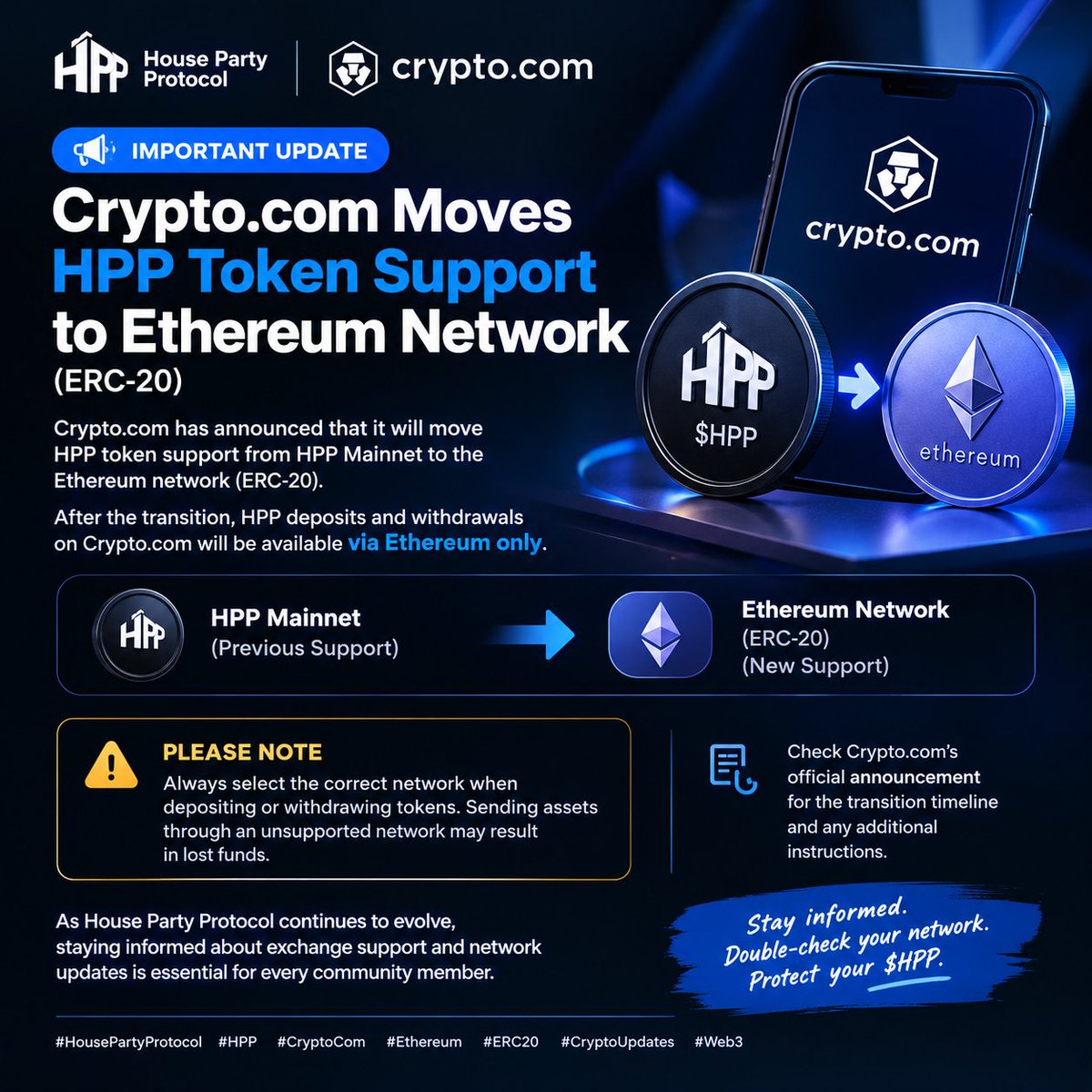
Important update for the $HPP community!
@cryptocom has announced that it will move HPP token support from HPP Mainnet to the Ethereum network (ERC-20).
Following this transition, HPP deposits and withdrawals on Crypto com will be available **via Ethereum only.
This is an important update for everyone holding or transferring $HPP through https://t.co/SGSkZATaot. Make sure you understand the network change before making any transactions.
➩ Always select the correct network when depositing or withdrawing tokens. Sending assets through an unsupported network may result in lost funds. Check https://t.co/SGSkZATaot’s official announcement for the transition timeline and any additional instructions.
As House Party Protocol continues to evolve, staying informed about exchange support and network updates is essential for every community member.
Stay informed. Double-check your network. Protect your $HPP.
#HousePartyProtocol #HPP
𝐈𝐦𝐚𝐠𝐢𝐧𝐞 𝐬𝐢𝐭𝐭𝐢𝐧𝐠 𝐝𝐨𝐰𝐧 𝐟𝐨𝐫 𝐚 𝐧𝐨𝐫𝐦𝐚𝐥 𝐜𝐚𝐬𝐢𝐧𝐨 𝐬𝐞𝐬𝐬𝐢𝐨𝐧, 𝐭𝐡𝐞𝐧 𝐬𝐮𝐝𝐝𝐞𝐧𝐥𝐲 𝐊𝐞𝐯𝐢𝐧 𝐇𝐚𝐫𝐭 𝐬𝐡𝐨𝐰𝐬 𝐮𝐩 𝐚𝐧𝐝 𝐭𝐮𝐫𝐧𝐬 𝐭𝐡𝐞 𝐰𝐡𝐨𝐥𝐞 𝐞𝐱𝐩𝐞𝐫𝐢𝐞𝐧𝐜𝐞 𝐢𝐧𝐭𝐨 𝐚 𝐜𝐨𝐦𝐞𝐝𝐲 𝐬𝐡𝐨𝐰!
Well, @parimatch is bringing that energy with the Pragmatic Play × Kevin Hart campaign, running from October 19 to November 7, 2026.
And there's more to it than just Kevin making an appearance. 👀
𝐀𝐂𝐓 𝟏: 𝐓𝐇𝐄 𝐖𝐎𝐑𝐃 𝐇𝐔𝐍𝐓 (𝐎𝐜𝐭 𝟏𝟗–𝐍𝐨𝐯 𝟐)
Play eligible games and look out for letters spelling PLAY in participating Live Casino games or KEVIN in selected slots. Complete the word, pick a chest, and see whether it reveals Free Chips.
𝐀𝐂𝐓 𝟐: 𝐁𝐄𝐓 𝐖𝐈𝐓𝐇 𝐊𝐄𝐕𝐈𝐍 (𝐍𝐨𝐯 𝟐–𝟕)
Eligible bets in selected Live Casino games can give players a chance to receive Free Chips, redeemable from November 6.
𝐀𝐂𝐓 𝟑: 𝐊𝐄𝐕𝐈𝐍 𝐌𝐀𝐊𝐄𝐒 𝐈𝐓 𝐑𝐀𝐈𝐍 (𝐍𝐨𝐯 𝟔–𝟕)
The man himself joins Pragmatic Play's Live Casino hosts for special live sessions, with additional prizes during the event.
The campaign advertises a €1,250,000 promotional prize pool across the campaign. That doesn't mean everyone wins, though Free Chips and prizes are subject to the official rules and eligibility requirements.
𝐓𝐡𝐞 𝐅𝐫𝐞𝐞 𝐂𝐡𝐢𝐩𝐬 𝐜𝐚𝐧 𝐛𝐞 𝐮𝐬𝐞𝐝 𝐨𝐧 𝐩𝐚𝐫𝐭𝐢𝐜𝐢𝐩𝐚𝐭𝐢𝐧𝐠 𝐊𝐞𝐯𝐢𝐧’𝐬 𝐏𝐢𝐜𝐤𝐬 𝐠𝐚𝐦𝐞𝐬, 𝐢𝐧𝐜𝐥𝐮𝐝𝐢𝐧𝐠 𝐌𝐞𝐠𝐚 𝐖𝐡𝐞𝐞𝐥, 𝐀𝐦𝐚𝐳𝐢𝐧𝐠 𝐁𝐚𝐜𝐜𝐚𝐫𝐚𝐭, 𝐆𝐚𝐭𝐞𝐬 𝐨𝐟 𝐎𝐥𝐲𝐦𝐩𝐮𝐬 𝐑𝐨𝐮𝐥𝐞𝐭𝐭𝐞, 𝐌𝐞𝐠𝐚 𝐑𝐨𝐮𝐥𝐞𝐭𝐭𝐞, 𝐌𝐨𝐧𝐞𝐲 𝐓𝐢𝐦𝐞, 𝐚𝐧𝐝 𝐒𝐰𝐞𝐞𝐭 𝐁𝐨𝐧𝐚𝐧𝐳𝐚 𝐂𝐚𝐧𝐝𝐲𝐋𝐚𝐧𝐝.
Honestly, the Kevin Hart crossover is an unexpected way to bring comedy and live casino entertainment together.
Would you be watching for Kevin's appearance or checking out how the campaign works?
@PragmaticPlay@parimatch@KevinHart4real
#Parimatch #KevinHart