They are absolutely a perfect match!! Their steps are almost perfectly synchronized and it's amazing! Father and daughter's breathing is completely synchronized! Dancing!! Bravo! 👏👏👏👏👏👏👏
Focus on what you can control.
Build something. Anything.
A product. Yourself. A family. Your community. A team. Relationships.
Or help someone else build theirs.
Don’t complain. Don’t play the victim.
Ever.
What are you building?
#PlayNiceButWin
An MIT professor taught the same math course for 62 years, and the day he retired, students from every country on earth showed up online to watch him give his final lecture.
I opened the playlist at 2am and ended up watching three of them back to back.
His name is Gilbert Strang. The course is MIT 18.06 Linear Algebra.
Every machine learning engineer, every data scientist, every quant, every self-taught programmer who actually understands how AI works learned the math from this one man. Most of them never set foot on MIT's campus. They just opened a free playlist on YouTube and let him teach.
Here's the story almost nobody tells you.
Strang joined the MIT math faculty in 1962. He retired in 2023. That is 61 years of standing at the same chalkboard teaching the same subject to 18-year-olds.
The interesting part is what he did when MIT launched OpenCourseWare in 2002. Most professors were skeptical. They worried that putting their lectures online would make their classrooms irrelevant. Strang did not hesitate. He said his life's mission was to open mathematics to students everywhere. He filmed every lecture and gave it away.
The decision quietly changed how the world learns math.
For decades linear algebra was taught the wrong way. Professors started with abstract vector spaces and proofs about field axioms. Students drowned in the abstraction. Most never recovered. They walked out believing they were bad at math when they had simply been taught in an order that nobody's brain is built to absorb.
Strang inverted the entire curriculum.
He started with matrix multiplication. Something you can write down on paper. Something you can compute by hand. Something you can see. Then he showed his students that everything else in linear algebra eigenvectors, singular value decomposition, orthogonality, the four fundamental subspaces was just a different lens for understanding what the matrix was actually doing under the hood.
His rule was strict. If a student could not explain a concept using a concrete 3 by 3 example, that student did not actually understand the concept yet. The abstraction was supposed to come last, not first. The intuition was the foundation. The proofs were just confirmation that the intuition was correct.
The second thing Strang changed was the classroom itself. He said please and thank you to his students. Every single lecture. He paused mid-derivation to ask "am I OK?" to check if anyone was lost. He never used the word "obviously" or "trivially" because he knew exactly what those words do to a student who is one step behind. He treated 19-year-olds learning math for the first time the way he treated his own colleagues. With patience. With respect. With the assumption that they belonged in the room.
For 62 years.
The result is something that has never happened in the history of education. A single math professor became the default teacher of his subject for the entire planet.
Universities in India, China, Brazil, Nigeria, every country with a computer science department, started telling their own students to just watch Strang's lectures. The University of Illinois revised its linear algebra course to do almost no in-person lecturing. The reason was honest. The professor said they could not compete with the videos.
His final lecture was in May 2023.
The auditorium was packed with students who had never met him before. He walked to the chalkboard, taught for an hour, and at the end the entire room stood and applauded. He looked confused for a moment, like he genuinely did not understand why they were cheering. Then he smiled and waved them off and walked out.
His written comment under the YouTube video of that final lecture was four sentences long. He said teaching had been a wonderful life. He said he was grateful to everyone who saw the importance of linear algebra. He said the movement of teaching it well would continue because it was right.
That was it. No book promotion. No farewell speech. No legacy management.
The man whose teaching is the foundation of modern AI just thanked the audience and went home.
20 million views. Zero ego. The entire engine of the AI revolution sits on top of math that millions of people learned for free from one quiet professor in Cambridge.
The course is still on MIT OpenCourseWare. Every lecture, every problem set, every exam, every solution. Free.
The most important math course of the 21st century is sitting one click away from you. Most people will never open it.
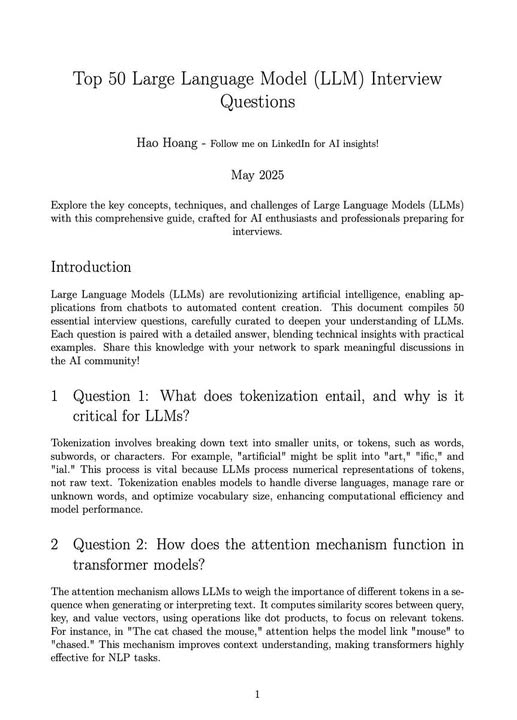
🚨 GOOGLE, META, OPENAI etc. BIG TECH are REJECTING JOB CANDIDATES BEFORE EVEN THEY FINISH TALKING.
50 LLM QUESTIONS. IF YOU CAN'T ANSWER THEM, THE INTERVIEW ENDS BEFORE IT STARTS.
The people passing these interviews are walking out with $200k+ offers.
Someone just LEAKED THE EXACT LLM INTERVIEW QUESTIONS these companies are asking right now.
And the gap between people who know these answers and people who do not is already costing careers.
Here is every category you need to know:
The Basics they always ask first:
↳ How does tokenization work and why does it matter
↳ How does attention actually work inside a transformer
↳ What is a context window and what breaks when it gets too big
↳ What are embeddings and how do they get initialized
↳ How does the model know word order without reading left to right
The fine-tuning questions that eliminate 80% of candidates:
↳ What is LoRA and why is it better than full fine-tuning
↳ What is QLoRA and when do you use it instead
↳ How do you fine-tune a model without making it forget everything it already knows
↳ What is model distillation and why do companies use it
↳ How do you handle vocabularies with millions of possible words
The generation questions most people guess on:
↳ Beam search vs greedy decoding, which one and when
↳ What temperature actually does to model output
↳ The difference between top-k and top-p sampling
↳ Why autoregressive models work differently from masked models
The advanced concepts that separate good from great:
↳ How RAG works and why it beats fine-tuning for factual accuracy
↳ Why Chain-of-Thought prompting makes models dramatically smarter
↳ What Mixture of Experts is and why every frontier model uses it now
↳ Zero-shot vs few-shot learning and when each one wins
The math questions that make people sweat:
↳ Why softmax is used inside attention and not something simpler
↳ What cross-entropy loss actually measures
↳ What KL divergence is and where it shows up in AI training
↳ Why vanishing gradients were destroying transformers and how they fixed it
If you are applying for any AI role in 2026 and you cannot answer at least 40 of these, you are not ready yet.
The full list of 50 questions is worth printing out and going through one by one.
Save this post. Your next interviewer has almost certainly pulled from this exact list.
This 25-minute talk by Anthropic's own applied AI team on how to use MCPs correctly
teach you more about making your AI tools actually work together than everything you've scrolled past this year.
Bookmark this & watch, no matter what.
Then read the guide below.
Dois engenheiros da Anthropic acabaram de mudar a forma como devs pensam sobre IA.
Barry Zhang e Mahesh Murag subiram no palco do AI Engineer Code Summit e disseram uma frase que incomodou muita gente:
"Parem de construir agentes. Construam Skills."
Em 16 minutos eles provam que a indústria inteira está resolvendo o problema errado.
Aqui está o que a maioria não entendeu:
→ Skills são pastas. Literalmente pastas com arquivos markdown.
→ Elas ensinam ao Claude o SEU fluxo de trabalho, a SUA expertise, o SEU domínio.
→ Um único agente genérico + biblioteca de Skills específicas supera dezenas de agentes especializados.
→ Fortune 100s já estão deployando Skills em escala pra ensinar agentes sobre processos internos.
→ Times de produtividade com 10.000+ devs usam Skills pra padronizar como código é escrito.
A analogia que eles usaram é perfeita:
Quem você quer fazendo seu imposto de renda? O gênio com QI 300 que nunca viu legislação tributária, ou o contador experiente que faz isso há 20 anos?
Inteligência sem expertise é entretenimento.
Expertise empacotada é produtividade.
O que mudou: a Anthropic parou de tentar criar agentes diferentes pra cada domínio.
Perceberam que com Claude Code, o padrão é sempre o mesmo. Um modelo acoplado a um runtime com filesystem.
A diferença entre um agente medíocre e um extraordinário não é o modelo. É o conhecimento de domínio que você alimenta.
Skills resolvem isso com progressive disclosure. O agente só carrega o nome e descrição da skill. Quando relevante, puxa o SKILL.md. Quando precisa de mais, navega os arquivos de referência. Zero desperdício de contexto.
Isso não é uma feature. É uma mudança de paradigma.
Quem entender isso agora vai operar em outro nível daqui a 90 dias.
Quem ignorar vai continuar escrevendo prompts de mil palavras toda vez que abrir o chat. E ainda explicar de novo e de novo o que “realmente” quer.
Every time you accepted a salary, chose a price, or walked into a negotiation, the other person was running GAME THEORY in their head.
You were guessing.
This 1-hour Yale lecture by Professor Ben Polak will permanently change how you read people and make decisions.
Most MBAs pay $150k to learn this. Yale posted it for free:
This 2-hour Stanford University lecture will teach you more about how LLMs like ChatGPT & Claude are built than most people learn in their entire careers.
Most people will scroll past this.
Big mistake.
Because this isn’t surface-level AI content it breaks down how these models actually work, from the ground up, in a way that finally clicks.
No hype. No fluff. Just real understanding.
If you’ve ever used ChatGPT or Claude and wondered “what’s actually happening behind the scenes?” this is the answer.
Bookmark this.
Give it 2 hours today, no matter what.
It might be the most productive thing you do this week.
This 2 hour Stanford lecture will teach you more about how LLMs like ChatGPT & Claude are built than most people working at top AI companies learn in their entire careers.
Bookmark this & give 2 hours today, no matter what. It'll be the most productive thing you do this week.
This 2 hour Stanford lecture shows exactly how Stanford trains it's engineers to build AI systems. It's more practical than every Claude tutorial & prompting threads you've seen.
Bookmark & give it 2 hours, no matter what. It'll be the most productive thing you do this weekend.
In 2007, Stanford professor Joel Peterson gave a 1 hour masterclass on how to negotiate & get what you want.
His ideas:
- Worst position is needing the deal
- Trust beats manipulation in long term
- Great negotiators think in relationships
12 lessons to negotiate better:
This 50 minute lecture from Jeff Bezos in 2005, before AWS, before Kindle, before Prime took over, will teach you more about building revolutionary products than a $150,000 MBA.
Bookmark this & give it 50 minutes today. It’s the most productive thing you can give your morning.
Steve Jobs on what John Sculley didn’t understand about building great products
“One of the things that really hurt Apple was, after I left, John Sculley got a very serious disease. And that disease—I’ve seen other people get it too—is the disease of thinking that a really great idea is 90% of the work.”
But that’s never the case. As Steve explains, a product idea never turns out as originally conceived because you learn a lot from the details of building it, and there are always tradeoffs you have to make.
“There’s a tremendous amount of craftsmanship between a great idea and a great product… and it’s that process that is the magic.”
He compares a team working hard on something they’re passionate about to a rock tumbler:
“It's through the team--through a group of incredibly talented people--bumping up against each other, having arguments, having fights sometimes, making some noise, and working together... they polish each other and polish the ideas. And what comes out are these really beautiful stones.”
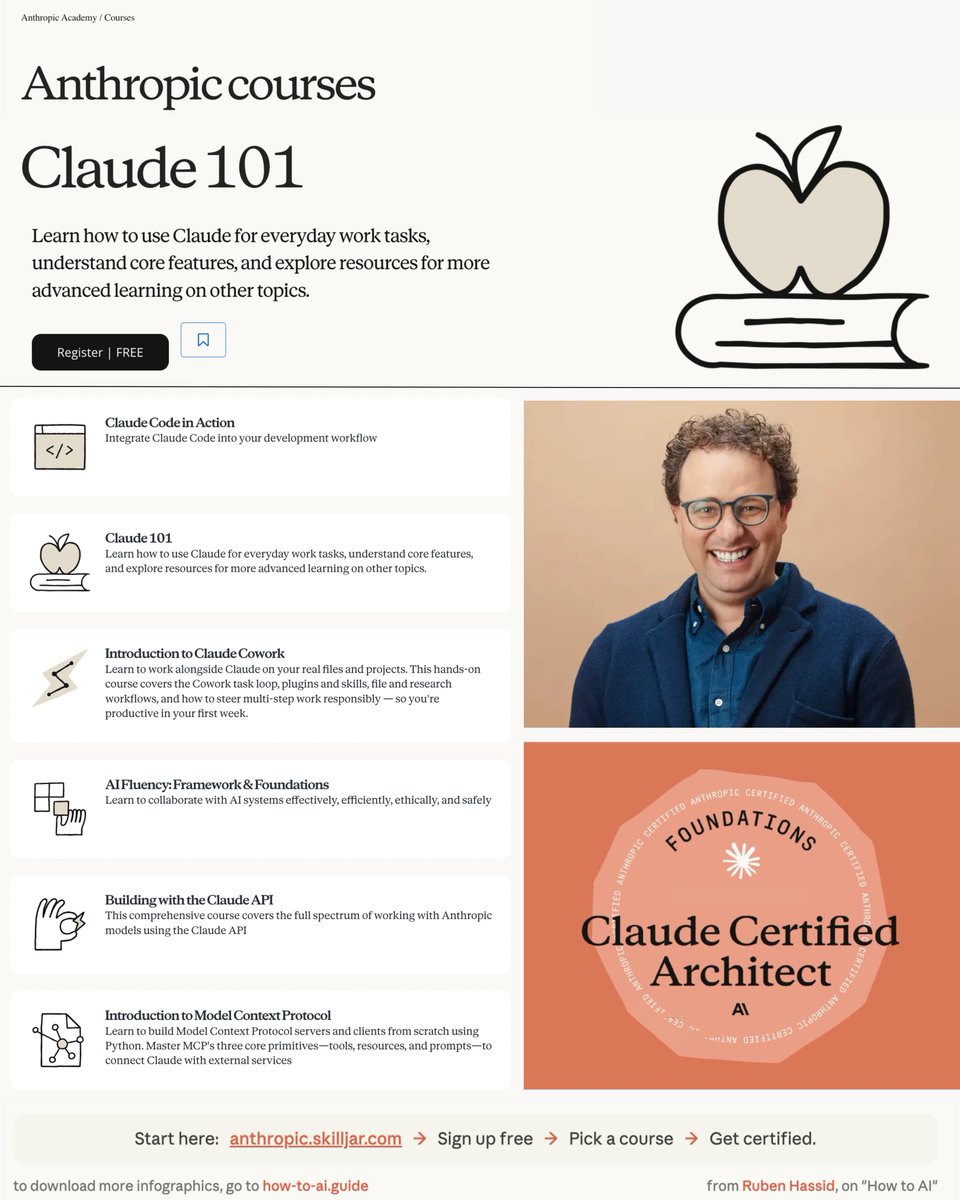
Claude is offering 13 AI courses & certificates.
All free. Here are all 13 links (+ my own guides):
1. Go to each link below. Enroll. It's free.
2. But honestly? My newsletter covers it better.
3. I'll explain at the end. Start with the official ones:
---
1 - Claude 101. Learn Claude for everyday work.
↳ https://t.co/OvBmlvnVqL
2 - AI Fluency: Frameworks & Foundations.
↳ https://t.co/cObZdwCmXP
3 - Introduction to Agent Skills.
↳ https://t.co/wZsD0PxJwi
4 - Building with the Claude API.
↳ https://t.co/RcCbfNjlzz
5 - Claude Code in Action.
↳ https://t.co/y29CC0GBaN
6 - Intro to Model Context Protocol.
↳ https://t.co/Qnrn0NHxyI
7 - MCP: Advanced Topics.
↳ https://t.co/0S5f4kESzG
8 - AI Fluency for Students.
↳ https://t.co/YIOopqo7WB
9 - AI Fluency for Educators.
↳ https://t.co/54oLlYjLGD
10 - Teaching AI Fluency.
↳ https://t.co/fHdgs6uNDM
11 - AI Fluency for Nonprofits.
↳ https://t.co/xFKngNz09m
12 - Claude with Amazon Bedrock.
↳ https://t.co/dV6xi7UiaL
13 - Claude with Google Cloud's Vertex AI.
↳ https://t.co/MEzAxODPW4
---
Official courses are good. But they're theoretical.
I wrote how-to guides that show you what to do.
Here's how to master Claude (for free):
1. Start here: https://t.co/jw2qdIcjnh
☑ The basics of Claude.
☑ How to prompt it the right way.
☑ The different types of Claude to master.
2. Move to Cowork: https://t.co/uWTpOI3Woc
☑ The more advanced Claude is Claude Cowork.
☑ How to prompt it and set it up properly.
☑ It's a long process. But worth every minute.
3. Set up Claude for teams: https://t.co/qxlcqhf8bM
☑ Setting up Claude for teams is different.
☑ This is the easiest 5-day plan I could find.
☑ 5 steps so your team runs on Claude in a week.
4. Use Claude Skills: https://t.co/jT4uB5Bdjw
☑ Stop prompting, build your first skill.
☑ 7 favourite hacks of Claude Skills.
☑ Access Claude's team skills.
5. Claude Computer: https://t.co/TxYuHPjgbV
☑ Access Claude Computer.
☑ Use cases of Claude Computer.
☑ Schedule tasks with Claude.
6. Claude Code: https://t.co/WYZd5ltVMW
☑ English is the new code.
☑ Code 100x faster.
☑ Prompt Claude Code the right way.
7. Bonus (to go even deeper).
☑ Claude for Excel.
☑ Claude interactive charts.
☑ How to move from ChatGPT to Claude.
---
All of this is free. Here's how to get it:
1. Go to https://t.co/psB7XxB2Y4. Add your email.
2. A pop-up will ask you to pay. Do not pay.
3. Open my welcome email & enjoy the free guides.
431,000+ people read it weekly. Join them.
♻️ Repost this so others get free AI education.
🚨 In 1992, a MIT lecture quietly revealed more about product and sales than most 2-year MBAs ever will.
Most people have never seen it.
It came from Steve Jobs and instead of teaching theory, he broke down how great products actually win.
Watching it today feels unreal.
He explained that people don’t buy products they buy meaning. The best products aren’t just functional, they connect with how people see themselves. That’s why some ideas spread effortlessly while others die, even if they’re technically better.
He also made it clear that marketing isn’t about features. It’s about clarity. If you can’t explain why your product matters in simple terms, it won’t matter at all. Complexity doesn’t impress it confuses.
And his biggest edge? Obsession with experience. Not just what the product does, but how it feels. The small details, the simplicity, the story that’s what separates good from unforgettable.
That’s why this MIT lecture still hits hard.
Because while most people are building products…
Very few understand why people actually buy them.
May 16, 1963. Gordon Cooper was orbiting Earth alone inside a capsule barely big enough to turn around in, moving at 17,500 miles per hour.
He had been up there for over a day.
Then the warnings started.
First a faulty sensor screaming that the ship was falling — it wasn't. He switched it off. Then something far worse: a short circuit knocked out the entire automated guidance system. The one that kept the capsule steady. The one that was supposed to bring him home.
Without it, reentry was nearly impossible.
Too shallow an angle and the capsule would bounce off the atmosphere back into space. Too steep and it would incinerate. The margin for error was razor thin — and every computer that was supposed to hit that margin was dead.
Down on the ground, NASA engineers watched the telemetry in silence. They could see everything going wrong. They could fix nothing.
Cooper didn't panic.
He uncapped a grease pencil and drew lines directly on the inside of his window to track the horizon. He looked up at the stars he had spent months memorizing and used their positions to orient the ship by eye. Then he set his wristwatch.
Because when you have no computers left, you become the computer.
At exactly the right moment — calculated in his head, confirmed by the stars outside — he fired the retrorockets. The capsule shook. The sky turned to fire. For several minutes, no one on Earth could reach him as plasma swallowed the ship whole.
Then the parachutes opened.
Faith 7 hit the water just four miles from the recovery ship — the single most accurate splashdown in the entire Mercury program.
The man with a wristwatch and a few pencil marks on a window had outperformed every automated system NASA had.
We talk a lot about technology saving us. And it often does.
But Cooper's story is a quiet reminder that behind every machine, there still has to be a human being who can look out the window, think clearly under pressure, and decide what to do next.
The final backup was never the software.
It was him.
Last month, Apple News showcased over 400 articles from left-leaning outlets while posting zero from right-leaning ones.
I am demanding answers from Tim Cook for this blatant bias against conservatives. Under President Trump, the era of Big Tech censorship is over.