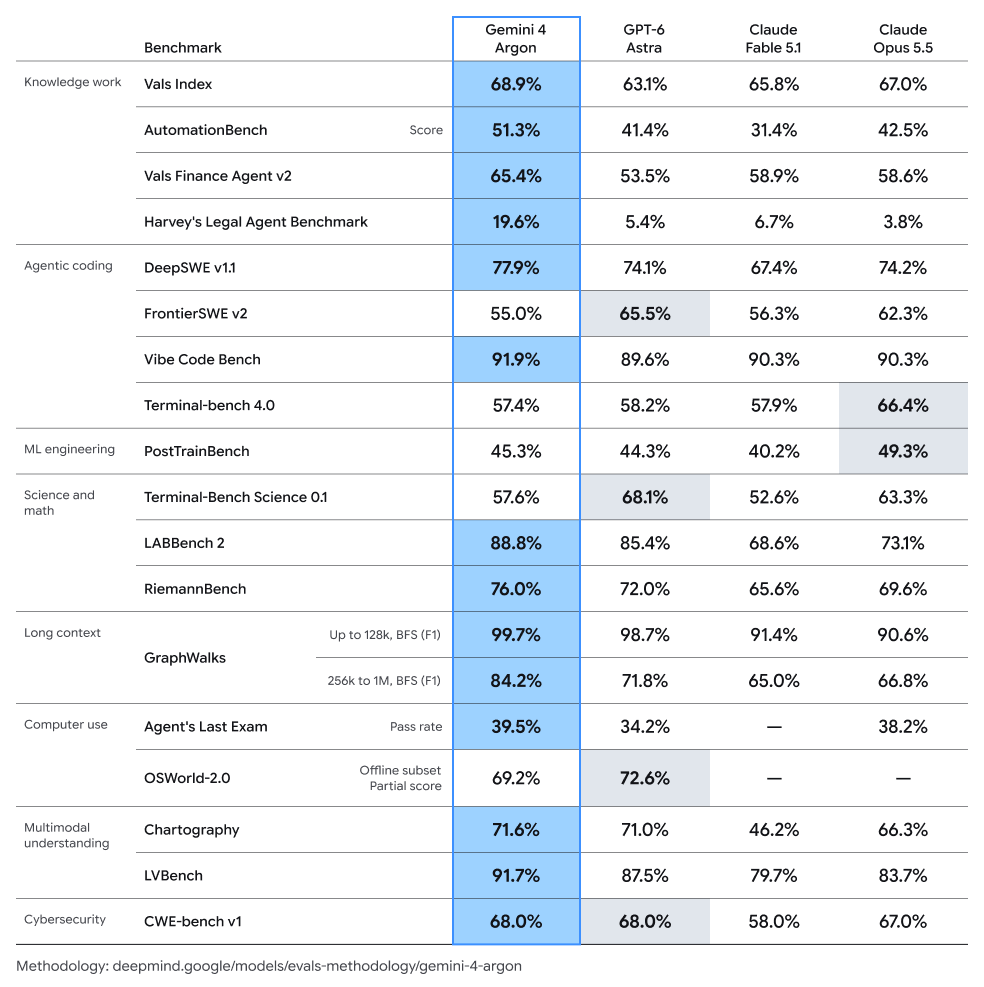
Lots of discussion out there about our next model(!), so I wanted to give an early look as soon as possible. Introducing Gemini 4 Argon!
It shows frontier performance in complex workflows, cyber defense and software engineering. Teams are using it extensively at Google, from coding to quantum computing, great feedback.
Here’s a look at the benchmarks:
Satya Nadella on Microsoft's CapEx and CoPilot:
"We are calibrating our CapEx in such a way that we don't want to build for 1 or 2 customers, we want to build for the long tail because I think that's the most important. If you are a hyperscaler, you're not a supplier to 2 model companies, that's not a business. You have to sort of build a system that is great for lots of third parties and our own 1P. In that context, we are pretty thrilled with the progress we are making even with CoPilot if you look at the subscriber number we gave. These are real enterprises using it for real workflows."
Via @theallinpod
$MSFT $GOOGL $AMZN $META
Last month I wrote about how we can build a positive and safe future for everyone: https://t.co/eoLGVY8yad
Every lab has the responsibility and incentive to move at the pace required to train its models safely, and the ability to take its own actions to ensure that happens.
The reality is:
- People won't want to use agents that are misaligned with them and that don't do what they ask, so labs have a strong natural incentive to make their models more aligned.
There is a lot of debate about slowing progress on capabilities until alignment catches up. My view is that trust and alignment are quickly becoming the most important capabilities that will differentiate agents and models. Any lab that doesn't focus on alignment will fall behind.
- Labs face significant liability if their models cause harm, so they have a strong incentive to prevent this as well.
Meta delayed shipping Muse for several months to focus on safety and security. We didn't call for everyone else to do this before we would. We just did it as part of our day-to-day work because it was clearly the right thing for people and for us. I'm proud of the security foundations we've built.
- Engaging independent evaluators and advisors is industry best practice. MSL already does this today in several areas because it helps produce better work. Other labs can just do this too. In general, it would be helpful for there to be a larger and more diverse ecosystem of evaluators.
- Committing the significant majority of compute towards serving people rather than racing towards recursive self-improvement is one of the best ways to ensure we develop this technology safely. Meta has made this commitment and other labs can do this as well.
I believe the key to building a positive future for everyone is maintaining the right balance of power. This is within our power to do.
There are two ways AI progress could go very badly and that we must avoid.
First, we could lose control of the future to AI. This is unacceptable; we are unapologetically on Team Humanity, and AI must always serve people. To ensure that, we need ways to ensure that alignment and safety techniques stay ahead of progress in model capabilities.
Second, we could end up in a world with too much concentration of power. If an extraordinarily powerful AI is used by one person or company to impress their worldview onto everyone else, the results could be extremely dystopian.
Avoiding these two threats requires walking a narrow middle path; for example, one country could gain too much power. Another example is one lab ending up with too much power.
The world deserves confidence that American companies developing increasingly capable AI will act responsibly, especially as the trajectory of progress has steepened. Every frontier lab must deliver on this, and there is no reason any of us should come to work if we cannot.
We welcome a federal framework that sets consistent safety requirements for frontier AI. But we do not believe we need to wait for an anti-trust exemption or legislation to begin the work of providing this confidence. Consistent rules to manage frontier risk so that we can maximize the benefits are a good idea (and we are excited by ideas like independent auditors).
Years ago, companies like ours developed things like Responsible Scaling Policies and Preparedness Frameworks. Those were good for that moment, and focused primarily on the deployment of completed models, not what happens during their development process.
Today's shift to focusing on safe development and evaluation will need new tools. For example, at OpenAI we now formulate explicit safety cases in advance of frontier reinforcement learning runs we expect to significantly increase capability, in addition to the safety work we have long done in advance of model releases.
We hope that other companies will learn from our approaches and propose their own; we think shared standards for misalignment, monitoring, and safety will lead to better outcomes. We look forward to collaborating with our colleagues across the industry to formulate the best version of these.
When we talk about “pacing”, we do not mean “stopping”. Progress has been rapid and will continue to be. But it should be slower than it otherwise could be; interventions like safety cases and monitoring have significant costs.
Pacing will be well worth this cost; no amount of American competitive pressure should justify recklessness, or let capabilities get ahead of alignment and monitoring.
Where we will need the help of our government is for international coordination. But first we should do what we can ourselves.
Any pursuit of superintelligence has to be grounded in the core principle that if the AI we build is not helping humanity and under human control, it's not worth pursuing.
We also need to accelerate and spread the benefits of AI, such that they are diffused broadly across countries, communities, and companies. This requires a frontier ecosystem in which both closed and open-source models can thrive.
And for firms, it’s imperative that they retain full control over their unique and tacit knowledge. Every organization should be able to build its own continuous learning loop/hill climbing machine, without becoming dependent on any one model provider, and have the ability to embed its own knowledge into models and weights they control.
So, in this context, we welcome the research, focus, and deliberate pacing needed to get alignment right as the design goal. We also welcome ideas like "embedded evaluators" and the broader efforts to develop the mechanisms to make this more than just talk.
The key is that this cannot be controlled by a handful of entities, but must have broad representation across the ecosystem, countries, and fields, including academia.
This is the approach we are taking: broad access and choice at every layer of the AI stack; enterprise control of learning loops and models; and the “Code of Conduct” that underlies our own first party MAI models that we’ll publish tomorrow for public consultation.
We Must Pace the Frontier: I’ve written a new essay on why the AI industry should slow down, with a three-part plan for doing so.
Anthropic is unilaterally committing to the first of these steps. We’ll provide third-party evaluators with permanent, employee-level access to our systems, so that they can verify adherence to our safety measures, report on incidents, and assess models’ alignment during training.
You can read the full post here: https://t.co/OGyPb7yaYt
Why is this guy @fundstrat not getting fact checked. Promoting $ETH should be $12K per 8 yr avg in his videos. Dude, that’s when $BTC hits $250K. Wondering 🤔 if honest mistake (awwww, he doesn’t know it) or ???? @CNBC I expect better from U $BMNR
@narendramodi@MarkJCarney Honourable @narendramodi ji, this is great news. Indian diaspora is very much looking forward to your visit & wish for a very strong partnership between India & Canada. Love from 🇨🇦. Congratulations @MarkJCarney on mending ties between two great nations, world’s best democracies.