An International Multicultural Intergenerational Organization Educating about Nonviolence & Much More Established in 2001,Incorporated as Nonprofit Org. in 2018
“Sometimes if we remember to look, the right message, on the right day, at the right time, is right there in front of us!” - Mr. Lindy Peter Crescitelli ( @LindyPeterC ) #LearnLeadServe :
#OnThisDay in 1960, four Black freshmen students from North Carolina A&T — Franklin McCain, Joseph A. McNeil, David L. Richmond and Ezell A. Blair Jr. — began to ask themselves what they were going to do about discrimination.
“At what point does a moral man act against injustice?” McCain recalled.
McNeil spoke up. “We have a definite purpose and goal in mind,” he said, “and with God on our side, then we ask, ‘Who can be against us?’”
That afternoon, they entered Woolworth’s in downtown Greensboro. After buying toothpaste and other items inside the store, they walked to the lunch counter and sat down.
They ordered coffee, but those in charge refused to serve them. The students stood their ground by keeping their seats.
The next day, they returned with dozens of students. This time, white customers shouted racial epithets and insults at them. The students stayed put. By the next day, the number of protesting students had doubled, and by the day after, about 300 students packed not just Woolworth’s, but the S.H. Kress Store as well.
A number of the protesting students were female students from Bennett College, where students had already been gathering for NAACP Youth Council meetings and had discussed possible sit-ins.
By the end of the month, 31 sit-ins had been held in nine other Southern states, resulting in hundreds of arrests. The International Civil Rights Center & Museum has preserved this famous lunch counter and the stories of courage of those who took part in the sit-ins.
https://t.co/qC7ZleyD0W
26 year old Langston Hughes at Lincoln University in 1927 (he attended 1926-1929)
—Born in Joplin, Missouri February 1, 1901 James Mercer Langston Hughes had already spent two years in Paris working as a busboy in a Montmartre restaurant owned by WWI pilot Eugene Jacques Bullard. It was in that club he first heard the music of Black American jazz greats who fled to France following the war. One of the earliest innovators of “jazz poetry”, Hughes is best known as the Poet Lauréat of the Harlem Renaissance. Hughes died May 22, 1967 in NYC.—
The Brotherhood of Sleeping Car Porters, led by A. Philip Randolph and made up of porters employed by the Pullman Company, was the first Black-led union to secure a contract with a major U.S. company. Fighting low wages and harsh conditions, these men paved the way for labor and civil rights victories that reshaped America. Here’s a look back at one of their triumphant fights—that began in 1934—for better working conditions. #BlackHistoryMonth
🎥: WTTW News, Chicago Stories, 2001
On this day, 65 years ago, the Greensboro Sit-in began — a pivotal moment in the fight for civil rights and proof of the power of nonviolent resistance.
President Lyndon B. Johnson signed the Voting Rights Act, outlawing the discriminatory voting practices adopted in many southern states after the Civil War, including literacy tests as a prerequisite to voting, #OTD in 1965.
Today marks the 70th anniversary of the historic Brown v. Board of Education ruling, which stated that "separate but equal" is never equal. This page from @FacingHistory features 6 resources to aid in students learning about this landmark decision: https://t.co/zDCb5vtHgJ
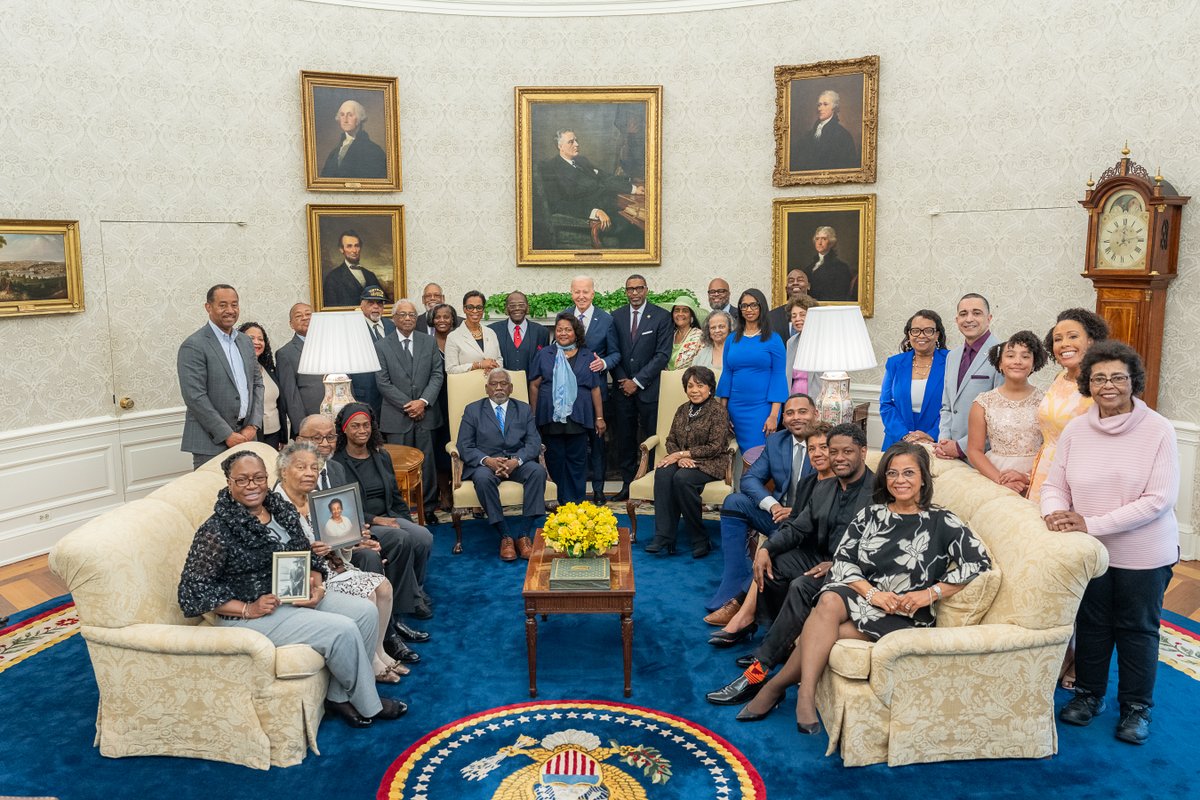
70 years after the Supreme Court ruled in Brown v. Board of Education that 'separate but equal' was unconstitutional, I welcomed plaintiffs and their families to the People’s House.
We haven't lived up to our founding promise of equality – but we're not walking away from it.