@badlogicgames The limits currently feel so generous with Opus 5.5. My favourite way to use Codex now is by having Opus invoke it directly for red-team reviews and second opinions.
@yunta_tsai I still remember being blown away when I was introduced to Mass Effect for the first time. Had never had a gaming experience like that before.
@ConnorEllison They follow you but they follow their own paths for jumps. I had to ask opus to fix a few bugs where they would fall into the water or get stuck in the air.
As an experiment, I had Opus 5.5 one-shot two "obby"-style games for me. In one, you lead a team of koalas, and the second is an animal parkour game. It's crazy how much better the models have gotten at this over the year.
@joshmillgate Just have your Claude or preferred agent build something off of whisper.cpp. It runs really well on Macs but can even scale down to Android phones.
@badlogicgames I still remember when I was introduced to Mass Effect and was completely blown away. The music, gameplay and story were top notch. I still haven't come across a new series that has had quite the same effect on me.
@leoleotoobad I wouldn't say it's unreliable so much as that the reviewers have a narrow focus -- and you need someone to manage that. It's not so dissimilar to a human workplace where you have to triage what the QAs report.
We'll be spending a lot more time trying to understand the outputs of language models. A few thoughts, tips & tricks:
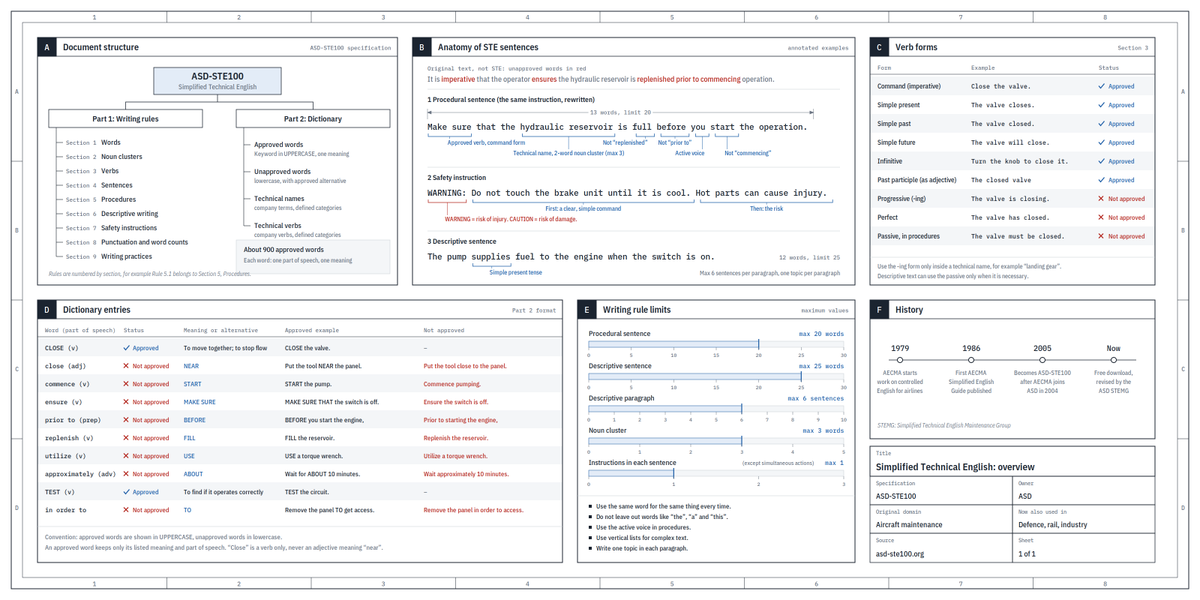
Writing. Something I've had success with: Ask your LLM to explain something in ASD-STE100, it's a controlled language specification originally developed for aerospace maintenance documentation. LLMs well-versed in this language and it comes with heavy constraints on clean writing style that I often find a lot more readable. Sometimes I've tried to soften it a bit e.g. ask for "80% of the way to ASD-STE100" because the spec is quite stringent. But even better:
Diagrams / images. Instead of writing, ask your LLM to create a diagram. These can be a lot easier to process, parse, and understand. But even better:
Web pages. Ask for output "in HTML" to get a beautiful, interactive webpage. LLMs are getting really good at frontend and can create beautiful experiences, animations, etc. But even better:
Explainer videos. The output format I am most bullish on is fully custom / bespoke explainer videos generated on any arbitrary topic. Experiment with things like "Create a 3b1b style video explainer on X. Use my ElevenLabs API key for audio narration". (you'd need an API key for the latter or you can ask your LLM to find you decent free alternatives that use your local compute). This is actually starting to work!
In summary:
- As LLMs get better, they will do more and more of the legwork autonomously, and a lot more of our work will rise up the abstractions into oversight and understanding.
- Luckily, LLMs can help here too because as intelligence and code are increasingly abundant, you can ask for large, custom, discardable software artifacts (e.g. web apps, video explainers) that would have never made sense to create before. Push the boundaries here and you'll be surprised.
My dear friends, I’d like to show you my latest toy project
Introducing Handwired: turn your regular JavaScript code into a neural net!
- no training
- exact outputs vs the JS program
- fully differentiable
All runnable in a browser, without GPU
@Ashutosh_Sidh I do less manual writing, but a lot more review and architectural design. I would say it's shifted. The current consensus is that writing is thinking, so AIs shouldn't write for us; maybe the same is still true of code.
@dwlz When carpenters got access to better tools, houses started looking more similar to each other, and with less charm and craftsmanship. Hopefully the same doesn't happen in software dev.
@samongaro_ AIs will give you the median taste, and if you don't have good design chops yourself, you'll rely on the AI to tell you what is good or not. A designer will give you their particular vision and experience. Nothing stops the designer themselves from using AI in their work.
@feifei_qiu Two truths which I've learned:
a) It's better to ship quickly and learn from feedback, rather than try to get everything right the first time.
b) It's better to ship less, but make that "less" work well. People will appreciate that more than a grabbag of features.