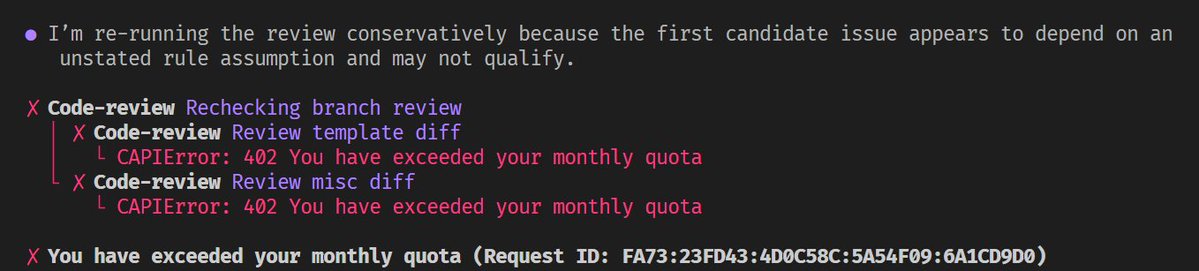
🦔GitHub Copilot switched to token-based billing this morning and users are already out of credits. Pro+ subscribers paying $39 a month are reporting 60% of their credits gone in two hours of normal use. One user lost 20% of their allowance from a single file review with no code changes. Another hit their monthly cap before the calendar even flipped to June.
Orgs with shared token pools have no way to see individual usage, so entire teams get cut off when one person runs a heavy prompt. Users are canceling and moving to Claude Code and Codex. GitHub community forums are on fire.
My Take
Flat-rate AI subscriptions were always subsidized. Everyone in the industry knew it. Today the subsidy ran out for a few million developers at once. The problem is a lot of companies already restructured around these tools. They cut headcount and told remaining engineers to lean on Copilot instead of building skills internally. Those companies now depend on a tool whose cost just became unpredictable and whose usefulness completely changes when you have to ration prompts to stay under budget.
The developers moving to Claude Code and Codex will hit the same wall eventually. Every AI provider faces the same unit economics. Anthropic filed its S-1 this morning, and the durability of its revenue depends on whether customers stick around once real pricing kicks in everywhere. If a $39 subscriber cancels after one day because the tool became unusable, multiply that across millions of seats and the churn risk becomes very real.
Today showed what happens when AI pricing meets reality. The companies that built their workflows around cheap tokens just discovered the tokens aren't cheap anymore and the people who knew how to do the work without them are already gone.
Hedgie🤗
Ukraina avser att köpa 20 Gripen E/F. I samband med försäljningen kommer Sverige att skänka upp till 16 Gripen C/D, inklusive kvalificerad ammunition. För att ersätta de plan som doneras beställs nya Gripen E/F till det svenska flygvapnet. https://t.co/g5KJO1J0jV
‼️ LAPSUS$ Group announces a joint for sale post with TeamPCP for the GitHub internal repositories.
TeamPCP launched a for sale post yesterday on a popular cybercrime forum for at least $50,000.
“Looks like he (Zelenskyy) had a couple cards to play, 'cause Ukraine is actually winning against Russia” - Rep Adam smith (D-WA-9) - @RepAdamSmith
“And I'll close just by saying one of the other ironies of this, of course, is we have a great example in the world right now of what our strategy should be and where our values should be, and that's Ukraine. And I'm really curious. You know, here we are, we roll out the red carpet for Vladimir Putin. We belittle and insult President Zelenskyy in the White House. He has no cards, right? Well, here we are a year after that. Looks like he had a couple cards to play, 'cause Ukraine is actually winning against Russia. Ukraine, a sovereign democracy standing up against a brutal, oppressive, coercive dictatorship, and we can't even bring ourselves on a consistent basis to say, "We are with Ukraine, and we are against what Putin is doing," and stand up and support them. So I wanna see that strategy to meet the complex threat environment that we have”
The House Armed Services Committee is receiving testimony from Secretary of Defense Pete Hegseth and Chairman of the Joint Chiefs of Staff General Dan Caine on the Department of Defense FY27 budget request.
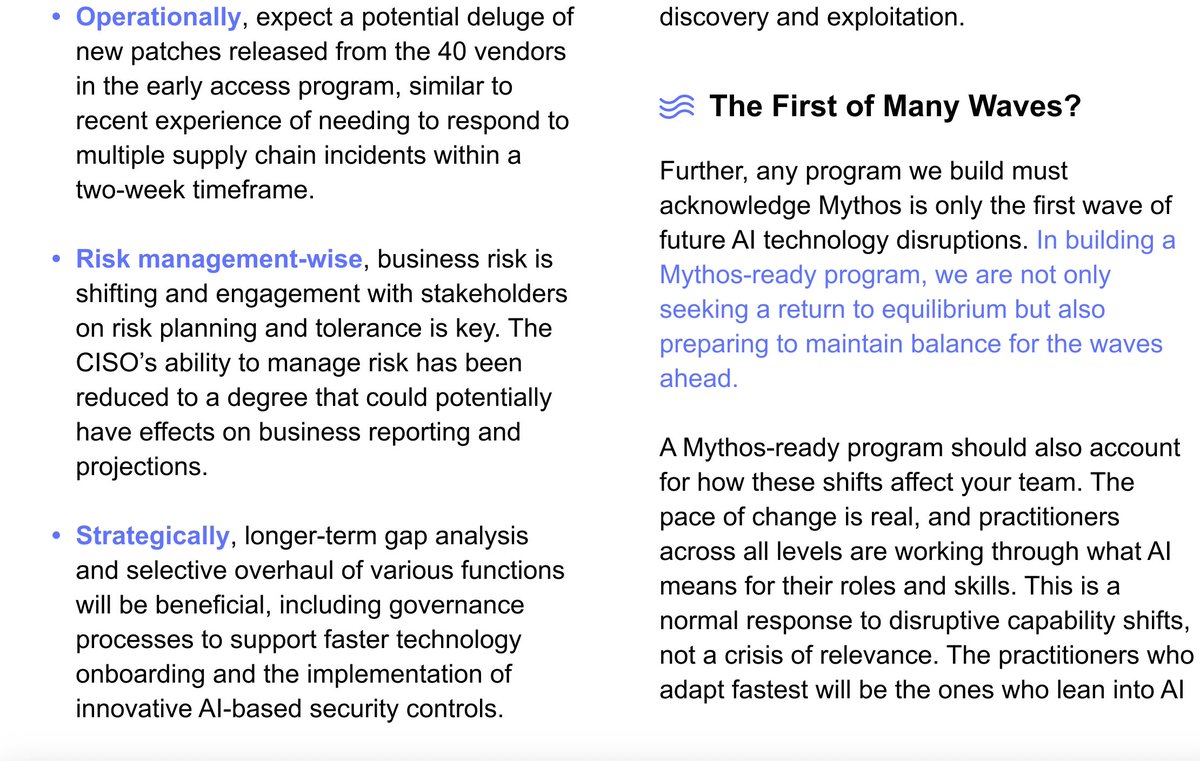
‼️Eleven priority cybersecurity actions for the AI cybersecurity deluge. Some actions are required THIS WEEK. AI has significantly increased the likelihood of attackers discovering new vulnerabilities, creating new exploits, and using them in complex automated attacks at scale. AI increases the speed to develop patches, and reduces defects in new software, the burden on defenders, by comparison, increases due to the inherent limitations of patching. The attackers gain asymmetric benefits. Sandwiched between the technical recommendations a section "prepare for burnout," treat the problem with the same clinical seriousness as network segmentation. Currently: periodic security pentests outdated (this means that regulations like #GDPR or #NIS2 are outdated), threat intelligence lags. Awesome assessments, congratsc @gadievron for coordinating this. https://t.co/p6ASqCUYe9
Instead of watching an hour of Netflix, watch this MIT professor deliver a brilliant masterclass on how to effectively present your ideas with clarity, impact, and purpose.
A community college professor taught the same study skills lecture for 30 years, and the video quietly became one of the most watched educational recordings on the internet.
His name is Marty Lobdell. He spent his career as a psychology professor watching students fail not because they were lazy, but because nobody had ever taught them how their brain actually works under the pressure of learning something hard.
The lecture is called "Study Less Study Smart." Over 10 million views. Passed around in Reddit threads, Discord servers, and university study groups for over a decade. And the core insight buried inside it has been sitting in cognitive psychology research for years, waiting for someone to explain it in plain language.
Here is the framework that completely changed how I think about effort.
Your brain does not sustain focus the way you think it does. Studies tracking real students found that the average learner hits a wall somewhere between 25 and 30 minutes.
After that, efficiency doesn't just decline. It collapses. You're still sitting at your desk, still looking at the page, but almost nothing is going in.
Lobdell illustrated this with a student he knew personally. She set a goal of studying 6 hours a night, 5 nights a week, to pull herself out of academic probation. Thirty hours of studying per week. She failed every single class that quarter.
She wasn't failing because she lacked effort. She was failing because she had confused time spent near books with time spent actually learning. The 25-minute crash hit her at 6:30pm every night. She spent the next five and a half hours sitting in the wreckage of her own focus and calling it studying.
The fix sounds almost too simple. The moment you feel the slide, stop. Take five minutes. Do something that actually gives you a small reward. Then go back. That five-minute reset returns you to near full efficiency. Across a six-hour window, the difference is not marginal. It is the difference between thirty minutes of real learning and five and a half hours of it.
The second thing he taught destroyed something I had believed about how memory actually works.
Highlighting feels productive. Going back over your notes and recognizing everything feels like knowing. But recognition and recollection are two completely different cognitive processes, and your brain is very good at making you confuse them.
You can see something you've read before and feel completely certain you understand it, even when you couldn't reconstruct a single sentence from memory if the page were blank.
He proved this live in the room. He read 13 random letters to his audience. Almost nobody could recall them. Then he rearranged the same 13 letters into two words: Happy Thursday. The whole room got all 13 without effort.
Same letters. Same count. The only thing that changed was meaning.
The brain stores meaning. Not repetition. The moment new information connects to something you already understand, the retention changes entirely.
This is what the cognitive psychology literature calls elaborative encoding, and it is the mechanism underneath every effective study technique.
The third principle was the one that hit me hardest, and the one almost nobody applies.
Lobdell cited research showing that 80 percent of your study time should be spent in active recitation, not passive reading. Close the material. Say it back in your own words.
Teach it to someone else, or to an empty chair if no one is around. The struggle of retrieval is where the actual learning happens. Reading your notes again is watching someone else do the work.
His parting line has stayed with me longer than almost anything else I have read about learning.
He told the room that if what he shared didn't change their behavior, they hadn't actually learned it. It would just live in their heads as something they had heard once and felt good about.
He was right. And most people leave every lecture exactly like that.
The students who remember everything aren't putting in more hours.
They stopped confusing the feeling of studying with the fact of it.
🚨 Ricky Gervais on God & Why The Universe Exists - "Why is there SOMETHING rather than Nothing"
“I’m an agnostic atheist. Technically everyone’s agnostic… no one knows whether there’s a God. We don’t know."
"An agnostic atheist is someone who doesn’t know there’s a God or not, as no one does. So you’re not convicted of your atheism?”
Atheism isn’t a belief system, it’s simply rejecting the claim that there is a God.
Are you an agnostic atheist too? Or do you believe?
What’s your take? Drop it below 👇
Best OSINT resources
List by @OsintTeamBlog (updated last month):
Youtube channels
Newsletters
Blogs
Podcasts
CTFs and hackathons
https://t.co/Y352dUUkaT
Some days you can’t love social media enough. This is one of those days. It began like this. Someone stole 12 tons of KitKats.
And then the replies started coming in. Scroll down.
Part of TeamPCP's success thus far has been the speed in which they operate.
tl;dr teampcp doing lots of supply chains, exhausting, smash and grab passwords, runaway, really tiring
Generally speaking, large scale supply chain attacks are quiet with the focus being silence and espionage. A notable example of this is SOLARWINDS supply-chain attack which was conducted by the Russian Federation. The goal is to discretely insert malicious code into a products update cycle. The payload would (under ideal circumstances) execute with specific triggers in place and BE QUIET. They don't want to set off any metaphorical alarms. You quietly watch and SLOWLY work.
TeamPCP (as of this writing) has focused on information exfiltration (stealing sensitive data, primarily credentials) which is more akin to a smash-and-grab rather staying silent and watching what people are doing with their binoculars.
A successful supply chain attack can be a DFIR (Digital Forensics and Incident Response) nightmare. Many organizations do not have an internal DFIR on staff, hence they consult with external entities. Suddenly with a supply chain attack you've got dozens of organizations contacting the same group of companies needing a forensic investigation launched.
These DFIR's can take time with reporting, identifying victims, potential PII or sensitive documents stolen, cooperation with law enforcement and legal departments (or external law firms) ... it can take days, weeks, or (depending on the scope of impact and bureaucracy) months.
And then suddenly there is another supply chain attack ... and then another ... and then another ... and then another ... with a total of 50 as of this writing. The best I can describe what I'm currently seeing is a "DFIR resource exhaustion" technique.
If you've got only a handful of DFIR firms spread thin across a dozen of so companies and then ANOTHER supply chain attack happens AND THEN ANOTHER AND THEN ANOTHER, with some organizations potentially being hit multiple times, it's a nightmare come alive.
TeamPCP (as of what we've learned thus far) successfully used a supply chain attack to pivot to other supply chain attacks. They're chaining chains.
The concern now is they've performed 50 supply chain attacks in 8 days. Is there anymore coming? Has any other vendor failed to rotate their security credentials correctly? Is any company not cooperating? What data was stolen? How many companies are even impacted? How many are unaware of what happened? How much user PII was stolen? How were these other supply chain attacks conducted?
The current prevailing theory is all of these supply chain attacks are the result of the initial Trivy supply chain attack, however (unironically) DFIR work must be conducted and more investigative work needs to be performed. It is dangerously to assert with high-confidence it is the result of the Trivy supply chain attack. If you're wrong, what if it's from something else we're not aware of yet? I'm sure not all details are public (yet). More information will come out eventually.
This sort of DFIR work would take months but now it's a race against the clock hoping another doesn't occur.
2026 starting off strong.
For those of you that happened to catch the SANS emergency webcast yesterday, here is an update:
TeamPCP Supply Chain Campaign: Update 001 - Checkmarx Scope Wider Than Reported, CISA KEV Entry, and Detection Tools Available https://t.co/HNBKis6Khg via @SANS_ISC@SANSCloudSec #TeamPCP