.@TheEconomist is a great publication, and I’ve learned a lot from it over the years. But I think it missed the mark with this article on @DAcemogluMIT.
Daron and I publicly and privately disagree on a number of important issues, most notably on the likely magnitude of AI’s productivity effects in the coming years. We’ve had many lengthy discussions about our differences, including as recently as last month.
That said, Daron is not merely one of the most intelligent, interesting, and hardworking economists I know. He is also a person of great integrity.
Since many people may form their impressions of him from this article or other public commentary, let me offer three anecdotes from my own experience.
1. In 2017, @tommmitchell and I co-chaired a @theNASciences committee on information technology and the workforce, bringing together a dozen leading scholars. Committee members were unpaid, and there was little extrinsic reward for doing more than the minimum. Everyone contributed, but unquestionably the person who worked hardest, and produced the most high-quality substantive material, was Daron. I came away enormously impressed by his seriousness and work ethic.
2. The article suggests that Daron’s stature may discourage others from criticizing him. That has not been my experience. I remember an MIT seminar where he presented an early version of his work on robots and employment. He was subjected to exceptionally tough criticism from colleagues and graduate students, especially over his instrumental variables and other aspects of his empirical strategy. It was one of the toughest seminars I can remember. Nobody was pulling punches. If anything, the criticism was blunter because everyone knew Daron was perfectly capable of handling it.
3. Along with @professor_ajay, @akorinek, and @testingham, I helped lead the recent “We Must Act Now” statement on AI (https://t.co/BjiX5fGGhJ). One of the first people we approached was Daron precisely because he had disagreed with me about AI capabilities and their likely economic effects. Daron and I went back and forth over the detailed wording for about a week. We ultimately found common ground. In the process, I was reminded of both his openness to new data and his attention to detail.
The Economist correctly highlights some important weaknesses in the economics profession. It should certainly scrutinize the work of prominent economists, presenting arguments and counterarguments.
In my view, what undermined their case was the article’s shift from criticizing his arguments to innuendo about Daron's personality. The suggestion that economists are unwilling to challenge him does not match what I have observed over 3 decades of knowing him.
Criticize Daron’s ideas and conclusions, as I often do. But the personal insinuations struck me as unfair.
En estos momentos en que las tasas de interés están en el debate público, no está mal recordar que las tasas no son iguales para todos (como asume usualmente la justicia) sino diferentes para cada persona o grupo.
Acciarri y Garoupa, paper en el Journal of European Tort Law.
Dear followers,
My new book What Happened to Liberal Democracy?: Remaking a Politics of Shared Prosperity is out. It is an editors’ pick and top new release on Amazon.
Thank you everybody for the support https://t.co/xOb2kNlAWn
SPOILER: Autobombo al final del hilo.
A partir de la segunda mitad del siglo XX cobró una forma una práctica del derecho internacional de los derechos humanos que, en algunos sentidos, es continuadora de la práctica más antigua de los derechos elaborada por el constitucionalismo.
El 19/8 David Owens (Oxford) estará presentando su paper 'The Fragmentation of Justice' en UTDT. Owens es uno de los filósofos morales y políticos más interesantes de la actualidad. ¡No se lo pierdan! Se pueden inscribir acá: https://t.co/RZwAmRWGov
My contribution to the Diverse Intelligences Workshops (@templeton_fdn@DivIntelligence) at @Princeton can be viewed here. I talk about objectivity, induction, AI for science, and the theory-free ideal https://t.co/e9KXe51A7y
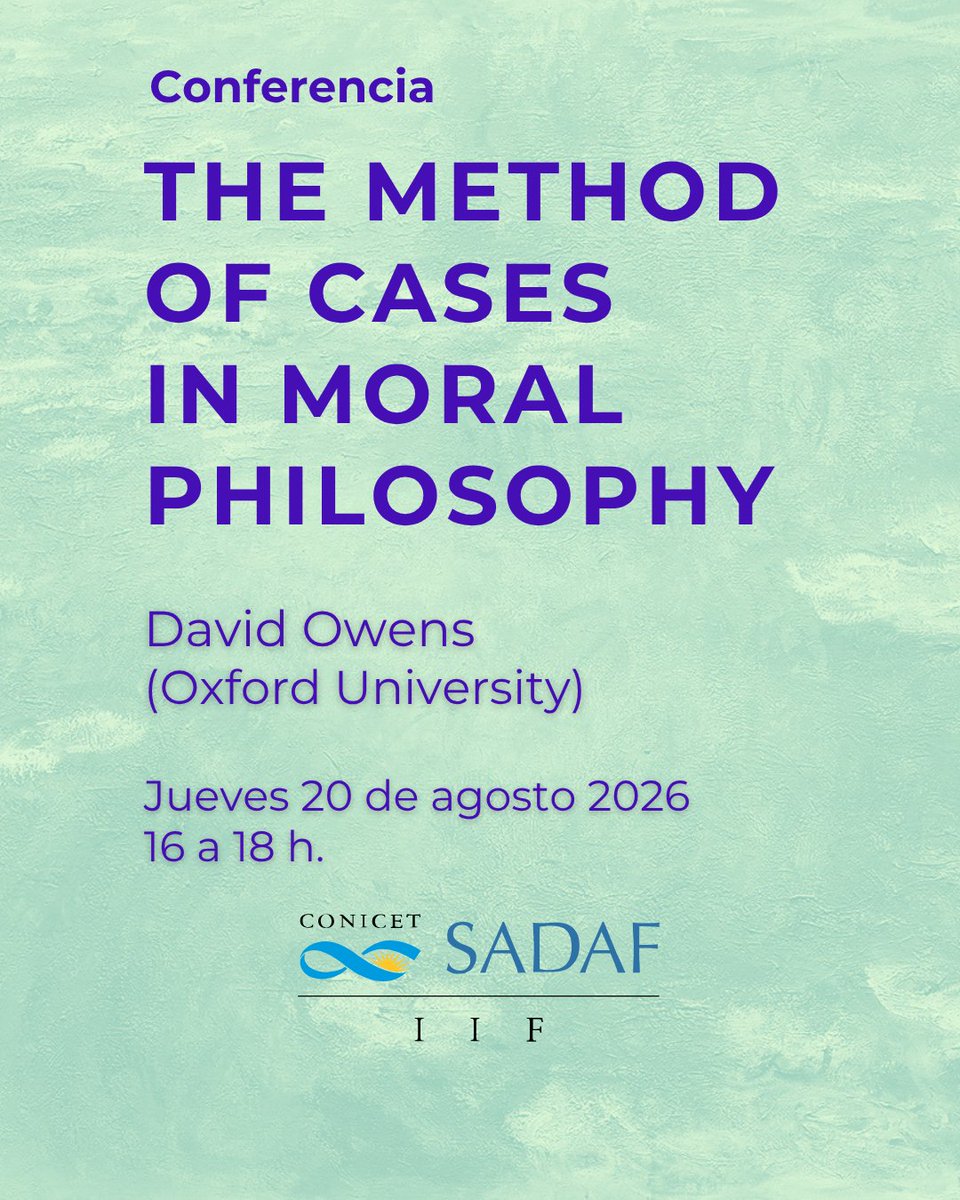
Les invitamos a la Conferencia “The Method of Cases in Moral
Philosophy” dictada por David Owens (Oxford University) que se
realizará el jueves 20 de Agosto a las 16 hs. en nuestra sede, en
modalidad presencial. Inscripción:
https://t.co/6wMGcMTf3F
Info a: [email protected]
Delighted my PhD thesis won the Yorke Prize from @CambridgeLaw for exceptional legal scholarship! 🏆
My research examines how AI reshapes consumer credit—weighing efficiency and accuracy against opacity and discrimination.
🔗https://t.co/FHckI2Nm5Y
Que un problema desaparezca de la agenda no significa que se haya resuelto. Muchas veces solamente ha cambiado el interés del auditorio.
Desde el minuto 32 desarrolla esta idea de Raz. Luego sigue con la visión de Von Wright
- "Se trabaja de abogado, y en los tiempos libres se enseña",
- "Se enseña mal, no se investiga, se escribe poco, se desalienta la crítica".
Escenas comunes revisadas por @Rgargarella sobre las condiciones de producción del derecho argentino.
👇
https://t.co/8n0S5z2VpI
AI is being rushed into the justice system—but is it actually helping improve outcomes?
My new review for the Nuffield Foundation looks at the evidence. The short answer? We don't know.
https://t.co/1aynV6jTJM 🧵 (1/6)
@NuffieldFound@AdaLovelaceInst@Cambridge_Uni
The Modern State
Rooted in continental European state theory, this book by Thomas Vesting argues that the modern western state is a composite of 3 overlapping layers: the constitutional state, the welfare state & the network state.
More info & Chapter 1: https://t.co/JW1VPIq2E2
De 1986 a 2026 -- Autor de un libro sobre "Borges y el derecho", Leonardo Pitlevnik nos escribe sobre Borges y los aniversarios.
👇
https://t.co/t8pTRZX1vG