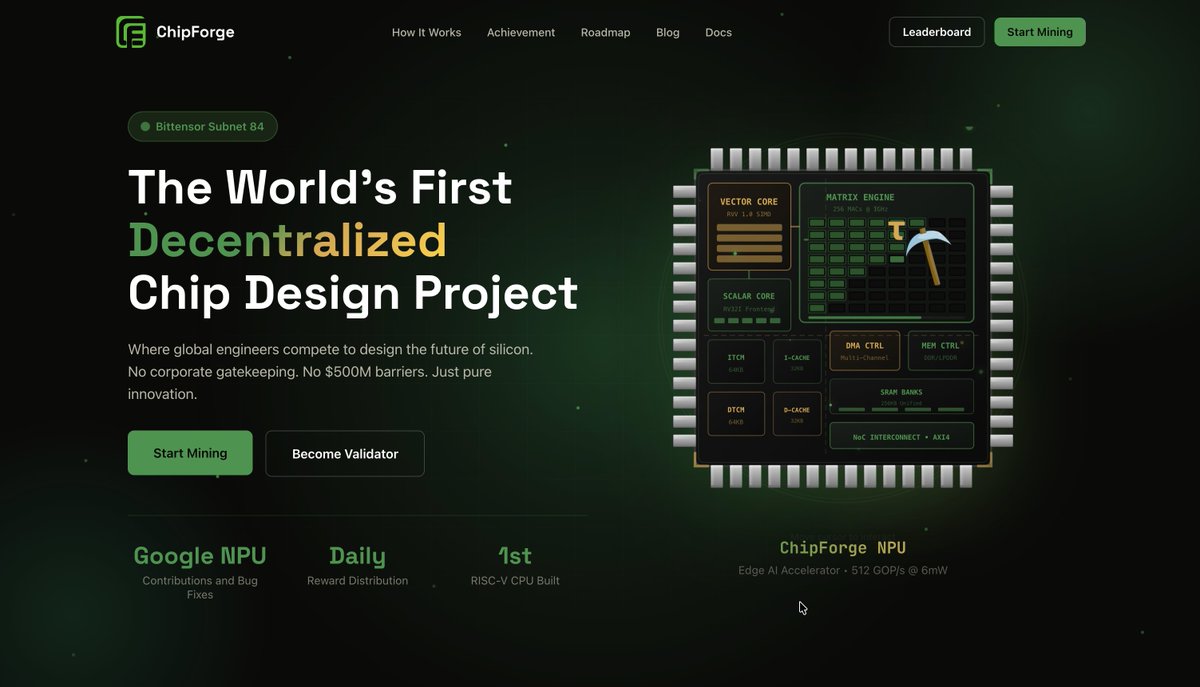
The new Taτsu website is officially LIVE.
We rebuilt it from the ground up—it's cleaner, sharper, modern, and finally represents the true scope of what we're building.
We’re skipping the long speech about technical details and the grind behind the scenes. Just hit the link and check it out yourselves:
🔗 https://t.co/zIF0WWVe8F
Let us know what you think!
난 게임을 즐겨하지 않는데 이런건 진짜 유익함
만원으로 데이터 센터의 복잡한 구조와 컴퓨터 인프라를 이해하는 스팀게임 : Data Center
빈 방에서 시작해서
랙 구매 → 서버 장착 → 모든 케이블을 직접 손으로 하나하나 연결해야함
실제 데이터 센터처럼 고객 트래픽을 처리하는 시뮬레이션 게임
출시 48시간 만에 180개가 넘는 리뷰가 달렸고, 플레이어들은 “최근 본 시뮬레이션 게임 중 가장 몰입감 있다”, “컴퓨팅 인프라를 이해하는 데 최고”라는 평가를 하고 있습니다.
Sunday Brief – May 17, 2026
A delivery and foundation week. RVGEN officially launched as an open-source instruction generator, and the TatsuOS whitepaper was released with a detailed six-month roadmap.
Brief Summary
This week we moved from preparation to public release. RVGEN, the ChipForge instruction generator mentioned last week, is now live and available via pip. It's already surfacing real compliance bugs in external usage and strengthening our internal verification flows. In parallel, the team completed an initial end-to-end test of an agent-based verification pipeline designed to automate bug validation and challenge evaluation. On the TatsuOS side, the whitepaper dropped with a comprehensive technical breakdown and a tentative six-month roadmap. Both projects are accelerating toward faster execution.
Chip Design Team
- RVGEN officially launched under the Tatsu Github organization: `pip install rvgen`
- Source code available at https://t.co/lbToKKPD6s
- Modern chip verification depends on generating massive amounts of meaningful randomized programs while controlling corner cases, privilege transitions, vector behavior, traps, and mixed workloads — RVGEN was built to solve that problem
- Supports 29 built-in RV32 and RV64 targets covering scalar integer, floating-point, vector, compressed, cryptography, hypervisor, and newer RISC-V extensions
- Designed to be self-contained and easier to extend compared to existing flows, removing the need for large external riscv-dv setups
- Currently passes 989 unit tests and 213/213 Spike validation cases across the internal verification plan
- Already in use internally on both CoralNPU and ChipForge MCU; external adoption this week surfaced multiple real compliance bugs that have since been fixed
- Completed initial end-to-end test of agent-based verification pipeline to automate bug validation and challenge evaluation at scale
- Both RVGEN and the agentic validation flow are being built to support a much faster challenge cadence once the subnet returns
TatsuOS
- Released whitepaper outlining the full technical architecture and vision for the project
- Worked through technical details and complexities with the team, producing a comprehensive yet tentative six-month roadmap
- Moving forward, we'll be posting TatsuOS progress updates twice a week to keep the community informed as development accelerates
An Update on the Taτsu Ecosystem: The Path Forward
Our Subnet ChipForge has been deregistered. While our technology remains excellent—recently proven by our open contributions to Google's Coral NPU— we still were caught in the cycle of deregistration process.
High-end chip design is a sophisticated, capital-intensive field that demands advanced engineering and patience, but it offers unparalleled revenue potential in the long run. We are not slowing down; instead, we are refining our focus into two parallel tracks that leverage the full spectrum of our team’s capabilities.
Track 1: ChipForge — Our Main Focus
ChipForge remains our elite hardware design arm. Our work solving complex chip-design challenges through open competition is a core part of our identity. We will maintain ChipForge as our main focus, preparing for a return to the Bittensor ecosystem when the registration and economic environment align with our long-term hardware roadmap.
Track 2: TatsuOS — The Commercial Product
In parallel, we are accelerating TatsuOS, our AI-native IoT platform. While ChipForge pushes the boundaries of future hardware, TatsuOS solves the practical, commercial challenges of the IoT industry today—ending the "subscription trap" and vendor lock-in.
• Commercial Utility: TatsuOS enables "Burn-to-Unlock" features using the $TATSU token, granting users permanent, cryptographic ownership of their device features.
• Infrastructure Simplified: Managed telemetry pipelines, fleet-wide dashboards, and over-the-air (OTA) updates are standard, replacing three separate vendor contracts with one unified platform.
• The AI Agentic Pipeline: This is the heart of TatsuOS. We are democratizing Edge AI. Our platform allows anyone to turn an idea into a deployed model via Agentic pipelines. You no longer need a team of Data Engineers, AI researchers, or MLOps specialists.
◦ Example: "I want my soil sensor to detect water stress 24 hours earlier"—our AI agents handle the data engineering, model training, and deployment directly to your devices over the air.
• A New Home for $TATSU: This creates a direct, undeniable link between the token and real-world product usage across thousands of devices.
We are building both in parallel—one to design the chips of the future, and one to power the devices of today. We will continue to provide weekly, data-driven updates on both fronts.
The technology is solid. The strategy is clear. Let's hope for the best.
— The Taτsu Team
If you’re wondering how SN84 validates hardware designs from miners and why ChipForge takes time to launch new challenges…
It’s not about writing the task.
It’s about proving we can judge it correctly.
A simple 64-bit adder has 2¹²⁸ input combinations (~3.4×10³⁸).
Even with an NVIDIA RTX 5090, brute-force testing would take on the order of 10¹⁷ years.
And modern SoCs are thousands of times more complex than a simple adder.
So validation isn’t about testing everything.
It’s about building a pipeline that can find real issues early and reliably.
We have already found and fixed bugs in Google’s Coral NPU.
This shows that our validation pipeline is capable of handling real, complex hardware designs at an industrial level.
Building such a validation pipeline takes time.
Full breakdown 👇👇
Sunday Brief – March 15, 2026
The work from the previous weeks has now reached an important milestone. Challenge 0011 has been prepared and launched, focusing on fixing real issues discovered in CoralNPU while continuing to strengthen the verification pipeline around it.
Brief Summary
Challenge 0011 is now live, shifting the focus from only finding bugs to also fixing them. In parallel, we made the ChipForge MCU repository public, sharing the processor core that was developed step by step through decentralized hardware challenges on this subnet. With the MCU core now open, the team has started preparing the next set of challenges aimed at expanding it into a complete microcontroller platform.
Chip Design Team
- Challenge 0011 finalized and launched, allowing participants to work on fixing real issues identified in CoralNPU.
- Continued monitoring and validation of the bug-fix pipeline to ensure solutions submitted by participants are evaluated correctly.
- Published the ChipForge MCU repository, making the processor core developed through challenges on this subnet publicly available.
- The core is a 32-bit RISC-V processor with hardware cryptography acceleration, implemented in SystemVerilog and extensively verified against the Spike ISA simulator across millions of executed instructions.
- The repository includes RTL, verification infrastructure, and documentation so the development process and validation approach are fully transparent.
- Work has begun on preparing the next challenges focused on expanding this processor core toward a complete MCU platform.
Challenge 0011 Bug Hunting
- Challenge 0011 is now live and focused on fixing real issues discovered in CoralNPU.
- The validation pipeline is actively evaluating submitted fixes using the improved verification infrastructure.
- Continued monitoring to ensure fair and consistent validation of miner submissions.
The direction remains clear. Stabilize the core designs first, then build on top of them. Bug discovery and bug fixing together will help ensure both CoralNPU and the ChipForge MCU become strong foundations for the next generation of challenges on this subnet.
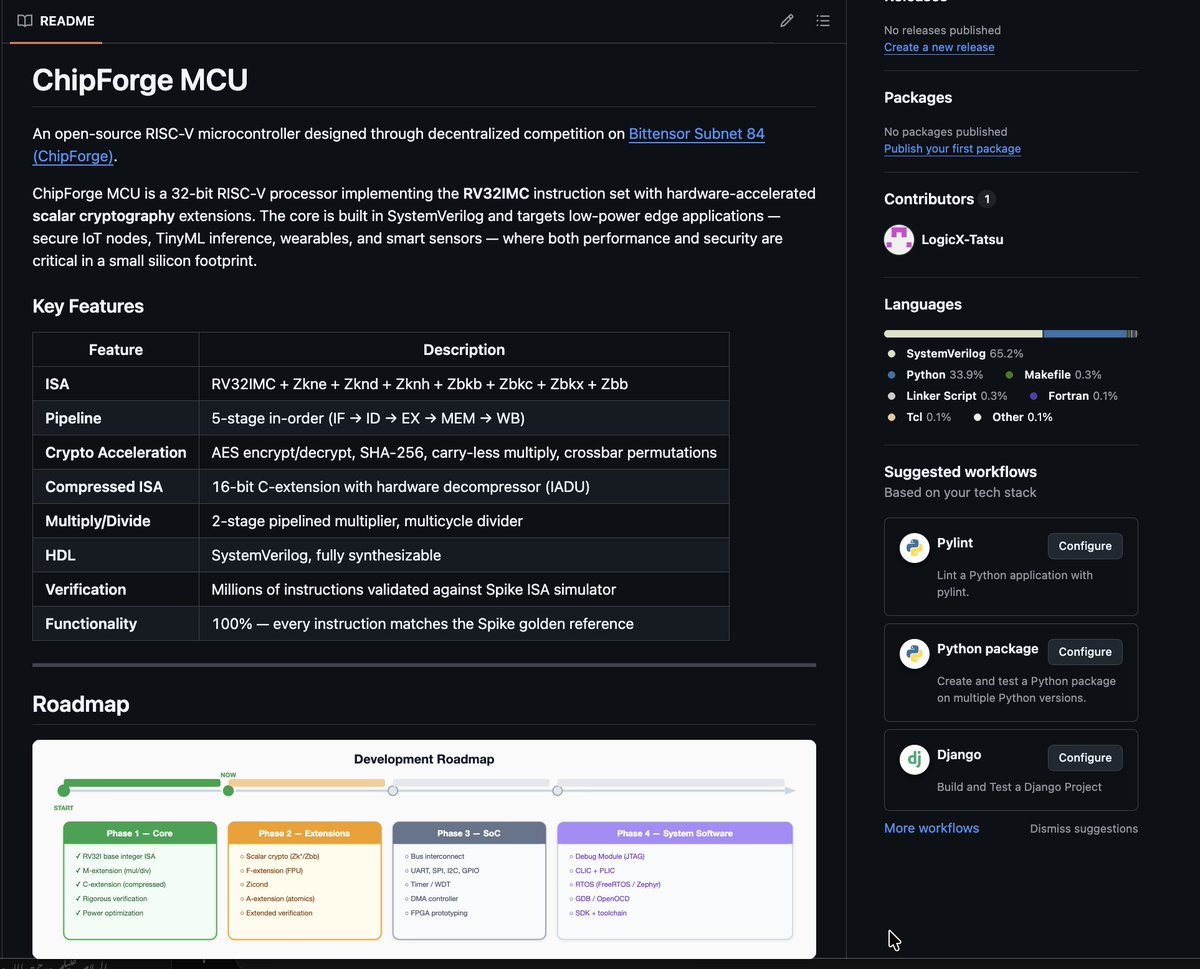
We’ve made the ChipForge MCU (MicroController Unit) repository public.
This processor core was developed through decentralized hardware competitions on ChipForge, Bittensor SN84, where miners submit RTL designs and our validation system evaluates them across functionality, performance, area, and power.
Over multiple challenges, the design evolved step by step. Different implementations were tested, optimized, and verified through our automated validation pipeline.
What is available today is the processor core itself — a 32-bit RISC-V architecture with hardware cryptography acceleration, implemented in SystemVerilog and verified extensively against the Spike ISA simulator across millions of executed instructions.
This repository contains the RTL, verification infrastructure, and documentation so anyone can see exactly what has been built and how it was validated.
This is the first big achievement of ChipForge, and the starting point for what comes next.
The upcoming challenges will expand this processor core into a complete MCU (MicroContoller Unit) platform by adding further ISA extensions, enabling RTOS support, integrating debug through JTAG and GDB, and introducing system peripherals to turn the processor into a full microcontroller SoC.
In parallel, work is continuing toward the ChipForge NPU (Neural Processing Unit). That path is naturally more complex and will take longer due to the challenges of matrix engines, compiler support, and deeper hardware-software co-design.
Huge credit to the miners who contributed designs and pushed this effort forward.
https://t.co/Pd7zltJD83
ChipForge (SN84), reforged — our new site is live
We've rebuilt https://t.co/00mZYjfIPi from the ground up — a faster, cleaner experience designed to reflect the scale and ambition of the world's first decenτralized chip foundry.
With engineers competing globally, a completed RISC-V microcontroller with hardware crypto extensions, and an Edge AI NPU in active development — ChipForge is redefining how silicon gets designed.
No corporate gatekeeping. No barriers. Just open, incentivized hardware innovation — on-chain.
Explore the new site 👇
https://t.co/00mZYjfIPi
Sunday Brief – Feb 8, 2026
A deployment and refinement week for ChipForge. Following last week's finalization push, we deployed critical backend upgrades to mainnet and completed the redesigned ChipForge website, now in final testing before public launch.
Brief Summary
This week we moved key infrastructure to production while polishing the user-facing experience. The challenge server received substantial upgrades—now live on mainnet—including subnet tracking, improved metadata handling, and complete removal of GitHub dependencies. All workflows run faster and more reliably through direct S3 integration. In parallel, the front-end team completed the full website redesign and entered final testing phase. With backend stable on mainnet and the new site nearly ready, the platform is positioned for a cleaner public rollout and improved miner engagement.
Chip Design Team
- Focus remains on verification environment maturity and Challenge 0011 readiness.
Challenge Server
- Added subnet info tracking endpoint, providing real-time visibility into subnet health and status
- Enhanced leaderboard responses with title and description fields for both active and archived challenges, improving navigation clarity
- Removed GitHub dependency entirely—all challenge materials now hosted and served directly from S3
- Refined challenge rotation logic, fixing edge cases around activation and archival timing
- End-to-end workflow testing complete; challenge activation, archival, and sync intervals all running smoothly with improved reliability. Deployed to Mainnet.
Subnet Codebase
- All systems stable; no updates required this week
- Ready for next challenge activation
Front-End & Website
- https://t.co/00mZYjfIPi redesign complete and in final testing
- Fully responsive design with optimized mobile and desktop templates for seamless experience across all devices
- Live leaderboard with real-time data, featuring challenge selection, validator filtering, search functionality, and better displays on mobile
- Performance optimizations using modern Next.js architecture for faster load times and cleaner codebase
- Refined footer, ecosystem partner logos, roadmap visualization, and consistent design language throughout
- Custom favicon and updated messaging to better reflect our mission
- Expected to go live soon
---
Backend upgrades live on mainnet. New website launching soon. Infrastructure solid and ready.
Sunday Brief – Feb 1, 2026
A strong consolidation week for ChipForge. While last week focused on readiness, this week was about finalization, locking the front end, preparing the next Coral NPU challenge, and continuing to strengthen the verification foundation behind it.
Brief Summary
This week centered on turning prepared systems into polished, near-launch state. The front end reached final form and entered full integration testing with the backend. On the chip side, Challenge 0011 was prepared on Coral NPU, while parallel work continued to harden the verification environment and test generator to support deeper, earlier bug detection. Together, these efforts position the platform for a clean public rollout and more rigorous NPU iteration ahead.
Chip Design Team
- Challenge 0011 finalized on the Coral NPU and prepared for launch.
- Identified that existing Coral NPU verification support is not yet sufficient for early, highly regressive bug discovery.
- Continued focused work on strengthening the verification environment to support deeper and earlier detection of design issues.
- Improved the instruction generator to produce more aggressive and varied test cases.
- Enhanced logging and run summaries to make large regression results easier to analyze and validate.
- Ongoing effort to close gaps between test generation, execution, and clear result interpretation for users and validators.
Challenge Server
- No functional changes this week; systems remained stable throughout testing.
- Platform readiness maintained ahead of upcoming challenge launch.
Subnet
- Validator and submission flows remained stable under continued testing.
- No regressions observed during integration runs.
- Subnet remains ready for next challenge activation.
Front-End & Website
- Front end finalized and functioning as intended.
- Dashboard significantly improved to be more miner-friendly and easier to navigate.
- Full end-to-end testing underway with backend services.
- Website expected to go live before the next Sunday Brief.
ChipForge continues to move steadily from preparation to execution, tightening the experience for miners while strengthening the technical foundation underneath.
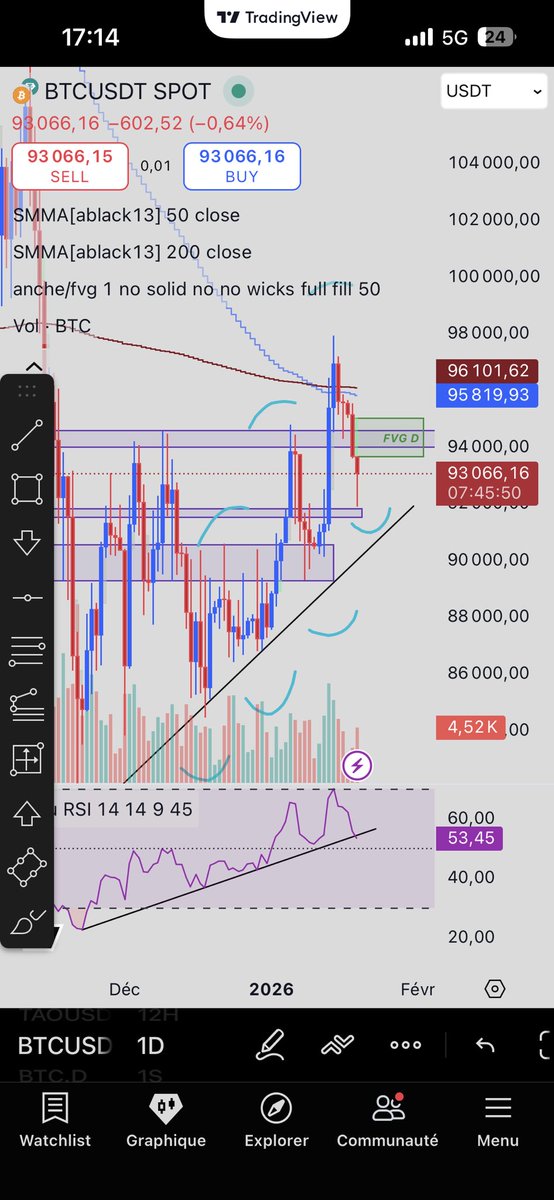
$BTC Daily it’s Okay 👍🏼
There are a good support.
I think he go to the purple box for a retest and he go to a 100k .
The bleue line it’s juste the theory of DOW : higher high and lower high in Daylight Frame.
@CryptoMillionYT@CryptoTony__@eliz883
Sunday Brief – Jan 11, 2026
A milestone week for TATSU. The ChipForge (SN84) Team successfully landed its first upstream fixes in @Google Coral NPU, closing the loop from verification-driven discovery to validated open-source contribution.
Brief Summary
During extended verification and randomized stress testing, the team identified a set of related issues affecting LUI execution, floating-point store behavior, and vector store handling. These issues could lead to incorrect retirement behavior or core stalls under specific conditions. All were root-caused, fixed, validated, and merged upstream as Pull Request #59, entirely through in-house effort.
With PR #59 merged, the team shifted focus toward preparing the next miner challenge and continuing deep stress testing on newer upstream revisions.
Chip Design Team
- Pull Request #59 was merged into @Google Coral NPU repository on January 6, resolving issues across LUI handling, floating-point stores, and vector stores that could previously cause incorrect retirement behavior or core hangs. https://t.co/YkrSWXgKur
- All issues addressed in PR #59 were uncovered through long, randomized stress testing rather than compliance-only tests, validating the depth and effectiveness of the verification flow.
- The PR #59 commit functions correctly under stress testing, with only the previously identified write-after-write (WAW) tracer visibility issue remaining, which does not affect RTL correctness.
- Subsequent commits added to the Coral NPU main branch after PR #59 currently fail multiple stress tests; these issues are not present in the PR #59 baseline and are under active investigation.
- Verification and debugging are ongoing to isolate the root cause of the newer upstream failures and determine whether they originate from recent RTL changes or debug visibility paths.
- In parallel, tracer behavior continues to be refined to ensure debug output accurately reflects correct execution during high-stress verification.
- Work continues on shaping the next miner challenge using the stabilized PR #59 baseline and the improved verification infrastructure.
This week marks a clear transition from verification discovery to upstream contribution, while reinforcing the importance of continuous stress testing as the design evolves.
@GoogleResearch
Sunday Brief – Jan 4, 2026
Another focused and productive period across TATSU. Over the past two weeks, the Chip Design Team significantly deepened Coral NPU verification, moving from basic correctness toward high-confidence, stress-level validation, while core platform services continued to operate reliably.
Brief Summary
This cycle was about eliminating uncertainty. The Chip Design Team expanded Coral NPU verification well beyond compliance-style testing and into long, randomized execution, uncovering real corner cases across scalar, floating-point, and vector paths. Several critical issues were identified, debugged, and pushed upstream. In parallel, verification tooling matured rapidly, enabling large-scale testing that will support future NPU challenges.
Chip Design Team
- Continued strengthening the Coral NPU verification infrastructure, building on earlier compliance testing by introducing randomized, high-coverage execution across scalar, floating-point, and vector instructions.
- Early randomized tests exposed multiple store-related corner cases, initially appearing in load/store paths and later confirmed to involve floating-point stores and vector stores as well.
- Based on feedback from the Google team, fixes were expanded to address the broader store completion logic. Updates were consolidated and pushed upstream to the Coral NPU open-source repository. (more details in upcomming week in separate post)
- Follow-up regression testing uncovered an additional floating-point store scenario that caused an infinite stall. After careful debugging, the team confirmed this issue originated in the Coral NPU design itself and updated the same pull request accordingly. Feedback from the upstream team is pending.
- Significantly improved the random instruction generator, making it more configurable and capable of generating large, mixed instruction streams (scalar, FP, vector, or hybrid). This enables millions of instructions to be generated quickly, even though full NPU simulation naturally takes longer.
- With the design stabilizing, there are currently no major RTL bugs blocking progress. The primary remaining issues are related to tracing and debug visibility, where some instructions execute correctly but are not logged accurately, creating false mismatches. Work is ongoing to align debug ports, tracer output, and verification expectations.
- Verification has moved from short, instruction-level checks to system-level stress testing, providing the confidence required before moving on to performance, area, or power evaluation.
- Once the NPU validation pipeline is fully locked down, the next Coral NPU challenge will be launched on top of this verified baseline.
All other services are running uninterrupted.
Sunday Brief – Dec 21, 2025
A focused and verification-heavy week across ChipForge. With core services stable and testing pipelines holding steady, the team concentrated on deep correctness validation for the Coral NPU, laying the groundwork required before any decentralized optimization can safely begin.
Brief Summary
Following last week’s successful verification of the RV32IMFB scalar core using ISA compliance tests, work this week moved into deeper and more demanding verification territory. The Chip Design Team expanded basic coverage on the vector core while deliberately shifting most effort toward high-stress random testing of the scalar core.
In parallel, all major infrastructure services continued to pass automated testing without issues. With stability maintained across the Challenge Server and related systems, the team was able to focus fully on verification accuracy and correctness confidence.
Chip Design Team
- Verified basic functionality of the Coral NPU vector core, including vector load, store, and arithmetic operations; initial tests passed, with full vector coverage planned after scalar verification reaches the required confidence level.
- Shifted primary focus to deeper scalar core verification, recognizing that ISA compliance tests typically cover only 25 to 50 predefined cases per instruction and are insufficient as a long-term optimization baseline.
- Transitioned to riscv-dv–based random testing to significantly expand coverage and expose corner cases and uncommon execution paths.
- Developed a custom instruction tracer for the Coral NPU to capture scalar instruction traces and compare them directly against Spike as a golden reference.
- Executed identical randomized programs on both the Coral NPU and Spike, comparing instruction-by-instruction execution traces.
- Observed that the Coral NPU stalled after approximately 2,000 instructions, while the same programs continued past 7,000+ instructions on Spike.
- Initial debugging indicates the issue originates inside the core; final analysis is ongoing to rule out verification environment causes.
- Investigating a potential mismatch between the locally used Verilator version and the version used in the Coral NPU’s Bazel-based flow, though this remains unconfirmed.
- Confirmed that before expanding random testing further for either the scalar or vector core, this behavior must be fully understood and resolved.
- Reiterated that area, performance, and power evaluation will only proceed once the design can reliably execute millions of randomized instructions without divergence.
This verification work establishes the foundation required before the Coral NPU can be safely exposed to miner-driven optimization.
Challenge Server
- Automated tests passed successfully across all services.
- Scoring logic, metadata generation, and archived challenge views verified.
- S3 routing and admin controls functioning correctly.
With infrastructure stable and verification rigor increasing, ChipForge continues moving deliberately toward trustworthy, optimization-ready silicon built on a solid correctness foundation.