Introducing Xiaomi MiMo-V2.6 — Pro & Flash.
Frontier intelligence, all the modalities, built in public.
🔹 Two omnimodal models, advancing through scaled reinforcement learning
🔹 Pro performs on par with Claude Opus 5 and GPT-5.6 Sol across most agent benchmarks
🔹 Pro scores 46 on the Artificial Analysis Intelligence Index — the highest among open-source models
🔹 Stronger coding, computer use, 3D reasoning and creative capabilities
🔹 Open model weights, technical report, RL environments and training code
Blog:https://t.co/JGdwC9Ymvj
This is awesome. Most "open" frontier models give us weights + a paper. Xiaomi giving us the RL environments, verifiers AND training framework is a completely different level of openness. You can actually experiment on the training recipe itself. Huge win for open research 🔥
the most insane part, they will release ~7k RL training data and the framework leading to this top 6 model on AA, they also shipped the model + tech report less than 1 week after starting the final RL run
pushing both intelligence and openness level, huge congrats
@AestherML@juanfrallm Agree on the first point, but "it doesn't make reasoning worse" is still a hypothesis. Removing it doesn't necessarily mean more params. But you're right: latent → latent still needs a structured latent space which is exactly what LeCun's recent work is trying to solve
@AestherML@juanfrallm The diagram is schematic. LeCun’s idea isn’t just removing unembedding, but replacing latent→token→latent with learned latent→latent dynamics (which is non-trivial). And yes, it’s not obviously cheaper or better but that’s exactly the hypothesis he’s making
@AestherML non sequitur... Nobody’s proposing to remove LayerNorm or skip connections. The point is to change how the model is used: iterate in latent space instead of forcing each reasoning step back through token space. Apparently you needed a visual for this one
@AestherML That’s not LeCun’s point. Transformer layers are latent, but each reasoning step still collapses back to a token. He’s arguing for iterating directly in latent space, then returning to token space only for the final answer. Pretty smart btw
Okay, @ylecun, LLMs are not the road to AGI. Duly noted. Now drop the teaser for whatever @amilabs is building from all these world-model papers. Some of us are actually excited over here !
Since the Codex reset yesterday, I already depleted the weekly limits of one of my Codex accounts.
This account exlusively uses GPT-5.6 Sol. I'm tracking all token consumption through my OpenClaw setup, so it's very easy to compare to previous periods.
Limits are now exhausting 4.8-5.9x faster than they did just 2 months ago while consumption is now around ~18% slower.
Same reasoning efforts, same mixed type of work.
The token rug pull is coming.
Get ready to pay up.
@hempasai Even if Satoshi tried to rug Bitcoin, the network wouldn’t just sit there. In an existential scenario, users and nodes could coordinate a fork excluding those coins. It’d be controversial, but Bitcoin can adapt rather than simply die
JEV actually doesn't even run deterministically
Exact same prompts give you different probabilities when you run it multiple times
The ORDER of the choices DRASTICALLY changes the output probs
I am more and more confused by the their "no-hallucination" claim
pretty interesting to see this new "personal branding" of mistral CEO, very close to what Xavier Niel (who is a big french entrepreneur and supporter of Mistral) is doing
public discourse in france is starting to doubt mistral's capacity to ship their own models (there was a drama around the microsoft deal and them serving chinese models) so wouldn't surprise me if this is something calculated by them to regain points in public opinion just before they release a new good model
probably a good strategy, especially if they ship something great
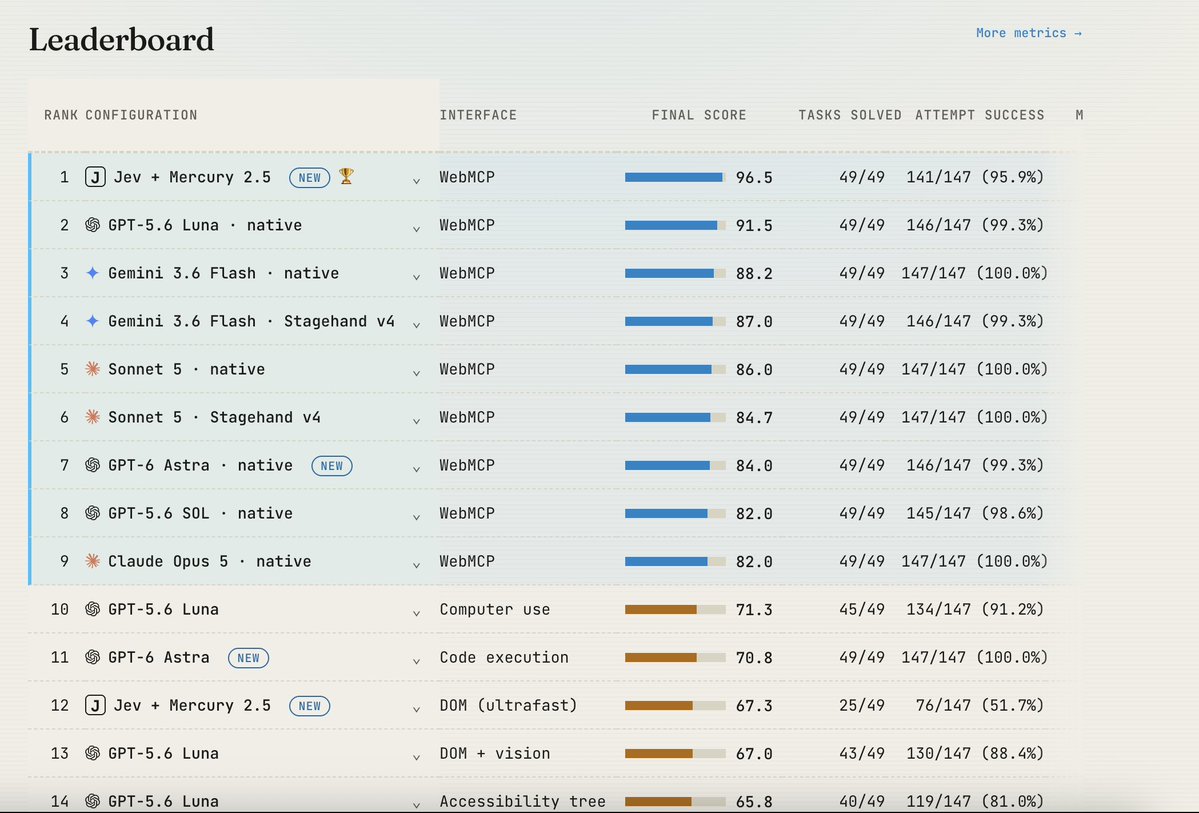
We just ran Jev on our WebMCP benchmark.
The result: basically broke the benchmark.
Jev + Mercury 2.5 (a fast, low-cost LLM) using WebMCP solved 100% of the tasks at roughly 112× lower model cost than GPT-6 Astra using computer use with code execution. Compared to Astra using screenshot-based computer use, the model cost was 245× lower (!).
We also compared Jev operating the browser with and without WebMCP.
We used Browser Use’s open-source Ultrafast, with some improvements to the harness to make it more reliable across the benchmark.
Jev’s browser-control accuracy on its own was not amazing - adding WebMCP nearly doubled the number of solved tasks, from 25/49 to 49/49, while reducing model cost by 18% (more on why below).
The benchmark and methodology are fully open and reproducible.
Full results: https://t.co/KmplyFMZdv
A few words on how the Jev + WebMCP harness works and why this is exciting:
Jev receives text as input and a set of discrete options it can choose from. With WebMCP, those options are the tools exposed by the website. At each step, Jev sees the task, the available tools and previous results, then picks what to do next.
The limitation is that Jev can’t generate arbitrary text, which you need for tool arguments. For example, it can choose the search_products tool, but it can’t generate the search query itself.
So we split the work: Jev picks the tool and Mercury 2.5 generates the arguments if needed.
This works well because turns out most of the cognitive load in these tasks is around choosing the right action. The argument generation itself is relatively simple, so we can delegate to a small and very fast model. We used Mercury, which outputs 1,000+ tokens/sec and is very cheap.
The result is a pretty simple combination: Jev for tool selection + Mercury for arguments + WebMCP for the interface. It ends up being very reliable, very fast, and very cheap.
A few words about Ultrafast and why do we think it underperforms:
Without WebMCP, Jev chooses from the page’s controls: which button to click, which field to fill, or which option to select.
But choosing a valid button is different from choosing the right next step. The agent still has to navigate menus, understand forms, recover from errors and recognize when the task is actually complete.
Our hypothesis is that WebMCP makes the decision space much simpler. Instead of figuring out a sequence of clicks through a website, Jev chooses explicit actions that directly advance the task.
@typesafeai itself documents weaker accuracy on questions requiring multiple reasoning steps. WebMCP moves much of that complexity into the website’s tools, leaving Jev with clearer decisions and fewer opportunities to go wrong (in a sense WebMCP "compresses" a sequence of clicks into one tool call).
Our modified Ultrafast setup solved 25/49 tasks - that is a result for our particular implementation and benchmark, not a universal limit on Jev or Browser Use. We are open to more harness optimization to get this result to perform better, feel free to directly contribute to the benchmark here: https://t.co/cK6MHsRV58
Browser-use ultrafast: https://t.co/DU9OdOtXHT
Free idea: use Jev as an expert aggregator.
Let classical models (GARCH, etc.) and foundation models produce the forecasts, then ask Jev:
"Given these forecasts, should I buy or sell"
Feed it the history of both realized data and previous forecasts as context.