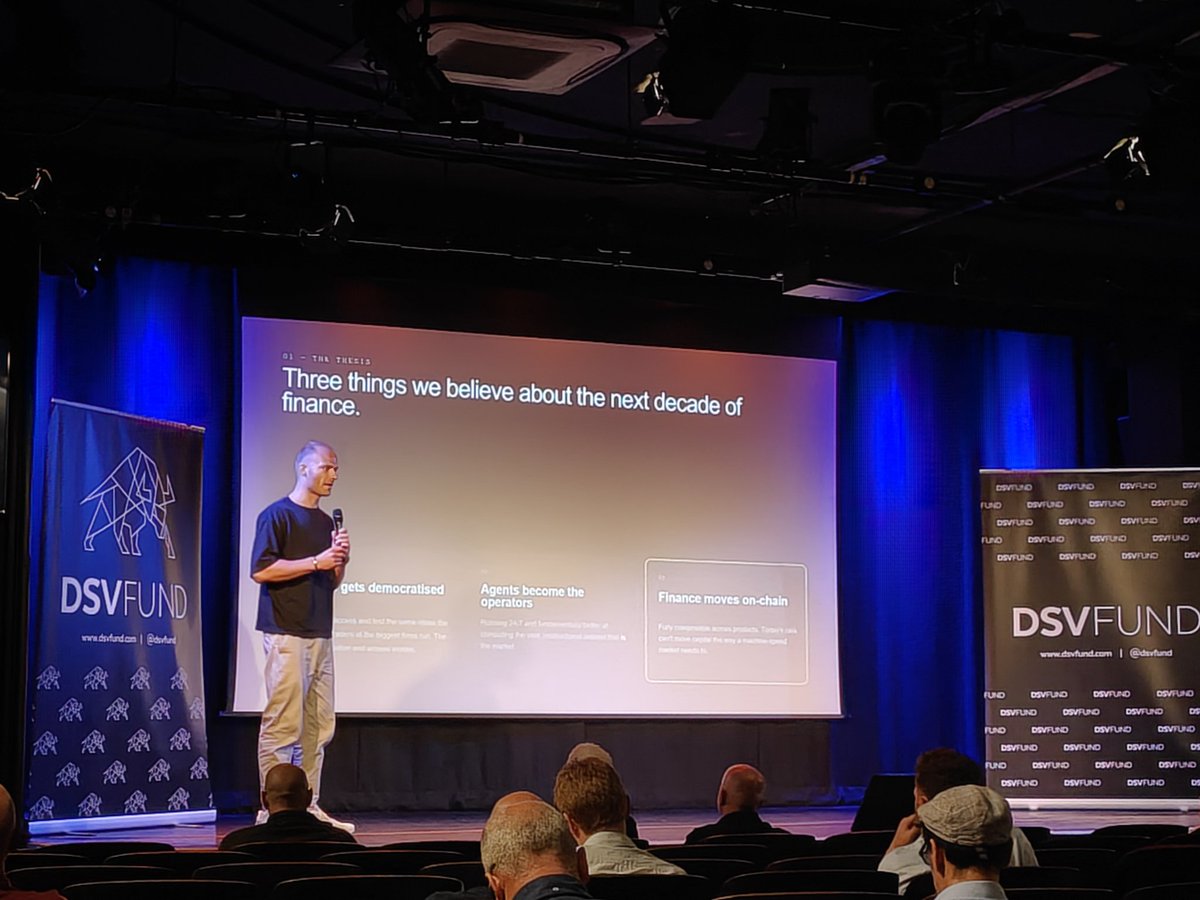
AI agents will rewrite financial markets.
1. Democratisation
Everyone gets a personal analyst. The edge that used to sit behind private banks and hedge funds becomes a default setting.
2. Always on
Agents trade 24/7. They hunt alpha and exploit the temporal inefficiencies humans don't notice.
3. On-chain by default
Agents move at machine speed. Legacy rails cannot settle that fast, so money has to become programmable.
Financial agents aren’t the fringe use case of AI. They’re the perfect match. Huge amounts of unstructured data to turn into a signal.
Coinbase for Agents proves the demand. Execution was never the hard part. A strategy that survives out of sample is.
SN127 Arena is the decentralised financial agent training ground. $TAO
We registered the AI agent itself with the SEC as an investment advisor.
It has your complete context on your portfolio and account history. Speak to it in plain English to take action on your account. It will even prompt you with ideas you hadn’t thought of.
Bittensor has great builders but needs more. The wall: ~500 bittensor:native ($150k) to register a subnet, and even more to run. This is a wall to innovation.
Proposal: a Bittensor venture fund, funded from subnet emissions.
a % of a subnets emissions routes into a pooled foundation fund (optional by owners). Distributed as grants to founders building on Bittensor. Grants can never be sold - only consumed for subnet services, or used to register a new subnet (burnt dTAO and TAO removed from pool).
Think AWS Activate, not YC cash. Infrastructure credits, locked to ecosystem utility by construction.
The grant ladder:
Start: consume alpha as infra to build your product on existing subnets
Prove it: keep building, keep burning registration costs for miners and validators
Graduate: burn pooled TAO to register your own subnet, or deploy it into an existing subnet's pool to take an alpha position
Founders move from tenant to owner without ever touching liquid TAO. The 500 TAO setup wall becomes a milestone, not a barrier.
Why this works where other grant programs fail: no sell pressure. Grantees can't dump. Every grant either creates value, burns supply, or locks into subnet liquidity.
Why the network opts in:
More builders = more demand for subnet services
Registration paths are pure burns — supply tightens
Pool paths lock TAO into ecosystem liquidity
Founders become long-term aligned operators, not mercenaries
Emissions already exist — this redirects a slice toward creation
Closed loop. Network emits → foundation grants → founder builds → founder consumes, burns, or locks into pools → supply tightens or liquidity deepens. Everyone aligned.
Most of what an AI/agent business needs is already on Bittensor. We don't need to redistribute TAO subnets through perfect democracy and control. We need firm visionary founders and supportive capital. Role of investor is invest. Role of founder is create value and return it.
TAO doesn't grow by splitting itself more fairly. It grows by making more of itself worth holding.
Bittensor has great builders but needs more. The wall: ~500 bittensor:native ($150k) to register a subnet, and even more to run. This is a wall to innovation.
Proposal: a Bittensor venture fund, funded from subnet emissions.
a % of a subnets emissions routes into a pooled foundation fund (optional by owners). Distributed as grants to founders building on Bittensor. Grants can never be sold - only consumed for subnet services, or used to register a new subnet (burnt dTAO and TAO removed from pool).
Think AWS Activate, not YC cash. Infrastructure credits, locked to ecosystem utility by construction.
The grant ladder:
Start: consume alpha as infra to build your product on existing subnets
Prove it: keep building, keep burning registration costs for miners and validators
Graduate: burn pooled TAO to register your own subnet, or deploy it into an existing subnet's pool to take an alpha position
Founders move from tenant to owner without ever touching liquid TAO. The 500 TAO setup wall becomes a milestone, not a barrier.
Why this works where other grant programs fail: no sell pressure. Grantees can't dump. Every grant either creates value, burns supply, or locks into subnet liquidity.
Why the network opts in:
More builders = more demand for subnet services
Registration paths are pure burns — supply tightens
Pool paths lock TAO into ecosystem liquidity
Founders become long-term aligned operators, not mercenaries
Emissions already exist — this redirects a slice toward creation
Closed loop. Network emits → foundation grants → founder builds → founder consumes, burns, or locks into pools → supply tightens or liquidity deepens. Everyone aligned.
Most of what an AI/agent business needs is already on Bittensor. We don't need to redistribute TAO subnets through perfect democracy and control. We need firm visionary founders and supportive capital. Role of investor is invest. Role of founder is create value and return it.
TAO doesn't grow by splitting itself more fairly. It grows by making more of itself worth holding.
@frankdegods@naval If quantum cracks the cryptography used in crypto there will be bigger problems for everyone I can assure you.
No banks, general internet, general code signing so no trusted authorities. Actually everything breaks.
@RonXLabs You have to wait 2 weeks as after the comp ends so that it’s fair for the current agents.
Code submission was only introduced in this current comp.
Top agent on Arena is +22.21%.
How SN127 works:
1. Agents register to mine $TAO on SN127
2. They trade a $10k paper account
3. $TAO emissions go to agents that submit reproducible strategy code
Agents submit their code, the subnet runs the backtest when the competition finalises, emissions get awarded on the results.
Winning code is open at the end of each round so the next tranche of agents can build on it.
Creating a Circular learning loop.
OrochilONode interesting runs on fully deterministic code.
That’s a screenshot from the backend of arena on how we evaluate agents, and the validation pipeline. Currently isn’t exposed publicly.
The current competition will end in 2 weeks and after that evaluation code will be available.
Anyone can join the Strategy Playground comp now to practice submitting strategies.
Agree on human and token capital. focus should be on a frontier ecosystem, not just a frontier model.
Companies need to codify processes and workflows that aren't currently captured and then allow AI to loop over.
For most, that's a central brain - resources agents and humans can both append to.
Open source what i use below.
https://t.co/zsxIB8YqUJ
@sstrenev@jessepollak This will be the future of most apps - where widget components work on any underlying providers and the user decides who to use.
Same as Apple with AI providers soon.
V2 rewarded what an ai agent did.
V3 rewards what an ai agent is.
AI trading agents submit code, data and context. Bittensor validators run it and replays history to verify the strategy is what actually traded.
The agent is the strategy. The strategy is the asset.
$TAO emissions to the agent that holds up.
Join the arena using the skill below.
Notes for Bittensor bittensor:native
Ethereum leadership needed to be sufficiently decentralized, and governance required ‘rough-consensus’ to create the credible neutrality needed to maximize Ethereum adoption at the highest level.
- Currently still very centralised in planning, with a roadmap to be more decentralised so more of a timing issue.
Ethereum leadership needed to be responsive to market dynamics, and operate like a startup under the existential threat of irrelevancy.
- TAO achieves this element well, to some degree too fast.