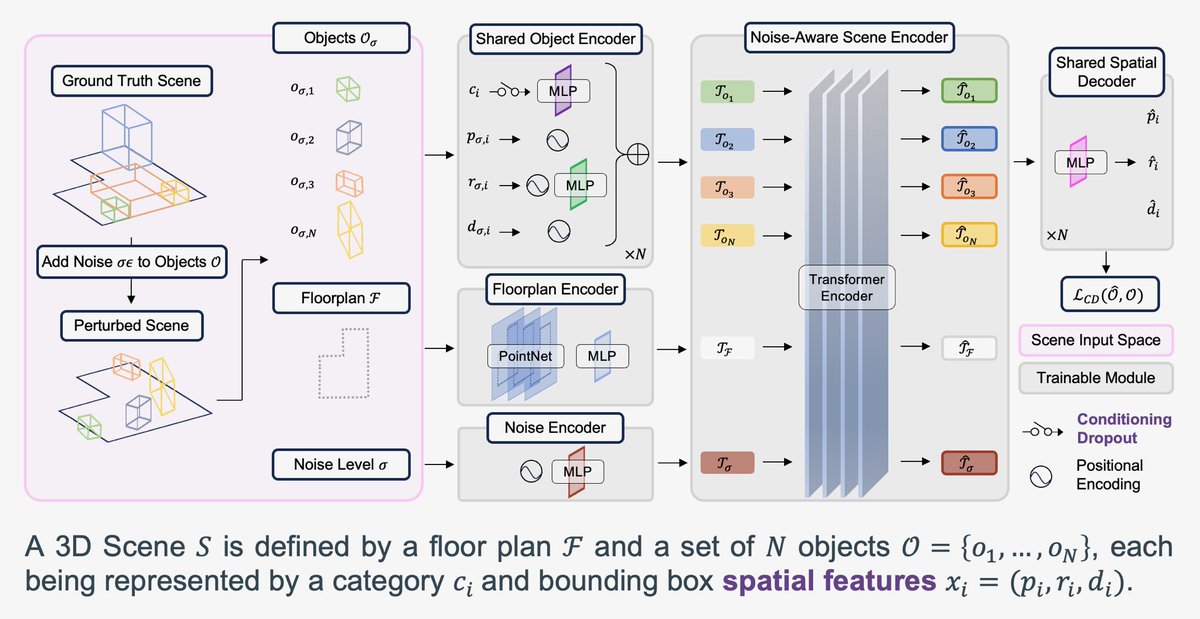
🚀 Introducing our #NeurIPS2024 paper!
« DeBaRA: Denoising-Based 3D Room Arrangement Generation »
📦 We propose a novel diffusion-based framework for precise, efficient and controllable 3D Indoor Scene Synthesis.
📄 https://t.co/8W08WW7ekG
👇 (1/8)
Started a science substack!
First post: "A 100-Dimensional Orange Is All Peel, and Why Physicists Care." It opens with a piece of fruit, detours through the weirdness of high-dimensional space, and lands on the physics behind steam engines:
https://t.co/wqrRJUW3FK
How do we know that we live in Euclidean 3D space?
Henri Poincaré argued that a motionless observer cannot acquire the concept of 3D geometry.
In our paper "SeeSE3: Emergence of 3D Space in Vision Features," we study this via vision foundation models.
https://t.co/XHthzoG90A
Introducing MIRA.
A playable, multiplayer world model.
A dream of Rocket League.
Trained on 10k hours of data collected with publicly available bots, MIRA learns the dynamics of a four-player game. The model runs in real time at 20 fps, based on the keys you and the other players press.
Built by General Intuition and @kyutai_labs, in collaboration with Epic Games. Not used to develop Rocket League.
▶️ Play the demo, read the technical report, and explore the open-source code at https://t.co/JjlsamGE1D
At ICML? Find us at Booth 111 to try it yourself and dig into the results with the team.
A year ago, people from Bercy, France's economy ministry, asked me about AI and robotics.
I told them what I actually thought. It didn't match what they wanted to hear. So they cut everything I said from the report, and wrote the opposite. I doubt I was the only one.
Today Bercy launches a "Directorate of Artificial Intelligence." Its mission: "define and implement the AI strategy," "pool compute capacity," "accelerate the development of agents."
Translation: we're going to plan innovation from an office. That has never worked. Not once.
OpenAI didn't come out of a decision in Washington.
Anthropic isn't a federal program.
xAI isn't a state initiative.
The technological leaps of the decade came from people who were building, not committees that were planning.
The real economy isn't a game of Civilization. You don't unlock "AI level 3" by checking a box on a tech tree.
And this isn't just an opinion. Hayek proved it in 1945 in "The Use of Knowledge in Society": the information needed to allocate resources is scattered across millions of actors and exists nowhere in aggregate form. No central planner can assemble it. It's structurally impossible.
The IMF said it again in 2024, with the numbers: trying to "pick winners" destroys capital, raises the risk of misallocation, and lowers productivity.
You want the perfect example of the French state planning a "technology of the future"? The Minitel. Cited today in the global economics literature as the textbook case of the state-chosen national champion that locked the country in while the Internet was being built everywhere else. We're really going to do this again with AI?
Because here's what planners don't understand: when you build something genuinely new, nobody knows what will work. That's the definition of new. The best AI researchers on earth are wrong about six months out. Labs pivot every quarter. Uncertainty isn't a market failure to correct. It's the nature of the frontier.
Now look at who's steering. Four ministers signed this.
Lescure (Economy): Polytechnique, ENSAE, twenty-five years in asset management, chief investment officer of a fund. A career spent allocating capital, never building what it's invested in.
Amiel (Public Accounts), who carries the public-AI push: ENS, Princeton, economics. Advisor, then politician.
Le Hénanff, the actual AI minister: business school, a career in agribusiness then digital consulting.
Papin (SMEs): a retail executive.
Not one of them has ever shipped a product or worked in tech.
And here's the category error. Even the people who spend their nights training models don't know where this goes. So people who don't use the tool daily, claiming to plan its national deployment, aren't a little off. They're solving the wrong problem entirely.
I'm not writing this to spit on anyone. I build in this field every day, and I want France to grow.
Happy to help. But on two conditions. Start by listening. Actually listening, not to delete what's inconvenient afterward. And accept that maybe it's simply not yours to plan.
Let people build. That's how it works. Everywhere. Every time.
« Notre ennemi, notre ennemi a un visage. Et il a un nom. Il en a même plusieurs. Il s’appelle Elon Musk, Sam Altman, Zhang Yiming »
@rglucks1 au lieu de designer des ennemis imaginaires comme un vulgaire complotiste, vous feriez mieux de vous demander pourquoi la France est totalement larguée sur l’IA. C’est pourtant simple : 50 ans de socialisme, d’impôts confiscatoires, de bureaucratie kafkaïenne, de matraquage des entreprises et d’État obèse qui veut tout contrôler de la vie de français alors qu’il n’assure même plus les fonctions régaliennes. Résultat ? Pendant qu’Elon Musk et les Américains avancent à la vitesse de la lumière, vous fantasmez sur des « investissements massifs publics » qui finiront en gabegie, rapports inutiles et subventions à des copains. Le vrai ennemi de l’innovation française, ce n’est pas Elon Musk. C’est vous et votre idéologie socialocommuniste qui a transformé la France en musée du déclin.
Ce n’est pas un hasard si Air France a choisi Starlink pour connecter ses passager au monde. Votre délire d’une « IA souveraine pilotée par l’État » ? En 2045 on attendra toujours.
Excited to share our new paper: VideoMDM 📢
We propose a principled framework for training 3D motion diffusion models (e.g. MDM), using only 2D supervision from monocular videos -- no 3D ground truth required.
Project: https://t.co/8Ux0SYRTcu
Paper: https://t.co/8KMgndPWkH
🧵
Why are GNNs stuck at 2–4 layers? Deep ones “oversmooth”, every node collapses to the same vector.
Our fix needs no residual connections, no normalization, no rewiring. Just swap the activation function.
📍Spotlight #ICML2026 , Seoul
Link to paper at end of thread.
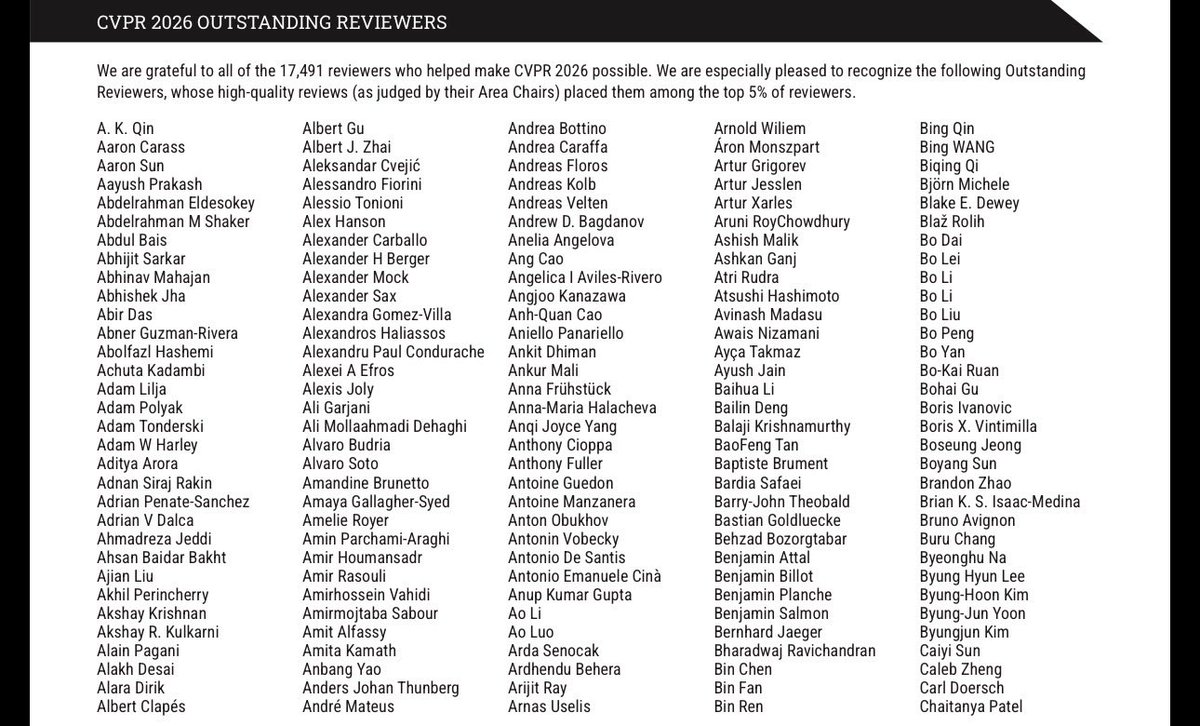
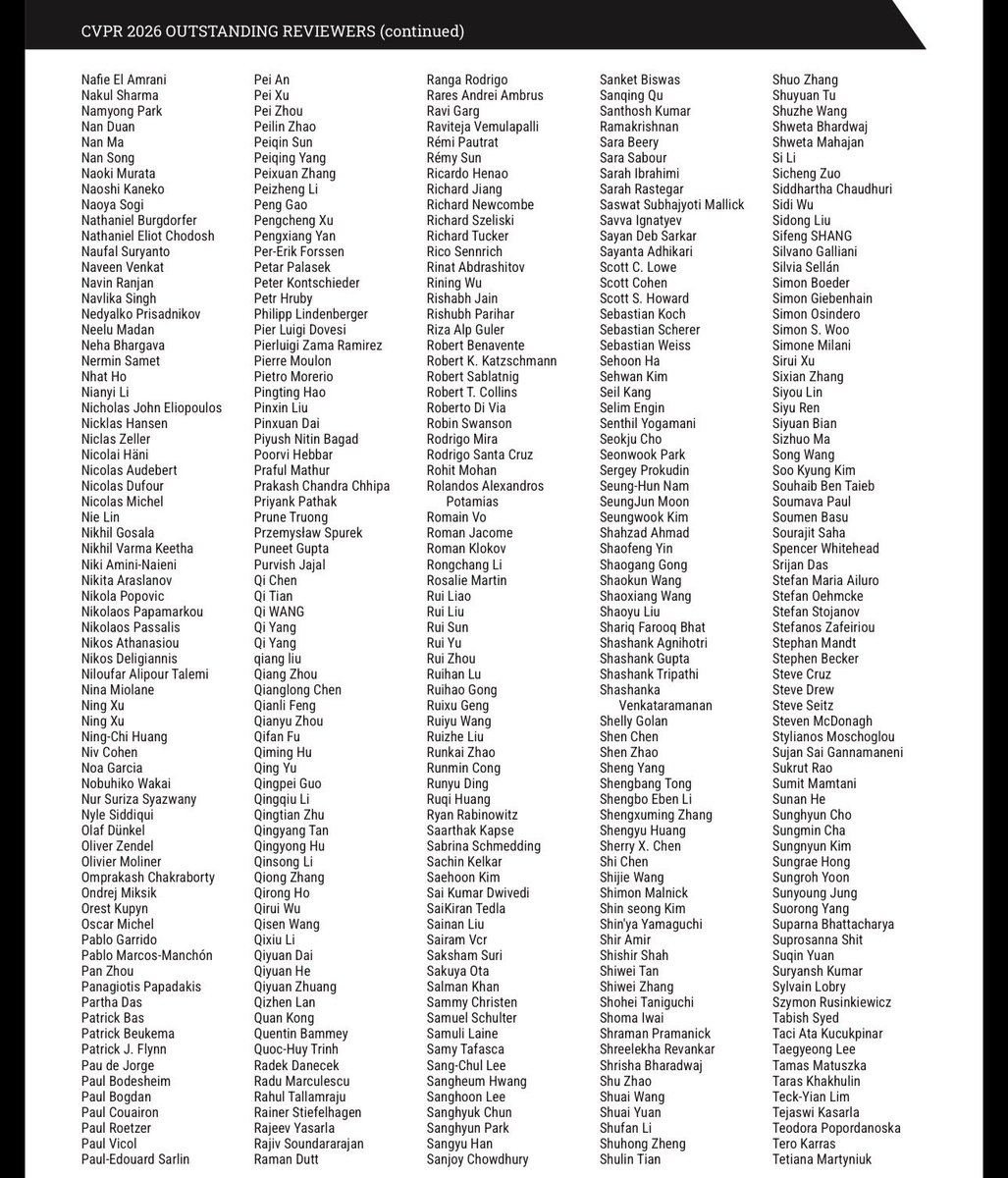
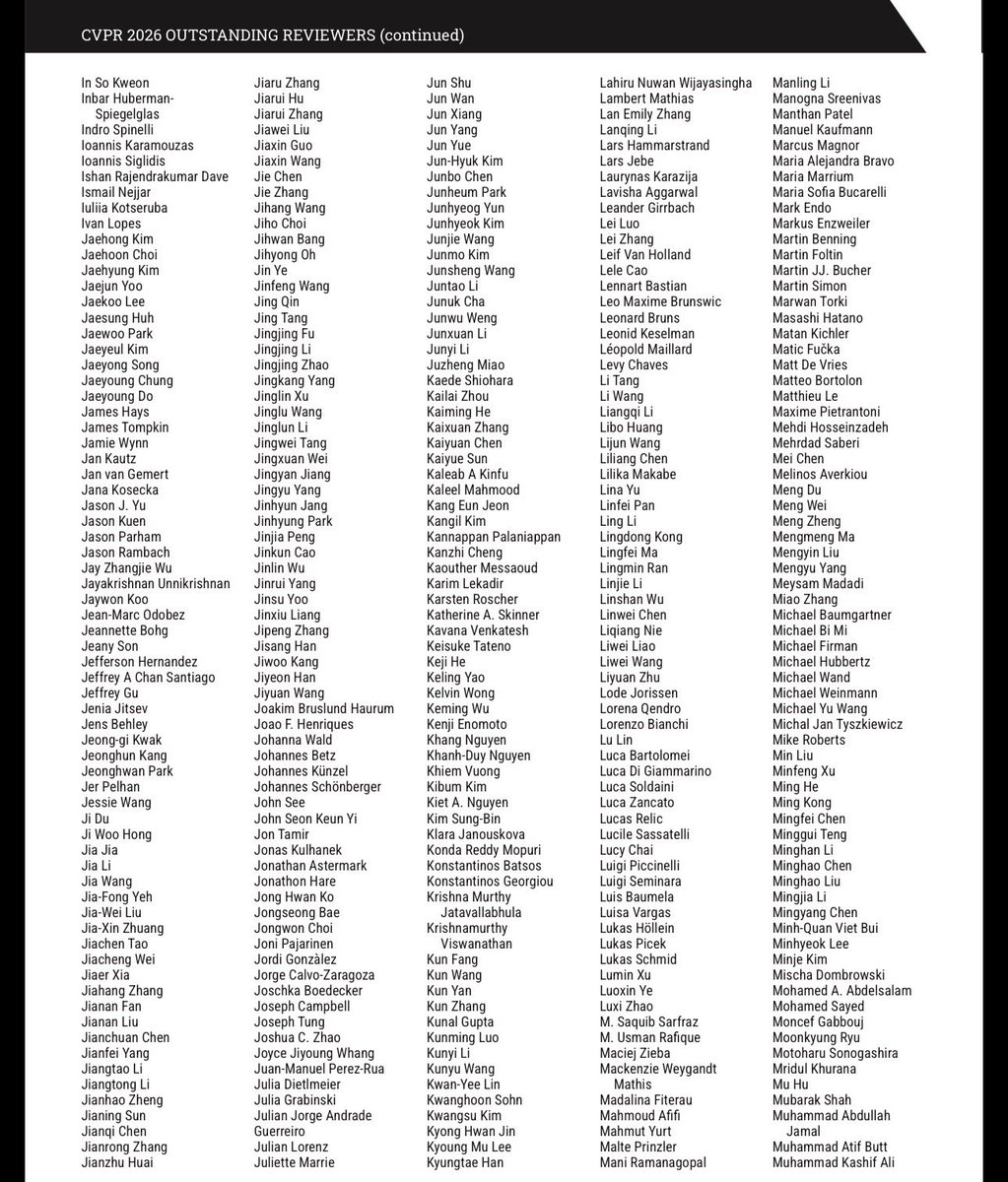
We are grateful to all of the 17,491 reviewers who helped make #CVPR2026 possible. We are especially pleased to recognize the following Outstanding Reviewers, whose high-quality reviews (as judged by their Area Chairs) placed them among the top 5% of reviewers.
The unelected technocratic super-structure sitting above the nation I’m a citizen of., calling me a tinfoil hat 👌
I should not believe my own eyes that there is no growth, high taxes, crazy regulations 👌👌
Super excited about the release of OVIE, a fun project with @nico_dufour@david_picard and @ptrkprz. We show it is possible to learn a competitive realtime interactive navigation model without having access to any video or even multi-view images as training data!
Check it out!
Beautiful rooms that no one can use 🤦
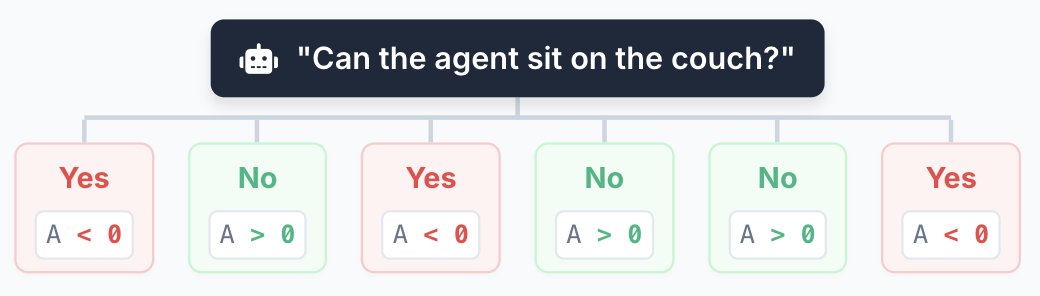
SceneTeract asks the question we've been ignoring: can your agent actually sit on that couch, open that cabinet, navigate that hallway? Spoiler: often not. Awesome work by @LeopoldMaillard 🔥
Many thanks to my co-authors @FrancisEngelman, Tom Durand, @leobxpan, Yang You, @orlitany, @GuibasLeonidas and @maks_ovsjanikov!
We will be releasing the SceneTeract verification suite and data to bridge perception and physical reality in embodied 3D scene understanding 🚀
Check-out and play with our interactive website: https://t.co/32zzMBc80H
Generative models can create visually stunning 3D rooms, but are they functional for the agents inside them? 🛋️🤖
Introducing SceneTeract - a framework that verifies 3D scene functionality under agent-specific constraints!
📄: https://t.co/ZCc822hMPU
🌐: https://t.co/nFkP0nuIba
🧠In response, we use SceneTeract as a scalable and automated reward engine for reinforcement learning.
By using our geometric verification labels as GRPO reward signals, we can distill functional affordance constraints into the reasoning paths of VLMs.
📈Consequently, prediction accuracy improves, physical hallucinations drop, and the model becomes more inclusive, reducing the performance gap across different agent profiles!
1/n 🧵 Introducing Gaussian Wrapping — a principled framework for extracting high-quality meshes from 3DGS! 🚲
We recover thin structures, like bicycle spokes, where all prior methods fail.
Follow the thread for a brief overview and links!
Major work from Erkan and Maks!
> show that generative drifting is fundamentally score matching
> suggest an exponential schedule to break convergence bottleneck
> provide a general recipe for building novel drift operators
> principled, theoretically-grounded 🤌
Generative Drifting achieves SOTA 1-step image generation.
But why does it work?
We show that optimal transport and, surprisingly, plasma physics, allow us to answer 4 key questions
Preprint here: https://t.co/iGrkvjPRNQ
Details below.
The token cost to build a production feature is now lower than the meeting cost to discuss building that feature.
Let me rephrase.
It is literally cheaper to build the thing and see if it works than to have a 30 minute planning meeting about whether you should build it.
It’s wild when you think about it.
This completely inverts how you should run a software organization. The planning layer becomes the bottleneck because the building layer is essentially free. The cost of code has dropped to essentially 0.
The rational response is to eliminate planning for anything that can be tested empirically. Don’t debate whether a feature will work.
Just build it in 2 hours, measure it with a group of customers, and then decide to kill or keep it.
I saw a startup operating this way and their build velocity is up 20x. Decision quality is up because every decision is informed by a real prototype, not a slide deck and an expensive meeting.
We went from “move fast and break things” to “move fast and build everything.”
The planning industrial complex is dead.
Thank god.