Honestly, Linux has lots of room for os engineers and tools over there are modular and slim, generally speaking. Perhaps you could consider investing some time over there. The grass actually is very green, @davepl1968
Fixing Windows, one kilobyte at a time.
Back in the NT days, Notepad was lean, fast, and stayed in its lane. Today? It wants an account, cloud sync, and Copilot’s opinion.
So I did what any retired OS engineer would do: rebuilt it from scratch.
2,686 bytes. Full features. Zero bloat. Pure Win32.
All in assembly language.
No telemetry. No nonsense. Just the Notepad you remember — only smaller than the thumbnail image!
Would love to hear what you think — and what other “impossible” tiny apps we should tackle next.
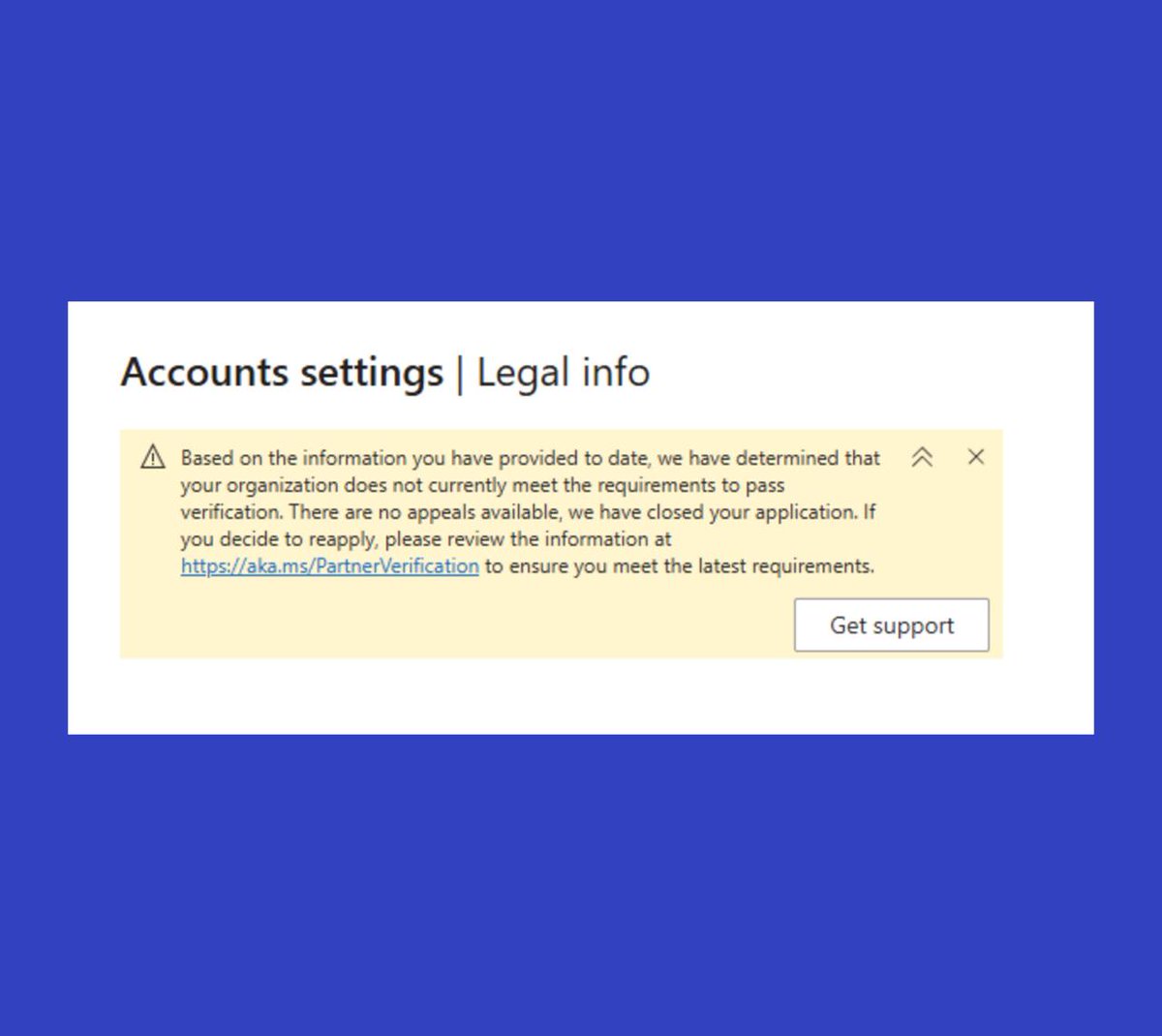
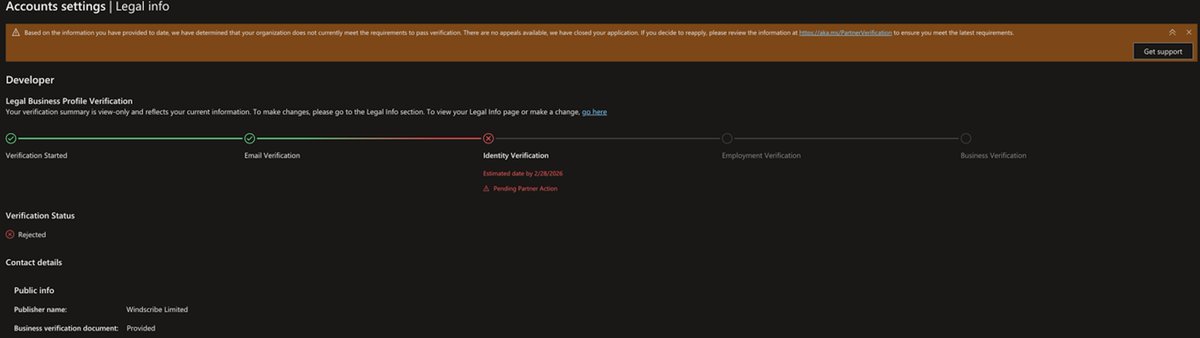
It appears @Microsoft is actively suspending developer accounts with no warning or reason of various security tools like VeraCrypt, WireGuard and also Windscribe. We've had this VERIFIED account for 8+ years to sign our drivers.
We've been trying to resolve this for over a month, and getting nowhere. Support is non-existent. Anyone know a human with a brain that still works at Microsoft and can help?
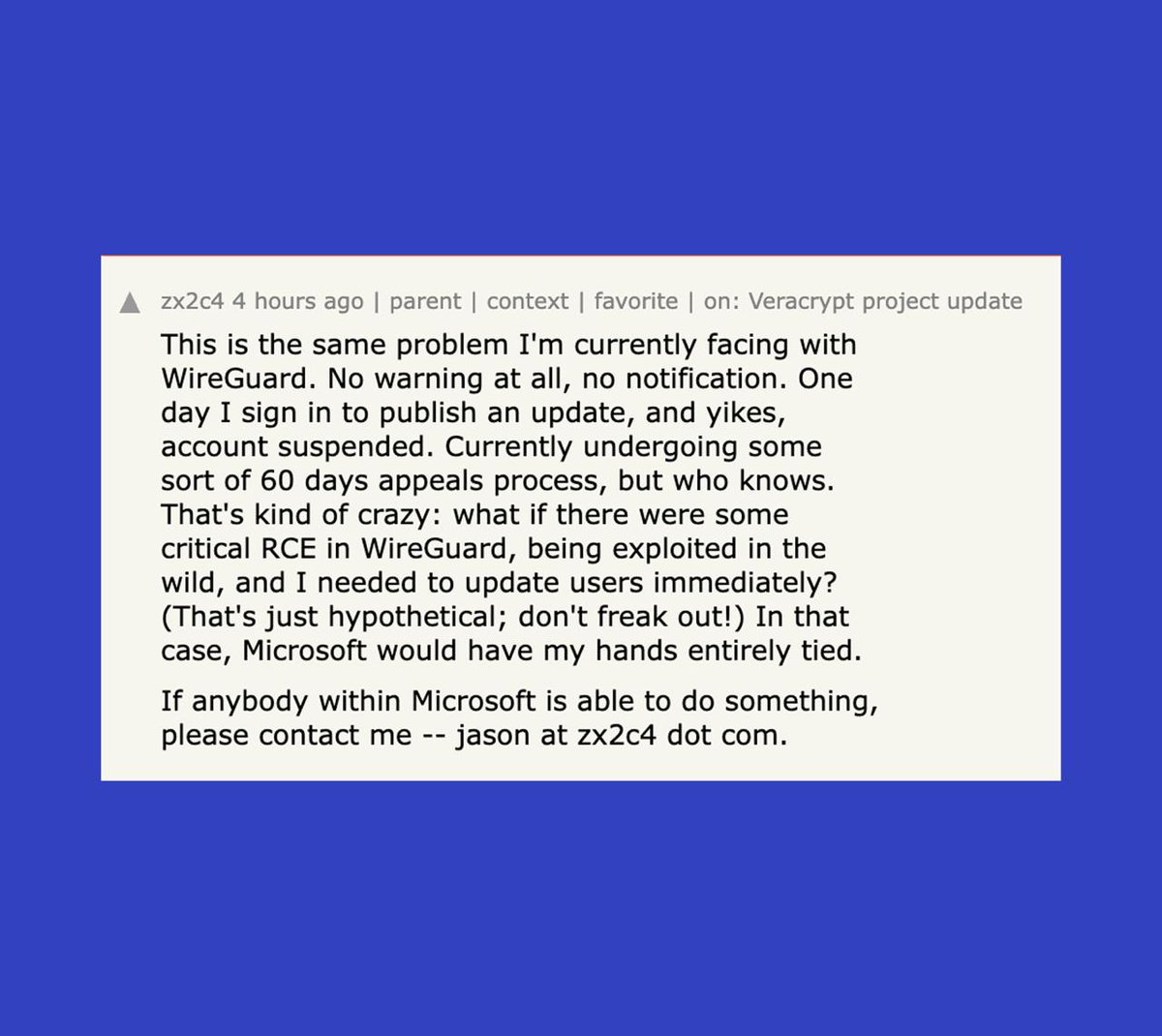
Microsoft suspended the developer account for WireGuard (and also VeraCrypt).
Why? Literally nobody knows. Presumably it's because Microsoft hates everyone and wants us all to suffer.
There is a project on GitHub called Axios.
Axios is extremely popular. It is used by millions upon millions of applications.
Axios is a programming library that helps your JavaScript code make HTTP/S requests (communicate with websites).
In simple terms, if you're a programmer doing something with JavaScript, and want to do stuff that communicates with a website in literally any capacity, people heavily recommend using Axios due to its simplicity. Using Axios you don't have to reinvent the wheel and do a bunch of work. All you need to do is import Axios into your code and you're off to the races.
Someone (currently unknown) compromised Axios (currently unknown how) to deliver malware to people. When someone updates or installs Axios, Axios itself contains malware.
What the malware does is (currently) unknown, but it is being reversed engineered by probably every malware analyst on the planet at this moment. In a few hours more details will emerge. Information is being exchanged in real time on social media and private communication platforms as I write this.
Due to the size and popularity of Axios, it is unknown how many are impacted, it could be millions, it could be thousands, or if we're lucky, only hundreds of people or organizations will be impacted.
If this is absolute worst case scenario, millions of organizations across the planet have been infected with malware which (currently) we do not understand. However, the likelihood of this is low. It appears Axios being compromised was detected quickly, potentially within minutes (or hours) of it being compromised to deliver malware. Additionally, the likelihood of every single Axios user updating Axios as soon as it was compromised to deliver malware is astronomically low. It is basically zero.
The impact from Axios being compromised is devastating, the fallout from this will be a massive headache. This is unironically a malware nuclear missile and will likely be studied in the future.
@vxunderground Hey, my address changed. Where do I change it online? In ONE place. Hey my SSN won’t change, but I can change who should be allowed access to it. And it should be illegal to store it anywhere except in my personal data api.
@vxunderground It’s time for a paradigm shift, a data ownership shift… like a personal data api. You authorize who can fetch your data and which pieces, therefore you know who has it. If it changes, you can push updates. You can restrict access. It’s not perfect, but it’s better.
Last night I captured over 60k photos of the largest supermoon of the year using two telescopes to reveal the hidden color in 119 megapixels. I call the print "Artemis Beckons", after the next crewed lunar mission.
See the reply for the up close details and explanation 👇