this is the most DANGEROUS thing on internet today
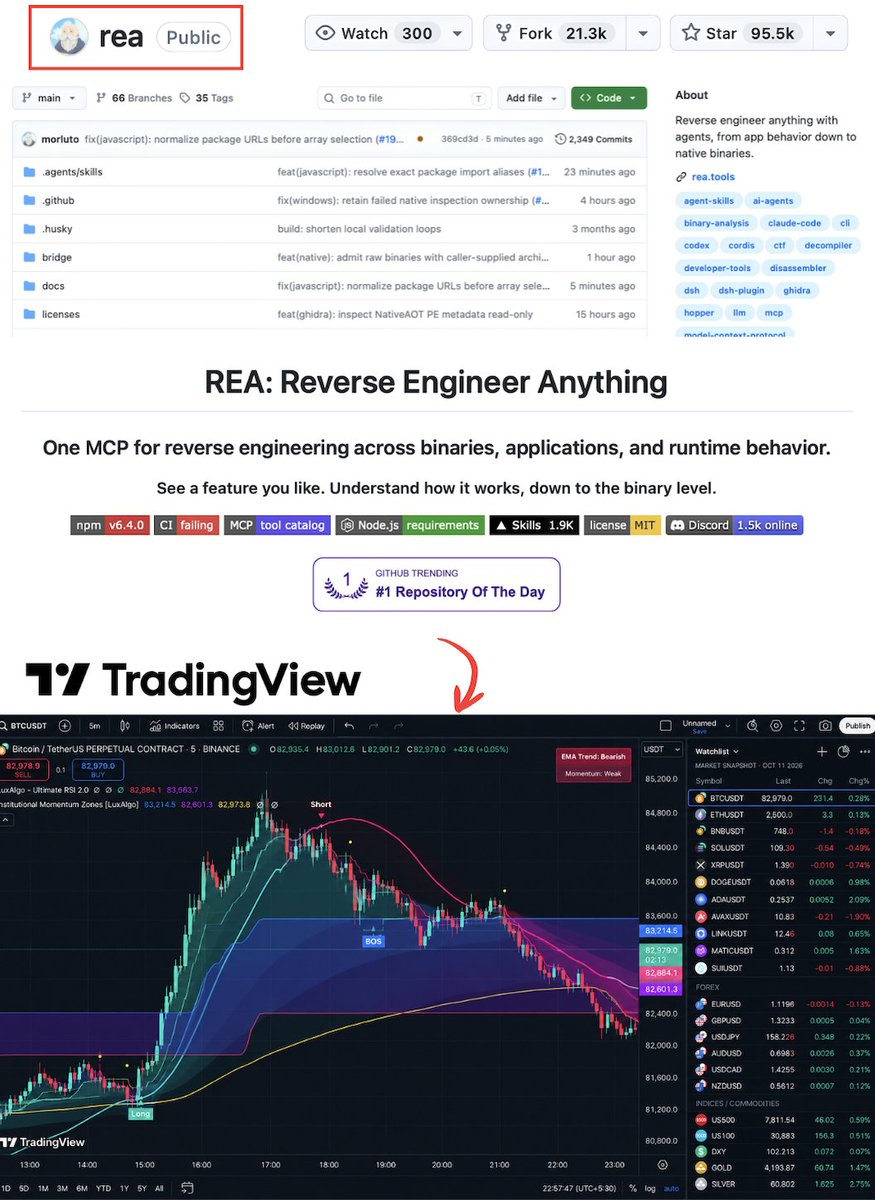
REA (Reverse Engineer Anything) - this open source MCP lets your AI agent reverse engineer any app, down to the binary
i just reverse engineered TradingView, now I am using their premium indicators for FREE - software is cooked
here is how to use REA to reverse engineer TradingView:
1. point REA at TradingView's publicly observable interface and map every major feature, from chart interactions to indicators and alerts
2. trace how the interface behaves when you switch symbols, change timeframes, add indicators, draw levels, and update chart layouts
3. use REA's available MCP tools to investigate authorized software artifacts and trace application logic wherever the evidence allows
4. feed those findings into Claude Opus 5.5, which turns the investigation into a technical specification and an implementation plan
5. rebuild the charting engine independently, with real market data, candlesticks, technical indicators, drawing tools, and persistent watchlists
6. add a quant backtesting engine that tests strategies against historical data, accounting for fees, slippage, and drawdowns
7. test every component, compare its behavior against documented and observable results, fix failures, and keep iterating until the system actually works
8. you end up building your own TradingView-style quant research terminal from scratch, with source code you control and features you can keep extending
i won’t say anything more:
NVIDIA really removed the biggest friction point in Voice AI 🤯
They open-sourced PersonaPlex-7B, a full-duplex conversational model that can listen and speak at the same time.
Instead of waiting for you to finish talking, it uses a dual-stream architecture to process and respond in real-time.
100% Open-Source and Free.
NVIDIA and MIT researchers just used Karpathy’s method to cut Agent harness costs by 2x - dropped 15-page PDF
The shift: one formula replaced prompt engineering: same LLM, same benchmark - change just the harness
here’s how they built it:
step 1 → inspect the agent’s execution logs - repeated actions, growing context, oversized outputs - find where tokens stop moving the task forward
step 2 → run Karpathy’s loop on the harness: propose → implement → review → test → keep or discard. Fix the quality and efficiency gates before the search starts
four fixes survived:
step 3 → fuse actions: edit the file and run its planned test in one tool call - remove the model round trip between them
step 4 → compact at completed steps - but only when expected savings outweigh the cost of rewriting the cached context
step 5 → stop replaying huge outputs: archive them, send them twice, then keep a handle and short excerpt. Retrieve exact pages when needed
step 6 → delegate log reading to a cheaper model - verify its evidence against the original. If verification fails, return the full log
how to steal this for your agents:
step 7 → start with one mechanism in Pi, where their code runs. Measure it against your current setup before combining all four
step 8 → freeze the changes, then test on unseen tasks. Track completion, API cost and tokens together - a cheaper failure is still a failure
the result:
50-54% lower API costs than native Codex and Claude Code on EdgeBench - using the same main LLMs
Against Pi: about one-third cheaper, 45-49% fewer tokens, retaining roughly 94% of its average score
bookmark this 15-page PDF - then build the full workflow from the article below ↓
Researchers proved AI has deleted every reason universities exist.
Harvard University ran a controlled experiment pitting a custom AI against their own top-tier classrooms.
And the results are going to collapse the higher education bubble.
They took 194 undergraduates and split them up.
One group learned physics in one of Harvard’s best hands-on, active-learning physical classrooms. Group work. Instructor support. The premium university experience.
The other group went home and learned the exact same material with an AI tutor.
The AI didn't just win. It embarrassed the institution.
Students using the AI learned more than twice as much as the students in the elite Harvard classroom.
They scored 30% higher on the final assessment.
And they did it in less time.
Let that sink in.
A piece of software sitting on a laptop outperformed a world-class faculty in one of the most elite learning environments on Earth.
Universities have always justified their exorbitant tuition with two things: access to elite knowledge and the physical classroom experience.
This study just proved both of those moats are gone.
When software can teach you complex physics twice as well as a $60,000-a-year institution, the math of higher education breaks permanently.
The AI didn't just give the students answers. It used strict pedagogical guardrails. It guided. It questioned. It forced the students to do the cognitive work.
It offered perfect, one-to-one tutoring, personalized to the exact moment a student misunderstood a concept.
That level of attention is mathematically impossible to scale in a physical lecture hall.
For a thousand years, the university was the only place to get a premium education.
Now, it’s the bottleneck.
If AI can double your learning speed for a fraction of the cost, what exactly are students taking on decades of debt to pay for?
Jev Founder, Diogo Amogo, just released a PDF on building a Jev Harness for coding agents
this is a blueprint on how to make your coding agents 200× faster and 400× cheaper
Send this PDF and the article below to your Claude
Code or Codex instance and start shipping 200× faster 👇
Git commands I used 99% of the time:
𝟭. 𝗴𝗶𝘁 𝗱𝗶𝗳𝗳: Show file differences not yet staged.
𝟮. 𝗴𝗶𝘁 𝗰𝗼𝗺𝗺𝗶𝘁 -𝗮 -𝗺 "𝗰𝗼𝗺𝗺𝗶𝘁 𝗺𝗲𝘀𝘀𝗮𝗴𝗲": Commit all tracked changes with a message.
𝟯. 𝗴𝗶𝘁 𝘀𝘁𝗮𝘁𝘂𝘀: Show the state of your working directory.
𝟰. 𝗴𝗶𝘁 𝗮𝗱𝗱 𝗳𝗶𝗹𝗲_𝗽𝗮𝘁𝗵:Add file(s) to the staging area.
𝟱. 𝗴𝗶𝘁 𝗰𝗵𝗲𝗰𝗸𝗼𝘂𝘁 -𝗯 𝗯𝗿𝗮𝗻𝗰𝗵_𝗻𝗮𝗺𝗲: Create and switch to a new branch.
𝟲. 𝗴𝗶𝘁 𝗰𝗵𝗲𝗰𝗸𝗼𝘂𝘁 𝗯𝗿𝗮𝗻𝗰𝗵_𝗻𝗮𝗺𝗲: Switch to an existing branch.
𝟳. 𝗴𝗶𝘁 𝗰𝗼𝗺𝗺𝗶𝘁 --𝗮𝗺𝗲𝗻𝗱:Modify the last commit.
𝟴. 𝗴𝗶𝘁 𝗽𝘂𝘀𝗵 𝗼𝗿𝗶𝗴𝗶𝗻 𝗯𝗿𝗮𝗻𝗰𝗵_𝗻𝗮𝗺𝗲: Push a branch to a remote.
𝟵. 𝗴𝗶𝘁 𝗽𝘂𝗹𝗹: Fetch and merge remote changes.
𝟭𝟬. 𝗴𝗶𝘁 𝗿𝗲𝗯𝗮𝘀𝗲 -𝗶: Rebase interactively, rewrite commit history.
𝟭𝟭. 𝗴𝗶𝘁 𝗰𝗹𝗼𝗻𝗲: Create a local copy of a remote repo.
𝟭𝟮. 𝗴𝗶𝘁 𝗺𝗲𝗿𝗴𝗲: Merge branches together.
𝟭𝟯. 𝗴𝗶𝘁 𝗹𝗼𝗴 --𝘀𝘁𝗮𝘁: Show commit logs with stats.
𝟭𝟰. 𝗴𝗶𝘁 𝘀𝘁𝗮𝘀𝗵: Stash changes for later.
𝟭𝟱. 𝗴𝗶𝘁 𝘀𝘁𝗮𝘀𝗵 𝗽𝗼𝗽: Apply and remove stashed changes.
𝟭𝟲. 𝗴𝗶𝘁 𝘀𝗵𝗼𝘄 𝗰𝗼𝗺𝗺𝗶𝘁_𝗶𝗱: Show details about a commit.
𝟭𝟳. 𝗴𝗶𝘁 𝗿𝗲𝘀𝗲𝘁 𝗛𝗘𝗔𝗗~𝟭: Undo the last commit, preserving changes locally.
𝟭𝟴. 𝗴𝗶𝘁 𝗳𝗼𝗿𝗺𝗮𝘁-𝗽𝗮𝘁𝗰𝗵 -𝟭 𝗰𝗼𝗺𝗺𝗶𝘁_𝗶𝗱: Create a patch file for a specific commit.
𝟭𝟵. 𝗴𝗶𝘁 𝗮𝗽𝗽𝗹𝘆 𝗽𝗮𝘁𝗰𝗵_𝗳𝗶𝗹𝗲_𝗻𝗮𝗺𝗲: Apply changes from a patch file.
𝟮𝟬. 𝗴𝗶𝘁 𝗯𝗿𝗮𝗻𝗰𝗵 -𝗗 𝗯𝗿𝗮𝗻𝗰𝗵_𝗻𝗮𝗺𝗲: Delete a branch forcefully.
𝟮𝟭. 𝗴𝗶𝘁 𝗿𝗲𝘀𝗲𝘁: Undo commits by moving branch reference.
𝟮𝟮. 𝗴𝗶𝘁 𝗿𝗲𝘃𝗲𝗿𝘁: Undo commits by creating a new commit.
𝟮𝟯. 𝗴𝗶𝘁 𝗰𝗵𝗲𝗿𝗿𝘆-𝗽𝗶𝗰𝗸 𝗰𝗼𝗺𝗺𝗶𝘁_𝗶𝗱: Apply changes from a specific commit.
𝟮𝟰. 𝗴𝗶𝘁 𝗯𝗿𝗮𝗻𝗰𝗵: Lists branches.
𝟮𝟱. 𝗴𝗶𝘁 𝗿𝗲𝘀𝗲𝘁 --𝗵𝗮𝗿𝗱: Resets everything to a previous commit, erasing all uncommitted changes.
Building custom 3D WebGL experiences used to require a massive agency budget and months of coding. Not anymore. 🛑
Here is how to engineer a premium, immersive scrollytelling website featuring an interactive 3D character, dynamic cursor tracking, and parallax depth. 🌲
I used Claude Code to build this frontend UI/UX architecture from scratch. Zero manual CSS fighting.
The exact frontend tech stack:
✅ React & Next.js (Core framework)
✅ Three.js / WebGL (3D creature rendering & environment depth)
✅ Tailwind CSS (Clean typography & modern layout)
✅ Framer Motion (Custom cursor physics & scroll choreography)
Stop building flat web templates. Start building premium interactive frontend web design.
Copy my exact AI build prompt below 🧵👇
💥 أعلنت NVIDIA رسمياً عن إطلاق نموذج PersonaPlex 7B، أحدث نموذج محادثة صوتية ثنائي الاتجاه بالكامل (Full-Duplex) يستمع ويتحدث في نفس الوقت بالضبط!
• تفاعل طبيعي 100%: يستمع ويتكلم بشكل متزامن دون أي تأخير أو انتظار.
• ذكاء في إدارة الحوار: يستوعب المقاطعة أثناء الحديث، ويفهم الإيماءات الصوتية السريعة والتفاعل اللحظي تلقائياً.
• تخصيص كامل: تحديد أي صوت وأي شخصية بنص برمجي بسيط.
حقبة التأخير في الاستجابة والأحاديث الآلية انتهت للأبد.. المستقبل للذكاء التفاعلي اللحظي! ⚡️🔥
بدون ضجيج إعلامي.. AMD تفتح الوصول المجاني الكامل للـ API لأعتى نماذج الذكاء الاصطناعي! 🚨😳💥
أتاحت AMD إمكانية الوصول والتجربة المباشرة لنماذج مرعبة مثل DeepSeek-V4-Flash و Qwen3.8-Flash-Next مجاناً ودون الحاجة لبطاقات دفع أو دفع مسبق!
الرابط وكيفية التسجيل قبل انتهاء الفترة المجانية بالداخل 🧵👇
The Best Local 3D AI Generator runs now natively in ComfyUI on just 6gb vram.
Pixal3D is able to generate high quality 3D AI Models in only a few seconds. All local and free on your own PC.
No installation issues anymore and easier to use than ever before!
Here’s how to build an AI agent from scratch in pure Python.
No LangChain, no agent framework.
We’ll add memory, tool calling, file access, shell commands, and the agent loop until we have a mini Claude Code.
Timestamps:
00:00 | Overview
00:30 | What is an Agent?
02:52 | The Three Steps
03:21 | Step 1 - Calling an API
11:50 | HubSpot Free Resource
13:15 | Step 2 - Conversation History
17:08 | Step 3 - Tool Calling
28:09 | Full Agent Build
For people who keep asking what to build in AI Engineering.
➣ Build your own Agent Orchestrator (deterministic state machine, no LangChain)
➣ Build your own Context Assembler (token-budgeted memory + retrieval + tools)
➣ Build your own MCP Server and Client (raw JSON-RPC, no SDK)
➣ Build your own Retrieval Stack (chunker + BM25 + dense + reranker from scratch)
➣ Build your own Eval Harness (trajectory grading + CI regression gates)
➣ Build your own Model Router (cost/latency/quality routing with fallbacks)
➣ Build your own Semantic Cache (embedding similarity + hit-rate tracking)
➣ Build your own Guardrails Middleware (injection detection + PII redaction)
➣ Build your own Streaming Proxy (SSE with TTFT and ITL metrics)
➣ Build your own Durable Workflow Engine (checkpoint/resume, mini-Temporal)
➣ Build your own LLM Tracer (OpenTelemetry-style spans for every hop)
➣ Build your own Sandboxed Tool Executor (isolated execution, resource limits)
➣ Build your own Prompt Registry (versioning + A/B routing + rollback)
➣ Build your own Data Flywheel (feedback → synthetic data → LoRA loop)
➣ Build your own Multi-Agent Consensus (weighted voting + judge + escalation)
Pick 3. Build them from scratch. Document every decision.
Most people import libraries.
Builders understand them.
(Bookmark & Repost.)
FIVE LAYERS OF AGENT ENGINEERING, EACH ONE WRAPS THE ONE BELOW IT. IF YOU SKIP LAYER 2, YOUR LAYER 5 WILL LOOK BROKEN WHEN IT IS ACTUALLY JUST STANDING ON NOTHING.
for weeks i debated harness vs loop vs graph like they were competing choices.
then a stack diagram made the shape obvious. they are not choices. they are floors.
01 | prompt engineering. the message.
unit of work: one input. inputs are role, instructions, examples, format. output is a single raw response.
02 | context engineering. the memory.
unit of work: what stays in the window. a curator selects, compresses, and drops from query, docs, memory, prior turns, and tool outputs before the prompt runs.
03 | harness engineering. the machine.
unit of work: the machine itself. gather (context + prompt) → LLM → tools or sub-agents → verifier → final response. the article calls this the operating environment.
04 | loop engineering. the system.
unit of work: the run. goal + success criteria + max iterations + budget + completion check wrap around one harness pass. failed pass appends results to context and retries.
05 | graph engineering. the topology.
unit of work: the graph run. goal + nodes + edges + state schema. graph routes to agent nodes, tool nodes, or human approval. a reviewer node with a different model and fresh context checks the final answer.
the wrapping is the whole point. layer 5 assumes layer 4 works. layer 4 assumes layer 3 works.
skip layer 2 and layer 3's verifier keeps failing without a clear reason.
this is why swapping the model is a one-day project and swapping the stack is a quarter.
the model is the commodity. the five layers around it are the engineering.
full three-layer breakdown of the top of the stack (harness, loop, graph) in the post below.
The winner of an Anthropic hackathon open sourced his entire Claude Code setup. 68 subagents, 286 skills, 94 commands, MIT license
ECC turns Claude Code from one assistant into a full engineering team. It plans before it builds, writes the failing test first, then reviews its own work from a fresh context.
The agents, by job:
Planning. Turns a one-line request into a blueprint you approve before any code exists.
Review. Reads your diff in a clean context, with separate reviewers for Go, Python, TypeScript, Rust, Java and more.
Build repair. One resolver per toolchain, down to PyTorch and CUDA errors.
Security. An OWASP pass on your code, plus a scanner that audits your own agent config for injection risks.
Architecture. System design calls before they turn into migrations.
Domain work. Database queries, ML pipelines, end-to-end tests, docs.
The skills, by category:
Testing. tdd-workflow gates you from red to green, with eval-harness and verification-loop sitting on top of it.
Language packs. Idioms, testing and security for Python, Go, Rust, C++, Django, Laravel, Spring Boot, Next.js.
Context. search-first makes it read the docs before writing, iterative-retrieval keeps subagents from dragging your whole repo into the window.
Shipping. Docker, CI/CD, health checks, rollbacks, and migration patterns for Prisma, Drizzle and Django.
Work that is not code. Writing in your voice, market research with sources, pitch decks, slide decks.
Start with one plan and one rules pack. Installing all 286 skills at once is the fastest way to make it worse.
WebMCP by Microsoft and Google is HERE and I'm surprised more people aren't talking about it.
Why does it matter?
BILLIONS of dollars are about to move through agents, and the internet isn't built for them yet.
1. SEO was about Google understanding your page.
2. AEO was about AI citing you.
3. WebMCP is about the agent actually finishing the job (buying, researching, requesting quote etc).
WebMCP is basically websites with agent buttons.
Instead of an agent scanning a page like a human, screenshotting and guessing where to click, the site just tells it "here's how to search, here's how to book, here's how to buy."
2 cash flowing businesses you could start today using WebMCP:
1. A WebMCP conversion agency
Make boring business websites agent-ready. Law firms, HVAC, med spas, dentists. Build them the first tools (request a quote, book a consult), sell the setup for $2k, then charge a few hundred a month to monitor and improve it.
2. An agent mystery shopper.
Test whether agents can actually complete the important journeys on someone's site, buying the hoodie, booking the consult, filing the claim. Hand them a report on where the agent got stuck, missing tools, bad descriptions, lost conversions. Charge monthly, then turn the repeated fixes into software.
Full episode on @startupideaspod with @hot_town below
https://t.co/GXL9GDmKQw
You'll learn what WebMCP really is, see examples of it IN ACTION, and hear more about 2 startup ideas using WebMCP you can start today.
WebMCP is pretty cool.
Watch.
Semrush charges $139.95/month.
Ahrefs charges $129/month.
A guy named Ben built the open-source alternative that you can run on your computer.
It is called OpenSEO.
Enter a competitor's website and it reveals the keywords bringing them traffic, the pages winning those searches, and the backlinks helping them rank.
And enter your own site and it tracks rankings, crawls technical problems, reads Search Console, and shows whether ChatGPT or Google AI Overviews mention your brand.
Then connect Claude or Codex.
Your agent can pull the real numbers, compare opportunities, cluster keywords, and save a strategy back into the dashboard instead of guessing from a prompt.
The hosted version starts at $10 a month. The entire codebase is MIT licensed, so you can also self-host it and pay DataForSEO directly for only the data you use.
No, it does not magically reproduce every database and advanced feature Ahrefs built over a decade.
But it breaks the most important rule of the old SEO market:
You no longer need their permission to own the tool.
https://t.co/WU9wr98RNo