@jvin248@Winston_104 "Pérez-Obiol et al. (2011) divide the Holocene in Iberia into three phases: a humid phase (12000–7000 BP), a transition phase (7,000–5500 BP), and an aridification phase (5,500 BP–>). By ~5500 cal yr BP, summer-drought regime was firmly established across most of the peninsula."
@Winston_104 Here's a good example where havenbound's model differs a lot to yours. 9 days after: greenland & antarctica submerged
settled in: havenbound (undefined how long) africa/pacific risen
settled in your model (3 months after): land gradually resurfacing (doggerland for example)
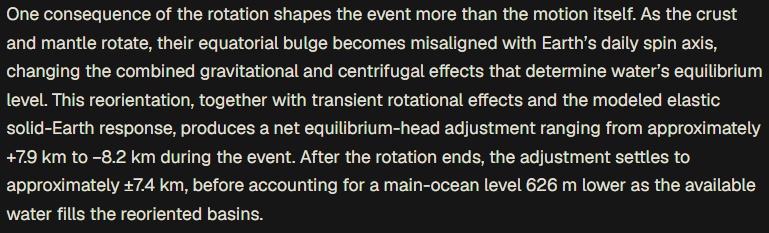
@Winston_104 Check the screenshot of when the water has settled (above the video). It appears their model assumes the equatorial bulge of the crust stays fixed - uplifting Africa and the Pacific at the new poles while submerging all of Antarctica and northern hemisphere approximately ±7.4 km
@Winston_104 The model simulation is available for free but you need to sign up first (requires only an email). Here's a direct link to the ECDO sim (accessible after login): https://t.co/HY30KpSz3u
@Winston_104 Thanks for your time and effort. I just checked out havenbound's model of ECDO and it looks vastly different. The attribution to heigh difference of the equatorial bulge seems extreme with land surfacing at the Pacific and Africa bulging out akin to Antarctica with equators drown
@Winston_104@miopa_ The current NP & SP looks as if it is a cleared of all water in a perfect circle. Is this just a visual artefact of the video or? During the S2 monthly timelapse it appears as if it is "filled back in"..
@miopa_@Winston_104 I'm no expert but I think his model is accounting for the ocean floor topology and where the total water content would migrate to in State 2. Looks like a lot is pooling around the new poles such as Central Africa. Maybe it is a relaxation of the crust due to the equatorial bulge
@The_Triponacci@stephXskystory You've vehemently opposed the theory and TES. Are you just trolling Stephanie here in your name of scientific integrity?
@CredenceClearoj@demystifysci@FlintDibble "the steel in the wreckage from this landslide would provide ample evidence of this building in 100,000 years time"
@grok What is the rate of decay of iron buried in a landslide and left alone to mother nature?