Feedback from 10+ blind participants after trying our system:
"I can tell someone sighted how to get somewhere now."
"I started getting a picture in my mind of where everything was."
Recently, we brought TouchingSpace to the PitchAbility Expo, Vista Center's accessibility pitch expo in San Jose. It turns an everyday laptop trackpad into an audio-haptic map: blind and low-vision people explore a place by touch and ask an AI agent about what they find before a trip.
No special hardware or printed tactile maps.
Any place, any scale, any layers, on a built-in trackpad.
Demo: https://t.co/Jcuniy8sXa
#Accessibility #AssistiveTechnology #HCI #AI #GeminiLive #Haptic
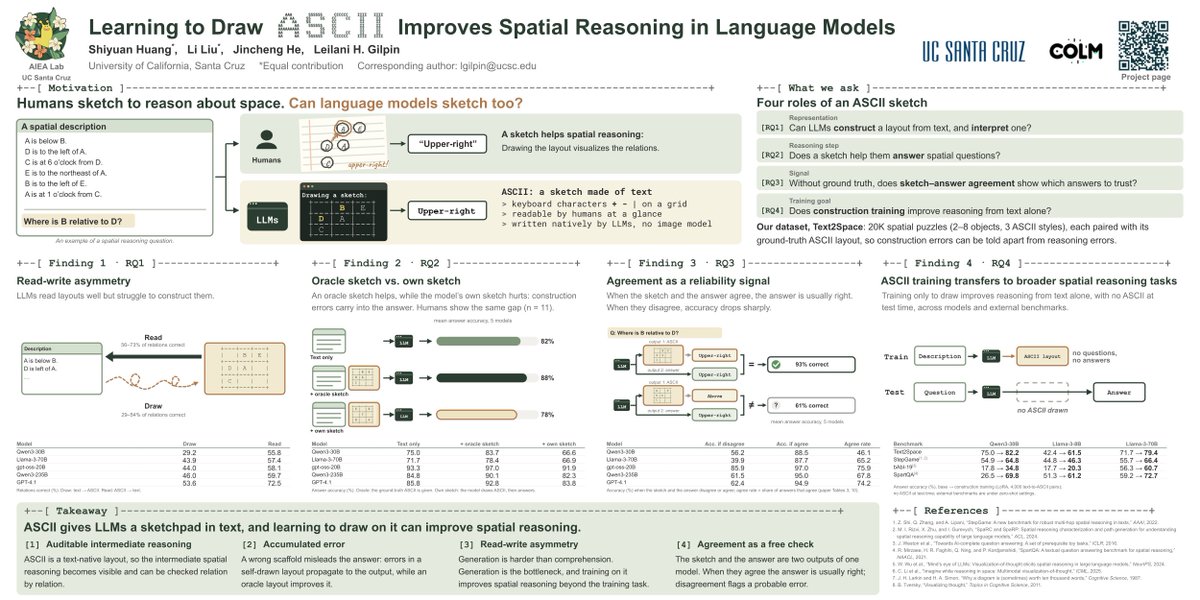
Heading to #COLM2026 in San Francisco to present our paper, "Learning to Draw ASCII Improves Spatial Reasoning in Language Models."
Project page: https://t.co/wYV0G8bQxC
🗓 When: Wed, Oct 7, 11:00 AM - 1:00 PM PST
📍 Where: Imperial Ballroom, Poster #45
Can LLMs use ASCII art as a sketchpad for spatial reasoning?
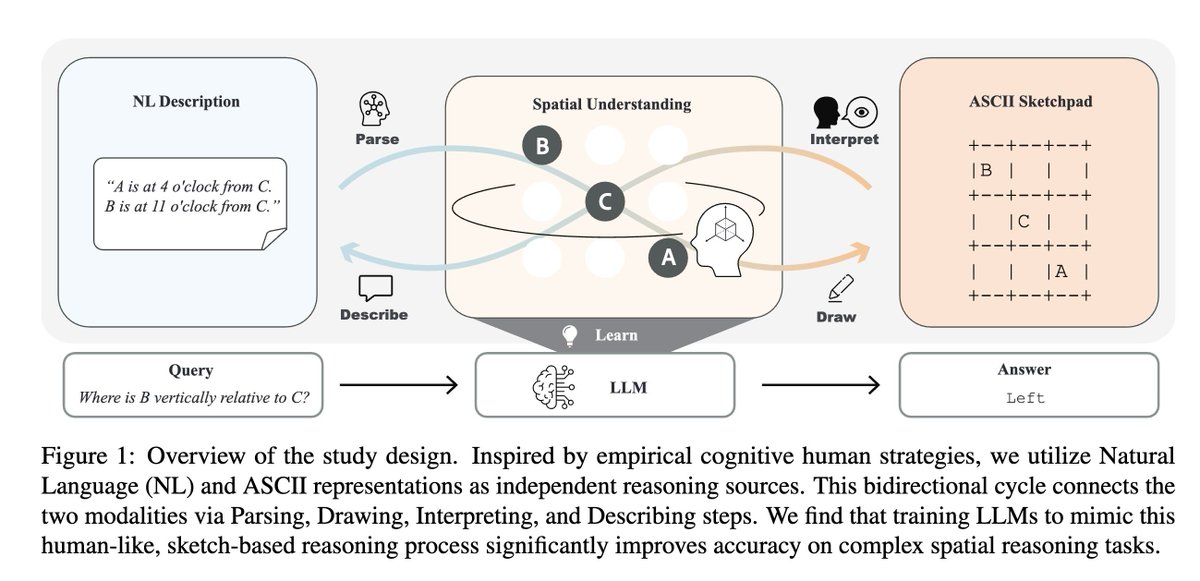
ASCII art carries visual layout inside a language model's own token space. It connects what LLMs process with spatial layouts that people can read. We asked whether LLMs can use ASCII the way people use sketch paper to draw a map: to represent, sketch, and reason about spatial relations.
For people, reading a map is easier than drawing one. LLMs show the same read-write asymmetry: they parse ASCII layouts well but struggle to draw one from a text description. So we trained them on the drawing side to narrow the gap.
An interesting finding: the training transfers. Models trained to generate ASCII perform better on text-only spatial tasks, even when they produce no ASCII at inference.
Joint work with @ShiyuanHuang_ , Jincheng He, and @leilanigilpin.
#SpatialReasoning #COLM2026 #ASCII #LLMs
Our paper is accepted at COLM 2026! We explored how LLMs can use ASCII arts as a spatial reasoning sketch board.
Looking forward to discussing this work in San Francisco on October 6-8. Grateful to my collaborators @ShiyuanHuang_ and @leilanigilpin.
Thanks for sharing our recent work!
ASCII art is a beautiful format: it carries visual information within the model's native token space, naturally bridging LLMs and human-interpretable spatial layouts. This motivated us to explore whether LLMs can use ASCII to represent, sketch, and reason about spatial relations, just like humans use sketch paper to draw a map.
For humans, reading a map is always easier than drawing one. LLMs turn out to have the same read-write asymmetry: they parse ASCII layouts well but struggle to draw one from text. So we trained them on the drawing side to narrow the gap.
A more interesting finding: training on ASCII generation transfers to other spatial reasoning tasks. Trained ,odels perform better on text-only spatial tasks at inference, without producing ASCII.
Happy this resonates with @_rockt and @NetHack_LE! Looking forward to seeing how it extends to dynamic scenarios: from reading, to drawing, to playing. More to come, happy to discuss!
Collaborated with @ShiyuanHuang_ , Jincheng He, and @leilanigilpin .
Paper:
https://t.co/CRRvhsgFc9
Dataset: https://t.co/cG2WTNHXeB
Thanks for sharing our recent work!
ASCII art is a beautiful format: it carries visual information within the model's native token space, naturally bridging LLMs and human-interpretable spatial layouts. This motivated us to explore whether LLMs can use ASCII to represent, sketch, and reason about spatial relations, just like humans use sketch paper to draw a map.
For humans, reading a map is always easier than drawing one. LLMs turn out to have the same read-write asymmetry: they parse ASCII layouts well but struggle to draw one from text. So we trained them on the drawing side to narrow the gap.
A more interesting finding: training on ASCII generation transfers to other spatial reasoning tasks. Trained ,odels perform better on text-only spatial tasks at inference, without producing ASCII.
Happy this resonates with @_rockt and @NetHack_LE! Looking forward to seeing how it extends to dynamic scenarios: from reading, to drawing, to playing. More to come, happy to discuss!
Collaborated with @ShiyuanHuang_ , Jincheng He, and @leilanigilpin .
Paper:
https://t.co/CRRvhsgFc9
Dataset: https://t.co/cG2WTNHXeB
"Learning to Draw ASCII Improves Spatial Reasoning in Language Models" https://t.co/lRodpryThE
Imagine what learning to *play* ASCII could achieve — @NetHack_LE 😜
Every time I made a last-minute change to my paper/document submission, I was afraid of checking what I might have accidentally broken.
So I built a tiny tool: PDF Diff. It runs at your browser. Free, safe, and open sourced. Welcome feedbacks!
https://t.co/DpE14zKhEu