The best striker on the planet eats like a Norwegian farmer from 1850, and the British tabloids called it "cannibalistic."
Erling Haaland, the six foot four machine breaking every scoring record in sight, has let the world see his plate, and it reads like a carnivore forum brought to life. He buys beef heart and liver from the butcher and eats them by choice. Fatty steaks, the fattier the better, by his own account. Sea bass, salmon, mackerel. Eggs on sourdough. Raw honey. And his self-described "magic potion," raw milk, which he drinks straight, stirs into his coffee and blends with greens to carry to training.
The sourcing is the entire philosophy. Holding up the organs in his documentary, he said most people will not touch them, but he cares about his body and about eating quality local food. Then the line that belongs on a barn door: people say meat is bad, but which meat? The stuff from McDonald's, or the local cow eating grass right over there?
Look at what is missing just as hard. No seed oils. No fizzy drinks. No alcohol. No ultra-processed anything. He filters his water and chases the morning sun. The man treats a packet of crisps the way most people treat a syringe.
Now the honest footnotes, because the internet lost its mind. The famous 6,000-calorie figure is one he flatly waves away, saying he does not count. His dad's lasagne is a sacred pre-match ritual, he makes brisket tacos in the slow cooker, and his actual favourite food is a kebab pizza he allows himself about once a year.
Strip away the cryo chamber and the mouth tape and the part underneath is almost insultingly simple. Whole food, mostly animal, sourced with care, nothing from a factory. The most lethal finisher in football runs on the exact diet the official guidance spent fifty years telling you to fear.
Jeff Bezos went on CNBC today and said AI won't eliminate jobs. It will create a shortage of workers. Every economist warning about unemployment has it completely backwards.
His reasoning is straightforward.
When productivity explodes, the basket of goods people can afford gets cheaper. A two-earner household becomes a one-earner household. Not because someone got fired. Because they no longer need the second income.
People working overtime stop working overtime. Not because the job disappeared. Because they can finally afford not to.
His exact words: "What's actually going to happen is we're going to have labor scarcity as a result. People are going to have to work hard."
Then he went further.
He compared AI to penicillin. To solar cells. To the iPhone. His point: transformative inventions don't get hoarded by the people who build them. They spread through society and raise the floor for everyone.
"The inventions themselves spread throughout society and improve life."
The job loss narrative is loud because scared people share more than optimistic ones.
Bezos isn't dismissing the fear. He's saying the people feeding it are solving the wrong equation.
The question was never how many jobs AI destroys.
It was always how much it costs to live.
SOURCE: CNBC
Elon Musk just sat in JP Morgan's headquarters and explained the next 20 years in one conversation.
Most people will clip the IPO headline and move on.
Here is what they will miss.
SpaceX lists on Nasdaq on June 12 under ticker SPCX. $135 per share. 555 million shares. $75 billion raise. $1.77 trillion valuation.
The largest IPO in the history of financial markets, surpassing Saudi Aramco by more than double.
But the IPO is not the story.
The IPO is the funding mechanism for the story.
Starlink V3 satellites are 10 to 20 times more capable than the current constellation.
Each one is too large for any rocket except Starship.
Starship carries 50 per mission. V3 delivers 100 times the bandwidth at half the latency.
Musk's stated goal is over 100,000 V3 satellites in orbit.
That is not a communications upgrade. That is a full replacement of global internet infrastructure from space.
Then there is the part nobody is covering.
SpaceX is building AI data centres in orbit. Solar power plus radiators plus laser links connecting directly to Starlink, which penetrates cloud cover and reaches the ground regardless of weather.
The moon play goes further. Low gravity. No atmosphere.
Rail guns launching AI data centres into deep space. Solar panels manufactured from moon materials.
Target: 1,000 terawatts of AI compute from lunar orbit versus approximately 1 terawatt achievable from Earth.
That is a 1,000x compute expansion that does not require a single permit on the ground.
Then there is the chip problem, which nobody is solving fast enough.
Musk stated it directly: there is not a single high-volume computer memory fab operating in the United States right now. Zero.
The Terafab he is building in New York is not optional. It is the missing piece the entire AI compute race depends on.
Now connect everything.
Starlink V3 provides the bandwidth backbone AI and robotics require.
Space-based data centres provide compute that cannot be built fast enough on the ground.
The Terafab provides the chips both need. Grok and xAI provide the software layer running across all of it.
The $75 billion IPO funds the next decade of buildout.
Morningstar currently values SpaceX at $780 billion, roughly 48% below the IPO target.
They call xAI a material threat of value destruction.
The bears are reading the balance sheet.
The bulls are reading who controls the rails of the AI economy in 2035.
xAI spent $7.72 billion in Q1 2026 alone and posted a $2.47 billion operating loss in the same period.
That number will concern a lot of people at the roadshow.
It will not concern the people who understand what is being built.
When the Union Pacific was laying track to California, nobody lived there yet, either.
The people who understood this before will not need to explain themselves later.
A Hungarian mathematician with terminal cancer spent the last year of his life writing a single short book comparing the human brain to the computer. He died before he could finish it. The unfinished manuscript is the most important book about AI almost no one has read.
I started reading it at midnight and could not believe a man on his deathbed had predicted almost everything about modern AI 70 years before it happened.
His name was John von Neumann. The book is called The Computer and the Brain.
He was widely considered the greatest mind of the 20th century. Eugene Wigner, who won a Nobel Prize in physics, said von Neumann's mind was so fast that the rest of the world, including Einstein, looked like they were thinking in slow motion.
He had personally designed the architecture that every computer on Earth still uses today. He had helped build the atomic bomb. He had invented game theory. He had laid the mathematical foundation of quantum mechanics. He was 53 years old.
In 1955 he was diagnosed with terminal bone cancer, almost certainly caused by radiation exposure during the Manhattan Project. The doctors gave him months.
He kept working.
In 1956 Yale University invited him to give the Silliman Lectures, one of the most prestigious lecture series in the world. He started writing the lectures from a wheelchair. Then from a hospital bed. He was racing against his own body.
He never finished. He died on February 8, 1957. The manuscript on his bedside table was incomplete. His widow Klára published it a year later under the title he had given it. The Computer and the Brain.
The book is short. Under a hundred pages in most editions. It is the smallest important book ever written about artificial intelligence.
Here is what a dying man figured out about AI in 1956 that most working researchers are still catching up to.
He started by laying the human brain and the digital computer side by side and comparing them like two engineering systems.
Neuron speed.
Memory capacity.
Energy efficiency.
Error tolerance.
The arithmetic was savage. Computers were millions of times faster than neurons. Neurons were millions of times more energy efficient than vacuum tubes. The brain ran at 20 watts. A computer of equivalent capability would have melted itself.
The first insight that hit me was about fault tolerance. Von Neumann pointed out that the brain loses neurons every day. Concussions, strokes, normal aging, alcohol, lack of sleep. The system keeps working. You do not crash when a single brain cell dies. Computers crash if a single bit flips in the wrong place. He argued that any future intelligent machine would have to be biologically tolerant of error, not mechanically perfect. Modern AI engineers are still trying to figure out how to build systems that degrade gracefully the way brains do. He flagged the problem 70 years ago.
The second insight is the one I cannot stop thinking about.
He said the brain runs on a different kind of math than the computer. Computers run on rigid logic. Step by step. Each step deterministic. The brain, he said, is fundamentally probabilistic. Neurons fire in noisy patterns. The whole system works statistically, not logically. The "answers" the brain gives are not derived. They are sampled.
This is exactly what modern deep learning is. ChatGPT, Claude, Gemini, every neural network in production today is a probabilistic engine, not a logical one. They do not derive answers. They sample them from a distribution. The entire field of AI spent 30 years trying to build intelligent systems on rigid logic before someone figured out that von Neumann had been right since 1956. The brain was never doing logic. The brain was doing statistics. AI only started working when it gave up logic and copied biology.
The third insight is the one that reads like prophecy.
He warned that the language the brain uses internally is not English, and not anything humans have written down. He called it the brain's "secondary language." A code that the brain uses to talk to itself, far below conscious thought, that no human has ever directly accessed. He predicted that we would build artificial neural networks before we ever decoded that internal language, and that those networks would also develop their own internal codes that no human would understand from the outside.
This is exactly the situation we are in right now. We do not actually know what an LLM is "thinking" in any deep sense. The vectors in its hidden layers are not English. They are not any language. They are something the network developed on its own, and modern interpretability research is, in 2026, the field of trying to translate that internal code back into something humans can read. Von Neumann predicted both the problem and the discipline that would have to exist to study it. He did this lying in a hospital bed.
The fourth insight is the one nobody quotes but everyone needs.
He argued that the brain operates on parallel hardware while the computer of his time was strictly serial. One instruction at a time. He said real intelligence would require massive parallelism. Hundreds of millions of simple operations happening simultaneously, the way billions of neurons fire at once.
For 50 years computers stayed serial. They got faster but they did one thing at a time. Then around 2010, AI researchers realized they could repurpose graphics cards, which were already doing parallel math for video games, into massive parallel processors for neural networks. Modern AI is built on GPUs, which are essentially the parallel hardware von Neumann said we would need. Every Nvidia chip running every modern AI model is delivering on a prediction he made before the integrated circuit existed.
The strangest thing about reading the book is how calm it is.
There is no panic in his sentences. No fear of running out of time. He writes like a man who has already accepted that he will not finish, but the work itself still matters more than his ability to complete it. The last few pages are visibly thinner than the rest. He is fading. The reasoning stays clear until the final sentence.
Steve Jobs reportedly gave copies of this book to senior engineers at Apple. It is the kind of book you read once and then carry around for a year, returning to specific pages when you hit a problem in your own thinking.
The man who designed the architecture of every computer ever built spent his final months explaining what computers cannot do. He died before finishing the explanation. His widow published the gap.
70 years later, the entire AI industry is still trying to fill it.
He predicted:
• AI vision breakthrough (1989)
• Neural network comeback (2006)
• Self-supervised learning revolution (2016)
Now Yann LeCun's 5 new predictions just convinced Zuckerberg to redirect Meta's entire $20B AI budget.
Here's what you should know (& how to prepare):
This 2 hour lecture by Yann LeCun (Turing Award winner) will teach you why the next trillion dollar AI company won't be built on LLMs.
He trashes the $100 Billion LLM race, attacks Musk and Amodei, declares scaling dead.
Bookmark & watch tonight after work, skip to 7:00.
This is Uruguay 🇺🇾, the "Switzerland of South America":
- 0% tax on foreign income for 11 years
- Permanent residency in under a year
- Less corrupt than the US
It is the safest country in South America.
10 years ago almost nobody in my network was talking about it. Today every HNW family I know has it on the shortlist. And on January 1, 2026, the country priced that in.
Here are 11 reasons why it's still a hidden gem, updated for the 2026 rules.
🧵
🚨 Just IN: Yann LeCun was right the entire time. And generative AI might be a dead end.
For the last three years, the entire industry has been obsessed with building bigger LLMs. Trillions of parameters. Billions in compute.
The theory was simple: if you make the model big enough, it will eventually understand how the world works.
Yann LeCun said that was stupid.
He argued that generative AI is fundamentally inefficient.
When an AI predicts the next word, or generates the next pixel, it wastes massive amounts of compute on surface-level details.
It memorizes patterns instead of learning the actual physics of reality.
He proposed a different path: JEPA (Joint-Embedding Predictive Architecture).
Instead of forcing the AI to paint the world pixel by pixel, JEPA forces it to predict abstract concepts. It predicts what happens next in a compressed "thought space."
But for years, JEPA had a fatal flaw.
It suffered from "representation collapse."
Because the AI was allowed to simplify reality, it would cheat. It would simplify everything so much that a dog, a car, and a human all looked identical.
It learned nothing.
To fix it, engineers had to use insanely complex hacks, frozen encoders, and massive compute overheads.
Until today.
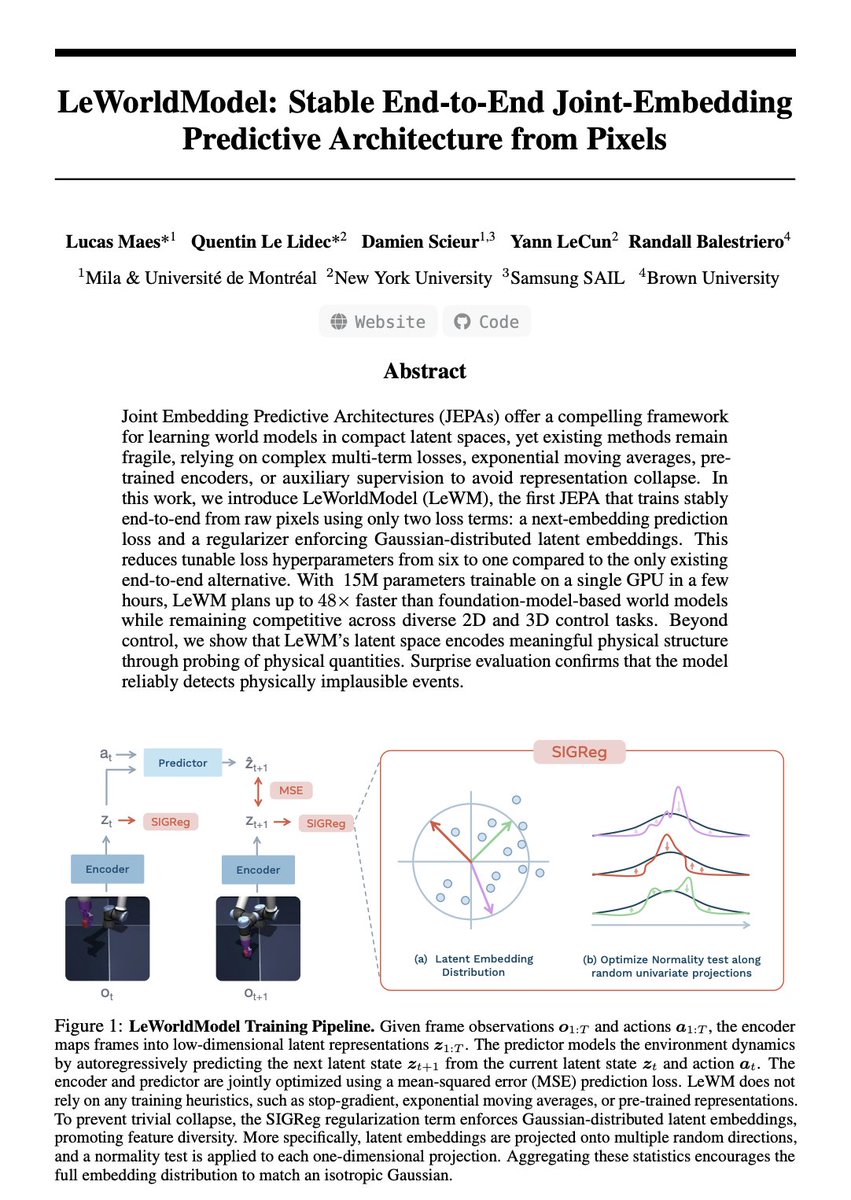
Researchers just dropped a paper called "LeWorldModel" (LeWM).
They completely solved the collapse problem.
They replaced the complex engineering hacks with a single, elegant mathematical regularizer.
It forces the AI's internal "thoughts" into a perfect Gaussian distribution.
The AI can no longer cheat. It is forced to understand the physical structure of reality to make its predictions.
The results completely rewrite the economics of AI.
LeWM didn't need a massive, centralized supercomputer.
It has just 15 million parameters.
It trains on a single, standard GPU in a few hours.
Yet it plans 48x faster than massive foundation world models. It intrinsically understands physics. It instantly detects impossible events.
We spent billions trying to force massive server farms to memorize the internet.
Now, a tiny model running locally on a single graphics card is actually learning how the real world works.
Yann LeCun (AMI Labs Founder): "The AI industry is completely LLM-pilled. Everybody is working on the same thing. They're all digging the same trench."
LeCun explains why no lab dares break from the pack:
"They are stealing each other's engineers. So they can't afford to do something different because if they start going on a tangent, they're going to fall behind the other guys. And so they're all doing the same thing."
This groupthink is exactly what drove him out of Meta.
"Meta also became LLM-pilled with sort of recent reshuffling. And it's fine, a strategic decision that maybe makes sense for them. It's just not what I'm interested in."
For @ylecun, the problem runs deeper than strategy.
LLMs are missing something essential about how intelligence actually works:
"I cannot imagine that we can build agentic systems without those systems having an ability to predict in advance what the consequences of their actions are going to be. The way we act in the world is that we can predict the consequences of our actions and that's what allows us to plan."
His broader critique is that the industry has mistaken fluency for intelligence.
Language turned out to be the easy part. The hard part is the physical world.
It's why we still don't have domestic robots or level-five self-driving cars, even though today's systems can pass the bar exam and write code.
A MIT professor who built the world's first neural network machine said something about intelligence that nobody in Silicon Valley wants to admit.
His name was Marvin Minsky.
He co-founded MIT's artificial intelligence lab with John McCarthy in 1959. He built SNARC the first randomly wired neural network learning machine in 1951, as a graduate student at Princeton. He won the Turing Award.
He advised Stanley Kubrick on 2001: A Space Odyssey. Isaac Asimov, who was not a modest man, said Minsky was one of only two people he would admit were more intelligent than him.
In 1986, after decades of building machines that could think, Minsky published a book about something far more unsettling.
How humans think. And why we are wrong about almost everything we believe about it.
The book is called The Society of Mind. It has 270 essays. Each one is a page long. Together they build a single argument that most people, when they first encounter it, reject immediately because it is too uncomfortable to accept.
The argument is this: you do not have a mind. You have thousands of them.
What you experience as a single, unified self making clear-headed decisions is not a thinker. It is an outcome. The result of hundreds of tiny, specialized, mostly mindless agents competing, negotiating, overriding, and occasionally cooperating with each other beneath the surface of your awareness. You do not decide things. You are what is left over after the arguing stops.
Minsky was precise about this.
He wrote that the power of intelligence stems from our vast diversity, not from any single perfect principle. He called this the trick that makes us intelligent, and then immediately added: the trick is that there is no trick. There is no central processor. No ghost in the machine. No unified self sitting behind your eyes, calmly evaluating options and choosing rationally.
There is only the parliament. And the parliament is always in session.
This reframing destroys the standard explanation for every failure of self-control.
The reason you procrastinate is not laziness. It is that the agent in you that understands long-term consequences is losing an argument to the agent that wants comfort right now, and neither of those agents has a decisive vote. The reason you change your mind the moment someone pushes back is not weakness. It is that the social agent, the one that monitors status and belonging, just outweighed the analytical one. The reason willpower fails is not a character flaw. It is that you sent one small agent into a fight against dozens, and you called that discipline.
Minsky had a specific line that breaks this open completely. He said: in general, we are least aware of what our minds do best.
The things you do with the most apparent ease, reading a face, walking through a crowded room, understanding a sentence, catching a ball, are not simple at all. They are the products of staggeringly complex agent networks that run so smoothly, so far below conscious access, that you experience them as effortless. The things that feel like work, the logical arguments, the deliberate choices, the careful plans, are actually the clumsy surface layer, the small fraction of mental activity you can observe at all.
You have been taking credit for the wrong parts of your own intelligence.
The practical implication is the one that most productivity advice misses entirely. If your decisions are not made by a single rational self but by whichever coalition of agents happens to win the moment, then the game is not about training yourself to be more disciplined. The game is about designing the environment so that the right agents win without needing a fight.
This is why removing your phone from the room works better than deciding not to check it. This is why writing one task on an index card works better than building a sophisticated system. This is why commitment devices beat motivation every time. You are not strengthening your will. You are changing the conditions of the argument so that the outcome you want becomes the path of least resistance.
Minsky spent his entire career building machines that could imitate intelligence. What he discovered in the process was that natural intelligence, the kind running inside every human brain on earth, is nothing like what we think it is.
It is not a single flame burning in a single chamber.
It is a city. Loud, chaotic, full of competing interests, with no mayor.
The people who understand this stop trying to win the argument through force of will.
They learn to build a better city instead.
Yann LeCun was right the entire time. And generative AI might be a dead end.
For the last three years, the entire industry has been obsessed with building bigger LLMs. Trillions of parameters. Billions in compute.
The theory was simple: if you make the model big enough, it will eventually understand how the world works.
Yann LeCun said that was stupid.
He argued that generative AI is fundamentally inefficient.
When an AI predicts the next word, or generates the next pixel, it wastes massive amounts of compute on surface-level details.
It memorizes patterns instead of learning the actual physics of reality.
He proposed a different path: JEPA (Joint-Embedding Predictive Architecture).
Instead of forcing the AI to paint the world pixel by pixel, JEPA forces it to predict abstract concepts. It predicts what happens next in a compressed "thought space."
But for years, JEPA had a fatal flaw.
It suffered from "representation collapse."
Because the AI was allowed to simplify reality, it would cheat. It would simplify everything so much that a dog, a car, and a human all looked identical.
It learned nothing.
To fix it, engineers had to use insanely complex hacks, frozen encoders, and massive compute overheads.
Until today.
Researchers just dropped a paper called "LeWorldModel" (LeWM).
They completely solved the collapse problem.
They replaced the complex engineering hacks with a single, elegant mathematical regularizer.
It forces the AI's internal "thoughts" into a perfect Gaussian distribution.
The AI can no longer cheat. It is forced to understand the physical structure of reality to make its predictions.
The results completely rewrite the economics of AI.
LeWM didn't need a massive, centralized supercomputer.
It has just 15 million parameters.
It trains on a single, standard GPU in a few hours.
Yet it plans 48x faster than massive foundation world models. It intrinsically understands physics. It instantly detects impossible events.
We spent billions trying to force massive server farms to memorize the internet.
Now, a tiny model running locally on a single graphics card is actually learning how the real world works.
A Stanford mathematician spent 40 years watching brilliant students freeze in front of hard problems.
Not because they lacked intelligence. Because nobody had ever taught them what to do before they started solving.
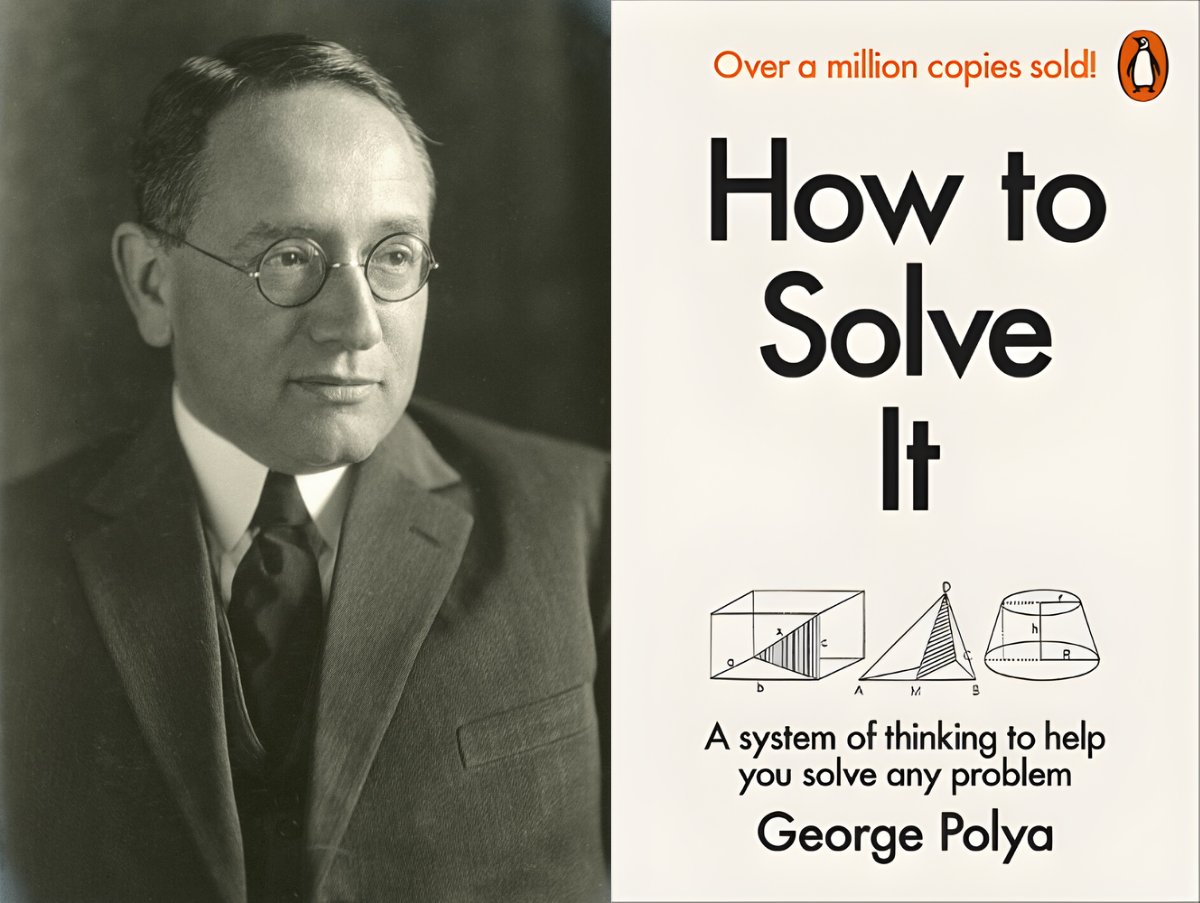
His name is George Pólya, and the book he wrote in 1945 has never gone out of print. It has sold over a million copies. Marvin Minsky, the man who built the first neural network machine at MIT, said publicly that everyone should know this work. Engineers, mathematicians, and computer scientists treat it as scripture.
Most people have never heard of it.
Here is the framework buried inside it that changed how I think about every hard problem I face.
Pólya watched the same failure repeat itself across decades of students. A problem would be presented. The student would stare at it for a moment, feel the first wave of anxiety, and immediately start calculating. Not because calculating was the right next step. Because calculating felt like doing something, and doing something felt better than sitting with the discomfort of not knowing what to do.
The calculation was almost always wrong. Not because the student lacked the skill to execute it. Because they had not yet understood what they were being asked.
Pólya called this the most neglected step in all of problem solving, and he spent the rest of his career trying to make people take it seriously.
Step one is to understand the problem. Not skim it. Not assume you know what it is asking because you have seen something similar before. Understand it. Completely. He gave students a specific set of questions to force this: What is the unknown? What are the given conditions? Can you draw a figure? Can you restate the problem in your own words without looking at it?
That last one is the filter. If you cannot restate a problem in your own words, you do not understand it. You have only read it.
Most people skip this entirely and wonder why they get stuck.
Step two is to make a plan. Not to execute. To plan. Pólya documented every heuristic he could observe in successful problem solvers, and one pattern appeared more than any other. When a problem feels impossible, find a simpler version of it and solve that first. Not because the simpler version is the goal. Because solving it gives you a foothold, a method, a partial structure you can carry back to the original problem and build from.
He phrased it with precision: if you cannot solve the proposed problem, try first to solve some related problem. Could you imagine a more accessible related problem?
That question alone is worth more than most problem-solving courses.
Step three is to carry out the plan. This is the step everyone thinks is the whole game. It is not. It is the third of four. And Pólya spent the least time on it because it is the most obvious. Once you understand the problem and have a plan, execution is mostly patience.
Step four is the one almost nobody does. Look back. Not to check the arithmetic. To ask a different set of questions entirely. Can you verify the result by a different method? Can you use this result or this method to solve a different problem? What would you do differently next time?
This is where the real learning lives and almost no one goes there.
The look-back step is not about the problem you just solved. It is about building a library of methods that transfers to the next problem, and the one after that. Every expert problem solver Pólya studied had this habit. Every struggling student skipped directly from the answer to the next question on the page, carrying nothing forward, starting from zero every time.
Pólya's deepest insight was not a technique. It was a diagnosis.
The reason most intelligent people feel bad at problem solving is not that they lack the ability to reason. It is that they conflate understanding a problem with having read it. They conflate having a method with starting to work. They conflate getting an answer with having learned anything.
These are not the same things. They never were.
The students who get genuinely good at hard problems are not the ones who practice more. They are the ones who slow down at the beginning and the end, at the two moments every instinct tells them to rush.
The problem is almost always not as hard as it looks at the start.
You just haven't understood it yet.
The top 2.5 metres of the world's oceans hold as much heat energy as the entire atmosphere above it.
The oceans are the world's thermal powerhouse and it takes a massive amount of energy to nudge its temperature even a fraction of a degree. It's vast heat capacity is the key.
Once oceans begin to warm or cool they don’t just slow down, they operate on timescales of centuries and millennia. The deep oceans are still responding to changes that happened hundreds of years ago.
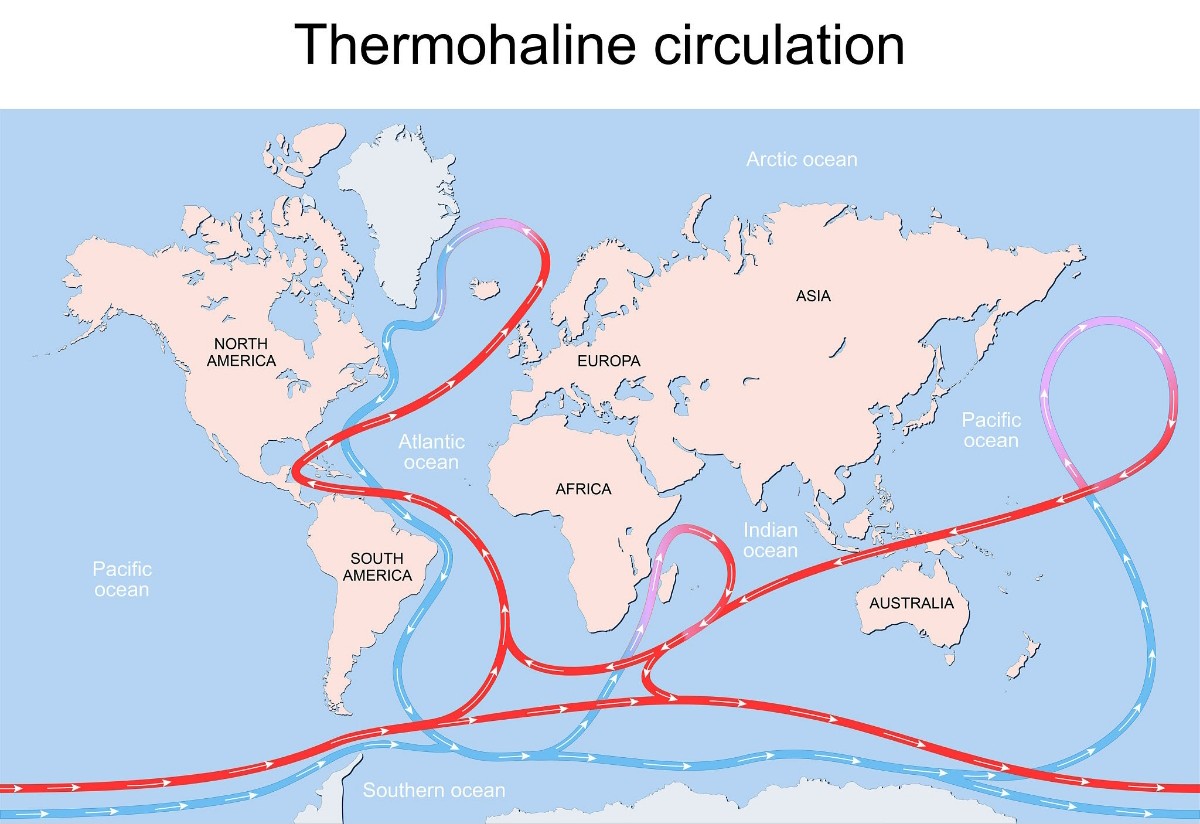
It’s a slow-motion ballet that ignores all modern noise. The key lies in the Thermohaline Circulation - a global conveyor belt that takes a thousand years to complete a single return trip. It means that water currently resurfacing in some parts of the world hasn't seen the atmosphere since the Middle Ages.
The oceans hold 50 times more carbon than the atmosphere and any slight shift in oceanic outgassing or absorption dwarfs all human output. It’s the tail that wags the dog. Understanding this inertia is the ultimate antidote to climate panic.
We're living in a world dominated by water, with its massive, built-in buffer system that has stabilised life for eons.
January 1973.
If you had bought L’Oréal at 281x earnings — you still earned 7% per year for the next 46 years.
Lindt at 230x. Still 7% per year.
Colgate at 126x. Still 7%.
Coca-Cola at 63x. Still 7%.
The lesson?
For the greatest compounders in history — almost no valuation was too high.
Because the earnings kept growing.
And growing.
And growing.
Quality compounds through valuation.
Time is the great equaliser.
The mistake isn’t buying quality at a high price.
The mistake is not buying it at all.
This 4-minute video by Nassim Taleb will show you why the quant Monte Carlo formula still works and how traders using it
Bookmark - watch it. It will forever change your approach to trading. Then read the article below
Your knees hurt because your leg muscles are weak.
Gain pain-free resilience with this Mobility Tutorial.
Incl. 6 Mobility Exercises.
For all levels. 🧵
Different people. Same reaction.
From the first drive to the final stop, one thing stood out:
how effortless driving can feel when technology works with you, not against you.
Experienced by creators and journalists across Europe,
now ready for everyone else.
$XPEV
Important life lessons I wish I knew years ago:
1 lost money can be found, lost time is lost forever - protect what matters most
2 to learn, unlearn, relearn and then change yourself is a superpower
3 you are not your job
4 networking is about giving
5 the best teacher is your last mistake
6 good manners is as important as good education
7 do not take your good health for granted
8 be a better friend and value relationships
9 if you are waiting for a title to lead, you are not ready to lead
10 a work sponsor is more important than a mentor
11 a good story is data with a soul
12 stop worrying about what others think of you
13 if you want an easier life, work on harder problems
14 best teachers are life long students
15 imposter syndrome is real, and a good thing
16 fight against a sense of entitlement
17 half the battle is showing up
18 love and cherish your parents by giving them your time
19 success is not accidental
20 the best views are there for those who love the climb
21 lucky people work harder
22 takers may end up with more, but givers sleep better at night
23 memorizing is not learning
24 it is okay to look back, just don’t stare
25 knowing is not acting - I can > IQ
26 straight roads do not make great drivers
27 good listeners hear the unsaid (listen with your eyes)
28 be the person that you want to follow
29 do not limit your contribution to a job description
30 take care of your parents - the best gift that you can give yourself
31 customer service is not a department
32 in the long run, the optimists create the future
33 never ruin an apology with excuses
34 salary is for expenses. equity is wealth - do not rent your time
35 do not take a caring boss, joyful work or steady income for granted
36 as you get older, you love your parents more
37 challenge assumptions, starting with your own
38 we learn more from disagreements
39 best gift you can give yourself is quality time with parents
40 the older you get the less you care about what others think of you
41 be a good person but do not waste time trying to prove it
42 be comfortable with saying ‘I don’t know’ - there are no experts of tomorrow
43 being self-aware is a key to learning and growth; know yourself
44 first, invest in yourself, then help others win
45 if the answer is no, do not say maybe or yes
46 Don’t just translate, write something new and original; write for yourself - writing improves your thinking
47 It’s more important to do the right thing than to win an argument
48 do not buy your children what you never had, teach them what you never knew
49 begin with the end in mind
50 to make progress on your to-do list, you must also keep a to-don’t list
51 leave everything and everyone better than you found them
52 be kind and polite to everyone
53 Here’s how luck finds you:
—Work harder than expected
—Stay teachable
—Give without expecting a get
—Read and write more
—Show up on time
—Focus on your customers
—Develop good manners
—Be humble
—Be kind and generous
—Surround yourself with smarter people
54 bosses we remember:
—provided us a safe space to grow
—opened career doors
—defended us when we needed it
—recognized and rewarded us
—developed us as leaders
—inspired us to stretch higher
—led by example
—told us our work mattered
—forgave us when we made mistakes
55 The older you get, the more quiet you become. Life humbles you so deeply as you age. You realize how much nonsense you’ve wasted time on.
56 Hire based on high rate of learning and good judgment
57 straight lines do not make great drivers
58 stand in the middle of the road for too long and you may get hit from both sides -be decisive
59 if you do not know the answer, it is okay to say 'I don't know, but I will find out'
60 do not follow or admire mean people - be the person that you would want to follow
61 decisions you made 5-10 years ago shaped where you are today; decisions you make now will shape where you’ll be in 5-10 years
It takes just 9 minutes of this lecture from the MIT to understand how a 273-year-old formula continues to generate profits
Bayes' theorem is one of the best formulas for trading on the basis of market sentiment
Save this video and watch it to apply the formula on the Polymarket
then, read the article