Zohran Mamdani becomes one of the first mayors in the US (and among a small handful of prominent US officials generally) to recognize the Nakba — the mass expulsion and forced displacement of 700,000+ Palestinians.
Connected directly with a Nakba survivor
This is one of the most famous letters written by Prophet Muhammad ﷺ. It was sent in the year 7 AH (628 CE) after the Treaty of Hudaybiyyah to Heraclius (Hercules), the Emperor of the Byzantine (Roman) Empire.
بِسْمِ اللّٰهِ الرَّحْمٰنِ الرَّحِيْمِ
مِنْ مُحَمَّدٍ عَبْدِ اللّٰهِ وَرَسُوْلِهٖ إِلَى هِرَقْلَ عَظِيْمِ الرُّوْمِ
سَلَامٌ عَلَى مَنِ اتَّبَعَ الْهُدَى
أَمَّا بَعْدُ فَإِنِّيْ أَدْعُوْكَ بِدَعْوَةِ الْإِسْلَامِ أَسْلِمْ تَسْلَمْ يُؤْتِكَ اللّٰهُ أَجْرَكَ مَرَّتَيْنِ وَإِنْ تَوَلَّيْتَ فَإِنَّ عَلَيْكَ إِثْمَ الْأَرِيْسِيِّيْنَ وَيَا أَهْلَ الْكِتَابِ تَعَالَوْا إِلَى كَلِمَةٍ سَوَاءٍ بَيْنَنَا وَبَيْنَكُمْ أَنْ لَّا نَعْبُدَ إِلَّا اللّٰهَ وَلَا نُشْرِكَ بِهٖ شَيْئًا وَلَا يَتَّخِذَ بَعْضُنَا بَعْضًا أَرْبَابًا مِنْ دُوْنِ اللّٰهِ فَإِنْ تَوَلَّوْا فَقُوْلُوْا اشْهَدُوْا بِأَنَّا مُسْلِمُوْنَ
English Translation:
In the name of Allah, the Most Gracious, the Most Merciful.
From Muhammad, the slave of Allah and His Messenger, to Heraclius, the great leader of the Romans.
Peace be upon him who follows the right path.
I invite you to the call of Islam. If you accept Islam, you will be safe and Allah will give you a double reward. But if you turn away, then upon you will be the sin of the Arisiyyin (your people).
O People of the Scripture! Come to a word that is common between us and you: that we worship none but Allah, and that we associate no partners with Him, and that none of us shall take others as lords besides Allah. But if they turn away, then say: Bear witness that we are Muslims.
✨You’ve seen this in every math class:
sin(a ± b) = sin a cos b ± cos a sin b
sin(2a) = 2 sin a cos a
cos(2a) = 1 − 2 sin²(a)
🚨But did you know these formulae came from a Muslim scholar 1000 years ago?
Meet Abū al-Wafā al-Būzjānī, the genius who shaped Trigonometry. 📐
Abū al-Wafā Būzhjānī (d. 998) was a Persian Muslim mathematician and astronomer from Khorasan. Born in Būzjān (near Nishapur, Iran), Būzhjānī showed early brilliance in mathematics and geometry.
He later moved to Baghdad, then the heart of the Islamic Golden Age, a city of scholars, libraries, and observatories.
In Baghdad, he became one of the leading scientists of the House of Wisdom (Bayt al-Ḥikmah). Here, he studied Greek works like Euclid and Ptolemy, and expanded them far beyond their original limits.
📐 His Contributions to Mathematics:
He established several trigonometric identities such as [sin(a±b)] in their modern form:
{sin(α ± β)= Sinα Cosβ ± Cosα Sinβ}
{sin(a + b) = Sin(a)Cos(b) + Cos(a)Sin(b)}
{Cos(2a) = 1-2sin²(a)}
{Sin(2a) = 2Sin(a) Cos(a)}
He compiled tables of sines and tangents at 15° intervals, introduced secant and cosecant, and explored the relationships between all six trigonometric lines. His work made both mathematics and astronomy quantitatively precise.
He also studied geometry, arithmetic, and number theory, writing detailed commentaries on al-Khwārizmī and Diophantus.
Some sources suggest that he introduced the tangent function, although other sources give the credit for this innovation to al-Marwazi.
🌌 His Work in Astronomy:
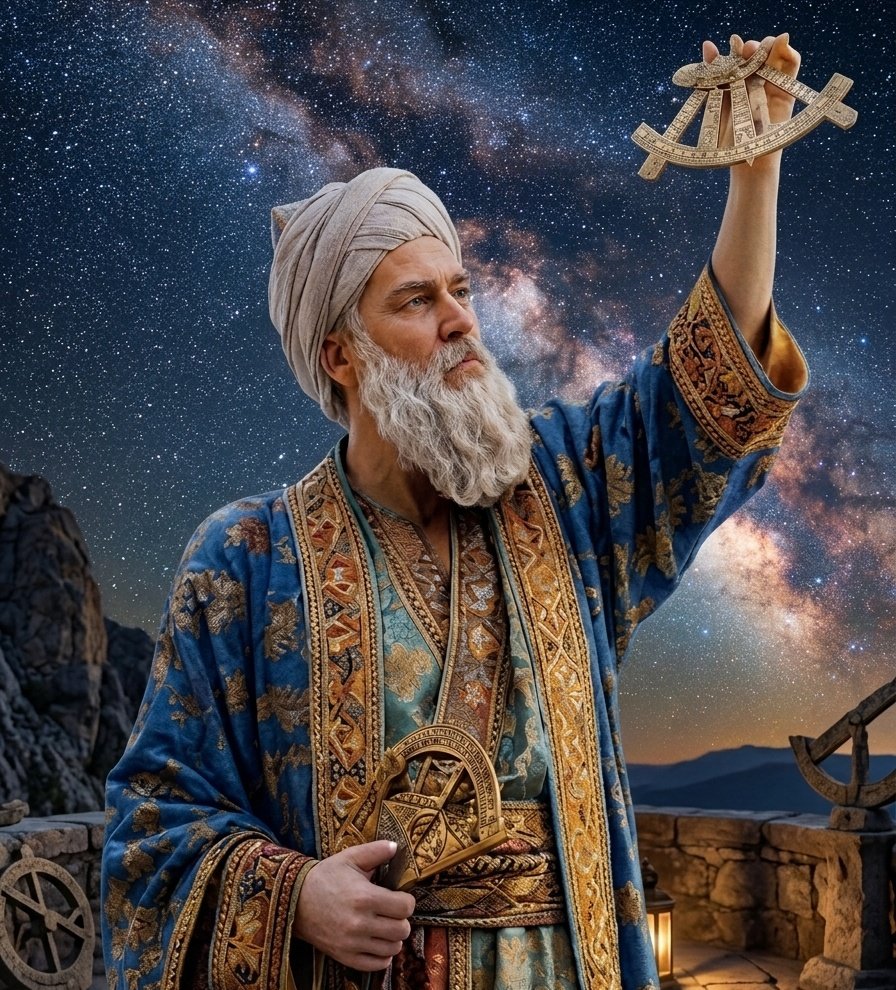
Abū al-Wafā designed and built a wall quadrant, a large, fixed instrument used to measure celestial altitudes with remarkable accuracy.
This invention influenced later observatories across the Islamic world.
His masterpiece, Kitāb al-Majisṭī (“The Almagest”), improved upon Ptolemy’s astronomy, described planetary motion, and developed mathematical methods for finding the Qibla direction, the direction of prayer. 🕌
In 997, he participated in an experiment to determine the difference in local time between his location, Baghdad, and that of al-Biruni (who was living in Kath, Uzbekistan).
Their result was astonishingly accurate, within about 1 hour of modern calculations. ⏱️
Iranians: The Pioneers of Science, Development, and Civilization
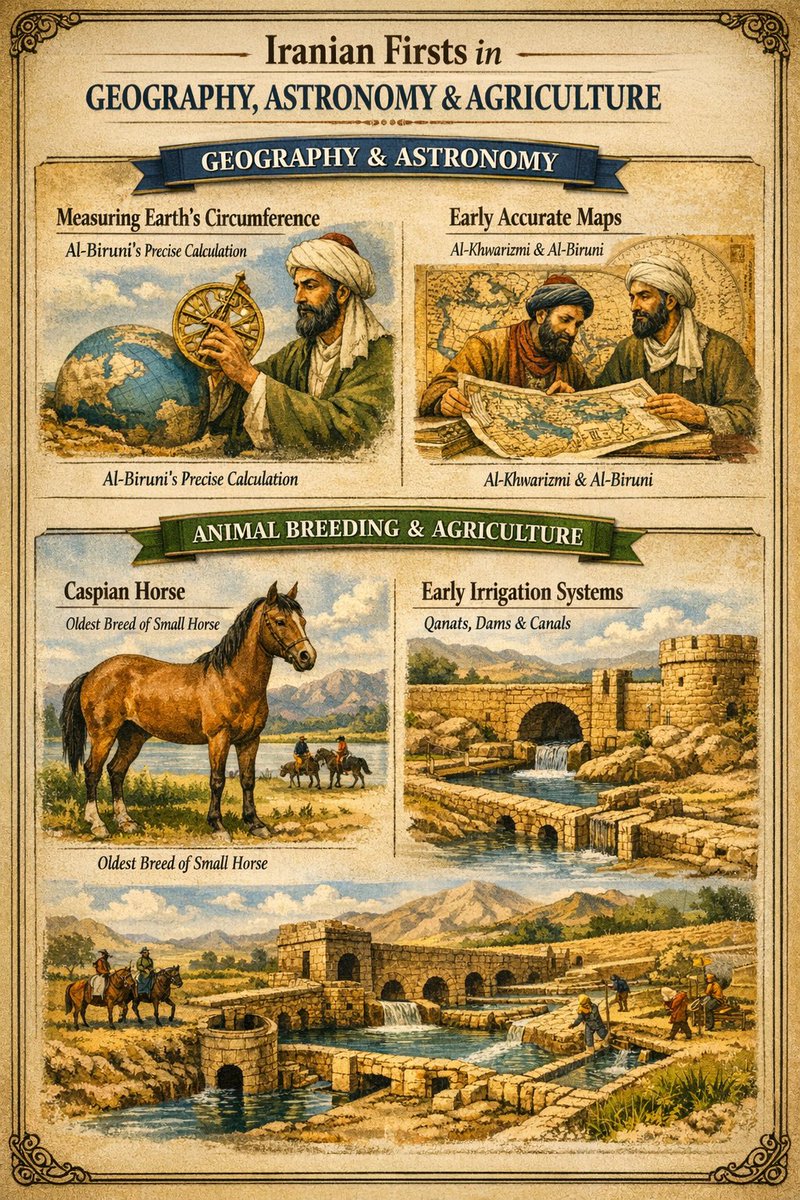
Al-Khwarizmi founded algebra and introduced algorithms, forming the basis of modern mathematics and computer science.
Al-Biruni measured the Earth’s circumference with less than 1% error and created precise geographical maps.
Omar Khayyam designed the Jalali Calendar, still considered the most accurate solar calendar in the world.
Avicenna (Ibn Sina) and Al-Razi (Rhazes) revolutionized medicine and pharmacy, separating science from alchemy and establishing systematic medical practice.
Meet the genius, Nasir al-Din al-Tusi (1201-1274):
— Built the most advanced observatory on Earth at his time, with a 400,000-volume library
— Invented a geometric model silently reuse 250 years later by Copernicus
— Founded trigonometry as a science of its own
— Wrote the ethics textbook taught in Persian schools for 600 years
— Was the first to argue the Milky Way is a cloud of countless stars — 350 years before Galileo's telescope




![IslamicSH_'s tweet photo. ✨You’ve seen this in every math class:
sin(a ± b) = sin a cos b ± cos a sin b
sin(2a) = 2 sin a cos a
cos(2a) = 1 − 2 sin²(a)
🚨But did you know these formulae came from a Muslim scholar 1000 years ago?
Meet Abū al-Wafā al-Būzjānī, the genius who shaped Trigonometry. 📐
Abū al-Wafā Būzhjānī (d. 998) was a Persian Muslim mathematician and astronomer from Khorasan. Born in Būzjān (near Nishapur, Iran), Būzhjānī showed early brilliance in mathematics and geometry.
He later moved to Baghdad, then the heart of the Islamic Golden Age, a city of scholars, libraries, and observatories.
In Baghdad, he became one of the leading scientists of the House of Wisdom (Bayt al-Ḥikmah). Here, he studied Greek works like Euclid and Ptolemy, and expanded them far beyond their original limits.
📐 His Contributions to Mathematics:
He established several trigonometric identities such as [sin(a±b)] in their modern form:
{sin(α ± β)= Sinα Cosβ ± Cosα Sinβ}
{sin(a + b) = Sin(a)Cos(b) + Cos(a)Sin(b)}
{Cos(2a) = 1-2sin²(a)}
{Sin(2a) = 2Sin(a) Cos(a)}
He compiled tables of sines and tangents at 15° intervals, introduced secant and cosecant, and explored the relationships between all six trigonometric lines. His work made both mathematics and astronomy quantitatively precise.
He also studied geometry, arithmetic, and number theory, writing detailed commentaries on al-Khwārizmī and Diophantus.
Some sources suggest that he introduced the tangent function, although other sources give the credit for this innovation to al-Marwazi.
🌌 His Work in Astronomy:
Abū al-Wafā designed and built a wall quadrant, a large, fixed instrument used to measure celestial altitudes with remarkable accuracy.
This invention influenced later observatories across the Islamic world.
His masterpiece, Kitāb al-Majisṭī (“The Almagest”), improved upon Ptolemy’s astronomy, described planetary motion, and developed mathematical methods for finding the Qibla direction, the direction of prayer. 🕌
In 997, he participated in an experiment to determine the difference in local time between his location, Baghdad, and that of al-Biruni (who was living in Kath, Uzbekistan).
Their result was astonishingly accurate, within about 1 hour of modern calculations. ⏱️](https://pbs.twimg.com/media/HHf61X_aIAAM_05.png)




![IslamicSH_'s tweet photo. ✨You’ve seen this in every math class:
sin(a ± b) = sin a cos b ± cos a sin b
sin(2a) = 2 sin a cos a
cos(2a) = 1 − 2 sin²(a)
🚨But did you know these formulae came from a Muslim scholar 1000 years ago?
Meet Abū al-Wafā al-Būzjānī, the genius who shaped Trigonometry. 📐
Abū al-Wafā Būzhjānī (d. 998) was a Persian Muslim mathematician and astronomer from Khorasan. Born in Būzjān (near Nishapur, Iran), Būzhjānī showed early brilliance in mathematics and geometry.
He later moved to Baghdad, then the heart of the Islamic Golden Age, a city of scholars, libraries, and observatories.
In Baghdad, he became one of the leading scientists of the House of Wisdom (Bayt al-Ḥikmah). Here, he studied Greek works like Euclid and Ptolemy, and expanded them far beyond their original limits.
📐 His Contributions to Mathematics:
He established several trigonometric identities such as [sin(a±b)] in their modern form:
{sin(α ± β)= Sinα Cosβ ± Cosα Sinβ}
{sin(a + b) = Sin(a)Cos(b) + Cos(a)Sin(b)}
{Cos(2a) = 1-2sin²(a)}
{Sin(2a) = 2Sin(a) Cos(a)}
He compiled tables of sines and tangents at 15° intervals, introduced secant and cosecant, and explored the relationships between all six trigonometric lines. His work made both mathematics and astronomy quantitatively precise.
He also studied geometry, arithmetic, and number theory, writing detailed commentaries on al-Khwārizmī and Diophantus.
Some sources suggest that he introduced the tangent function, although other sources give the credit for this innovation to al-Marwazi.
🌌 His Work in Astronomy:
Abū al-Wafā designed and built a wall quadrant, a large, fixed instrument used to measure celestial altitudes with remarkable accuracy.
This invention influenced later observatories across the Islamic world.
His masterpiece, Kitāb al-Majisṭī (“The Almagest”), improved upon Ptolemy’s astronomy, described planetary motion, and developed mathematical methods for finding the Qibla direction, the direction of prayer. 🕌
In 997, he participated in an experiment to determine the difference in local time between his location, Baghdad, and that of al-Biruni (who was living in Kath, Uzbekistan).
Their result was astonishingly accurate, within about 1 hour of modern calculations. ⏱️](https://pbs.twimg.com/media/HHf669za0AErbcc.jpg)