📢ANNOUNCEMENT📢 (sound 🔊)
ECHOGRAPH - my Fatal Frame, Resident Evil, and Silent Hill inspired game gets a new trailer!
👇 Wishlist now!
🔁 Reposts appreciated!
Demo coming later this year.
Today is my last day at my day job, I just quit to get this game to y'all ASAP!
Announcing Superblocks on Snowflake: Secure Enterprise Vibe Coding on the AI Data Cloud
This couldn't be more timely.
Vibe coding is exploding inside the enterprise.
It’s also becoming the fastest path to a data breach.
Every CEO is trying to accelerate adoption of vibe coding for business users automate, without blocking on engineering.
Every VP of Data and CIO is trying to figure out how to lock down their data, harden their permissions, and gain centralized visibility.
That’s exactly what this partnership unlocks.
Superblocks becomes the enterprise platform for governed vibe coding across business teams, deeply embedded within Snowflake:
> Snowflake Postgres becomes your secure vibe coding database. Superblocks spins it up in every app for fast writes and net new operational workflow data
>Snowflake Cortex becomes the inference engine for Superblocks. Your prompts and vibe coded AI features run within your trusted security perimeter
>Snowflake Warehouse governance is enforced. AI apps use federated token passthrough so your existing row level access policies, dynamic data masking, tag-based-access controls are respected
“With Superblocks on Snowflake, any business team can safely build AI applications governed on their Snowflake data. It’s a dream come true.” -Unmesh Jagtap, Director of Product, Snowflake
Now enterprises can stop playing whack-a-mole, and move your organization past the AI prototype graveyard.
If you’re a Snowflake customer, book a demo (link in comments)
Thanks to the Snowflake team for the partnership: Christian Kleinerman, @vivek7ue, Bala Kasiviswanathan, Unmesh Jagtap, and Myles Borins for helping shape how the industry democratizes governed AI app development while centralizing control on the AI Data Cloud.
The era of “move fast and break things” just became “move fast and get breached.”
Between recent supply chain attacks and security incidents across vibe coding vendors, it’s tempting to think this is just a bad couple of weeks.
It’s not. This is the new baseline and the number breaches will skyrocket from here.
AI offense is accelerating at a pace most organizations aren’t prepared for. The next generation of models will only widen that gap. I am hearing Mythos will be released soon.
Which means every enterprise must now fight back against shadow AI.
That employee connecting AI tools to internal systems without oversight? Over.
That team granting broad OAuth permissions without understanding the risk? Over.
That vendor processing PII data in their cloud with no InfoSec review? Over.
Enterprises will demand a new standard from AI vendors:
First, self-hosted deployments will become the norm. Bring AI to your data.
Second, the switch from buying AI Agents to Enterprise Platforms. Where every permission, every integration, every action that's auditable, enforceable, and controlled by IT and security teams.
Third, the AI Gateway. Enterprises will build AI gateways and force all LLM calls through them centrally for governance and auditing.
IT and Security teams will become the heroes of the AI era.
And the AI vendors that win won’t be the ones with the flashy demos, they’ll be the ones with who put Security, IT controls and Governance at the center of their products.
Introducing Superblocks 2.0: AI-generated enterprise apps – finally under IT control.
Vibe-coded apps just became the #1 attack vector in the enterprise.
Business teams are building on production data, while IT has zero visibility.
No reviews. No audits. No permissions. No control.
AI hackers are about to get 100x better. Anthropic proved it with Mythos.
Superblocks 2.0 is the only platform to take back control:
> Business teams build AI-powered apps with permissions baked in.
> IT and Security can audit everything and lock down anything, instantly.
> Engineering sets the standards. Every app follows them.
Instacart, SoFi, and LinkedIn run Superblocks in production today.
And larger organizations we can't yet name are too:
A Fortune 500 just shut down 2,500 Replit users to standardize on Superblocks, running the platform air-gapped in their AWS environment.
A 150,000-employee global services firm replaced Lovable with Superblocks to unlock AI-built apps on restricted internal systems.
Every IT leader we’ve demoed to using Replit, Lovable or v0 asked for early access.
Today we open access to the world.
The genie is out of the bottle on employee vibe coding.
Let it run wild, or take back control – https://t.co/8TEolq14Z5
📢 ANNOUNCEMENT 📢 (sound 🔊)
ECHOGRAPH - my Fatal Frame, Resident Evil, and Silent Hill inspired game is FINALLY on Steam.
👇 WISHLIST NOW!
🔁 Repost to help a small solo dev get noticed 🥺
I can finally map @NBA player's position from the camera perspective onto the court map
it's still a bit shaky... I'll smooth it out later
it's time to detect shooting motions and mark the shot location!
some of the code has already been migrated to: https://t.co/VK0RQFWud1
I’m excited to introduce Clark, the first AI Agent to build internal enterprise apps.
We’ve raised $60M, including a fresh $23M from @sparkcapital@kleinerperkins, @MeritechCapital and Greenoaks.
Unlike consumer vibe coding tools like Lovable, Replit and Bolt that only generate prototypes, Clark builds production-ready internal apps — enforcing your enterprise standards:
🧩 UIs generated using your design system
🔌 Integrations with private APIs, databases and SaaS apps
🔐 Permissions mapped to @okta & @azuread groups
🛡️ Security with audit logging, secrets management, and vulnerability scans
Clark is designed to operate exactly like a human internal tools team. It's built on a state-of-the-art multi-agent architecture, emulating your Designer, IT admin, Engineer, Security Operations, and QA employees.
When Clark generates an application, you can modify it in 3 ways:
1. Natural language - talk to Clark
2. Visual – Edit it like in Figma
3. Code – Use your IDE like Cursor or VSCode
Global enterprises in regulated industries like @Instacart (CART), @carrier (CARR), and @cvent (Blackstone) already run their mission-critical apps on our platform.
Our customers save $5m on average. Book a demo and we'll save you $5m too. And we're so confident that if we can't, we'll donate $5,000 to a charity of your choice:
Book a Demo – https://t.co/oG5LaD10V9
---------
As part of this launch, we’re giving away the system prompts of leading AI products like Cursor, Manus, and Codex.
These 6,000 line system prompts have enabled them to become billion-dollar companies on top of foundation models.
Retweet this post and comment ‘Superblocks’ below, and we'll send you the link so you can engineer world class prompts yourself.
👇 See Clark in action in the thread below
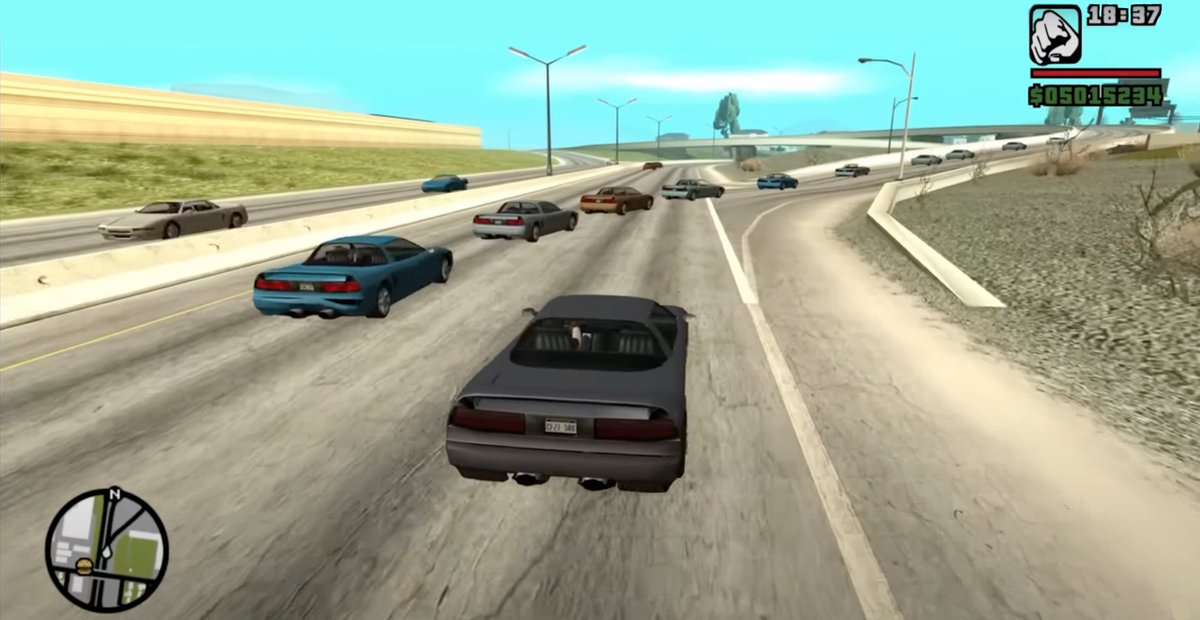
As a kid, I always knew I'd see the same car over and over, and people thought I was crazy for it. Now, knowing I was right all along, I feel completely validated
For gta3, Vice and SA; Memory on the ps2 was tight. We had to limit the number of used vehicle models to 8.
My code would occasionally pick a car model to be phased out. Once there were none left on the map, this model would be removed and a new model could be loaded.
The code would pick a model that was appropriate for the area (sports cars in business district, old cars in run-down areas etc).
Most of the time this worked fine.
A few things could throw a spanner in the works:
If the player had gone up the wanted levels, some of the 8 slots would be taken up by police cars, FIB and swat vans and the police heli.
Level designers would sometimes load specific car models for missions. Often these were not appropriate to be used for ambient traffic.
Ambulance and firetrucks could be needed if there was an accident.
If the player travelled to a different area of the map; some of the loaded cars would look out of place and could not be used. It would take a while for replacement models to be loaded.
The game would keep the last player driven car, as it would be jarring if the player went back and it wasn’t there.
At times there would only be 1 or 2 cars models available for ambient traffic. This lack of variation was particularly noticeable if the player was driving the one car that had to be used.
To alleviate the problem, garages remove cars inside of them once the door has closed. This way the model could be removed. When the player opened the door, the cars were re-created in the same spot.
Npc models were loaded/removed the same way. It just wasn’t as noticeable if variety was lacking.
For each game we picked a generic looking character model that looked appropriate in each area of the map. This model was never removed and always ready to fill in.
Screenshot from this vid: https://t.co/TGafociYJ0
The streets of gta3 looked too clean so I added litter.
It is a single rectangle that occasionally moves with the wind. It can also be dragged along by passing cars. The artists created 4 textures for it. 2 newspapers and 2 leaves.
In Vice City there is a mission (Dildo Dodo) where the player drops flyers for Candy Suxx’s show. From that point onwards, 1 of the 4 litter textures is replaced with the flyer.
For each ‘hop’ the animation consist of:
Movement along the ground. Further if it’s windy.
Movement up and down along a sinus function.
Rotation of the rectangle.
More hops occur when it’s windy.
Because line-scans were slow, it only detects the height of the ground at the landing location. (not in between) This is why it can go through the map in some cases.
Not everyone on the team liked the litter. I removed it for San Andreas because I eventually lost the argument.
In the last months of Manhunt development, some gta-ers helped out. I added the same litter code to Manhunt.