Intermediate macro instructors: You probably need to talk about the impact of AI on the labor market. But to make contact with the notion that this can destroy jobs and potentially reduce wages you need to introduce the task-based model of production. Cobb-Douglas (or CES) just doesn't cut it for this issue.
You might consider using my undergrad textbook chapter on production where I cover this topic in a way that (I hope) is accessible to undergrads (see section 7 of the chapter):
https://t.co/m5lKx5rM3I
I also have a pretty detailed discussion of how technical change affects the labor share and the recent apparent fall in the labor share (section 6), which is obviously related to the AI issue.
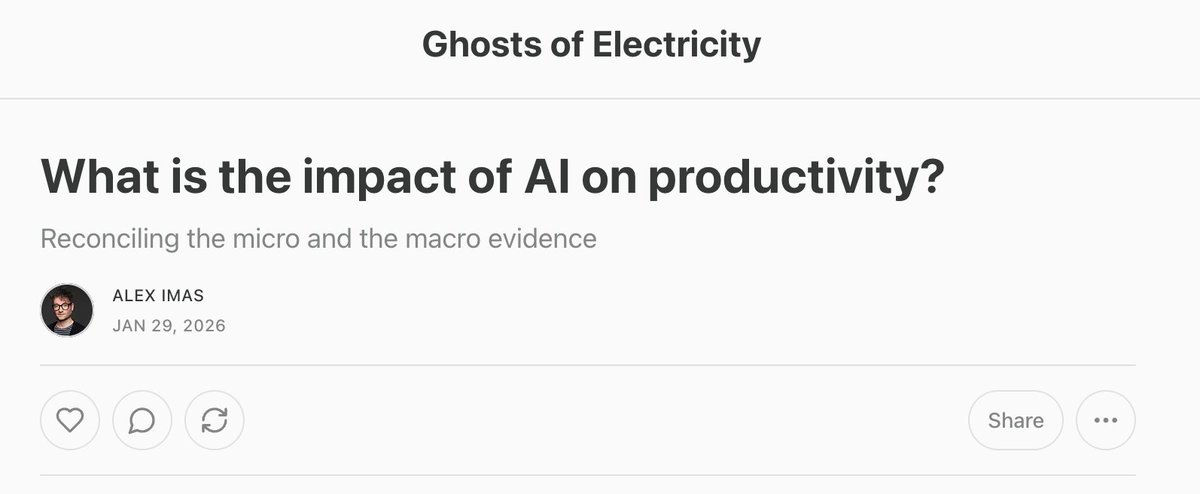
New post: What is the impact of AI on productivity?
I review all of the studies and data that I can find and try to provide a synthesis.
There’s a lot of disagreement on what we know about the productivity impact. Part of the reason for this is the disconnect between the micro and macro evidence.
The micro studies overwhelmingly find positive productivity benefits (except for one notable exception), but these productivity benefits are yet to show up in the macro data.
There is also a disconnect on who benefits most: micro (mostly) finds low-skill/less-experienced workers see higher returns, the (limited) macro evidence is more mixed but leans toward higher wage/higher ed people seeing more of the benefits.
I discuss potential reasons for the micro-macro gap in the post and 🧵 below.
Importantly, this is a living post. I will update it continuously as new data comes in. If you see something I'm missing, please let me know and I will add it.
For regular updates, please consider subscribing to the substack. Here is the link:
https://t.co/AtsqhaH23B
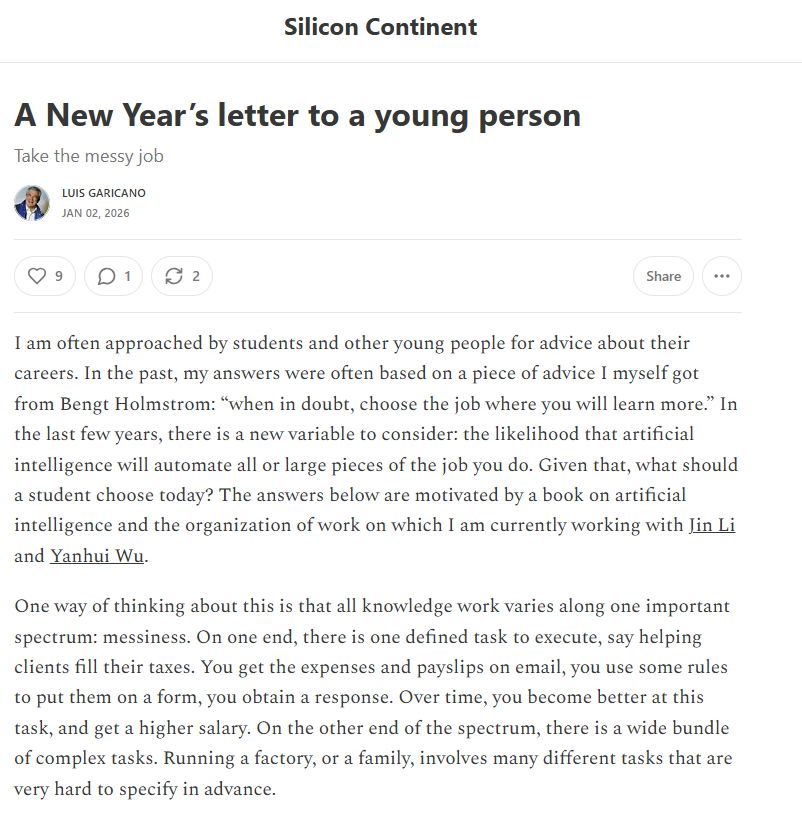
My New Year post is a letter to a young person trying to find their direction in a world disrupted by AI. My advice, in four words: take the messy job. I hope you enjoy it and find it useful. Happy New Year!
*Trade war: my theory of the case*
1. What is the goal/ideal outcome/trump admin hopes: 10% tariff across the board with no retaliation + direct non-tariff favors from other countries to settle this at 10% + a possible full-scale bilateral trade war with China. (1/n)
Universities should make clear that their formidable financial endowments are not there to simply be envied or admired. Part of their function is to be drawn down in the face of emergencies, and covering federal funding lapses surely counts as one. My column today in @nytopinion.
https://t.co/TMl7t0TNXt
Interesting to see some basic demand theory applied to tariff choices. So…
What’s wrong with it?
Used in isolation on a single small trading partner the formula makes some sense. But if applied widely to many non trivial ones it does not. 1/2
88% of the variance in bilateral balances can be explained without making any reference to asymmetries in bilateral trade costs.
See my EER-paper with @YotovG "A solution to the mystery of excess trade balances"
https://t.co/hjRYzRpQSA via @cepr_org@WIFOat
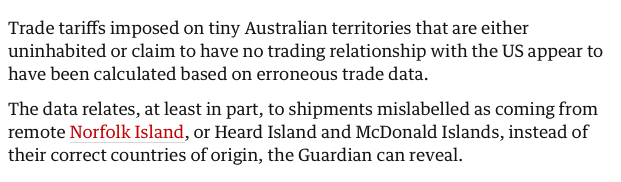
Trade flows are measured with error: https://t.co/TWg8RbP9l5
The Guardian found the errant bills of lading that explain US import tariffs "imposed on tiny Australian territories that are either uninhabited or claim to have no trading relationship with the US".
I do not think that the government's formula is an appropriate way to think about reciprocal tariffs. And it is unclear what the note references or doesn’t from my research with Cavallo et al. But I believe our work suggests the value for the “elasticity of import prices to tariffs” should be close to 1. If that value were used, rather than 0.25, I believe their calculation of reciprocal tariffs would be lower by a factor of four.
🆕 How does internet connectivity impact developing economies? 🔊
Today on #VoxDevTalks, @LinTianEcon (@INSEAD) tells @timsvengali about the profound but uneven impact of the internet on developing countries: https://t.co/HPcIo5OPlV
A new India-China fact (to me):
The Chinese state prioritized primary education over secondary/tertiary, while the Indian state did the opposite.
Chinese primary enrollment rate passed India in 1950, secondary 1975, and tertiary only in 2000!
Wrapped up the third edition of INSEAD-SMU International Economics Workshop last week!🍾Huge thanks to our keynotes @pol_antras & @HansbergRossi, presenters, and participants for their valuable insights and contributions. Here’s to more collaboration and discovery! #inseadSMU2024
@HjortJ & I sent 1st draft of our invited overview piece to Annual Review of Econ., CEPR wp here. On economic impacts of internet connectivity in developing countries; 90/150 studies we cover provide direct empirical evidence on this (+60 w/rich country or other related findings)
Overall the literature points towards sizeable, positive economic impacts in many—but not all—settings. Considerable uncertainty remains, and we know almost nothing about many important parts of internet-in-developing-countries. We highlight promising future research directions