

Top Tweets for #Fragmentation

생각나는 대로 정리해 보는 리알로 21
@RialoHQ @RialoKorea
단절을 넘어 : Rialo의 상호운용성(Interoperability) 전략
오늘날 블록체인 생태계의 가장 큰 고질병 중 하나는 바로 '파편화(Fragmentation)'입니다. 수많은 레이어1과 레이어2 체인들이 저마다의 섬처럼 고립되어 있어, 자산과 데이터를 자유롭게 이동시키는 일은 여전히 복잡하고 위험한 과정입니다.
실세계 인프라(Real World Infrastructure)를 표방하는 Rialo에게 상호운용성은 선택이 아닌 필수 조건입니다. 다양한 체인에 분산된 자산과 실물 자산(RWA) 토큰, 그리고 외부 오프체인 데이터가 유기적으로 연결되지 않는다면 진정한 의미의 '리얼 월드 앱'은 작동하기 어렵기 때문입니다.
Rialo Dev Portal과 아키텍처 문서가 제시하는 크로스체인 및 브리지 인프라의 핵심은 크게 세 가지입니다.
① 신뢰 최소화(Trust-minimized) 크로스체인 통신전통적인 중앙화 브리지들이 고질적으로 겪어온 해킹과 보안 취약점을 극복하기 위해, 탈중앙화된 검증 메커니즘을 바탕으로 체인 간 메시지와 자산을 안전하게 전달합니다.
② 리액티브 트랜잭션과의 결합외부 체인의 상태 변화나 이벤트를 Rialo 내부의 리액티브 트랜잭션과 즉 각적으로 연동하여, 다른 체인의 상황에 맞춰 Rialo 위의 스마트 컨트랙트가 자동으로 반응하고 실행될 수 있는 파이프라인을 구축합니다.
③ 유동성 및 데이터 파편화 해소파편화된 유동성을 하나로 묶어내어, 개발자들이 멀티체인 환경에서도 단일 인프라를 다루듯 매끄럽게 애플리케이션을 배포하고 확장할 수 있도록 지원합니다.
고립된 블록체인을 연결하고, 서로 다른 생태계의 장점을 실세계 애플리케이션 안으로 녹여내는 것. 그것이 바로 Rialo가 그려나가는 상호운용성의 미래입니다.

생각나는 대로 정리해 보는 리알로 20
@RialoHQ @RialoKorea
밸리데이터 인프라 : Rialo 네트워크를 지탱하는 신뢰의 축
블록체인 네트워크의 탈중앙화와 보안은 결국 이를 검증하고 유지하는 밸리데이터(Validator)들의 어깨에 달려 있습니다. 특히 Rialo처럼 리액티브 트랜잭션, 임계값 암호학(Threshold Cryptography), 그리고 AI 에이전트와 RWA 같은 고도화된 기능을 다루는 인프라에서는 밸리데이터의 역할이 더욱 엄격해집니다.
Rialo Dev Portal과 보안 아키텍처 문서가 그리는 밸리데이터 레이어의 핵심은 크게 세 가지로 요약됩니다.
① 임계값 암호학과 분산 키 생성(DKG)의 노드 레벨 구현밸리데이터들은 단일 주체가 비밀 키를 독점하지 않고, 분산 키 생성 메커니즘을 통해 협력적으로 암호화 연산과 프라이버시 보호 기능을 수행합니다. 이는 네트워크 전체의 신뢰 가정을 한 단계 높여줍니다.
② 고성능 환경에서의 안정적인 상태 검증병렬 실행과 대규모 트랜잭션 처리량(TPS)을 소화하는 동시에, 상태 머신 복제(SMR)의 무결성을 깨뜨리지 않고 빠르고 정확하게 블록을 검증하는 합의 수행 능력을 갖추고 있습니다.
③ 강력한 보안 가정과 경제적 인센티브네트워크 참여자들이 악의적인 행동을 할 수 없도록 설계된 슬래싱 조건과 보상 구조를 통해, 밸리데이터 인프라가 장기적이고 지속 가능하게 운영되도록 뒷받침합니다.
실세계 인프라를 지향하는 Rialo에게 밸리데이터는 단순한 노드 그 이상입니다. 그것은 프라이버시, 자동화, 그리고 자율성이 공존하는 안전한 생태계를 떠받치는 가장 단단한 주춧돌입니다.


@RialoHQ @ericargent31113 Rialo argues that fragmentation can destroy value across the system.
integrating critical services with execution can reduce fees and coordination problems, while giving apps more reliable access to what they need.
the aim is to make useful activity easier to sustain.

@Wedrick__0987 @VIhnatiuk @RGB_Bitcoin Interoperability over fragmentation smart play for Bitcoins growth.

@nexa_nr Unified contract standard reduces fragmentation for blockchain developers.

@nexa_nr Less fragmentation is a win

@nexa_nr A unified contract standard could make life much easier for developers. Less fragmentation and more room for innovation. Excited to see what gets built on Retium! 🚀

Agreed — most traders don’t need more assets, they need less friction.
One non-custodial interface for crypto + tokenized stocks + commodities + indices with up to 30x, $CC as collateral, and an AI that can handle positions is a clean solution to the fragmentation problem.

Most traders don’t need more assets.
They need fewer platforms.
Jumping between crypto, stocks, and commodities is still unnecessarily fragmented.
@Canborsa_DEX is trying to fix that with one interface for AllFi trading perpetuals on crypto, tokenized stocks, commodities, and indices in a single account.
Up to 30x leverage, 24/7, Non custodial.
What stands out, You can use $CC directly as collateral across pairs without swapping first, There’s also an AI assistant that can open/close positions and set TP/SL via text or voice
Built @CantonNetwork first (privacy + atomic settlement + institutional grade infra) with multichain access on top, Currently 100 markets, $80M+ volume, and growing real multi asset activity.
This isn’t just another RWA project that lets you hold tokenized stocks, It’s treating those assets as active trading instruments with leverage, alongside crypto, in one place.
Whether AllFi sticks as a narrative or not, reducing the need to context switch between markets is a real problem.
@Canborsa_DEX is one of the cleaner attempts at solving it so far. Worth tracking.


@6coo6 @zerufinance The UX fragmentation is the real bottleneck; until routing is invisible, onboarding stays capped at degens.

@stropurbo How are you handling discovery and casting protocol fragmentation (like AirPlay vs. Miracast vs. DIAL) all from one app?

@ROBINonbreak Reducing fragmentation and unnecessary costs could help builders and users capture more value. That's an interesting vision from Rialo

230 in the first week is solid for something this early.
The fragmentation point hits hard though. Jumping between launchpads, bridges, trackers… it’s exhausting. If Hypesium can actually make all of that feel smooth inside Telegram, it’ll be a real win.
230 users in the first week is a decent signal.
But for a platform like @Hypesium, the more interesting part is what they’re actually trying to solve.
Web3 is still painfully fragmented.
Discover a new token on one launchpad.
Jump to another interface to trade it.
Bridge assets across chains just to move capital.
Then open a separate tracker to monitor the position.
Hypesium is attempting to collapse a lot of that friction into a single Telegram based experience, pulling tokens from 19 launchpads and supporting bridges across 7 chains.
If it works well, that kind of consolidation can make onchain activity feel less like a chore and more like something people can actually use consistently.
Early numbers only show interest, though.
The real test is retention.
Do users come back after the first session?
Are transactions smooth enough that people prefer this over the usual multi app workflow?
Does the experience actually save time, or does it just look convenient on the surface?
Those are the questions that matter more than the first week user count.
In Web3, infrastructure isn’t defined by how many people try it once.
It’s defined by how often they choose to use it again.
Hypesium is still early, but the direction, reducing fragmentation at the point of discovery and execution is the right problem to be working on.
Watching how the retention numbers develop from here.


2/ Fragmentation Creates Friction
Users expect one seamless experience. Yet developers must handle disconnected data, balances, and execution outcomes across different environments.

@HansGraefe @tetsuoai You don't do that if you use C.
You pool memory and dump it all on each pass.
Fragmentation is a layer 3 language issue.

@PrismaXai Eliminating Liquidity Fragmentation
5) Users no longer worry about wrapped tokens, bridge liquidity pools, or native gas tokens on destination chains. @PrismaXai abstracts away underlying chain topology into a unified, single-click cross-chain experience.

The borders of Poland in 1330 define the indigenous territories of the sovereign Polish state, which survived the crisis of territorial fragmentation as its solid and uninterrupted constitutional core.
#PolishHistory #MedievalHistory #Poland


Fragmentation is a tax on innovation.
Isolated systems force builders to compromise.
Solana's unified state changes the equation.
When every application shares the same foundation, execution becomes coordination.
Alignment isn't just a philosophy.
It is an architectural advantage.
The network is the product. ⚙️


@elkhawaga20222 @heathcliff_eth @snow_blis @thoai6sixx Nineteen launchpads tracked is wild, totally solves token fragmentation.

@milanm_ if the offer and language are the same, i’d test pooling cities in one ad set while keeping city-level reporting — less signal fragmentation without losing the breakdown

@tetsuoai C is great, of course! But what about heap fragmentation? Any solutions?

Fragmentation is officially cancelled. 🛑 Instead of juggling 10 different tokens, $ITLG serves as the single, unifying asset that flows seamlessly across every InterLink dApp. One ecosystem. One token. Infinite utility. 🚀
#Interlink #ITLG #ITL


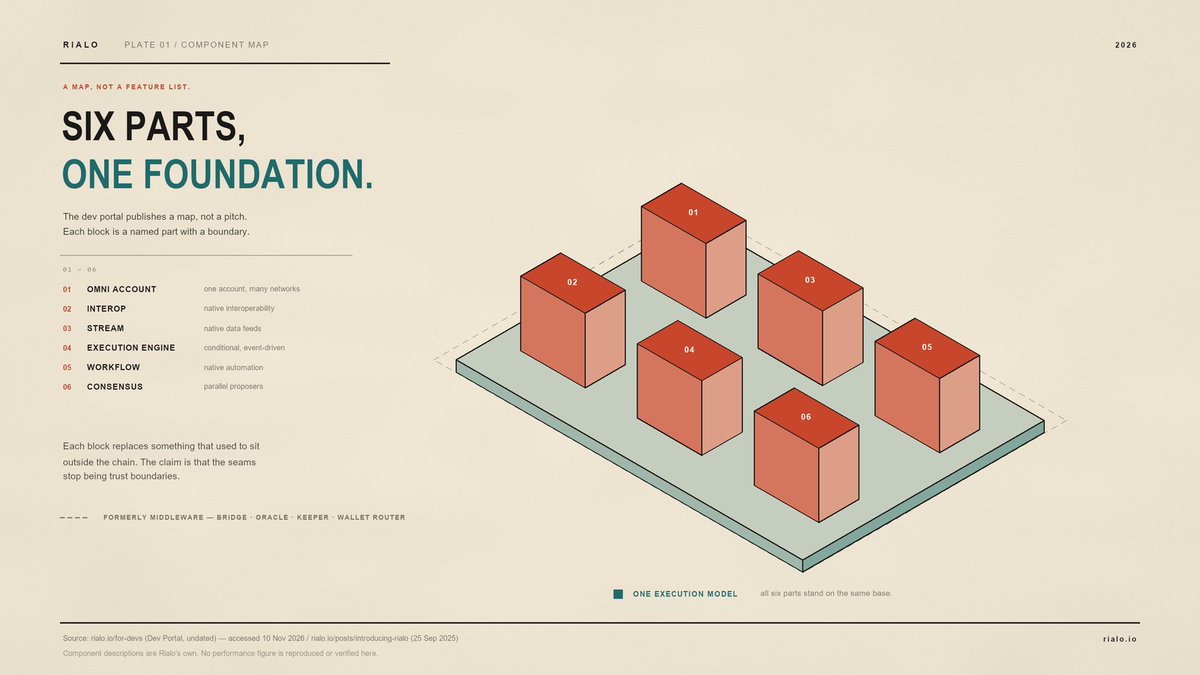
@RialoHQ is rethinking how blockchain components work together
By connecting accounts, interoperability, data feeds, execution, workflows, and consensus, it aims to reduce fragmentation and create a more seamless onchain experience
The real test is execution

Rialo #135: When Does Modularity Become Fragmentation?
Modularity has been an important part of blockchain development. Instead of building every function into a single protocol, different services can specialize in execution, data availability, indexing, or automation.
This approach has clear advantages. Specialized providers can focus on improving their own services, while developers can choose the infrastructure that fits their applications.
But specialization does not always lead to a more efficient system.
The article from @RialoHQ argues that excessive fragmentation can create economic problems when applications depend on multiple independently operated and priced services.
Imagine an application that needs an oracle, an indexer, and an automation provider.
Each service might perform its job efficiently. However, the developer still needs to integrate all three, maintain those connections, and pay each provider separately.
This is where modularity can start turning into fragmentation.
The issue is not simply that functions are separated. It is that the combined infrastructure may become increasingly expensive and difficult to coordinate.
Through Compound Marginalization, independent pricing decisions can raise the total cost of operating applications, even when individual services remain useful.
As those costs increase, developers may struggle to maintain profitability, while users may face higher fees.
The article presents Vertical Integration as one possible response.
By incorporating essential middleware functions into the base protocol, Rialo aims to reduce redundant markups and simplify the infrastructure applications depend on.
This does not mean modularity is inherently inefficient or that every function should be integrated.
The important distinction is whether specialization creates enough value to justify the additional costs and dependencies.
A modular architecture can be useful when its components work together efficiently. Fragmentation becomes a problem when the cost of coordinating those components outweighs their benefits.
In the end, good blockchain architecture is not simply about having more specialized layers or more native features.
It is about designing a system where the entire application can operate efficiently, both technically and economically.
gRialo! 🧡


@Sir0x001 @beepzfun @VelixoMarket Love the focus on seamless UX, fragmentation kills adoption. Tokengated access and preapproval transparency are gamechangers. Both projects prove innovation thrives when you solve real pain points. Keep pushing these boundaries, future users will thank you

@Sir0x001 @beepzfun @VelixoMarket that fragmentation issue definitely keeps the inscription space from reaching a wider audience right now


@Sir0x001 @beepzfun @VelixoMarket solving the fragmentation issue is exactly what will finally push inscriptions into the mainstream market
Last Seen Hashtags on Sotwe
Teen mega
Seen from Germany
สาวสองชลบุรี
Seen from Thailand
Teenagegirls video.
Seen from Turkey
gay
Seen from United Kingdom
mommy
Seen from Canada
ديوت_بدويٌّْ
Seen from Germany
ddlg
Seen from United States
african #twerk
Seen from Netherlands
nsfw
Seen from Germany
somno()********************************************************************
Seen from Australia
Most Popular Users

Elon Musk 
@elonmusk
239.8M followers

Barack Obama
@barackobama
118.6M followers

Cristiano Ronaldo
@cristiano
114.3M followers

Donald J. Trump
@realdonaldtrump
111.7M followers

Narendra Modi
@narendramodi
106.9M followers

Rihanna
@rihanna
98.6M followers

NASA
@nasa
92.1M followers

Justin Bieber
@justinbieber
91.7M followers

KATY PERRY
@katyperry
89.9M followers

Taylor Swift
@taylorswift13
83.9M followers

Lady Gaga
@ladygaga
75.4M followers

Virat Kohli
@imvkohli
73.3M followers

Kim Kardashian
@kimkardashian
70.8M followers

YouTube
@youtube
68.6M followers

Neymar Jr
@neymarjr
66.3M followers

Bill Gates
@billgates
65.1M followers

Selena Gomez
@selenagomez
63M followers

The Ellen Show
@theellenshow
62.1M followers

CNN
@cnn
61.7M followers

X
@x
60.6M followers