After Charlie Kirk’s murder, colleges rushed to police what students and faculty said about it.
One year later, the same instincts are back.
We’ve said it before, and we’ll say it again: Speech doesn’t lose its protections just because people find it offensive.
BREAKING: FIRE’s 2027 College Free Speech Rankings reveal the state of free speech on America’s college campuses — an issue that affects us all.
With @CollegeInsights, we ranked 261 colleges and universities based on nearly 63,000 student responses. Here’s what we found. ⬇️
My team is looking for an attorney or non-attorney advocate with exceptional research skills and a passion for campus free speech. Are you our person?
https://t.co/BWoBpjCvKT
The @whitmancollege Republican Club’s application for college affiliation was unanimously rejected by the student senate, 25-0.
Why? Before the vote, senators grilled club members about the Republican Party platform and told them to “scrub” the club’s name of their politics.
The @whitmancollege Republican Club was unanimously denied recognition after student senators pressed club members to criticize the GOP and President Trump — all while recognizing Planned Parenthood and climate change groups.
This is viewpoint discrimination, pure and simple.
Yesterday, FIRE urged Sec. McMahon to back the renewed focus on campus speech with clear constitutional guardrails: protect lawful expression, enforce harassment rules consistently, and stop colleges from using parallel policies to evade free-speech and due-process protections.
The University of Washington canceled its scheduled Hasan Piker event after the university said the planning process "did not meet the necessary level of rigor."
If the decision was based on process — and not public backlash or criticism — @UW should be transparent about what standards were not met and how they were applied.
Public universities can set standards for events. But they can’t use those standards as cover for canceling a speaker because of their views.
College administrators should not act as fashion police.
@TuskegeeUniv’s ban on bonnets, du-rags, “sagging pants,” and profane messages or illicit substances on clothing treats ordinary style choices as a disciplinary problem under the vague banner of “professionalism.”
Tuskegee says the policy prepares students for success after graduation. But in practice, it invites administrators to police personal expression.
Some dress code rules serve real safety or instructional needs. Loose clothing in a laboratory is an obvious example. A du-rag in a campus cafeteria is not.
Banning head coverings and certain clothing turns administrators into campus censors. Unless the university can show that the banned apparel is substantially disruptive to the educational environment, Tuskegee’s rules are administrative overreach and an abuse of authority, especially given its stated commitment to free expression on campus.
Universities should prepare young adults for the professional world, not infantilize them by dictating wardrobe choices.
This professor criticized a course. Then he faced discipline. Then @TheFIREorg helped him. Then he got into more trouble.
Help us tell Hofstra to stop the nonsense: https://t.co/FIqsOdyrNX
Here’s what two decades of sustained pressure against bad campus speech policies can do:
In 2006, just 8 colleges earned @TheFIREorg’s top “green light” rating. Today, 76 do, while “red light” schools have fallen to a record low.
Secretary McMahon’s letter identifies several opportunities for colleges to restore public trust in higher ed. FIRE has long documented the damage caused by shout-downs, viewpoint discrimination, ideological litmus tests, and institutions’ failure to defend free inquiry. Our 10 common-sense reforms offer a roadmap for colleges seeking to restore public trust while protecting free speech and academic freedom.
https://t.co/XImjMRW6dm
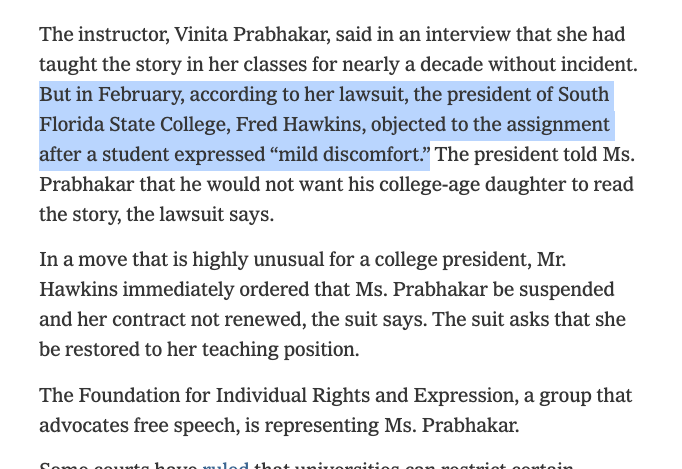
New @thefireorg lawsuit! We're defending an English prof fired for assigning a short story.
Like we've told students for years:
If you go to school for 4 years and don't once encounter an idea that challenges, offends, or shocks you — well, you should ask for your money back.
A win for academic freedom at West Point—for now.
The Academy chose not to appeal a judge’s temporary order blocking enforcement against civilian faculty of a policy requiring advance approval before speaking to outside audiences about their expertise.
While the case isn’t over, the ruling is an important development for academic freedom. The judge’s conclusion that faculty scholarship is generally protected speech on public concerns matters far beyond this case.
West Point adopted the policy after President Trump ordered military institutions not to promote certain “un-American” or “divisive” ideas. But the First Amendment protects faculty members’ right to express political views, even when those views conflict with the government’s or their institution’s.
Lawmakers are demanding that Indiana University fire Professor Elizabeth Booker Houston for delivering a cake reading “Congratudolences” to the late Senator Lindsey Graham's office.
They may find her expression controversial or offensive, but that does not make it punishable. As a public university, @IndianaUniv cannot discipline a professor for protected political speech made as a private citizen.
IU must stand firm and protect her First Amendment rights.
4/ Three: Even if it *were* a DEI conference, professors have the First Amendment right to learn about (and teach about) DEI. Colleges like UNT have an obligation to uphold that right.
https://t.co/1lJXVcUKhq
FIRE will be presenting at @AEJMC in August, but University of North Texas profs won’t. Why? Because UNT says AEJ involves too much DEI, and funding attendance would violate SB 17. Here are three reasons why that’s just wrong.
3/ Two: I’ve been to AEJ several times. While the organization has DEI commitments and offers DEI-related sessions, it’s not a DEI conference. It features sessions on journalism history, AI, and media law (including FIRE’s @marie_mac99 presenting on college press censorship.)