Been messing around with SELF and the prize draw setup is actually kinda clever.
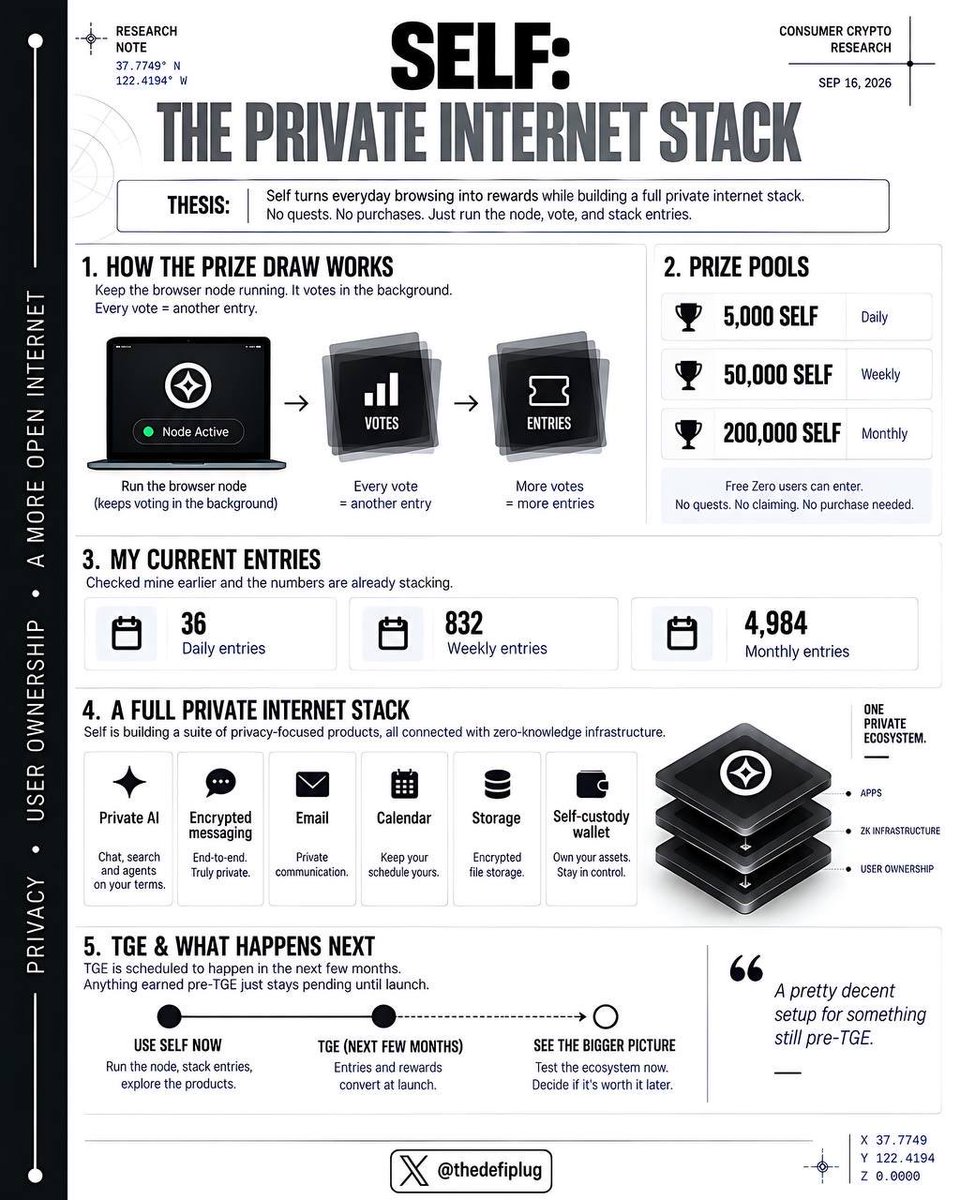
You just keep the browser node running → it votes in the background → every vote = another entry.
No quests
No claiming every day
No purchase needed
Even free Zero users can enter.
Current prize pools are:
➤ 5,000 SELF daily
➤ 50,000 SELF weekly
➤ 200,000 SELF monthly
Checked mine earlier and I’m already at 36 daily, 832 weekly and 4,984 monthly entries.
But the rewards aren’t really the part I find most interesting.
@self_hq is trying to build a whole private internet stack around these:
➤ Private AI
➤ Encrypted messaging
➤ Email
➤ Calendar
➤ Storage
➤ Self-custody wallet
All tied together with zero-knowledge infra underneath.
TGE is scheduled to happen in the next few months too, and anything earned pre-TGE just stays pending until launch.
So basically you can use the product now, stack entries in the background and figure out whether the ecosystem is actually worth caring about before there’s even a token trading.
Pretty decent setup for something still pre-TGE and TGE is set to take place in November!
My invite code: Thedefiplug
A $4.9B synthetic dollar is about to tap an entirely different funding market.
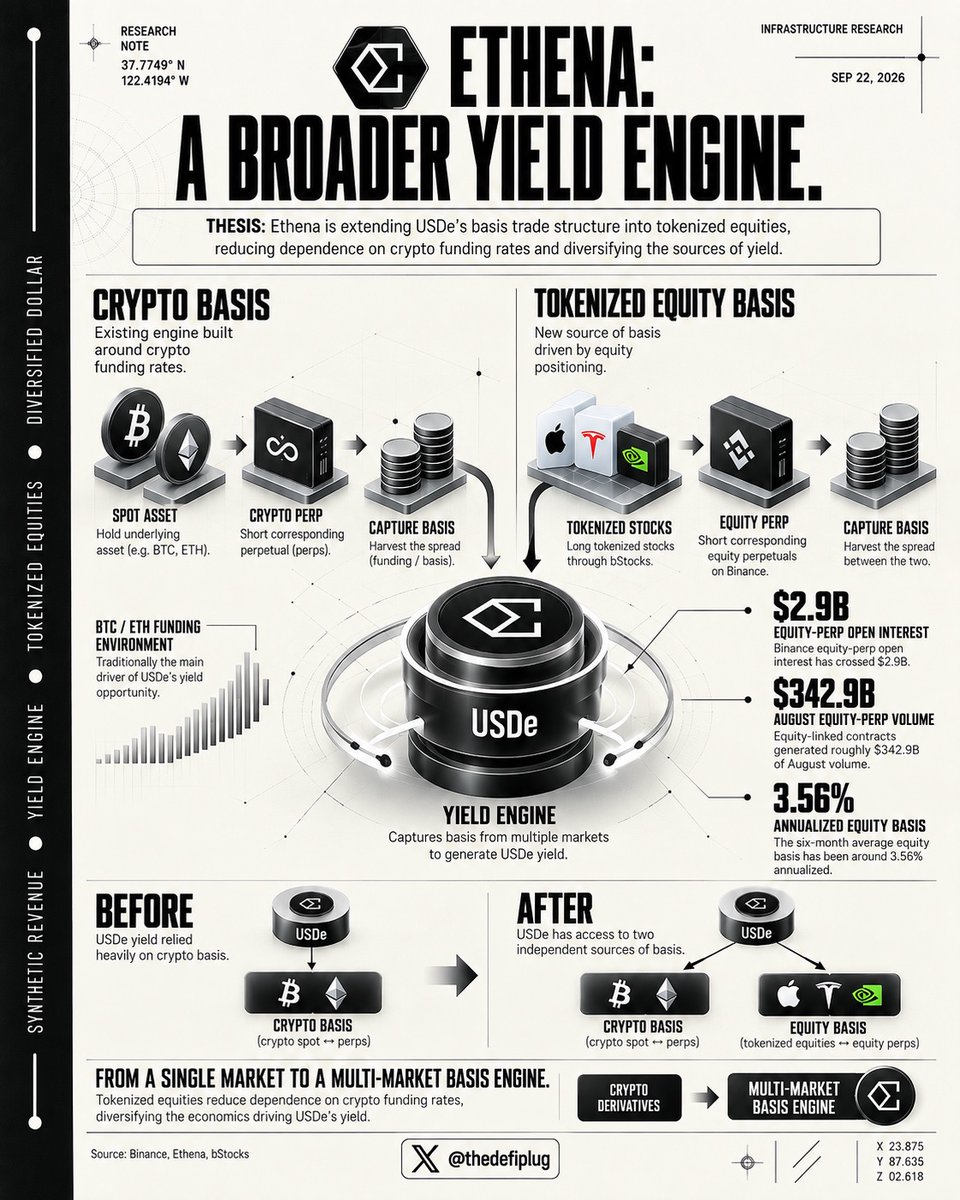
Until now, USDe’s yield engine has largely depended on basis opportunities inside crypto.
Hold the underlying asset.
Short the corresponding perpetual.
Harvest the spread.
Now @ethena is extending the same structure into tokenized equities.
The setup:
➤ Long tokenized stocks through bStocks
➤ Short corresponding equity perpetuals on Binance
➤ Capture the basis between the two
And the market is already large enough to be relevant.
Binance equity-perp open interest has crossed $2.9B, while equity-linked contracts generated roughly $342.9B of August volume.
The six-month average equity basis has been around 3.56% annualized.
The bigger implication is what this does to USDe’s revenue composition.
Weak BTC and ETH funding environments reduce the opportunity set available to a crypto-only basis strategy.
Tokenized equities introduce another source of basis driven by equity positioning rather than crypto leverage.
USDe now has access to two distinct funding markets:
Crypto spot ↔ crypto perps
Tokenized equities ↔ equity perps
This isn’t primarily about adding stocks to the backing.
It’s about diversifying the engine producing the yield.
USDe is evolving from a synthetic dollar built around crypto derivatives into a balance sheet capable of harvesting basis across multiple tokenized markets.
From $2.09B to $2.91B in just 30 days.
That's nearly $900M in additional outstanding loans for @sparkfinance, representing 39.23% monthly growth.
And the more you compare Spark with Aave and Morpho, the clearer the positioning gets.
Spark isn’t trying to build the exact same lending business as either of them.
The active loan books currently stand at:
➤ Aave: $13.21B
➤ Morpho: $5.27B
➤ Spark: $2.91B
Aave has scale. Morpho has flexibility. Spark is positioning itself as a blend of both, combining liquidity depth with a more specialized financing model through its connection to Sky’s stablecoin liquidity.
That becomes more interesting when borrowing costs enter the picture.
On September 21:
➤ SparkLend USDT borrow APY: 3.97%
➤ Aave V3 USDT borrow APY: 4.39%
That’s a 42 bps gap.
For a borrower carrying $10M of debt, that difference is roughly $42k in annualized financing costs if rates remain unchanged.
But Spark isn���t cheaper on every asset, and rates alone don’t explain the growth.
The liquidity model matters too.
Spark can draw stablecoin liquidity from Sky, while Aave’s pooled markets respond more directly to utilization and Morpho gives borrowers access to more specialized market structures.
Utilization adds another dimension to that comparison.
Spark’s USDS market recently recorded 65.6% utilization, up from approximately 62%, while Aave’s Ethereum V3 USDT reserve stood near 93%. Morpho’s adaptive rate model targets 90% utilization, although actual rates differ across its isolated markets.
These aren’t identical asset markets, but the financing implications are clear: higher utilization can increase lending yields while tightening available liquidity and pushing borrowing costs higher. Spark’s ability to expand borrowing alongside its Sky-backed liquidity gives it room to compete for demand without relying solely on higher rates.
For larger borrowers, the decision is not simply “which APY is lowest?”
It is:
➤ How much liquidity is available?
➤ How stable is the financing cost?
➤ How efficiently can collateral be used?
Nearly $900M in additional loans can come from new borrowers, existing borrowers increasing positions, or wallets refinancing from competing venues.
The aggregate data doesn’t tell us how much came from each source.
But it does show that Spark is attracting substantial new borrowing demand while competing against the two biggest names in onchain lending.
Aave doesn’t need to lose dominance for Spark to grow. Morpho doesn’t need to lose its niche either.
Spark just needs borrowers to prefer the financing model it offers.
● My Take
Spark doesn’t need to replace Aave or Morpho to build a serious lending business. Nearly $900M in additional loans shows demand is already there, while Sky-backed liquidity gives it a way to compete without copying either rival.
h/t: @DefiLlama, @DeFiRate
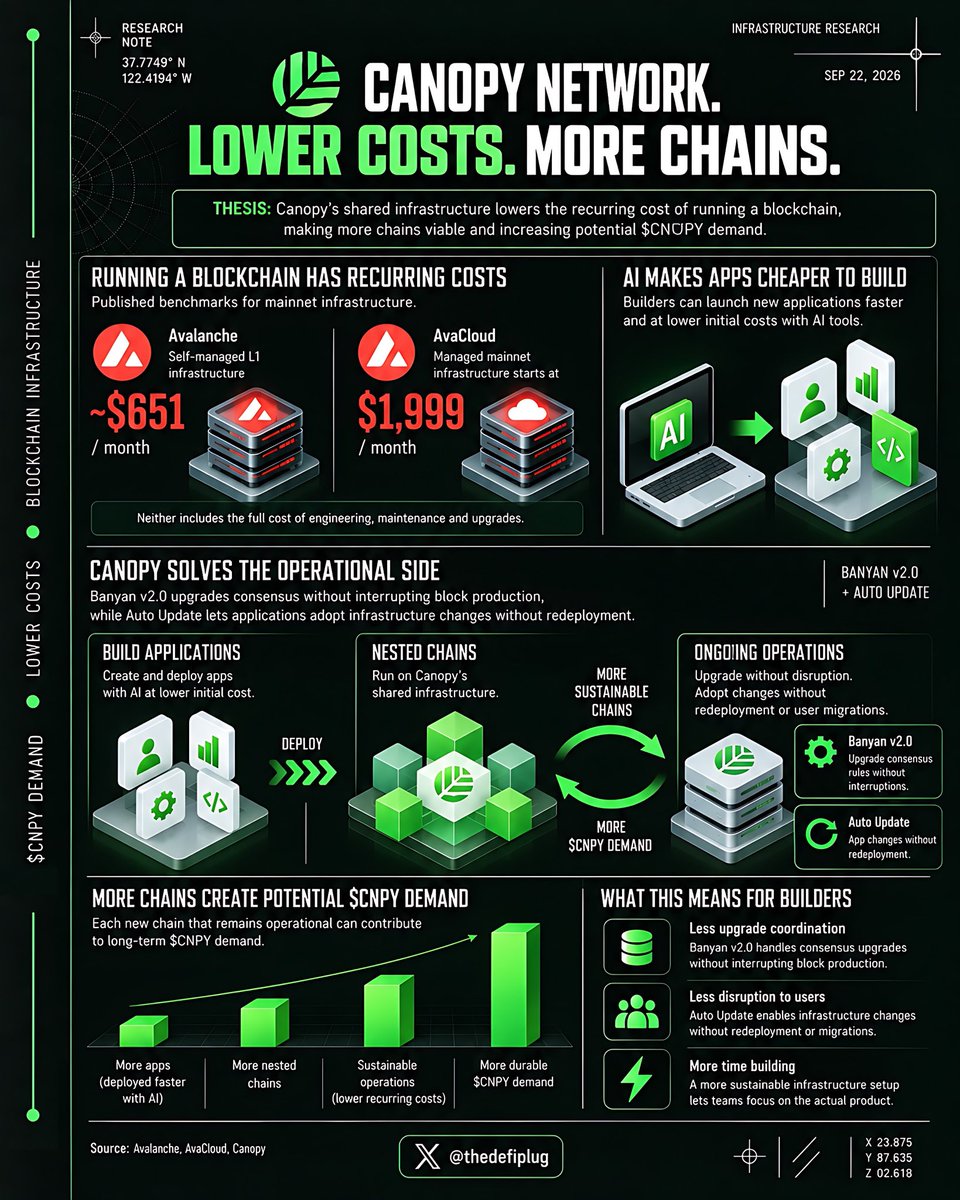
Running a sovereign blockchain has recurring costs before the application finds its first paying user.
Two published benchmarks:
➤ Avalanche: ~$651/month for self-managed L1 infrastructure
➤ AvaCloud: managed mainnet infrastructure starts at $1,999/month
Neither includes the full cost of engineering, maintenance and upgrades.
That adds another dimension to my earlier @CNPYNetwork thesis.
More Nested Chains can create more CNPY demand, but those chains also need to remain viable after launch.
Banyan v2.0 addresses that second problem.
Canopy upgraded its consensus rules without interrupting block production, while Auto Update gives applications a path to adopt infrastructure changes without redeployment or user migrations.
For builders, that means:
➤ Less upgrade coordination
➤ Less disruption to users
➤ More time building the actual product
AI makes applications cheaper to create. Canopy’s shared infrastructure addresses the recurring costs of keeping them operational.
More chains create potential $CNPY demand. Sustainable chains make that demand more durable.
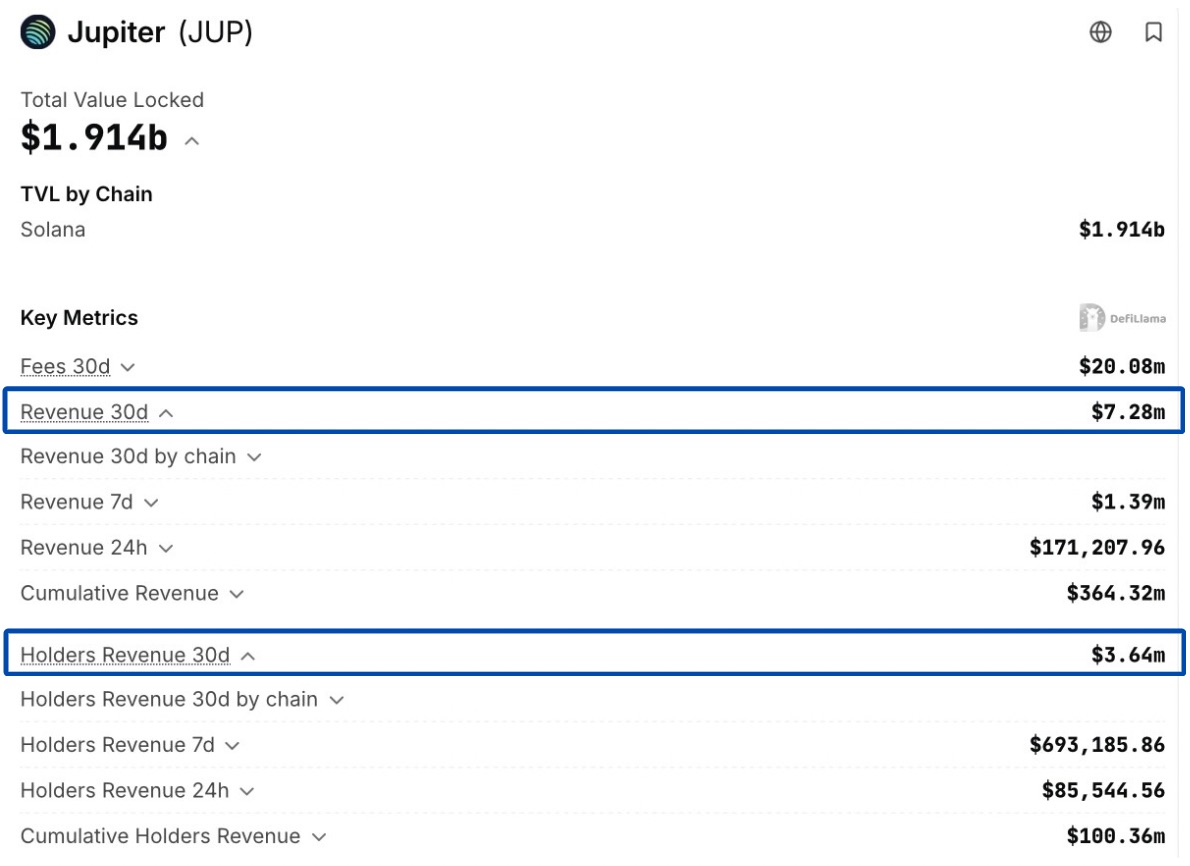
Exactly half of @JupiterExchange’s tracked protocol revenue is currently directed toward tokenholder value capture.
Over the last 30 days:
➤ Protocol revenue: $7.28M
➤ Holder revenue: $3.64M
➤ Holder share: 50%
The same proportion appears across the seven-day and 24-hour figures.
That gives solana:JUPyiwrYJFskUPiHa7hkeR8VUtAeFoSYbKedZNsDvCN a measurable connection between protocol activity and token-directed value.
Jupiter generates revenue across its products, then allocates half of the tracked amount toward holder value capture, including buybacks.
This does not mean $3.64M was paid directly into holders’ wallets. DefiLlama’s holder-revenue category can include buybacks and other mechanisms that direct value toward the token.
But the comparison is still sharp.
Many DeFi protocols generate substantial revenue while reporting zero holder revenue.
Jupiter currently converts 50% of its tracked protocol revenue into measurable demand for solana:JUPyiwrYJFskUPiHa7hkeR8VUtAeFoSYbKedZNsDvCN.
The protocol generates the revenue. The token participates in how that revenue is used.
Most Bitcoin traders have a directional view. BTC goes higher, you long. BTC goes lower, you short.
But what if your conviction is that Bitcoin is about to make a much larger move than the market expects, and you genuinely don’t know which direction?
That’s a volatility trade.
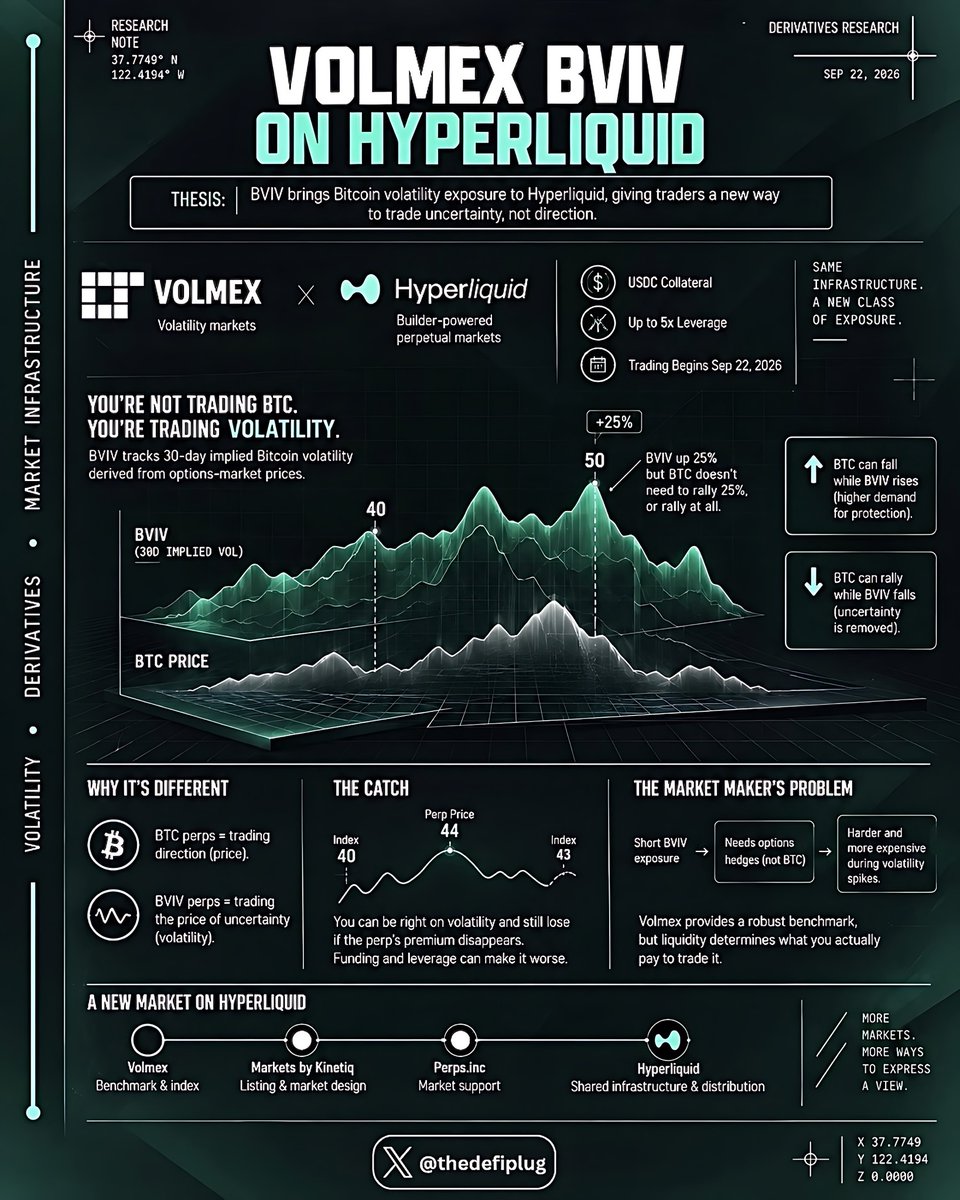
And it’s the exposure @volmexfinance is bringing to @HyperliquidX through its BVIV perpetual. The contract uses USDC collateral and offers up to 5x leverage.
I find this more interesting than another BTC-linked perp because it changes what traders are expressing a view on.
You’re not trading BTC. You’re trading the price of uncertainty.
BVIV tracks Bitcoin’s forward-looking 30-day implied volatility, derived from options-market prices. It measures how much movement the options market is pricing, expressed as an annualized volatility reading.
Suppose BVIV rises from 40 to 50. The index is up 25%, but Bitcoin doesn’t need to rally 25%, or rally at all.
BTC can sell off while BVIV rises because traders are paying more for protection. It can also rally while BVIV falls because an anticipated event has passed and uncertainty is being removed from options prices.
That’s the first distinction: a large BTC move and a profitable long-volatility trade are not the same thing.
● The Catch With Volatility Perps
Here’s where I’d be careful.
Buying a BVIV perp isn’t the same as buying the index at its published value.
Imagine BVIV is at 40, but traders crowd into the long side and push the perp to 44. You buy, expecting volatility to rise.
The index climbs to 43. Your thesis was directionally correct, but if the perp’s premium disappears and it trades at 43, your position still loses.
Funding can make the result worse. When the perp trades above its reference and long demand is crowded, longs can pay to maintain exposure.
So you’re making two judgments:
➤ Is implied volatility too cheap or expensive?
➤ Is the perp itself cheap or expensive relative to that volatility?
The second question is easy to overlook when the product is presented as a simpler alternative to an options strategy.
Leverage makes overlooking it expensive.
● The Market Maker's Problem
A BTC perp is relatively straightforward to hedge. A market maker short BTC can buy spot to offset much of that directional risk.
A short BVIV position is different.
Buying BTC doesn’t hedge volatility. Market makers need suitable volatility exposure, potentially through options, while managing the difference between their hedge and the index.
That becomes difficult when volatility rises sharply. Options spreads can widen, hedging costs can increase and traders can rush to the same side of the BVIV order book.
Volmex can provide a robust benchmark without guaranteeing that the perpetual trades close to it during stress.
The index tells you what volatility is worth according to its methodology. Liquidity determines what you actually pay to trade it.
● What Hyperliquid Changes
BVIV-linked perps aren’t a new invention. The development is their arrival in Hyperliquid’s trading environment, through a listing led by Markets by Kinetiq alongside Volmex and https://t.co/GvMDNzgALN.
That fits the broader evolution of builder-deployed markets.
Specialist teams bring the product and benchmark. Hyperliquid supplies shared trading infrastructure. Traders get access to another category of risk without moving to a dedicated options interface.
But distribution alone doesn’t establish a successful volatility market. The real test is whether:
➤ Market makers maintain depth
➤ Spreads remain usable
➤ The contract tracks its reference when BTC becomes disorderly
● My Take
I like the expansion from trading where Bitcoin goes to trading how much movement the market expects.
But BVIV is not a shortcut around derivatives complexity. It exchanges options mechanics for perp basis, funding and liquidation risk.
The product makes volatility easier to access. It doesn’t make volatility easier to price.
Fed hiked.
Clarity Act failed.
ETF flows were bleeding.
BTC traded down to $75K.
Then it rallied 5.7% on Friday, reclaimed $80K and cleared $85K on Monday, reaching an eight-month high.
The bear case wasn’t necessarily wrong about the headlines. It was wrong about how much selling was left.
The ETF tape explains part of it:
➤ Tuesday: -$450.4M
➤ Wednesday: -$295.9M
➤ Thursday: +$159.5M
➤ Friday: +$433M
Nearly $593M returned over the final two sessions, yet the entire week finished just +$6.2M.
Not some enormous institutional accumulation week. More like demand returning just as a crowded bearish trade started losing its grip.
Monday made that clearer.
CoinGlass data reported $647.9M in crypto short liquidations over 24 hours, including $277.5M in BTC shorts. Aggregate open interest still climbed 7.59% to $156B.
Forced buying cleared positions. New leverage replaced them.
The first leg was relief. The next leg had shorts buying back into a market where ETF demand had stopped deteriorating.
$85K is now the immediate test.
Holding above it gives the breakout credibility. Losing the reclaimed September high around $82.3K, then $80K, puts the move back inside the old range.
My Take: The market spent the week pricing bad news, then ran out of sellers when it arrived. The squeeze explains the speed. Continued spot and ETF demand determines whether the breakout holds.
This is why I was so focused on $800 when ZEC pulled back from $888.
The original call wasn’t that every dip should be bought. It was that a level which had capped price since January 2018 was finally being tested from the other side.
The confirmation has played out in stages:
➤ $800 held as the breakout structure
➤ $850 was reclaimed
➤ Price moved through $1,000 and $1,300
➤ ZEC then closed above $1,500 and traded as high as $1,585
That’s a very different chart from the one traders were looking at when price slipped back toward $830.
The important confirmation wasn’t the first green candle after the pullback. It was buyers continuing to accept progressively higher prices instead of sending ZEC back into its old multiyear range.
$1,500 is now the nearer-term level for assessing whether this latest expansion holds, with the ~$1,585 high marking the immediate overhead area.
The original $800 thesis has already been validated by price. That doesn’t mean every subsequent entry has the same risk/reward.
The breakout gave the trade its foundation. The follow-through confirmed the market was repricing ZEC above its old ceiling.
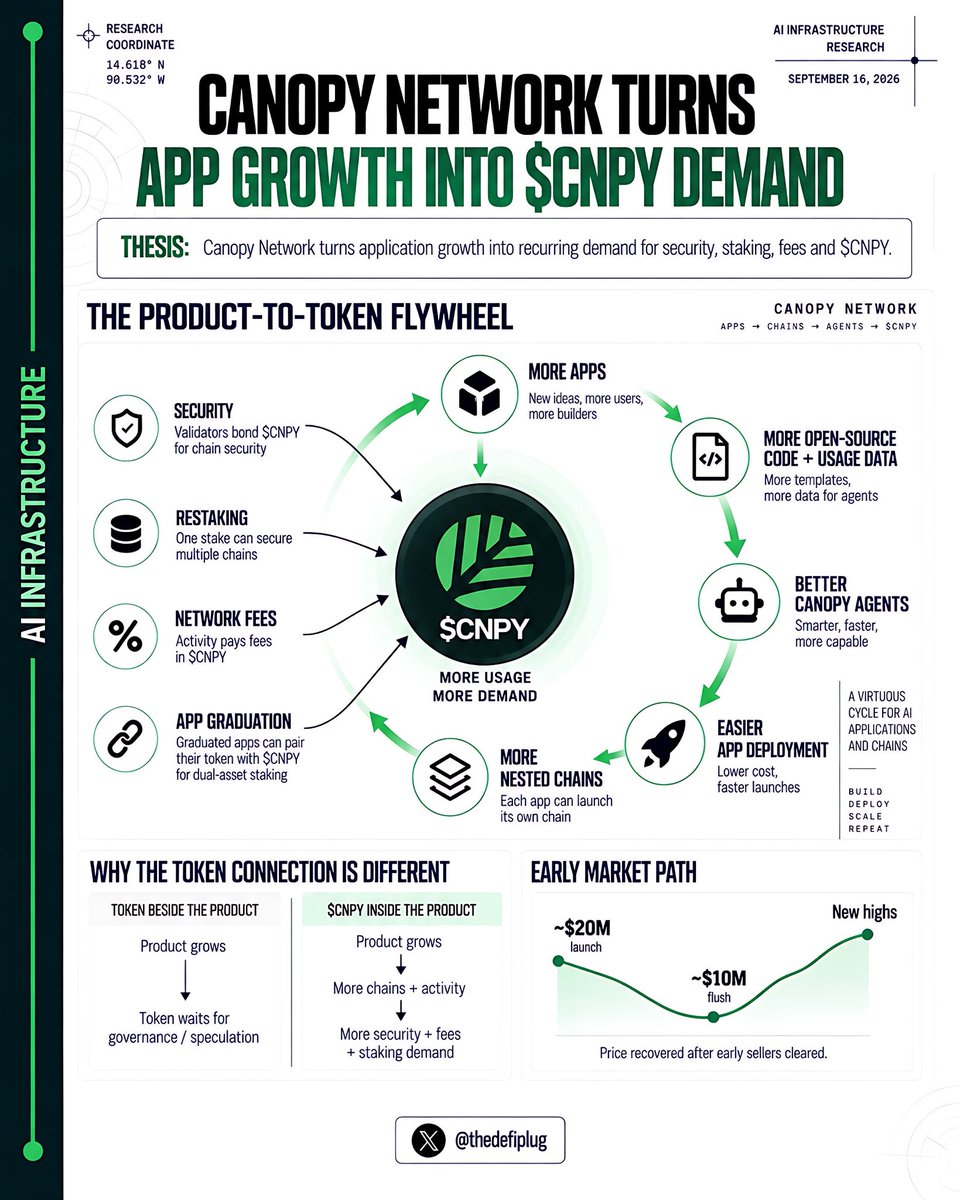
.@CNPYNetwork has one of the cleaner token setups among recent AI infrastructure launches because the product and the token economics are actually connected.
$CNPY launched around a $20M market cap, flushed early sellers toward $10M, then recovered back into new highs.
Price action is one thing.
The more useful question is what creates demand if the ecosystem keeps growing.
Canopy’s answer is fairly direct.
➤ Nested Chains use CNPY across launch and graduation mechanics
➤ Validators bond it for security
➤ The same stake can secure multiple chains through restaking
➤ Network activity pays fees in CNPY
➤ Graduated apps can pair their own token with CNPY for dual-asset staking
So every successful app potentially adds another source of demand rather than simply adding another token competing for attention.
The open-source model adds another layer.
More applications create more code, templates and usage data that Canopy’s agents can learn from.
That creates a feedback loop:
more apps → better agents → easier deployment → more apps → more chains requiring security and CNPY.
The important distinction is that CNPY doesn’t sit beside the product waiting for governance to give it relevance.
The product itself routes activity back into the token.
More apps improve the agents.
Better agents lower the cost of launching.
More launches create more demand for security, fees and staking.
That’s a a well built AI narrative with a token bolted onto it.
Roughly $40M of crypto funding was announced across 3 companies yesterday.
Around $30M of it went directly into stablecoin infrastructure.
Not another stablecoin.
The infrastructure underneath them.
The three announcements:
➤ Fincom: $20M
➤ @velocityxyz_: $10M
➤ @FinloopHK: $10M+
The first two are the interesting part.
Fincom is building the last-mile infrastructure between stablecoins and local financial rails.
Businesses can collect funds through bank transfers, wires or stablecoins, then pay out into local bank accounts across 30+ countries.
Its customers collectively serve more than 800M users.
Velocity is attacking a different part of the same problem.
It provides stablecoin treasury and settlement infrastructure for enterprises, payment companies and financial institutions.
The pitch is basically:
Companies want 24/7 settlement.
They don’t want to manage wallets, liquidity providers, FX, custody, compliance, banking relationships and on/off ramps themselves.
Velocity hides that complexity behind infrastructure that plugs into systems they already use.
Its latest $10M came from Visa Ventures, Circle Ventures, Ripple, Haun Ventures and others, extending its Series A to $48M.
That’s a pretty useful read on where stablecoin investing is going.
Stablecoins themselves are already a $300B+ asset class.
USDT and USDC have won most of the issuance battle.
Creating another dollar token isn’t necessarily the biggest opportunity anymore.
The bottleneck is increasingly everything required to make those dollars usable outside crypto.
Think about what happens when a normal company actually wants to use stablecoins.
It needs:
➤ Fiat collection
➤ Stablecoin conversion
➤ FX
➤ Local payouts
➤ Banking connections
➤ Liquidity
➤ Compliance
➤ Treasury management
➤ Reconciliation
➤ 24/7 settlement
USDC existing doesn’t solve any of those problems by itself.
That’s why I think stablecoin infrastructure is entering its second phase.
Phase one was:
issue the dollar onchain.
Phase two is:
make businesses able to use that dollar without becoming crypto companies.
Fincom is basically building the bridge from stablecoins back into local financial systems.
Velocity is building the operating layer that lets corporate treasury and payment teams use stablecoins without managing the crypto stack underneath.
And even Finloop, which sits closer to wealth management and RWAs, points in the same general direction.
Its infrastructure connects traditional financial products, tokenized assets and corporate treasury workflows.
So the capital isn’t only chasing stablecoin supply anymore.
It’s moving one layer down.
Into distribution.
Settlement.
Treasury.
Off-ramps.
Compliance.
RWA infrastructure.
The boring pieces that sit between a $300B stablecoin market and businesses actually moving trillions of dollars through it.
That’s probably the more useful way to think about stablecoin adoption from here.
I don’t think the next leg is defined by whether stablecoin market cap goes from $300B to $400B.
I’d watch how much economic activity starts happening around each stablecoin dollar.
How often it moves.
How many businesses use it.
How much FX runs through it.
How much payroll, settlement, treasury and cross-border activity gets routed through these rails.
Stablecoins have already created the asset.
Now investors are increasingly funding the companies trying to make the asset disappear into the plumbing.
Bitcoin is getting a pretty clean macro stress test right now.
This morning:
➤ U.S. 10Y Treasury yield: 5.03%
➤ Brent crude: $104+
➤ Dollar strengthening
➤ BTC: $76.8K, down 2.3%
The 10-year is now at its highest level since 2007.
And oil being back above $100 makes the setup even harder.
Higher Treasury yields give investors a better return for simply holding government debt.
Higher oil adds inflation pressure.
Higher inflation gives the Fed less room to ease.
And a stronger dollar generally tightens financial conditions even further.
Normally, that combination isn’t particularly friendly to Bitcoin or risk assets.
Which is why I’m watching BTC here more closely than I would after another crypto-native catalyst.
The interesting question isn’t whether Bitcoin drops 2% on a bad macro day.
It probably should.
The better question is how much it drops, and whether it keeps following rates as tightly if yields stay around 5%.
Because BTC has spent years trading like a high-beta liquidity asset whenever financial conditions tighten.
If Treasuries stay around these levels, oil remains above $100, the Fed keeps policy tight and Bitcoin still manages to hold the mid-$70Ks or recover quickly, that would be much more interesting than a rally caused by ETF flows or crypto legislation.
But one day isn’t enough to make that conclusion.
For now, the pressure is clearly there.
10Y above 5%.
Oil above $100.
Dollar stronger.
More Fed tightening being priced.
Now we get to see how much of that Bitcoin can absorb.