The world just minted its first trillionaire. As wealth concentration grows, HKU researchers are asking: what happens to those on the other side of the equation?
Founded in late 2025, HKU’s Stone Centre is part of a network of 13 institutions around the globe – and the only one of its kind in Asia – looking at the causes and effects of socioeconomic inequality.
It’s not just about money. Inequality accumulates across people’s lives, affecting everything from financial wealth to where they live, their education, and what job opportunities they have.
HKU’s Stone Centre will focus on four interconnected research directions:
Wealth and income concentration, with a focus on Asia;
The role of economic policies and shocks on inequality;
The behaviour and networks of the ultra rich;
The impact of socioeconomic inequality on people’s lives, work, and health.
“For a very long time, the study of inequality wasn’t fashionable,” says Professor Tarani Chandola @TaraniChandola , one of the Stone Centre’s co-Directors, alongside Professor Uta Schönberg and Professor Ming Wen.
“Researchers believed that societies should focus on getting rich, then worry about redistribution. But people increasingly see you can’t wait, that inequality itself drives whether societies and individuals become rich or poor.”
Our paper is online now! It suggests that prior research might have overestimated the long-term cognitive benefits of studying a second language. https://t.co/eMMTBsm8nl
The future of care starts at home. 🤍
As populations age and care needs grow, domestic workers - including migrant domestic workers - are becoming even more essential.
Decent care needs decent work for domestic workers. #RatifyC189
“Decomposing Differences in Cohort Health Expectancy by Cause & Age”: Tao Sun, Huiping Zheng & Xiaojun Wang offer new methods for decomposing cohort HE to “promote a better understanding of how age patterns & disease burdens contribute" w/in & across pops. https://t.co/sZULGnbPTf
🚨Out today in @Nature our new paper uses deep learning to map four decades of global human migration.
By building the first comprehensive dataset of global annual flows (1990-2023), we reveal that migration has nearly tripled since 2000.
🔗https://t.co/DuPQKF1asT
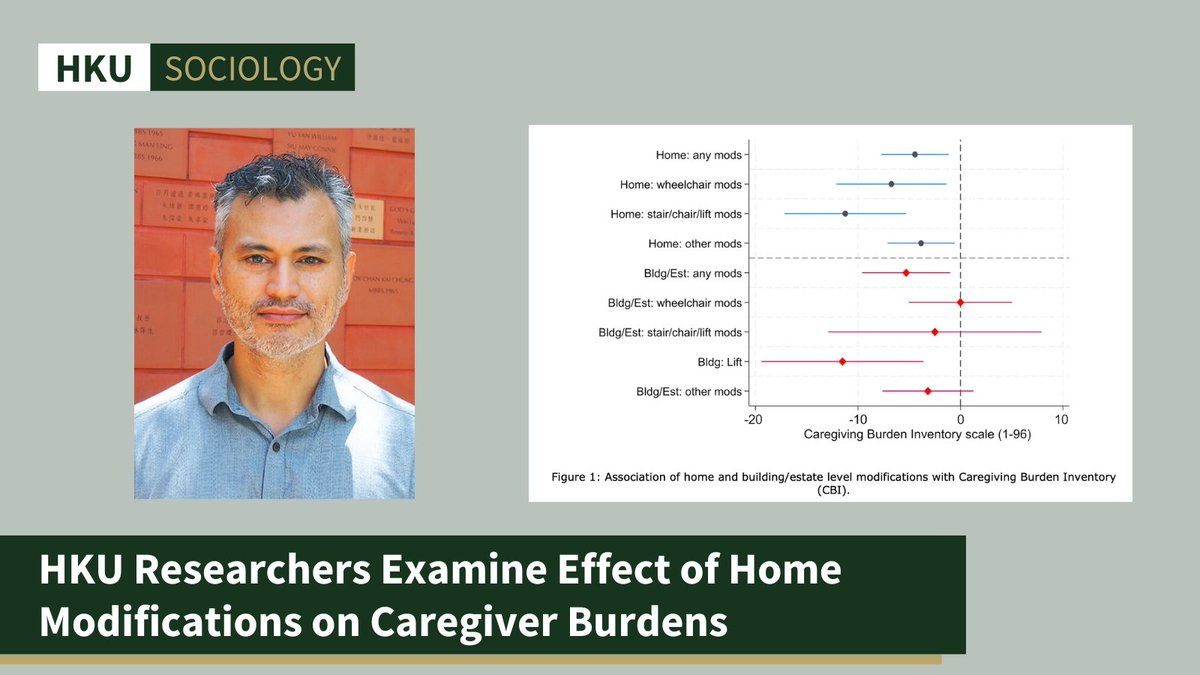
Can a concerted push to roll out home modifications, including wheelchair ramps, chair lifts, and handrails, help reduce stress on caregivers and allow more Hong Kong residents to age in place? New research led by @HKUsociology’s Professor Tarani Chandola suggests the answer is yes – especially when modifications are instituted across a given community.
“At the community level, more accessible housing can facilitate older adults’ social participation within high-rise estates and reduce isolation,” the team wrote. “At the societal level, investments in home modifications may help contain long-term care and health-care costs and promote more equitable ageing trajectories in dense urban settings.”
The study points to the importance of initiatives like the “Age-Friendly Home” programme, which offers Hong Kong residents assessments and financial assistance for modifying homes to add assistive devices.
We’re hiring postdocs and predocs at Yale (ZCAFE) working on AI and social science methods.
Projects include using AI and computer vision to work with multimodal data, build new indices, and design experiments. We’re especially interested in candidates who care about substantive social science questions and have experience with predictive modeling or LLMs.
Appointments are for one year, with the possibility of extension.
To apply, please send a CV and writing sample to [email protected].
Who lives alone in South Korea?
Join CASER at @nyushanghai for a Zoom seminar with Hyunjoon Park of @Penn on April 2, 2026, 8:00–9:30 PM CST, exploring trends in solo living from 1980 to 2020 and what they reveal about family change in contemporary Korea.
Upcoming @WFRN Conference on June 17-20 in Montreal. Everything you need to know from President @Jenlhook. Prelim Prog now available, Mentor/Mentees, dinners, expeditions, best paper awards and more! https://t.co/yj4IIilWZy
@MishaTeplitskiy I suspect that the programs and teams that accept pivots may benefit more than the pivots themselves. From the team’s perspective, taking in switchers can expand the research agenda and amplify impact
📊 Too much global development data still lives in spreadsheets.
But modern analysis requires data acquisition as code.
Today I’m pleased to share that the unicefData R package is now available on CRAN, providing direct programmatic access to the UNICEF Data Warehouse.
Researchers, policymakers, and analysts can now retrieve 700+ internationally comparable indicators on children and women directly from R — enabling reproducible analytics, transparent workflows, and faster evidence generation.
Install
install.packages("unicefData")
Example
library(unicefData)
df <- unicefData(
indicator = "CME_MRY0T4",
countries = c("BRA","USA","IND"),
year = "2015:2023"
)
Why this matters
Reliable evidence depends not only on good data, but also on how easily that data can be accessed, reproduced, and reused.
The unicefData package helps bridge the gap between official statistics and modern data science workflows by enabling:
• Access to 700+ indicators across countries and years
• Integration with reproducible research pipelines
• Use of SDMX international statistical standards
• Consistent interfaces across R, Python, and Stata
Making official statistics more accessible, reproducible, and interoperable is an important step toward strengthening evidence for policies that improve outcomes for children.
📦 CRAN
https://t.co/F5odst3I3y
#OpenData #OfficialStatistics #RStats #DataForChildren #ReproducibleResearch
LLMs + agents now outperform trained human coders at building large-scale political datasets.
We introduce and evaluate an agentic framework that automates global elite biography dataset (think research-grade political LinkedIn) from the web. 🧵(1/9) https://t.co/A7z7g2Mkfa
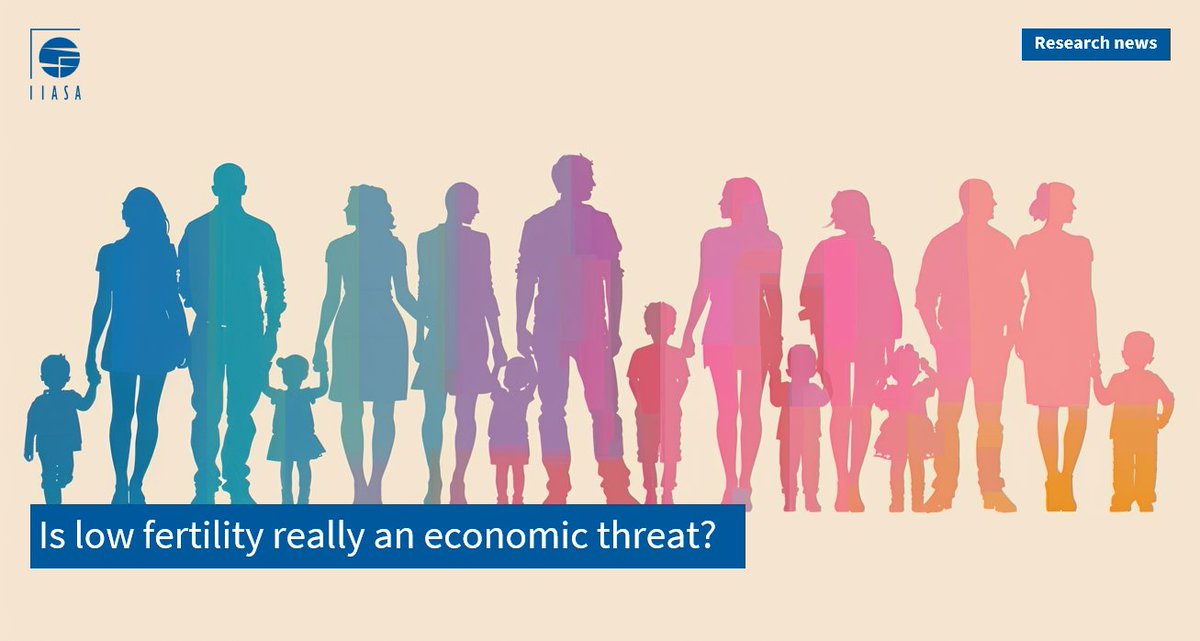
In @Nature Human Behaviour, Wolfgang Lutz & Guillaume Marois show that higher development now correlates with lower fertility - and 2.1 births per woman isn’t an economic magic number. 💬 “There is no single ‘ideal’ fertility level that guarantees prosperity.” - Lutz
https://t.co/rvBhT9DhFY
AI agents are “Airplanes for the mind”.
Check out my latest piece in @Nature, where I outline an agenda for how to think about AI agents in science and discovery.
Steve Jobs famously called computers “bicycles for the mind”—a metaphor for the personal-computing era, emphasizing tools that let individuals go farther and faster with less effort. Today, AI agents demand a new metaphor. They are airplanes for the mind: heavier-than-air machines that should not fly but do.
These “airplanes” have the potential to dramatically extend the scale, speed, and coordination of human cognition, while introducing new challenges for science and discovery.
The piece outlines five key principles to help us understand what changes for science when AI systems move from passive tools to active partners.
Throughout history, discoveries have been made by humans. As AI systems increasingly participate in discovery, the central question is how we design human–AI collaboration to make science more accountable, reproducible, and ultimately transformative.
The question is not whether machines replace scientists, but what kind of scientist emerges when we learn to fly.
Check out the piece and let me know what you think!
Link in the first reply
Revisiting the Relationship between Marriage and Childbearing in East Asia: The Role of Fertility Desires in Japan - Uchikoshi - Population and Development Review - Wiley Online Library https://t.co/6TL7a49xXs
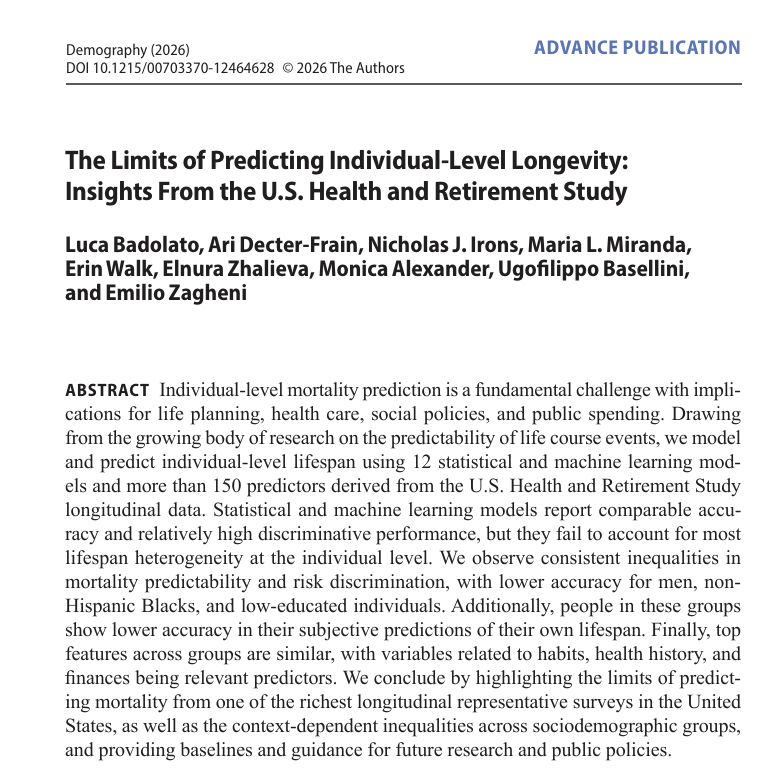
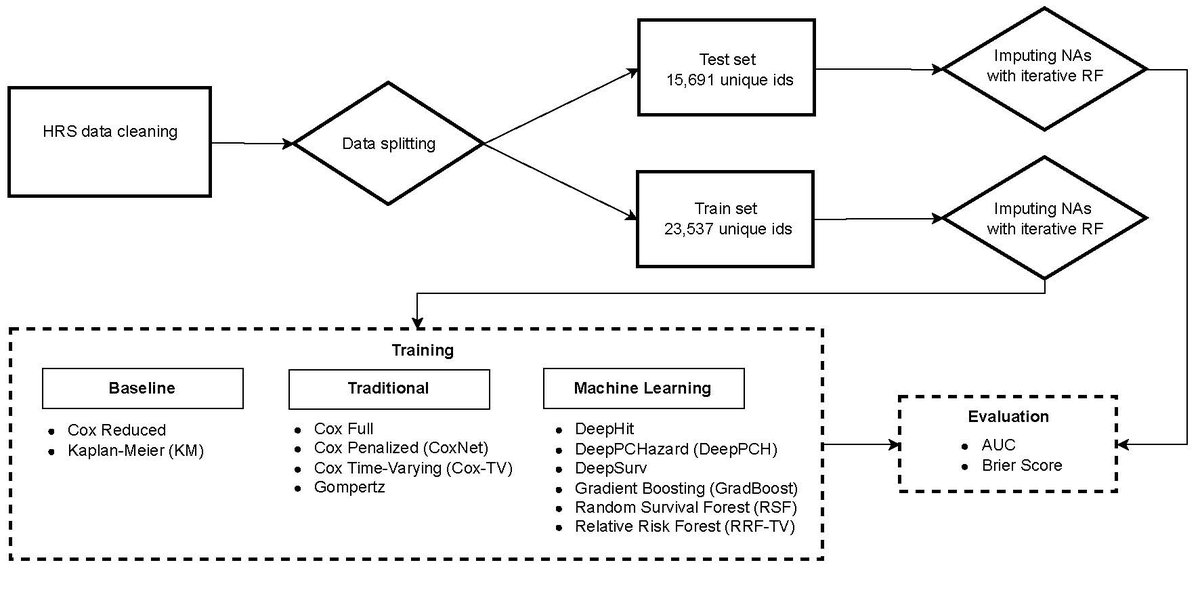
@BadolatoLuca@ugobas@ezagheni et al assess a range of statistical & machine learning survival analysis models on mortality. @MPIDRnews The Limits of Predicting Individual-Level Longevity: Insights From the U.S. Health and Retirement Study | Demography | Duke University Press
🆕 New research
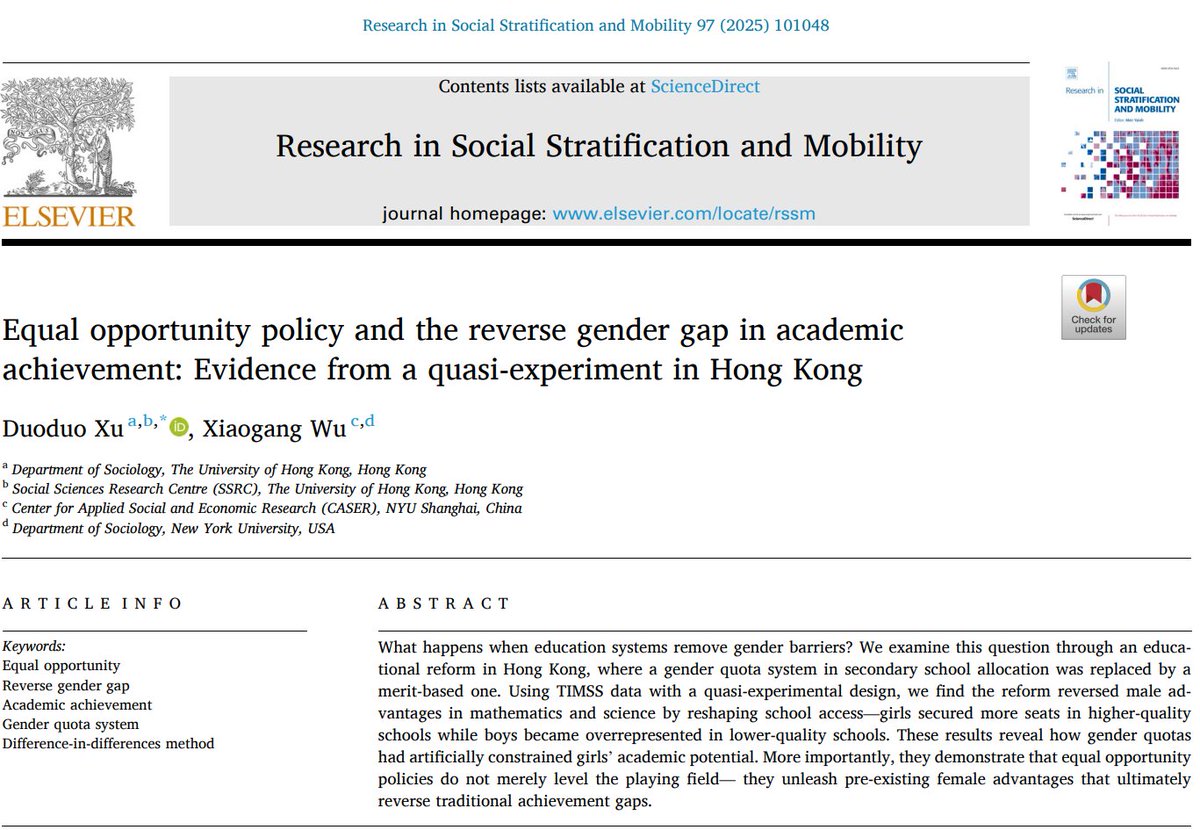
📄 Equal opportunity policy and the reverse gender gap in academic achievement
🎓 When gender-based barriers in school admissions are removed, girls not only catch up—but outperform boys in math and science.
👩🏫 Duoduo Xu (HKU) & Xiaogang Wu
📖 Published in RSSM
Korea’s fertility rate is now lower than Japan’s—but why? Our new paper explores how youth labor market challenges, especially male economic inactivity, help explain Korea’s steeper fertility decline. @SinnWon
https://t.co/AbaAidyc5H
Congratulations to #hku professor Tarani Chandola, whose research on the cumulative stress impact of the “Anxious Monday” effect just won China’s answer to the Ig Nobel: a Pineapple Science Award, given to “fun and serious” scientific achievements.
For many workers, the start of the week triggers feelings of stress and anxiety. But how does that anxiety, accumulated across thousands of Mondays, affect us over the long term?
In search of the answer, Professor Chandola and his coauthors, Wanying Ling and Dr Patrick Rouxel, looked at cortisol levels in older adults with Monday anxiety. They found levels that were significantly higher than their peers – and that this effect persisted even after retirement, suggesting it had become biologically embedded.
Although studying the “Monday blues” may sound a bit “strange and weird”, as Professor Chandola puts it, the paper’s findings also have a serious side. Mondays are linked to a spike in heart attacks, and the team’s research points to a possible explanation: chronic stress hormone dysregulation. That could lead to new pathways in the treatment of heart disease in aging populations.
The awarded study focuses on populations in the United Kingdom, but Professor Chandola says he would like to look at work-related stress in Hong Kong in the future. “We all know work-related stress is high in Hong Kong,” he says. “But it would be interesting to look at how these objective measures of stress compare to other cities in the world.”
Read more: https://t.co/3mdtpSLmUE
#HKU #香港大學 #UniversityofHongKong