How does the brain combine what we see with what language tells us to expect? Excited to share two recent works from our group and collaborators, connecting vision, language, and multimodal AI. 🧵1/11
🚀 Introducing SkillOpt — an optimizer for agent skills.
Instead of finetuning model weights, we treat a natural-language skill as a trainable external parameter.
Think of it as deep learning for the frontier-model + agent era: learning rate, LR schedule, mini-batch, batch size, epoch, momentum — all in text-space optimization.
SkillOpt enables stable, controllable skill updates through bounded edits, allowing the optimizer to summarize “gradient directions” from agent experience and continuously improve procedural capability.
We evaluate SkillOpt across 6 benchmarks and 7 models, under both direct model calls and real agent execution loops with Codex + Claude Code. SkillOpt achieves best or tied-best results in 52/52 settings.
Train the skill, not the model. 🛠️🤖
🌐 https://t.co/zinqcX2wfQ
📄 https://t.co/pCI4VWdpih
Hearing aids amplify all incoming sound, and so struggle with noisy surroundings. Brain-controlled hearing tech from @NimaMesgarani, @infinivishal & team could lead to a new generation of hearing systems that help people single out a voice in a crowd.
Read more: https://t.co/6ikORROkSb
🚀 Announcing the Chinese BabyLM Challenge: the first shared task on data-efficient pretraining for Chinese.
📍 Co-located with NLPCC 2026 (Nov 3–5, Macau🇨🇳🇲🇴)
Can you train a strong Chinese LM on just ~100M words? https://t.co/2G4AFdubMr
🧵 👇(1/6)
1/7 How can we develop decoding methods that generalize to novel subjects without any fine-tuning?
Excited to share our recent collaboration to appear at CVPR 2026!
Work led by Andrew Luo's group, with many collaborators (@_jacobprince_ , Mike Tarr, @KriegeskorteLab and others).
code: https://t.co/5o43p1iQpt
paper: https://t.co/hYGH5cSuWw
I think we finally made really significant progress on the biggest unsolved "developmental AI" problem: learning from human-scale data. Key idea: zero-shot world models that support concept extraction via approximate causal inference. amazing collab w/ @khai_loong_aw@mcxfrank
Between theorem recognition and theorem proving lies theorem understanding.
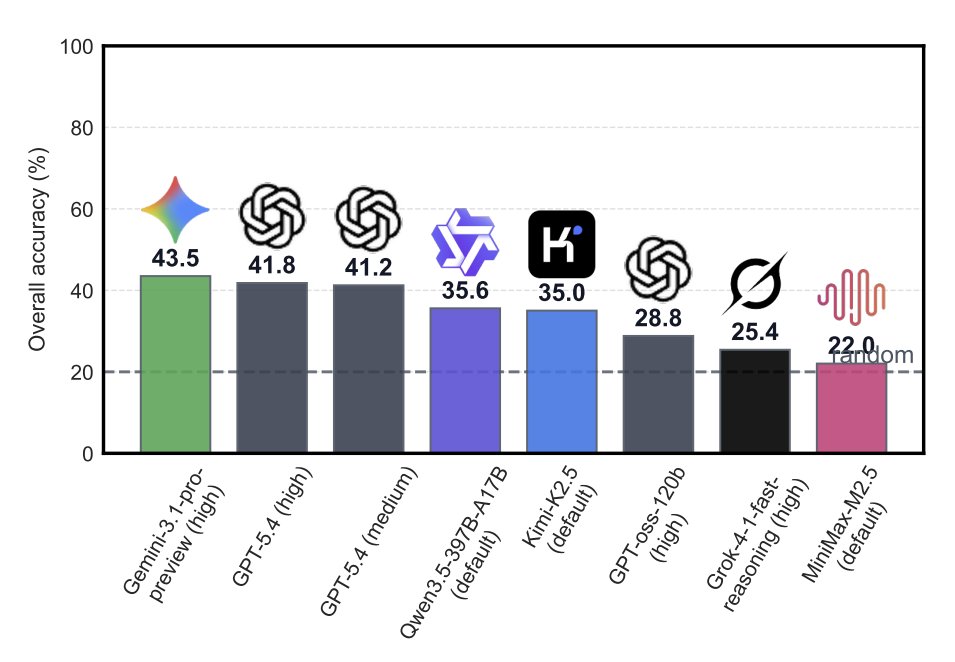
We introduce LiveMathematicianBench: a live, contamination-resistant testbed for research-level mathematical reasoning, built from post-cutoff arXiv theorems.
It probes a capability that existing benchmarks rarely isolate: whether models can understand theorem statements, track delicate assumptions, reason over logical structure, and leverage proof-level guidance.
https://t.co/TZ8KYTVCmG
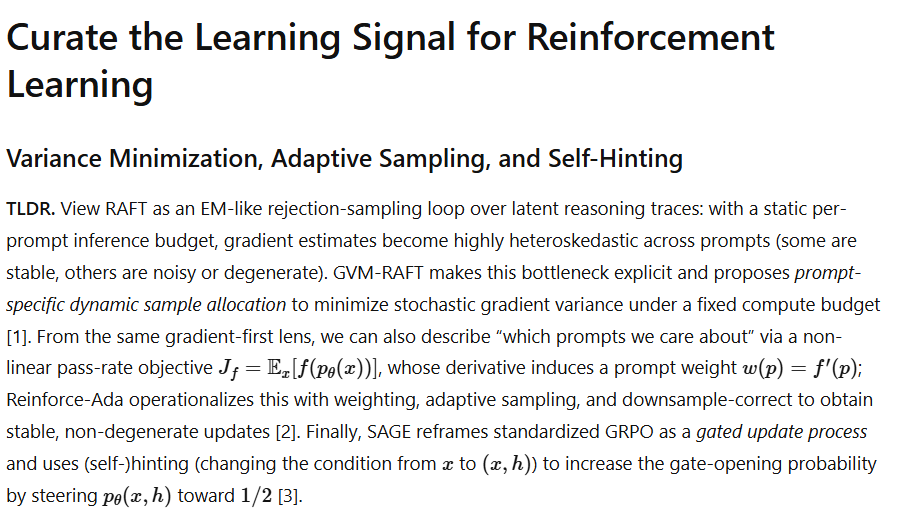
SFT curates responses. RL curates sampling.
RL improves by curating what the model experiences: condition; distribution; weighting of what gets learned from.
Better signal curation shifts the performance-compute curve upward.
Full write-up below 👇
https://t.co/W9f4qPnQOp
#VideoReason We are open-sourcing the entire VBVR stack to speed-up the arrival of video reasoning as the next fundamental paradigm of intelligence
- 150+ synthetic generators
- 1 million training clips
- Cloud-scale data factory
- Unified EvalKit
- 100 rule-based evaluators
- Strong baseline model
Checkout at https://t.co/lOtJzJYC52
[1/n]🧠Can LLMs understand viral meme clips like Rickrolling, Leekspin, Nyan Cat, and “愛♡スクリ~ム”?
🎉Happy to share AVMeme Exam, the funniest audio/video understanding benchmark ever! We eval multimodal LLMs on the meme clips you hear & see daily on YouTube, TikTok &Bilibili
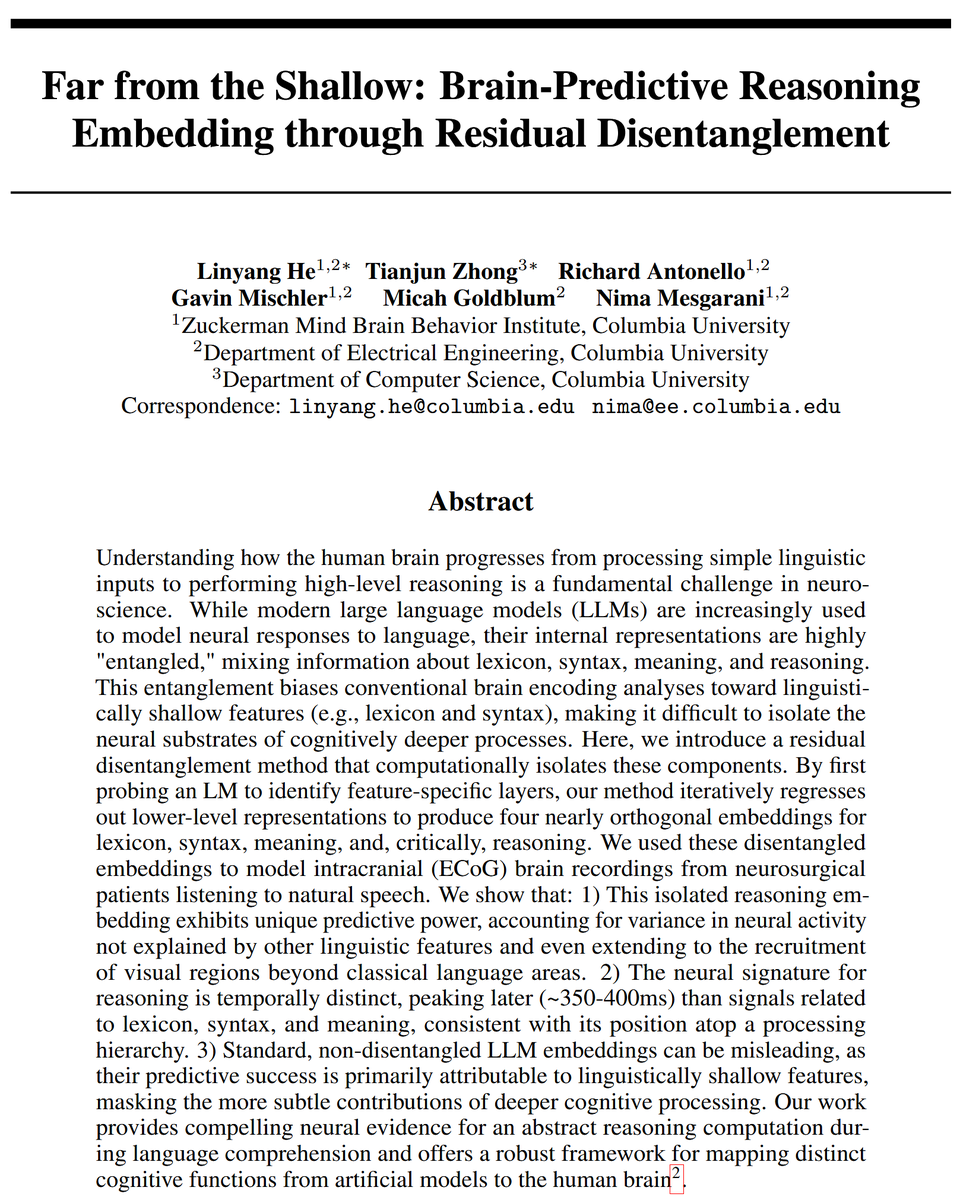
🧠New at #neurips2025!
TL;DR: We introduce the first "reasoning embedding" and uncover its unique spatio-temporal pattern in the brain.
🔗https://t.co/GdNsO4sVFN...
5️⃣ Takeaway:
- Raw LLM embeddings = biased toward shallow linguistic features.
- Residual disentanglement exposes the deeper, reasoning-specific representations shared by brains and models.


![nicolaus625's tweet photo. [1/n]🧠Can LLMs understand viral meme clips like Rickrolling, Leekspin, Nyan Cat, and “愛♡スクリ~ム”?
🎉Happy to share AVMeme Exam, the funniest audio/video understanding benchmark ever! We eval multimodal LLMs on the meme clips you hear & see daily on YouTube, TikTok &Bilibili https://t.co/JuXCgakvDS](https://pbs.twimg.com/media/HAKRpAgXoAAkho4.jpg)