Neuroscience and improv? Check out @columbiamag’s profile of postdoc @RajyashreeSen, a social behavior researcher who founded the Lab—an improv troupe that uses comedy to communicate science to the public!
Join us for the next Music on the Brain: From Signal to Sound!
MRI pioneer Dr. Tommy Vaughan and saxophonist Patience Higgins will explore how we use technology to better understand the brain and how those same ideas connect to music. The evening will also feature live performances by the Patience Higgins Quartet.
Thursday, November 12, 7–8 PM
National Jazz Museum in Harlem
Free and open to the public!
https://t.co/Kyf3phhG8y
Don't miss our @SNForg Brain Insight Lecture: Looking Within the Autistic Experience. Today at 6:30 pm. 🕡
Featuring Matthew Zajic, Erica Musser, and Andrew Marin.
Register here:
https://t.co/deNlRr8mqA
What can math tell us about the mind? Our Center for Theoretical Neuroscience @cu_neurotheory builds mathematical models of the brain that help explain everything from how its electrical activity remains stable to how memories are stored.
Meet some of the scientists advancing this young field, using tools borrowed from physics, statistics and other disciplines.
https://t.co/rCmygpcTDD
Thank you to everyone who supported the Zuckerman Mind Brain Behavior Institute on #ColumbiaGivingDay! Thanks to your help we won two separate hourly challenges yesterday that awarded additional bonus funds for our early-career scientists.
Please contact us if you have any questions or would like to learn more about The Future in Mind Initiative:
https://t.co/EijH4vsxZb
Please join us on Nov 4 for our next @SNForg Brain Insight Lecture, Looking Within the Autistic Experience.
Experts from education and psychology will come together to discuss the importance of centering autistic narratives in research.
Learn more and register:
https://t.co/SMjaBm4xFg
It’s #ColumbiaGivingDay! 🧠 Donate to @columbia’s Zuckerman Institute before midnight to support early-career scientists—from undergrads to junior faculty. Every dollar fuels neuroscience research, and first-time gifts are 100% MATCHED (up to $1,000) https://t.co/D3yeqUruSB.
Congratulations to neuroscientist @GogosLabZMBBI and @ColumbiaMed physician-scientist Stephen Kushner, whose innovative research advancing the understanding and treatment of mental illness is being recognized by the Brain & Behavior Research Foundation @BBRFoundation.
https://t.co/83n5Fu5SfS
Amyloid fibers are best known as hallmarks of Alzheimer’s and other neurodegenerative diseases. But they recently turned up in a surprising place: in sperm, shuttling genetic material. The new research from the @FitzpatrickLab holds potential for gene-editing technologies.
Learn more from @MolecularCell:
https://t.co/tGDWsrewNX
@ColumbiaMed
Congratulations to the @NimaMesgarani lab’s Xiaomin He and alumnus @infinivishal, who received the Best Student Paper Award at #interspeech2026 for their work on brain-controlled hearing research. 👏🧠👏
Read more: https://t.co/v1fm3zAtvK
@ColumbiaMed
Save the date: Wednesday, October 28, is #ColumbiaGivingDay!
https://t.co/GToJQQXq48
Stand for science on Giving Day! Your donation goes directly to supporting the students and postdocs who make research possible: the next generation of neuroscientists discovering incredible things about mind, brain and behavior at Columbia University’s Zuckerman Institute.
Please pass this along to friends and all who might be interested. All first-time gifts to the university or institute will be 100% matched (up to $1,000) on October 28, thanks to Giving Day Challenge Funds!
Why bring writers and neuroscientists together? Pulitzer Prize-winning novelist Hernan Diaz explored that question in the @FT, sharing how his experiences as a writer-in-residence at @Columbia’s Zuckerman Institute shaped his novel Ply (and showing off a 3D-printed brain!).
https://t.co/D9AUMrwpYd
Why study cuttlefish in a neuroscience lab? A recent @nytimes article dives deep into this creature’s ability to mimic on its skin what it sees in the environment.
Read more about Tessa Montague, Connor Gibbons Thomas Barlow and Erika Shook:
https://t.co/TyFBdkyyTP
Exclusive: When Tessa Montague learned about #CRISPR, the gene-editing system that was supposed to make it easy to modify any organism, she set her sights on the cuttlefish. The Columbia University neuroscientist dreamed of injecting its embryos with genes that would prompt its neurons to fluoresce as they fired.
The flashes would let her track how this tentacled creature's brain controls one of its most striking behaviors: camouflaging itself by copying patterns it perceives in its surroundings onto its skin. Unlike most animals, she says, “cuttlefish can actually tell us what they see.”
Six years and thousands of embryos later, she has reached a milestone: seven cuttlefish that glow red under fluorescent light. Every cell in their boneless bodies contains a gene encoding a synthetic fluorescent protein—even their eggs and sperm, which means their cuttlebabies glow, too.
The work, posted as a preprint, marks the first time anyone has successfully added a new gene to a cephalopod. https://t.co/URTEOdc5za @NewsfromScience
As we congratulate @Columbia economist Michael Woodford on his Nobel Prize, we remember an unusual collaboration he undertook years ago with neuroscientist Jacqueline Gottlieb: an exploration of what motivates us to pay attention to certain pieces of information and invest in acquiring them.
https://t.co/4EAoJHSF7K
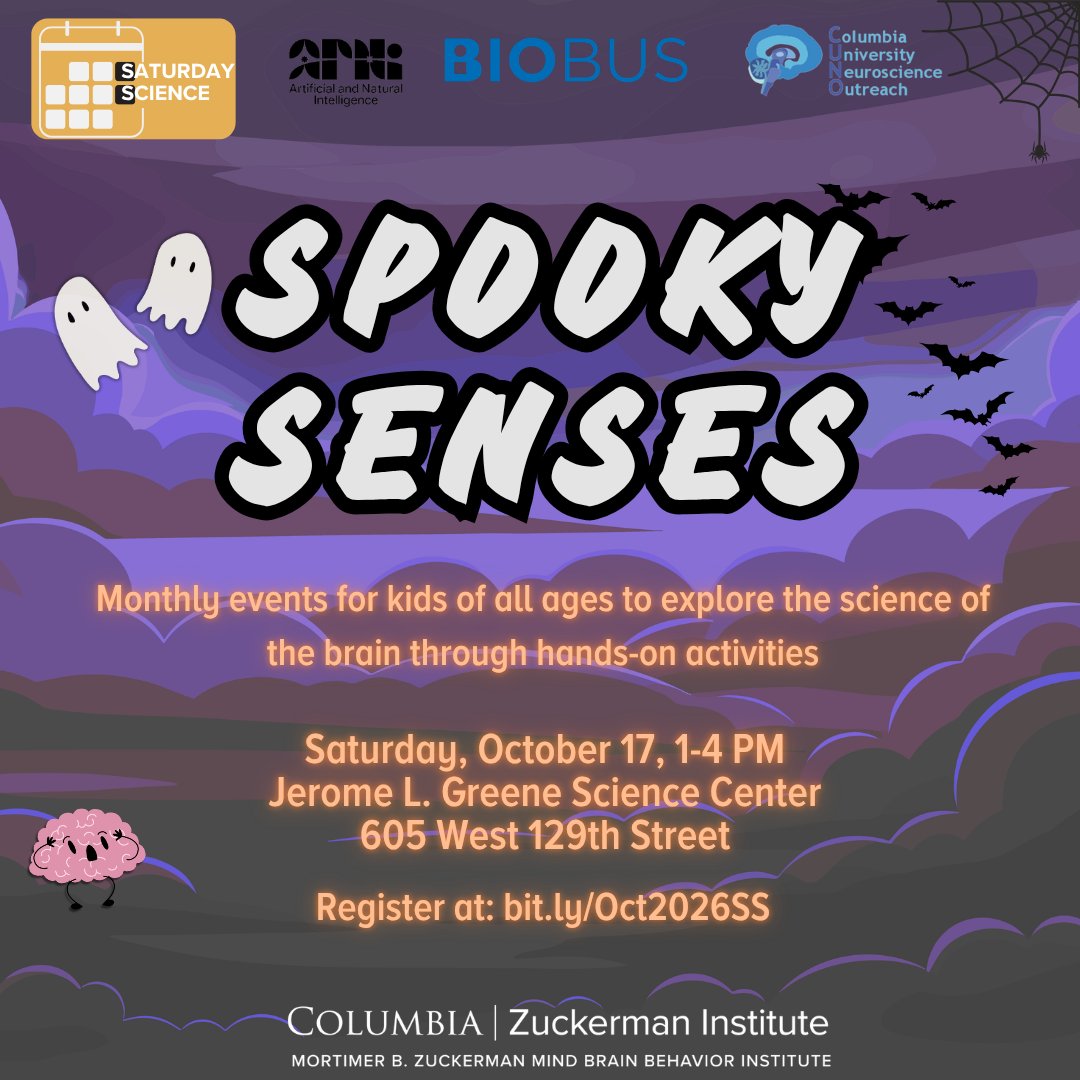
Things are getting spooky at Saturday Science!
Join us on October 17 for Spooky Senses, an afternoon of hands-on activities exploring the science of the brain and our senses. Bring the whole family for some spooky science fun!
Free and open to all ages! Register at https://t.co/FUlqvzl99k