🩸 THIS IS GETTING SCARIER EVERY DAY
SAYLOR'S $STRC IS GETTING FCKING DESTROYED.
ALL THAT MONEY THROWN AT BUYBACKS AND IT'S STILL DUMPING HARD.
THE MARKET IS LOSING FAITH IN SAYLOR.
BTC AND STRATEGY ARE IN SERIOUS TROUBLE.
@JamesKhoroshin@Brennan_BTC22@Strategy@grok Hey man you seen $STRC 😂
you see when you understand the capital structure of any business you could say for sure what happens over time . Over 25% of strc issuance bought at premium.
Just a reminder to never follow hype quick way to loose a fortune.
Saylor can't sell Bitcoin without crashing the price so he sells $MSTR printed shares transfers financial risk to share holders leaving them with the bag any one buying $mstr is literally buying Bitcoin at the top.
THE MICHAEL SAYLOR BROKEN PROMISE TRACKER 🧵
A running record of what Michael Saylor said versus what Strategy has actually done.
(Updated with data available as of mid-November 2026.)
1. STRC buyback discipline: Buy more at deeper discounts.
July 27th: “We intend to remain a regular, disciplined buyer of STRC below $100. More at deeper discounts, less as STRC nears $100.”
BROKEN: The largest buybacks occurred at prices approaching $99–$100. Analysis of filings shows approximately $1.4 billion spent between late September and mid-November, at weekly average prices of $99.06–$99.93. That represents more than half of the approximately $2.7 billion deployed under the preferred repurchase programme since July.
The November 9–15 period alone saw a record $228.1 million repurchase at an implied average price of approximately $99.93. Only $332.2 million remains under the $3 billion authorisation.
The numbers make the disconnect even clearer:
→ Average STRC issue price: $95.81
→ Average STRC buyback price: $97.93
→ Average STRC trading price to date: $89.92
2. MSCI index inclusion.
January 7th: Saylor stated that $MSTR would remain in MSCI indexes.
BROKEN: On November 11, MSCI officially confirmed Strategy’s removal from the MSCI USA Index and relevant global indexes, including MSCI World, under its new non-operating company eligibility rules. The changes take effect after the November 30 close.
3. STRC returning to par within approximately 70 days.
On the Q2 earnings call, Saylor suggested approximately 70 days was a reasonable timeframe for STRC to return to par, implying a target around September 8.
BROKEN: STRC remained below par for approximately 165 days, from mid-May until briefly reaching $100 around November 4th. Its recovery required billions in repurchases and a sustained 12% dividend rate. Briefly touching par is hardly evidence of sustainable, independent demand.
4. Never sell Bitcoin.
Saylor repeatedly promoted the idea that Strategy would never sell its Bitcoin.
BROKEN: Strategy introduced its Bitcoin Monetization Program as part of its June 29, 2026 Digital Credit Capital Framework, authorising up to $1.25 billion in Bitcoin sales to fund its USD Reserve, alongside additional authorised sales to meet dividend and interest obligations and fund repurchases.
Strategy subsequently disclosed actual Bitcoin sales of approximately 6,948 BTC for ~$432 million in 2026 to fund preferred dividends and related obligations.
The perpetual-hold promise was broken.
5. Increase Bitcoin per share and deliver positive Bitcoin yield. Never dilute at the expense of BPS.
The central promise of Strategy’s model is to continually increase Bitcoin per share (BPS) and deliver positive Bitcoin yield, without diluting shareholders in a way that reduces their underlying Bitcoin exposure.
BROKEN: Common share issuance has continued while Bitcoin per diluted share has declined. As of November 15, 2026, Strategy held 850,849 BTC against 457.244 million ADSO, equating to 186,082 sats per diluted share, down from 194,986 sats at year-end 2025.
Strategy’s own BTC Yield YTD stands at –4.6%.
Net Bitcoin purchases have failed to offset the dilution effect on a per-share basis. Further issuance of common shares to support cash reserves and preferred-stock obligations raises serious questions about the model’s central promise.
6. Never dilute below successive mNAV thresholds: First 2.5x basic, then 1.0x basic, then 1.22x EV.
BROKEN: Strategy’s original, more conservative issuance thresholds were progressively abandoned as its market premium compressed. Management subsequently referenced a roughly 1.22x enterprise-value mNAV threshold as a measure of accretive issuance.
That threshold was also breached as the premium compressed, yet common share issuance continued at lower premiums. Substantial proceeds were directed towards preferred-stock repurchases and cash reserves rather than Bitcoin accumulation.
The goalposts kept moving as the premium disappeared.
7. Maintain capital allocation discipline near 1x mNAV.
June 29: Strategy said it expected to “remain disciplined in its use of MSTR issuance, particularly when the stock trades at or near 1x mNAV.”
BROKEN: Common share issuance continued at compressed premiums, with substantial proceeds directed towards preferred-stock repurchases and cash reserves rather than Bitcoin accumulation. This is difficult to reconcile with the stated commitment to capital allocation discipline near 1x mNAV.
8. STRC as a stable, low-volatility instrument.
STRC was presented as a stable, money-market-like instrument, with an approximately 3% volatility target.
BROKEN: STRC fell as low as $71.25 in June 2026 and subsequently required substantial buyback support and a 12% dividend rate to recover towards par. Its realised volatility has materially exceeded the stated low-volatility objective.
9. Deploy the $42 billion capital plan methodically over three years.
BROKEN: The $42 billion figure announced in March 2026 represented new ATM capacity added on top of existing programmes: $21 billion in MSTR common stock and $21 billion in STRC preferred stock. It was framed as supporting continued, multi-year Bitcoin accumulation.
Strategy raised approximately $21.23 billion in total capital in 2026 through late October, but only $14.33 billion went towards Bitcoin purchases. Roughly $6.9 billion was directed towards USD reserves, preferred-stock repurchases (mainly STRC) and dividend coverage instead.
The Q3 figures are particularly revealing: Strategy raised approximately $5.41 billion through common stock issuance but spent only $588 million on Bitcoin.
The figures expose a significant shift in the pace and allocation of capital raised. What was presented as a multi-year Bitcoin accumulation plan has increasingly become a mechanism for funding reserves and managing preferred-stock obligations.
10. “There is no second-best crypto asset.”
Saylor repeatedly positioned Bitcoin as the only legitimate crypto asset and dismissed alternatives.
BROKEN: Strategy’s broader financial strategy has increasingly incorporated alternative digital-asset, DeFi and stablecoin yield opportunities. Its promotion of external protocols, including Apyx and Saturn, warrants scrutiny against its previous absolutist positioning on Bitcoin.
11. “Chasing yield is how you lose your Bitcoin.”
Saylor repeatedly warned against chasing yield and taking unnecessary risks with Bitcoin.
BROKEN: Strategy created and scaled STRC, a high-yield preferred security, introducing substantial recurring dividend obligations and additional financial complexity. Yield-driven preferred issuance, repurchases and associated capital management have become central to its structure, with Bitcoin sales also authorised to support those obligations.
The very financial engineering that Saylor warned against has become central to Strategy’s capital structure.
12. “Zero counterparty risk.”
Strategy has repeatedly presented its Bitcoin treasury model as a way to eliminate traditional financial and counterparty risks.
BROKEN: The expanding preferred-stock structure introduces significant financing, liquidity and dividend obligations. These create recurring cash requirements and reliance on continued capital-market access or Bitcoin monetisation, introducing structural risks that go well beyond simply holding Bitcoin.
13. Maintain accurate, lawful corporate accounting.
MicroStrategy’s accounting scandal in 2000 resulted in an SEC settlement and restatement of financial results.
HISTORICAL CREDIBILITY ISSUE: This is not a new accounting allegation, but an important part of Saylor’s corporate history that investors should not overlook when evaluating his financial reporting and credibility.
⸻
THE EVER-CHANGING mNAV GOALPOSTS
Is it a coincidence that every time $MSTR’s mNAV falls below 1x, a new valuation metric emerges that pushes the reported multiple back above 1x?
Look at the progression:
mNAV snapshot: November 17, 2026.
→ Basic mNAV: 0.76x
→ Diluted mNAV: 0.78x
→ EV mNAV: 1.04x
→ Net mNAV: 1.07x
Same company. Four different valuation metrics, with each successive measure presenting a higher multiple.
At what point does changing the denominator stop being financial innovation and start becoming narrative management via deceptive financial engineering?
Investors deserve consistency and transparency, not an ever-changing set of metrics that make the valuation look more favourable whenever the previous one becomes inconvenient.
⸻
That’s 13 points. And I’m sure I’ve missed a few.
Yet retail investors continue to swallow the narrative, the AI slop and the deceptive marketing tactics.
I’ll keep calling this out until the sector moves beyond this nonsense and the people who have damaged its reputation are replaced by the good actors building genuine Bitcoin and shareholder-aligned solutions.
Bitcoin’s integration into capital markets is inevitable.
The question is whether we build it on the same value-eroding financial engineering we came to Bitcoin to escape, or on models that actually align Bitcoin, companies and shareholders.
$MSTR $STRC
If Saylor is going to sell Bitcoin to fund STRC buy back then he’s going to have to sell Bitcoin at a loss below average cost to fund buybacks on STRC . makes zero sense to me he diluted your stock then your Bitcoin .
It’s a check mate for MSTR shareholders .
I am an MSTR holder who supports STRC buybacks.
If MSTR mNAV fell below 1.0x, I would still support STRC buybacks.
However, instead of funding them via common ATM, I'd prefer funding them via BTC sales.
This would be most economically efficient at <1 mNAV.
@SemperVigilant1 Exactly 😂 , the investment didn’t need maths just had to understand the mechanics of Bitcoin it self beyond the fixed supply thesis to tell how MSTR would perform .No financial engineering can save MSTR and STRC if Bitcoin falls a lot more It’s Not rocket science .
@BitcoinTeacher_ But then saylor not being able to absorbs the bitcoin shorts puts the entire thing at risk of liquidation .
If Bitcoin keeps going a lot lower no financial engineering can save microstrategy
So he is trying to save the financing machine and hoping bitcoin dosent fall a lot .
@BitcoinTeacher_ He has to keep buying it because it’s the only means to finance Bitcoin buys $MSTR has been diluted almost to nothing .
The entire point is financing is of greater priority than the share holders ,, you lose the financing machine ($STRC)the entire thing implodes including You
The U.S. Dollar Index just hit its highest level since Trump's Liberation Day tariffs in April 2025.
Investors are moving out of stocks, metals and crypto and into cash.
“I SOLD ALL MY $ASST TO BUY $MSTR.”
Robin Seyr joins RE:Bitcoin to present the investment thesis behind selling all of his @Strive shares to double down on @Strategy, even though he admits ASST could outperform MSTR in the near term.
🎥 Full episode with @RobinSeyr on Youtube: https://t.co/ElwVH3IgAB
Silver closed Friday at $49.03, 60% below the January high of $121.30
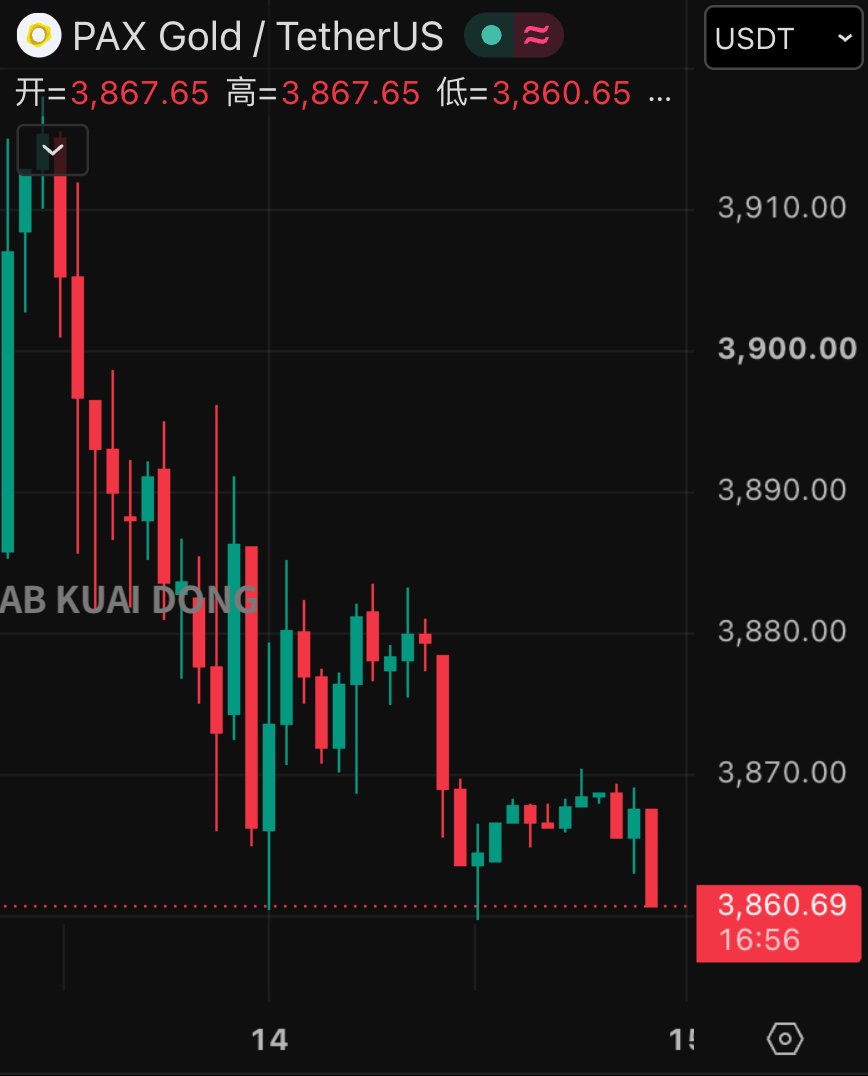
Gold finished near $3,890 after falling in 10 of the last 12 weeks, the worst streak since 1989
This is what it looks like when an energy crisis drains markets liquidity, but few understand this still