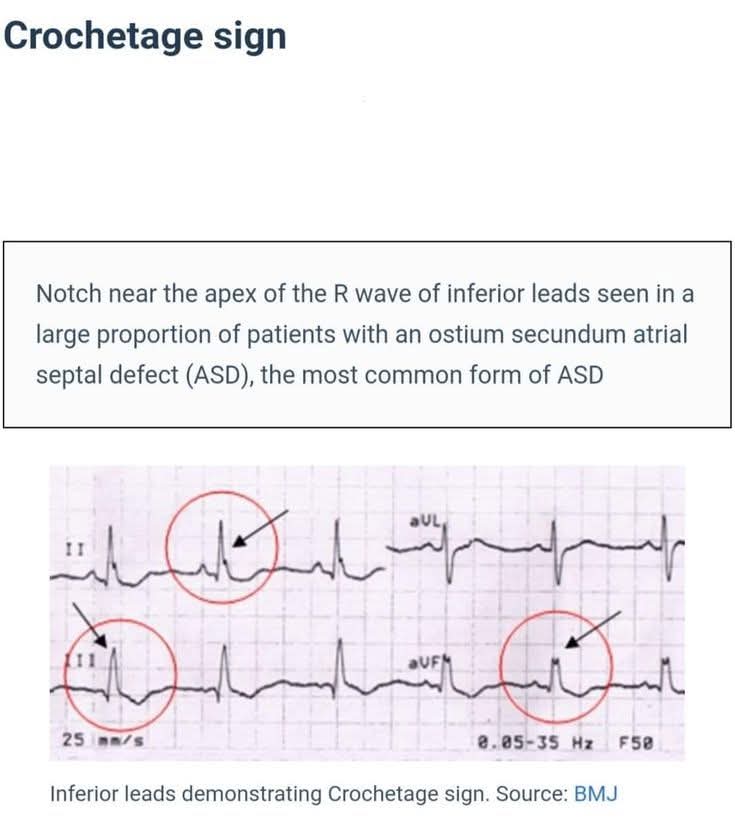
The Crochetage sign & ostium secundum ASD.
● Crochetage sign = Notching of the R wave at the apex of the R wave in the inferior leads on ECG.
● Seen in leads II, III, and aVF
● The notch resembles a “crochet hook”, which is why it is called crochetage (French for crochet).
》ECG Appearance
● Notched R wave in inferior leads (II, III, aVF).
● The notch is typically at the peak of the R wave.
● Often associated with incomplete right bundle branch block.
》Diagnostic Value
● Highly suggestive of secundum ASD.
● Specificity increases when present in all three inferior leads.
● The sign may disappear after ASD closure (surgical or device closure).
》Clinical Pearls
● Crochetage sign + incomplete RBBB → think ASD.
● Persistence of the sign may indicate residual shunt after closure.
Interesting bubble #echofirst image
What does it demonstrate?
What is the likely diagnosis?
#POCUS#Nephmadness
Source: J Cardiothorac Surg. 2024;19(1):175. doi: 10.1186/s13019-024-02709-8.
#Tirzepatide compared with #semaglutide and 10-year cardiovascular disease risk reduction in obesity: post-hoc analysis of the SURMOUNT-5 trial https://t.co/vgL4dQrJHM
📍A practical guide to the management of dyslipidaemia
👉Dyslipidaemia: from guidelines to real life (and why we’re still failing)
1️⃣LDL-C remains causal for ASCVD — dose- and time-dependent. Lower and earlier is better. No credible safety signal at very low levels.
2️⃣Targets are clear, achievement is not: most high- and very-high risk patients still miss guideline LDL-C goals in daily practice.
3️⃣Risk ≠ LDL-C alone: ApoB, remnant cholesterol, and lipoprotein(a) explain a large part of residual risk.
4️⃣Lp(a) matters: measure it at least once in every patient. Levels >50 mg/dL (>125 nmol/L) are a true risk enhancer.
5️⃣Risk modifiers change decisions: chronic inflammatory diseases, CKD, HIV, family history, and imaging findings should up-classify risk.
6️⃣Lifestyle is mandatory—but insufficient for most high-risk patients. Supplements? No evidence, no benefit.
7️⃣Statins first, but not alone: early combination therapy (statin + ezetimibe ± bempedoic acid) should be the norm, not the exception.
8️⃣PCSK9 inhibition works: robust LDL-C lowering and outcome benefits, even in high-risk primary prevention.
9️⃣Post-ACS paradigm shift: strike early and strong with upfront combination therapy. Delay costs events.
🔟Bottom line: combination lipid-lowering can get >90% of patients to target—if we actually use it.
👉 Guidelines are not the problem. Implementation is.
🔗Open Access https://t.co/DiIhKxTtZ5
@society_eas@SpringerNature
LV Thr unusual since preserved LV contractility. Angiosarcoma?
2 different patients with similar multiple masses in LA.
In both cases it turned out to be an angiosarcoma #echofirst
Beyond the Statin: Navigating the New Frontier of Heart Health 🚀❤️
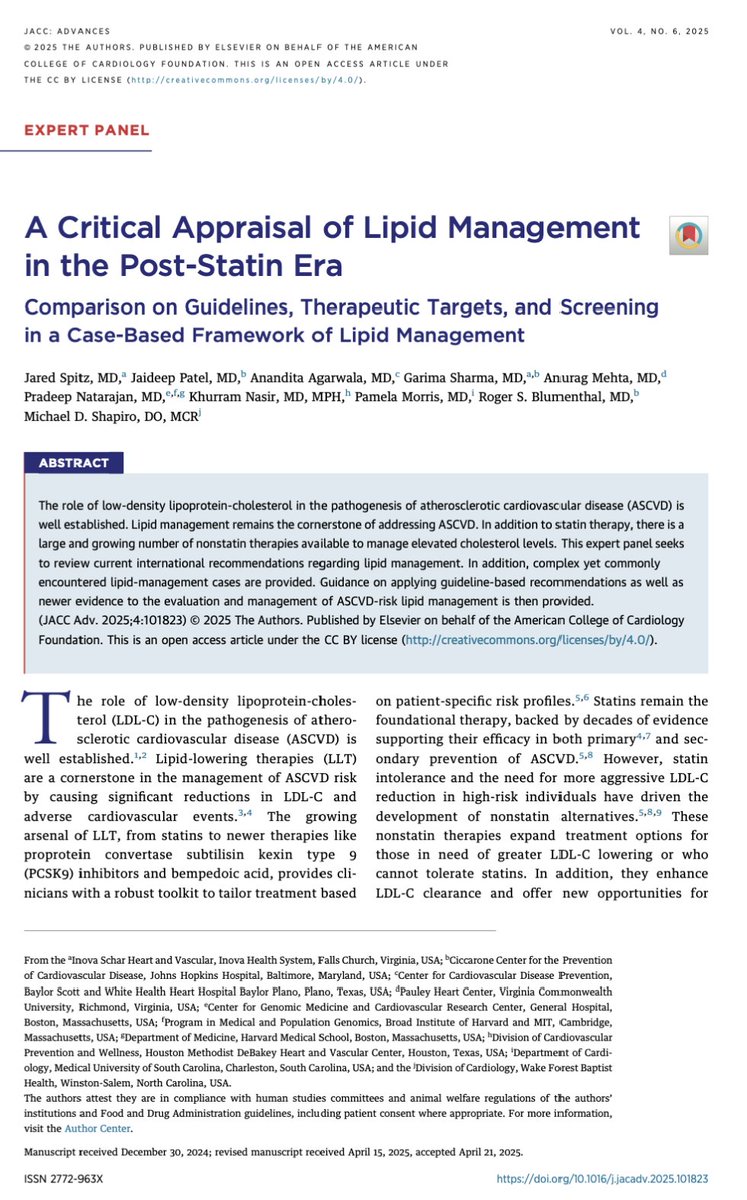
The "statin-only" era has officially evolved! A 2025 appraisal in JACC: Advances reveals that while statins remain the foundational therapy, we've entered a "Post-Statin Era" defined by a massive, personalized toolkit to slash cardiovascular risk.
The 2026 Game-Changers 🧬
The PREVENT Revolution: New PREVENT equations are replacing older models to offer more accurate, race-free risk estimation. However, they often yield lower risk scores, requiring clinicians to use sharper judgment to ensure high-risk patients aren't overlooked.
The Power of "Plus": Doubling a statin dose only adds about 6% more LDL-C lowering. But adding non-statin therapies like ezetimibe, PCSK9 inhibitors, or bempedoic acid can reduce levels by an additional 20–50%!
The CAC "Tie-Breaker": Coronary Artery Calcium (CAC) scoring is now the ultimate tool for personalizing care. 📸
CAC = 0: May allow for the safe deferral of statins in many patients.
CAC ≥ 300: This is considered "Very High Risk"—a danger level similar to having already survived a heart attack.
Precision for Every Population 🌍
The findings emphasize that "average" care isn't enough:
South Asian Populations: Often face more aggressive disease at lower "traditional" risk levels and may benefit from earlier screening.
Younger Adults: 10-year scores often hide a massive lifetime risk; we must look at the 30-year horizon.
Women's Health: Managing severe cholesterol during pregnancy requires a careful balance using safe options like bile acid sequestrants.
Heart health in 2026 is no longer about a single pill—it’s about a strategy tailored to your unique biology. 🤝✨
#Cardiology #HeartHealth #MedEd #LipidManagement #PostStatinEra #PreventiveMedicine
This is impressive CV risk reduction with Tirzepatide vs Semaglutide
The fact that we have these incretin therapies available is a game changer. Now we just have to make them accessible and cheaper #GLP1RA#weightloss#CVRisk#CVPrev#cardiotwitter
Prophylactic ICD therapy did not 🚫 reduce mortality in patients with a prior MI, persistent moderate LV systolic dysfunction and abnormal ECG markers🚩, based on findings from REFINE-ICD presented at #ESCCongress.
➡️ Read the news story: https://t.co/J9w6Zqx32Y
Early Withdrawal of Aspirin after PCI in Acute Coronary Syndromes: @NEJM
🥸 The slow decline of aspirin: #ESCCongress2025
😱 Here is the summary of the NEO-MINDSET Trial
👇👇👇
Empagliflozin in the Prevention of Cardiotoxicity in Cancer Patients Undergoing Chemotherapy Based on Anthracyclines (EMPACT)
EMPACT (EMPAgliflozin in prevention of chemotherapy-related CardioToxicity) study is a randomized, multi-center, placebo-controlled, double-blind trial to evaluate efficacy of empagliflozin in prevention of left ventricular (LV) dysfunction in patients receiving high cumulative doses of anthracyclines
https://t.co/mXrXUiLbEc
🫀 #CardioNugget:
Unroofed Coronary Sinus
An unroofed coronary sinus (URCS) is a rare anomaly where part of the wall between the CS and LA is missing, allowing oxygenated blood from LA to shunt into the CS, then RA ➡️ mimicking an ASD!
💡 Key clues:
Dilated coronary sinus on echo
Often associated with a persistent left SVC
#CardioNuggets #CardioTwitter #MedEd
In frail, elderly #AFib patients previously on a vitamin K antagonist, switching to standard-dose direct-acting oral anticoagulant reduced stroke, fatal/intracranial bleeding, and death, despite more GI bleeding. https://t.co/VueCCDedLL #JACC#DOAC