@SeroBass1 Older dude here. Scared to death of blowing out my Achilles. I’ve heard inclines help but still a real concern if considering sprints. Any thoughts on that?
@MrWhiplash_@OYourNameHereO Keeping in mind this is a Trump initiative. Does anyone actually believe a) that it’ll actually happen, b) that it’s not some sort of scam to help his grifters, and c) it’s not a cash grab that somehow the Trump family will cash in on?
@mass_ave I worked there about 10 years later. Just remember line workers going out on lunch / smoke breaks and discretely tossing CDs over the chain link fence. Then when they got off work, they’d go out into the field and pick them up.
BREAKING: In an amazing moment, Admiral William McRaven, who led the raid to take out Bin Laden, just slammed Trump and gave an inspiring vision for the nation's future. Every American needs to watch this.
@jimstewartson Too many believe the 26 election, the 28 election, or his impending death will put an end to all this. It won’t. The Heritage Foundation playbook is designed to live beyond him. Trump is just the vessel.
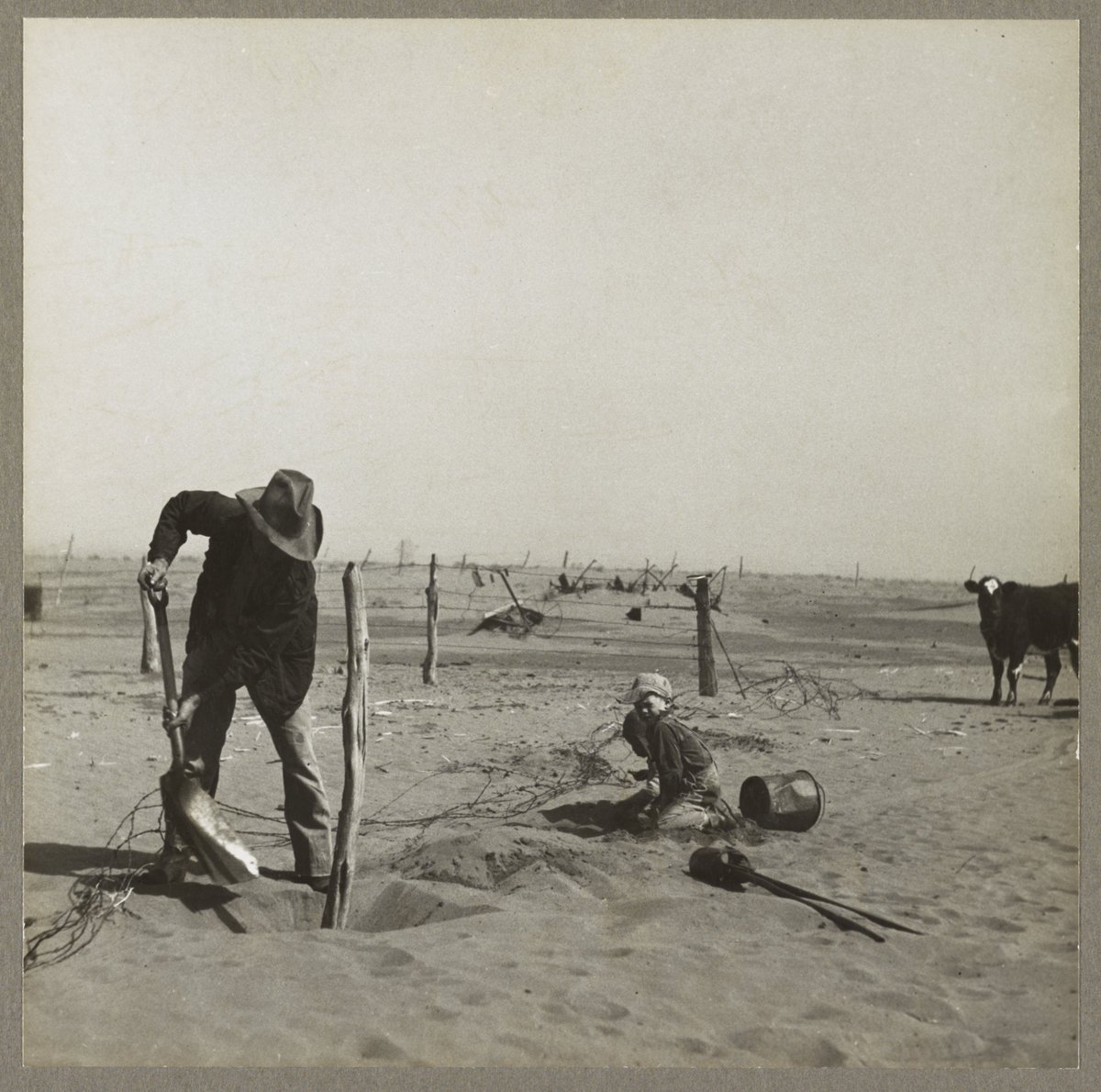
The Dust Bowl was made by expert advice, and the advice was to plough up grazing land and grow crops on it.
School files it under weather. A drought came, the wind got up, Steinbeck wrote a book. Nature did it, and nobody's name is on it.
Plenty of names are on it.
The southern Plains had been grassland since the ice went. Buffalo grass and blue grama, a mat of root that had sat through every drought for thousands of years with 30 million bison standing on it. Rainfall out there runs 10 to 20 inches a year. The first surveyors took one look and wrote Great American Desert across the map, meaning graze it, and leave the plough at home. John Wesley Powell, the explorer who had actually walked the ground and went on to run the US Geological Survey, told Congress as much in 1878 and again, with maps, in 1890. Congress thanked him and carried on.
Then a professor at the University of Nebraska, Samuel Aughey, announced that breaking the sod released moisture and changed the climate. A land promoter called Charles Dana Wilber boiled it down in 1881 to four words: rain follows the plow. The railroads, who had several million acres of desert to sell, reprinted it by the cartload. It was what everyone wanted to hear, it came with charts, and it was science.
Washington joined in. The Enlarged Homestead Act of 1909 handed 320-acre blocks of dry grassland to anyone who would break them. In 1917 the government guaranteed wheat at over $2 a bushel and told farmers wheat would win the war. Then the tractor arrived, and a man who could turn 3 acres a day behind horses could turn 50. Between 1925 and 1930 more than 5 million acres of native grass on the southern Plains went under, in what the locals called the Great Plow-Up. The cattle came off and the wheat went in. When the wheat price collapsed at the end of the decade, farmers ploughed up more grass to make the same money from a lower price, which is the sort of decision a spreadsheet makes.
The rain, having not read Professor Aughey, stopped in 1931.
Wheat has the root system of a doormat. With the grass gone there was nothing holding Kansas down, and Kansas left. In May 1934 it fell on ships 300 miles out in the Atlantic. On 14 April 1935, Black Sunday, a wall of topsoil thousands of feet high rolled across the Plains and turned the afternoon into midnight. Children died of dust pneumonia behind wet sheets nailed over the windows. 100 million acres were damaged and around 2.5 million people packed up and left.
That spring a soil scientist called Hugh Bennett was giving evidence to a Senate committee when the sky over Washington went brown with what had recently been Oklahoma. He got his Soil Conservation Service within weeks.
Then the federal government did something your textbook skips. It bought back more than 11 million acres of the wrecked cropland, put it down to grass again, and put cattle on it. It is still there. They're called the National Grasslands, nearly 4 million acres of them, grazed under permit to this day, and they have not blown anywhere since.
So America has run the experiment at full scale. Take land that only grass will hold, remove the grazing animal, and grow human food crops on it because the experts and the price say so. It took 5 years to plough and 10 to bury a region.
Every few months now a report lands explaining that pasture is wasted land, and that if we only took the cattle off we could grow crops there instead. It has charts. It is science.
Ask them what follows the plough this time.
Bug zappers are shit at killing mosquitoes and excellent at killing beneficial bugs. If you have one running, unplug it.
In 1994, two entomologists at the University of Delaware put six residential zappers in suburban backyards and ran them for ten weeks. Then they counted and identified every single thing that died in them.
13,789 insects total. Only 31 of them were biting insects, like gnats and mosquitoes. Not 31%, 31 total. .2% of the total.
Almost half were non-biting aquatic insects, caddisflies and midges blown in off nearby creeks, which are the base of the food web for fish, bats, swallows and dragonflies.
Another chunk were moths, which pollinate at night and feed the birds and bats in your yard. Roughly 14% were predators that eat pests: ground beetles, parasitic wasps, ladybugs.
The zapper averaged 445 kills per trap per night.
Bug zappers suck at targeting mosquitoes for a simple reason: the female mosquito isn't looking for light. She's tracking the carbon dioxide you exhale, your body heat, the lactic acid on your skin.
She flies past the zapper without it even registering. Every moth in the neighborhood navigates by light, so the device pulls them in from across the yard and kills them.
Notre Dame ran the other half of the test: yards with zappers and yards without had no significant difference in mosquitoes present.
Unplug it. It's doing terrible things for the local environment and nothing beneficial for you.