@RoosterAnalysis Working capital is the line buyers skip most. If customers pay in 45 days, you're funding payroll for the first month and a half after close, and none of that shows up in the down payment.
@jessedilillo One way to see it: price the deal the way a cash buyer would, then compare it to the seller-financed price. The difference is what you're paying for the terms.
@JonMStoddard That gap hits twice: once in the price and again after close. Stock that isn't moving usually has to be discounted to clear, and lenders tend to haircut aged inventory too, so it often isn't worth what the balance sheet says.
@Storage_Venture Agreed on the order. Underwrite it at the price with normal bank debt first, then let the seller note improve the return. If the note is the only reason the numbers work, the price is too high.
@BizScout_ $250K on $128K is about 1.95x. On a restaurant the question is how much of that $128K is the owner working the line. If replacing them costs ~$55K, cash flow is closer to $73K and the multiple is ~3.4x.
@brianbeers Those three numbers also make the coverage check easy. Monthly payment times 12 against the cash flow left after paying a manager tells you whether the business pays the note or you do.
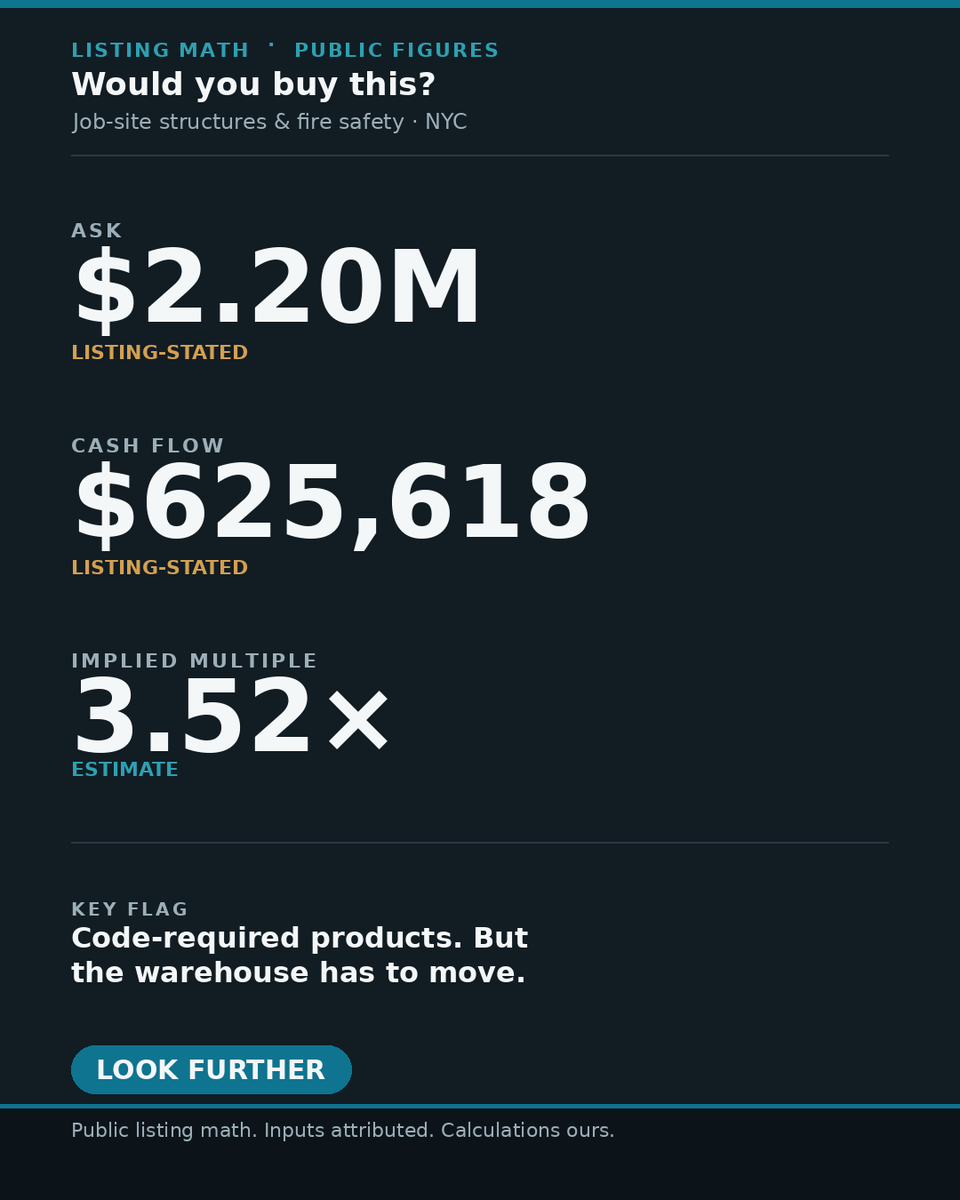
Would you buy this? NYC job-site structures & fire-safety maker, 6 staff, since 2012.
Ask $2,200,000. Listed cash flow $625,618 = 3.52x (our math).
Verdict: LOOK FURTHER. Flag: the warehouse has to move.
Listing-stated, unverified. Not advice.
@downsjoe Self-storage is one of the few deals where the business and the real estate get underwritten together, so the term mix matters a lot. Real estate can amortize over 25 years and the business piece over 10, and that split moves the coverage ratio more than the headline rate.
@zaneccampbell The balloon is the part to plan for. At 0% over 240 months that's $375 a month, so after 60 payments you've paid $22,500 and still owe $67,500. The refi has to work in year 5 at whatever rates are then.
@heIpfullandlord A seller willing to carry paper is also betting the asset keeps paying, which is useful information on its own. Same logic in small business deals: a seller note that gets paid out of the cash flow is the seller putting money behind their own numbers.
@SMB_Attorney Those are the businesses that show up on listing sites with no website and a 2-3x multiple. Cabinets, sheds, farm equipment. The catch is usually the same: the owner is the salesman and the best craftsman, so part of the cash flow walks out the door with them.
@acquiredotcom $750K on $246K of profit is about 3.05x. The question at that multiple is how much of the $246K is the founder's own time. If it takes a ~$75K operator to run, profit is closer to $171K and the multiple is ~4.4x.
@HelenGuo_ Keeping the day job usually means paying a GM. On an $887K deal, a market GM at ~$90K comes straight out of the cash flow the bank underwrites, so the business has to cover the manager and the debt before the owner sees a dollar. Curious what the coverage looked like.
@taytodde Rough math: at ~10.5% over 10 years, $100K a year of debt service carries about $617K of loan. At 1.25x the business needs $125K of cash flow after a market owner salary to support it.
@baton_market Landlord consent is a common one. A lease assignment can take weeks, and lenders usually want the lease to run about as long as the loan. A 10-year note on a business with 3 years left on its lease is a problem nobody priced.
@john_jacob The 10% is on total project cost, not the price. Add working capital, closing costs and the guarantee fee and a $1M business can turn into a ~$1.15M project, so the check is closer to $115K.
@bizbritain Usually the gap just moves to the seller. If the bank lends 70% of a $1M deal instead of 80%, that's $100K more in seller note or equity. Worth checking the cash flow covers both payments before anyone signs.
@Flippa@thestevemcgarry Clean books move more than the multiple. Lenders underwrite the tax return, so $100K of add-backs nobody can document, priced at 3x, is $300K of purchase price the bank won't finance.
@agazdecki That $200K shows up in the exit math too. If the founder runs it for free, a buyer will subtract a CEO salary anyway, so $1M of profit is really $800K. Hiring first just proves the number the buyer would have adjusted to.