YES! Brian, appreciate you checking it out. We're working powered sites across the Midwest and partner on larger campuses. Most of it moves off-market, so email me at [email protected] and let's compare notes. What are you hunting right now, raw land to power up or sites already in a utility study?
Avison Young is tracking 124 proposed or announced U.S. manufacturing projects worth about $3.4T. Only about two dozen, roughly $500B, are actually under construction.
The gap is the story. Announcements are easy. Power, permits and site prep decide which ones get built, and the Midwest is in that race (SK Hynix's $4B chip packaging plant in West Lafayette, Indiana broke ground in August).
Every one of these plants pulls suppliers and logistics space behind it.
(Avison Young via Bisnow and CRE Daily. h/t Jake Heller's PLOT roundup)
When the public market goes into the too hard bucket, a lot of capital looks for assets it can underwrite on a site visit. In the Midwest that means cash flowing industrial and powered land: a basis you can defend, a tenant you can call, and a utility timeline you can verify. Boring gets interesting again.
On the data center line: Missouri already makes the biggest loads carry their own costs. Evergy's large-load rate starts at 75 MW, with long-term contracts and minimum payments, and Evergy says expected data center revenue cut its new Missouri West rate request by $61 million. The rate protection he's asking for exists here. A federal pause would hit projects that are paying in.
Senate Republicans trying to figure out what to do in the next 6 weeks? Here you go:
DEFUND Planned Parenthood
MORATORIUM on data centers
SUSPEND the gas tax
FUND rural hospitals
SAVE AMERICA ACT
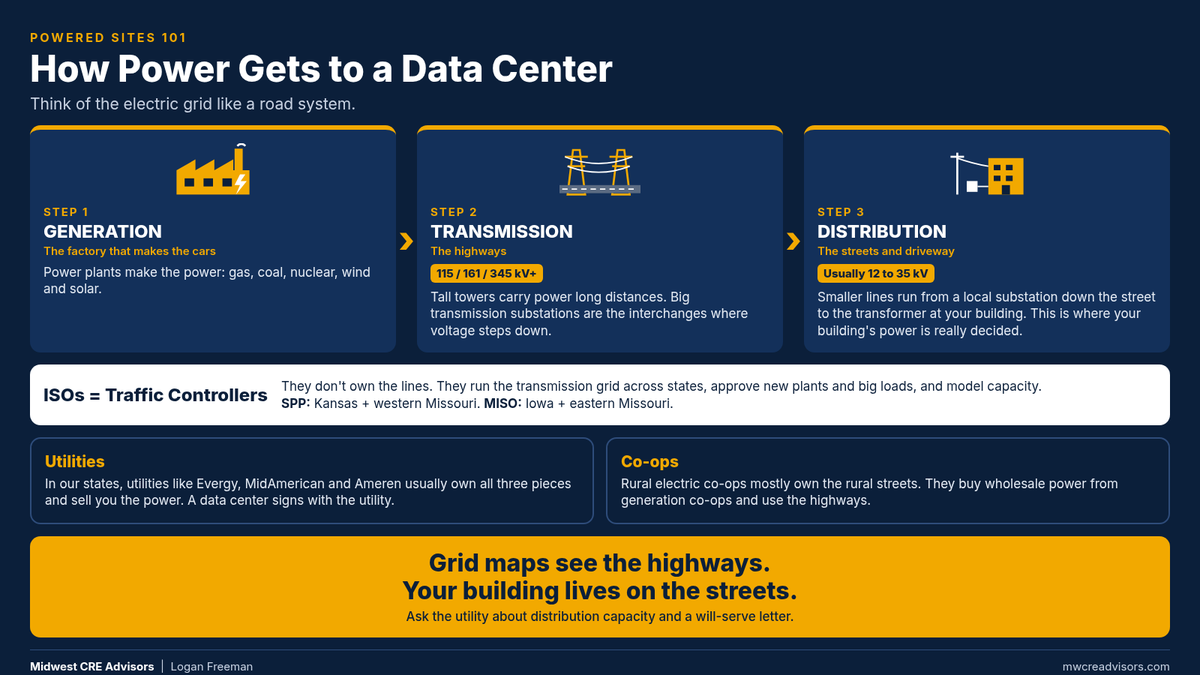
Grid maps see the highways. Your building lives on the streets.
How power gets to a data center, in road terms:
1. Generation = the factory that makes the cars. Power plants: gas, coal, nuclear, wind, solar.
2. Transmission = the highways. Tall towers, very high voltage (115/161/345 kV+), long distances. Big transmission substations are the interchanges where voltage steps down.
3. Distribution = the streets and driveway. Smaller lines, usually 12 to 35 kV, from a local substation to the transformer at your building. This is where it really gets decided.
ISOs (SPP, MISO, PJM) are the traffic controllers. They don't own the lines. They run the grid across states and approve new plants and big loads. Kansas + western Missouri = SPP. Iowa + eastern Missouri = MISO.
Utilities like Evergy, MidAmerican and Ameren usually own all three pieces here. A data center signs with the utility. Rural co-ops mostly own the rural streets.
Most online tools only see the highways. They can't see the streets or the line of big users already waiting for power.
Transmission tells you power is nearby. Distribution and a will-serve letter tell you if your building can get it.
That's what I help owners and data center buyers figure out at Midwest CRE Advisors: which buildings can actually get power.
@KCBizJournal Two tax levers on the same equipment this week. The federal write-off on servers and GPUs, and Thursday's KC Council vote on a 50% personal-property abatement for a Northland data center. If both shrink, the equipment math on new projects changes fast.
Under construction is now its own asset class.
Oracle's CFO says the data centers already being built get more valuable as they near completion. My read on the land side: in KC, sites that cleared zoning before the backlash should be worth more than ones that haven't. Agree?
Oracle CFO predicts its data centers under construction will become even more valuable as they get closer to completion, noting anti-data center sentiment didn’t just arise on Election Day
David Faber: “We’ve been talking a lot since the election about the possibility of data center delays. How important is that to your ability to continue to grow and meet the specific metrics you just lined out?”
Hilary Maxson (CFO): “They get a lot of headlines. We have five large data centers under construction already in the US. One of those is nearing completion, so there’s four primarily that are under construction today. They started in our calendar year ‘26, all the way through ‘29. So it’s part of the seven gigawatts we’re bringing online, but not all. That said, it’s an important part, and we think that we have all of the scenario planning in place in order to bring those data centers online in a timing that allows us to achieve the commitments that we gave.”
David Faber: “Regardless of our political environment? Or the various referendums that said, hey, no more data centers in our backyard?”
Hilary Maxson: “These are projects that are already under construction, which generally are quite different than new data centers. So I think we feel pretty confident. It’s not like anti-data center sentiment just arose last Tuesday. Actually, this is an environment that we’ve been dealing with for at least the past eight to ten months. So I don’t think anything really changed for us on Tuesday, aside from maybe those data centers, as we get them to completion, will actually be even more valuable in future.”
$ORCL
_______
Source: CNBC
Meta has $355.73B in leases it has signed but not yet started, per its Q3 10-Q.
Data centers, energy infrastructure, colocation and network. Start dates run from late 2026 through 2036, with terms up to 30 years.
That demand is already on paper. What's scarce is powered land that can actually deliver on schedule, and more of that conversation is happening in the Midwest.
h/t Jake Heller's PLOT roundup
https://t.co/m6pVof2Rui
"Fully permitted" is doing a lot of work in that sentence.
10x more demand than capacity through 2027, and the deliveries he trusts are the permitted ones. In the Midwest, zoning plus a utility path in hand is the scarce product. Builders, what's your permit-to-power time?
$CRWV CEO: CoreWeave has 10 times more qualified demand than capacity through 2027 and sees 'no material risks' to its 2027 deliveries at *fully permitted* sites
CEO Michael Intrator: “The number of organizations committing more than $100 million to CoreWeave Cloud increased more than 2.5 times year over year. As customers find more valuable uses for AI, they need more from the platform. That broadens our opportunities and deepens our relationships.”
“We have 10 times as much qualified demand as available capacity through the end of 2027, and demand for 2028 is already several times larger than our available capacity, even before we have brought it formally to market.”
“We now have more than 1.7 gigawatts of active power. We continue to expect to reach more than 1.85 gigawatts of active power by year-end. We also do not see material risks to our 2027 deliveries based on ongoing construction at fully permitted sites.”
Kansas City gets its own test of this tomorrow.
The Council is set to vote on a 10-year, 50% personal-property abatement for a Northland data center, worth about $20.37M. Opponents point to three new jobs. Would a written benefits agreement change the math for you?
‘An imperfect solution’ gains traction in data center fight | Kinnia Cheuk, Politico
Governors are turning to community benefit agreements as they scramble to address data center blowback without alienating tech giants.
Democratic governors have a new message for data center developers amid community backlash: Cut a deal.
Community benefit agreements are increasingly appearing in state strategies for handling the data center boom. In recent months, three Rust Belt governors — Pennsylvania’s Josh Shapiro, Illinois’ JB Pritzker and Michigan’s Gretchen Whitmer — have called on project developers to enter into legal agreements with communities that can cement pollution limits, hiring commitments and local investment promises.
“My message to data center developers is clear: if you can’t agree to our strict requirements and get the community where you want to build to say ‘yes,’ you’re not going to have the Commonwealth’s support either,” Shapiro said in a statement when he signed an executive order last month that features CBAs. “These are some of the biggest companies in the world — they can afford to be good neighbors, follow the rules, and do this right.”
CBAs first cropped up 25 years ago, when a coalition of Los Angeles community groups hammered out a deal with the developers of the Staples Center. That first-ever CBA traded promises of jobs and local investment for community support that helped secure city subsidies. Since then, communities across the U.S. have used versions of the legal agreement to secure economic benefits from a variety of developments.
Policymakers are now mulling mandates for such agreements. Shapiro signed an executive order last month ordering his state’s Department of Environmental Protection to only review permit applications for data center developers that have agreed to sign a CBA with their local community, among other requirements. Otherwise, DEP will not begin review until after all local approvals, including for zoning and land use, are secured.
The move was the latest sign that Shapiro, a likely 2028 presidential contender, has gone from a data center cheerleader to a vocal skeptic. He’s not alone. Both Democrats and Republicans are grappling with how to address a growing public backlash to the energy- and water-guzzling facilities, which are cropping up faster than political leaders and regulators can keep up.
CBAs appeal to moderate Democratic governors who are scrambling to address data center blowback without alienating the tech giants they hope can provide a much-needed boost to their local economies. But even progressives who support moratoriums on data centers, like Michigan Senate Democratic nominee Abdul El-Sayed, have referenced CBAs as a way to protect communities from data centers’ possible impacts.
Abre’ Conner, director of the NAACP’s Center for Environmental and Climate Justice, said organizers of the group’s Stop Dirty Data Centers campaign quickly realized that some projects can’t be stopped by advocacy efforts — no matter how fervently communities oppose them.
CBAs can be “a tool in communities’ toolboxes” during negotiations when data center developments turn out to be inevitable, Conner said.
Experts say that the legal agreements are far from a cure-all. So far, only one community seems to have cut a deal with a data center developer.
The Data Center Coalition also argues that the vast majority of its members— including the likes of Google and Amazon — have voluntarily invested in communities beyond the jobs they create, like filling school budget gaps. Mandating CBAs before zoning or permitting, as some states are considering, could create delays and drive developments away, said Brad Tietz, the group’s director of government affairs in the Midwest.
“We’re in uncharted territory,” said Tietz. “Mandating something legislatively is far different than it occurring naturally between the local government and the company.”
But some politicians see CBAs as a stop-gap solution, providing relief for communities and serving as a model for responsible developers before other regulations are set in stone. That’s the idea behind a package of bills that Michigan state senators unveiled in June. The legislation, backed by Whitmer, would require local governments to reach a CBA with developers before moving forward with zoning approvals.
“Community benefits agreements will not solve all of the problems, but if you can put it together with strong regulations on data centers and the entire regulatory framework, then I do think that we’re in a stronger position to have members of our community feel that they are being heard right now,” said Michigan state Sen. Darrin Camilleri (D), assistant majority leader and the package’s primary sponsor.
(Re)building trust
Data centers’ sky high unpopularity has given many communities the power to demand environmental standards and investments from developers.
“Two years ago, communities really didn’t have much leverage against a Google or a Meta. But now we’re starting to see so many data centers that are canceled because of public defense, and so now communities really have a lot more leverage than they had in the past,” said Dana Kuhnline, program director at regional coalition ReImagine Appalachia.
At least 20 proposed data center projects were canceled after local pushback during the first three months of 2026, accounting for more than $41.7 billion in investment and 3.5 gigawatts of electricity demand, according to data from Heatmap.
The opposition has prompted a wave of local moratoriums and restrictions: Virginia has enacted a new energy consumption tax and New York has paused new data center construction for a year. In Illinois, lawmakers have proposed the POWER Act, which would require data center developers to enter into a CBA with a coalition of community-based organizations or a community advisory board formed by the municipal government.
Meagan Niebler, program director at the nonprofit law firm Fair Shake Environmental Legal Services, said more communities want to stop data centers entirely instead of reaching a deal.
But if developments continue to move forward, communities will be thinking about how to hold companies legally accountable and ensure protections with CBAs, said Niebler, who has collaborated with Midwest communities to ensure environmental protections in data center development.
Pennsylvania’s regulations and proposed laws in Illinois and Michigan would mandate that companies negotiate with communities until both sides agree. But nonmandatory CBAs depend heavily on a developer’s good faith effort.
It’s “very hard” to get large companies to a table for open dialogue with communities, and locals often need a lot of organizing and legal leverage to even get their foot in the door, Niebler said.
“There’s a lot of things that make it an imperfect solution, but an imperfect solution is still better than nothing,” said Liza Paudel, senior program manager for tech equity at the nonprofit Greenlining Institute.
The data center industry says their key concern is timing. Delays can significantly derail a project if local governments are slow to appoint community members to an advisory board to discuss contract terms — like the Illinois proposal would require — or if negotiations are stretched out indefinitely, Tietz said.
“What if you have a local government who’s interested, but obviously opposition rises, and then you’ve spent 10, 12 months negotiating for the project that is not even going to advance?” Tietz said.
Developers would have more confidence in the project if permitting could occur while the CBA is being negotiated, Tietz said. That could mean, for example, requiring an agreement to be reached before construction begins — rather than before a permit is issued.
States could alternatively offer incentives — such as tax breaks — to developers who reach community benefit agreements, he said.
Past programs emphasizing community engagement have had mixed results.
In 2021, the Biden-era Department of Energy required all clean energy projects funded by the Inflation Reduction Act to submit community benefit plans detailing how developers would engage in the local workforce and benefit disadvantaged communities. But the plans were not negotiated — and many residents complained that the process left community members without a role in any talks.
Projects that won grants often fell short of true community engagement, according to a former senior DOE official under then-President Joe Biden who was granted anonymity because they were not authorized to speak by their current employer.
Many communities had “no idea” that any sort of benefits were promised to them, and the terms of the program were often drafted and implemented unilaterally on the developers’ side, the former official said.
“I never wanted it to be seen as the gold standard. We did a lot in a very constrained environment, but it wasn’t enough,” the official said.
For mandatory CBAs to work, they said, the community has to have the veto power to shut the project down.
Looking to Lancaster
You have to travel to the heart of Amish country to find the data center industry’s only CBA, according to research by the Sabin Center for Climate Change Law at Columbia University.
Chirisa Technology Parks and codeveloper Machine Investment Group have an agreement with the government of Lancaster, Pennsylvania, over two data center sites in the city, encompassing approximately 2 million square feet with at least 700 megawatts of planned capacity.
First proposed by then-mayor Danene Sorace, the agreement was formally executed in November. The company had already planned to adhere to certain environmental standards, so executives thought the CBA was a “great idea,” said David Kelly, chief technology officer at Chirisa.
Barry Handwerger, who drafted the agreement for Lancaster as city solicitor, said the city determined the bulk of the terms. Chirisa mainly met with the mayor’s office, though it held an open house for the community early on in the process.
The final agreement requires that Chirisa source all its power from clean energy sources, employ a closed loop cooling system that conserves water and adhere to a publicly disclosed municipal water use cap, noise limits and wastewater regulations. The company must submit annual environmental and operational reporting and make its power use public, said Handwerger. The agreement also holds Chirisa to investing $20 million into clean energy and sustainable development for the city.
If those requirements aren’t met, the company faces millions of dollars in penalties and permanent injunctions for breaches of nonfinancial commitments like noise limit violations.
Several state and local officials within and outside of Pennsylvania have reached out to City Council members to learn about the agreement, said Lancaster City Council President Ahmed Ahmed, who voted to pass the CBA.
The data center issue is a “very difficult topic” to discuss in the public forum, he said, but the CBA quelled residents’ anxieties on whether the project would use too much water or rely on fossil fuels.
The activist organization Lancaster Stands Up challenged the city’s approval of the Chirisa project, encouraging residents to express their concerns at City Council meetings. Some meetings drew 100 people to city hall, said Frank Arcoleo, a Lancaster resident and member of the group. Arcoleo appealed the zoning approval for the data centers in August but was ultimately unsuccessful.
The group also submitted detailed recommendations for the CBA, including requirements for renewable energy, noise limits and decommissioning. Arcoleo said nearly all of them made it into the final agreement.
“Had there been a little bit of public grousing and complaining about these data centers, but it went away, I think they wouldn’t have done anything,” he said.
Lancaster Stands Up, which is part of Pennsylvania Stands Up, has shared its documents and experience with other chapters of the organization, especially those involved in data center fights themselves, Arcoleo said.
“Where they’re winning, they’re stopping the data centers to begin with. Where they’re losing, they’re at least demanding that the community benefits agreement be at least as good as Lancaster’s,” he said.
Complementary solutions
CBAs are only one aspect of the major new strategies that states are rolling out for the data center boom.
Pennsylvania’s regulations, as well as the proposals from Illinois and Michigan, include provisions that protect ratepayers from bearing the cost of data center projects and prohibit developers from entering into certain nondisclosure agreements to maintain transparency.
Republican senators in Michigan say that the legislation is more talking points than substance. State Sen. Jim Runestad, assistant minority caucus chair of the Michigan Senate, has proposed a one-year moratorium on data centers. Absent a moratorium, developers may still be able to have their way over community’s needs, he said.
Mandating community benefits between local government and developers may mean that “some board, county board, city board, negotiates something for themselves, which may be a swimming pool close to the elected official’s backyard,” he said. “It’s all fluff.”
While CBAs can be valuable tools for some communities, blanket local zoning ordinances can provide many of its benefits, said Christina Libre, attorney at the Southern Environmental Law Center.
Zoning ordinances ensure that all baseline considerations are taken into account every time a data center application comes before the locality, rather than relying on the goodwill of any individual developer to negotiate an agreement with the community, she said.
Possible ordinances could require all data center developments get city council approval, she said, or mandate pollution limits.
Lancaster began drafting a data center zoning ordinance only after Chirisa proposed building its data centers last spring. The ordinance passed this July, mandating noise mitigation plans, air quality testing, and water and power use reporting. The law also limits data center development to land zoned for suburban manufacturing, reducing land open to data centers from 200 potential parcels to only 16.
But Christopher Delfs, Lancaster’s director of economic development, still sees a role for CBAs in the future.
“Zoning is about regulation and what you can’t do, but a CBA is more creative about what you want a data center to achieve, like finding other ways for the city to realize its sustainability plan by investments in renewable energy, and other funds like the economic development and innovation funds,” he said.
Chirisa is currently partnering with the nonprofit Economic Development Co. of Lancaster County to determine how the financial commitments from Chirisa will be used, said EDC Lancaster County President Ezra Rothman. He hopes that Chirisa’s data centers won’t just be “server rooms” for Lancaster, but can help drive how the city’s schools and companies prepare for an AI future.
“Hopefully the agreement is a start, and the partnerships in our community can really become a model for leveraging the physical construction of a data center to drive innovation,” he said.
https://t.co/rxh7TX6q48
@rtoinsider Where the threshold sits decides who gets the fast lane and who carries the risk. Texas is pulling smaller loads into review. In Evergy's Missouri territory the large-load rate starts at 75 MW, with long contracts and minimum bills. Which approach gets more built?
@JustAFamilyMan_ They are. One of the biggest in the KC area is going on the former Sunflower Army Ammunition Plant in De Soto, a remediated 9,000+ acre industrial site. The catch isn't land, it's power: Evergy expects the service agreement for the 1.4 GW expansion in the first half of 2027.
In Silicon Valley, industrial sites with ~4,000+ amps are leasing at 49% higher rents than standard industrial (JLL via Commercial Observer).
Electrified outdoor storage is a real category now. If you own a KC truck yard, find out what power you have before you price it.
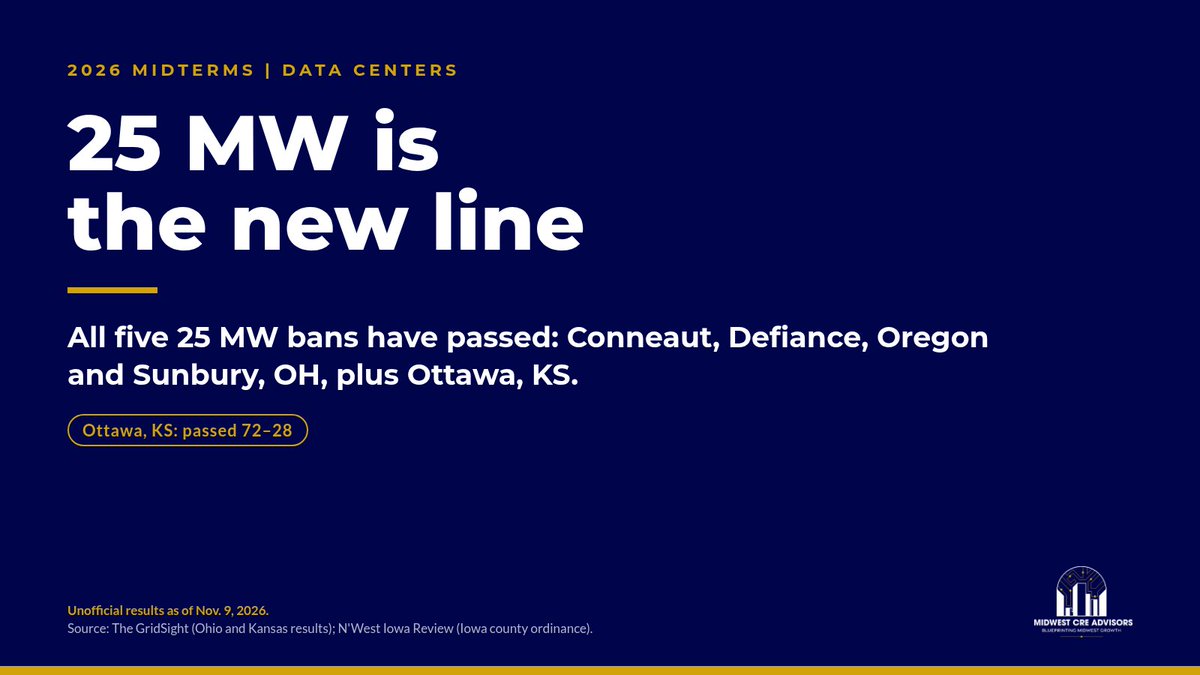
25 MW is becoming the line. All five 25 MW bans have passed: Conneaut, Defiance, Oregon and Sunbury, OH, plus Ottawa, KS (72–28). An Iowa county's 25 MW per-site cap took effect Nov. 4. Phase accordingly.
@TheMaineWonk Missouri is already testing this in Evergy's rate case. "Data centers pay their own way" is the easy part. The real protection is the minimum bill and contract length, and that's what's being argued at the PSC right now. A federal floor should leave room for those terms.
@ActforMissouri The number to watch is $60M vs $117M: how much large-load revenue gets credited back to everyone else. Public Counsel also wants a 90% minimum bill and 20-year contracts instead of 80% and 12. Those terms decide who carries the risk if a data center uses less or leaves.
You don't have to own a data center to get paid by one.
CBRE (Oct 26): industrial space inside data center clusters (11+ operating facilities within ~2 miles) rents ~6.8% more than comparable space elsewhere. Near clusters of 21+, it's 9.8%. Near 10 or fewer, no premium.
Who pays it: the companies that build, supply and service them. Inside clusters, tech tenants sign 13.9% of leases vs 7.1% outside. The premium runs ~14% for specialized R&D space and ~5% for distribution.
Older, smaller buildings inside clusters still get it. Proven power and fiber beat ceiling height.
Midwest: CBRE flags Milwaukee as a likely new cluster, with Chicago and Columbus worth watching.
https://t.co/3izN4DhjZm
KC owners with small-bay or flex near real power: are data center suppliers already calling you?
Freeze it or price it. Those are the two models now.
Texas paused approvals. In Missouri, Evergy's data center rates, with minimum payments and upfront direct costs, cut the Missouri West rate request by $61M (Nov 3 filing).
Which one gets more built?
🚨 Texas is putting a stop to new data center projects — including Elon Musk’s.
Gina Hinojosa, who won the race for Texas governor this week, says data center approvals should stay frozen until the Legislature passes "real protections so Texans can have a seat at the table to decide if and how data centers come into their communities."
In a video posted in October, she promised that as governor she would issue "a moratorium — a ban — on all data center approvals until laws can be passed."
Her plan would make operators prove that households won't pay more for electricity or water, end state subsidies for the industry, ban the nondisclosure agreements that keep projects secret, and require union labor.
The stakes are enormous.
According to The Information, by July 2026, SpaceXAI had investigated a number of potential sites for a large scale data center in Texas, which could match or surpass its two existing data centers in the Memphis area that have an estimated one gigawatt of combined compute capacity.
Now, it looks like that will be paused.
Texas has about 296 operating data centers and 170 more planned, according to Pew Research Center, and the governor's office says the state grid operator is weighing connection requests of more than 474 gigawatts, over five times Texas's record peak demand, with roughly 90% of it from data centers. Outgoing Gov. Greg Abbott already began pausing approvals in August while regulators audit the grid and water supplies, so Hinojosa's pledge would keep that freeze going rather than start a new one.
Hinojosa takes office on January 19, and any lasting protections depend on what the Legislature passes after it meets in January. Either way, the question of who pays for the AI boom's power and water is now front and center in the country's second-biggest data center state.
source: Foxhall, E. (2026) Under Hinojosa, Texas data center approvals could stay paused. The Texas Tribune.
@infra_marginal The benefits agreement and the power pledge answer two different fears. One covers water and noise, the other covers household bills.
Projects that put both in writing before the vote look better placed than ones asking for trust. Is anyone tracking approvals that way?