Most people don't need more motivation.
They need workouts that fit their life.
Short workouts • Smarter training • Lasting consistency.
Our Platfrom ↓
The dirty little secret about magnesium supplements - 400 mg of magnesium citrate is not 400 mg of magnesium.
Magnesium citrate contains both magnesium and citrate. A label listing only “magnesium citrate, 400 mg” gives the weight of the entire compound, not the elemental magnesium dose, and can make the dose look much larger than it is.
A clear label should read something like: “Magnesium (as magnesium glycinate), 120 mg, 29% Daily Value.”
Magnesium also has an established Daily Value. If the panel says otherwise, that’s another red flag, and a reason to check the labels on your other mineral supplements, too!
Heavy weights aren’t the only answer for strong shoulders. Controlled moves like this can help with shoulder strength, mobility and posture at the same time.
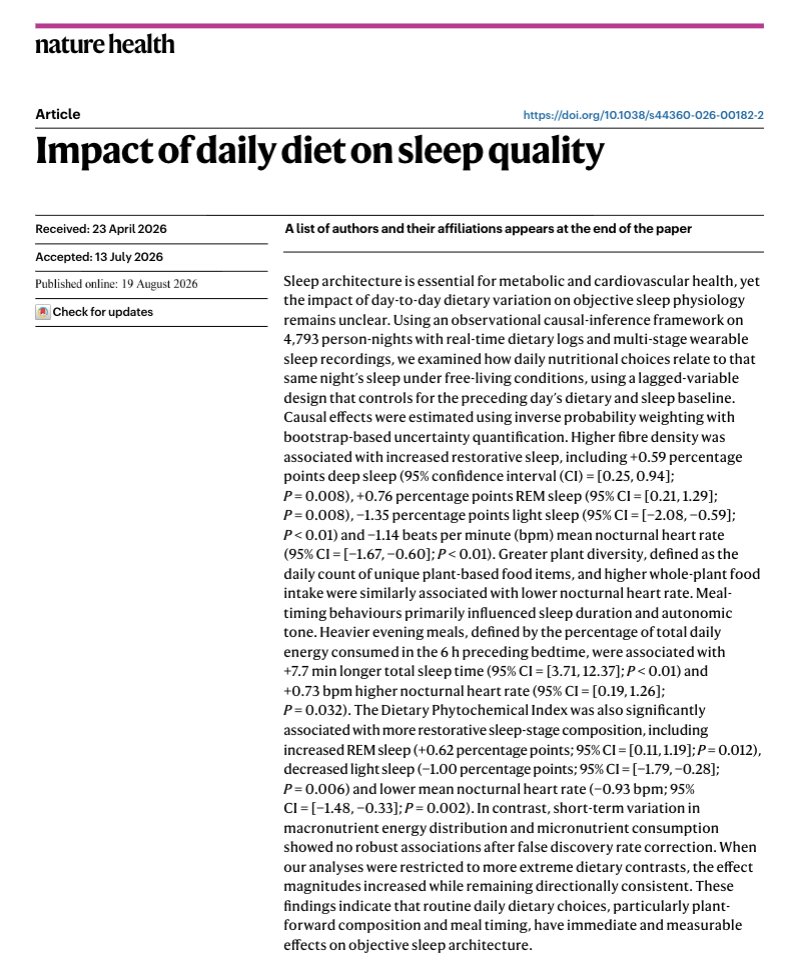
Your diet today influences how well you sleep tonight.
Higher-fiber days produced about 3% more deep sleep, 3% more REM sleep, 2% less light sleep, and a 2% lower sleeping heart rate relative to lower-fiber days.
More plant diversity and phytochemical-rich foods showed similar benefits. Yet short-term differences in carbs, fat, protein, individual micronutrients, and most diet-quality scores did not.
That pattern favors a whole-food/food-matrix effect rather than individual macro- or micronutrients acting independently on sleep.
The people who move the best…
Move every day.
Not for an hour.
Not until they’re exhausted.
Just a few intentional minutes.
That’s why I start most mornings with a quick mobility flow.
Here’s today’s routine:
• Neck Circles – 30s
• Torso Twists – 30s
• Tai Chi Reach – 30s
• Hand to Foot – 30s
• Deep Side Lunge – 30s
• Bear Twist – 30s
• Lunge Rotation – 30s
Five minutes.
No equipment.
No perfect routine.
Just a simple habit that helps me feel younger, move better, and train harder.
You don’t build a resilient body from one amazing workout.
You build it from hundreds of small decisions that compound over time.
Start with five minutes tomorrow morning.
Exercise and meditation don’t have to compete for your time. You can do both at once.
Mindfulness can be practiced during physical activity, including vigorous aerobic exercise. That combination may be especially interesting because aerobic exercise is a powerful stimulus for neuroplasticity, increasing the brain’s capacity to change in response to experience.
Pairing the neuroplastic effects of exercise with intentional mental training is an opportunity to cultivate awareness, connection, compassion, or other constructive states of mind.
From the latest episode of the FoundMyFitness podcast with @RichieJDavidson.
More protein does not necessarily mean more muscle.
For most people doing resistance training, gains in muscle and strength appear to plateau around 1.6 g/kg/day.
But there’s a good reason to push protein higher when the goal is fat loss or body recomposition. Higher protein intake can:
- increase satiety and make a calorie deficit easier to sustain
- help preserve lean mass so more of the weight lost comes from fat
- modestly increase energy expenditure through the thermic effect of food
This often gets lost in debates about “optimal” protein intake. You may not need more than ~1.6 g/kg/day to maximize muscle growth, but higher intakes can still be useful when you’re trying to lose fat without losing muscle.
Why is the Norwegian Method sweeping the endurance training world? Author @sweatscience Alex Hutchinson gives his take to @mackinprof & @gibalam in our latest epsiode of the Exercise Science podcast.
Full ep:
https://t.co/WLtiSLhNPZ
Want to improve your mood? Change your physiology.
I think the science is strongest for these strategies:
- Move your body (even briefly) and get outside.
- Make your days bright and your nights dark.
- Cover your nutritional bases, and consider omega-3s, magnesium, and creatine. They support pathways involved in inflammation, the stress response, and brain energy metabolism.
- Use sauna and other forms of deliberate heat exposure strategically.
Want to improve your mood? Change your physiology.
I think the science is strongest for these strategies:
- Move your body (even briefly) and get outside.
- Make your days bright and your nights dark.
- Cover your nutritional bases, and consider omega-3s, magnesium, and creatine. They support pathways involved in inflammation, the stress response, and brain energy metabolism.
- Use sauna and other forms of deliberate heat exposure strategically.
Fitness advice often starts with the ideal program.
Maybe it should start with your actual life.
Your job.
Your schedule.
Your energy.
Your available equipment.
Then build the training around that.
Make fitness fit real life.
A realistic training day can look like:
Morning: 10 min strength
Lunch: 15 min walk
Evening: 10 min mobility
You don't need to turn your entire day into a workout.
You just need to stop treating movement like it only counts when it happens all at once and for a full hour.
#fitness
The biggest fitness mistake busy people make might be waiting for enough time.
10 minutes isn't a failed 60-minute workout.
It's 10 minutes of training you actually did.