As a nation, are our choices still made under scarcity as a fact in every part of the world? Public funds have an opportunity cost, a trade of between spending it in a fertile way or increasing taxes to finance abortive government spending.
Today societies, nations and the entire world stands to be driven by fluid innovation and technology.
From the quest for a JUST energy transition all the way to JUST-IN-TIME production models, innovations and technologies continue to be the advantage or disadvantage in several parts of the world.
Today, the Centre for Research in Energy and Energy Conservation has embraced an important initiative to take advantage of the benefits of innovation and technology to achieve sustainable energy efficiency, production and practices through the CREEC Innovators Network.
I am pleased to have the opportunity to coordinate this huge team to realize a more vital innovative community particularly in clean energy technologies.
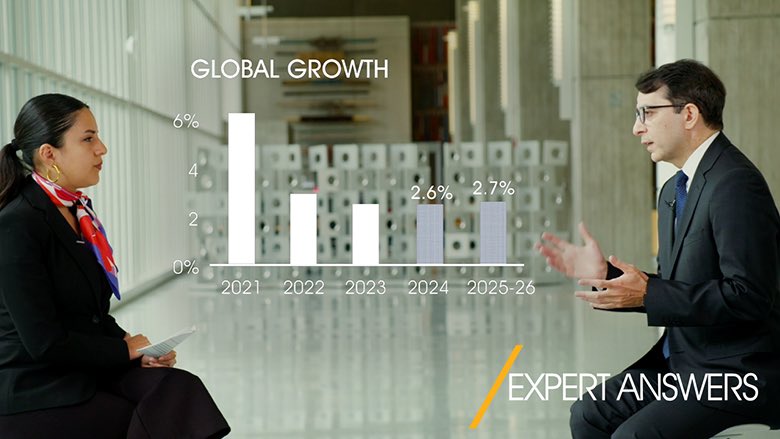
The global economy is expected to stabilize in 2024, but at a level that is weak by recent historical standards.
Gain insights from Ayhan Kose, Deputy Chief Economist, as he analyzes the Global Economic Prospects
@WorldBank
Not sure if everyone got along well with this report on Uganda from @moodysratings, but here's a few issues noticeable.
Moody’s rating is a crucial tool for investors, financial institutions, and policymakers, aiding in informed decision-making and risk management within the ever-changing scenery of global finance.
Moody's Ratings has recently downgraded Uganda's long term foreign currency and local currency issuer ratings from B2 to B3, while also shifting the outlook from negative to stable. This decision, according to Moody's, reflects a decline in debt affordability and restricted financing avenues for Uganda. The downgrade indicates the nation's delicate reliance on costly domestic and non-concessional external financing sources, exacerbating its vulnerability to external financial conditions and dwindling foreign exchange reserves.
Moody's stable outlook suggests that Uganda's credit challenges and strengths are included at the B3 rating level. Nevertheless, risks concerning debt affordability and external vulnerability persist. The potential for gradual improvements in revenue mobilization could alleviate fiscal burdens, although execution risks remain a concern.
The local and foreign currency country ceilings for Uganda have also been adjusted downwards to Ba3 and B1 from Ba2 and Ba3, respectively. This adjustment takes into account the government's limited economic footprint, despite facing external imbalances and geopolitical risks, which could constrain its ability to respond to future economic shocks.
Moody's projects that Uganda's credit profile will remain stable at the B3 level. Fiscal consolidation efforts and a positive growth outlook are anticipated to stabilize the nation's debt burden, although at close to 50% of GDP in fiscal 2024. However, the sustainability of this trajectory hinges on continued progress in implementing the government's revenue mobilization strategy and enhancing overall public financial management.
Gradual enhancements in revenue mobilization capacity hold the promise of alleviating liquidity pressures and debt affordability challenges. Moody's forecasts that Uganda's track record of macroeconomic stability will persist, with average real GDP growth of 4.7%, outpacing that of B-rated countries over the past decade. Additionally, investments in the oil sector are expected to shape Uganda's economic trajectory, with production set to commence in 2025.
Uganda's ESG Credit Impact Score accentuates significant exposure to environmental and social risks, coupled with weak governance and fiscal metrics. Moody's suggests that sustained progress in revenue generation capacity and access to moderate-cost funding could exert upward pressure on the rating, reversing the decline in debt affordability. Conversely, a deterioration in external imbalances, refinancing risks, or domestic political instability could exert downward pressure, endangering Uganda's macroeconomic stability.
@GovUganda
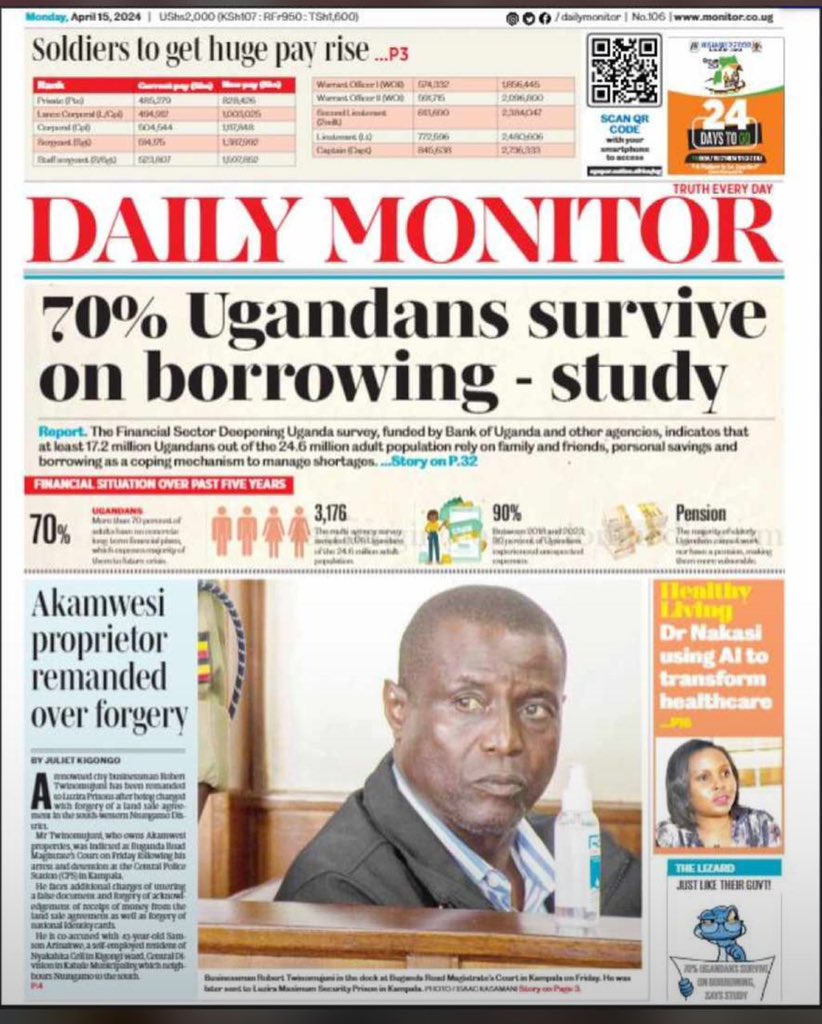
70% of Ugandans survive on borrowing according to a publication on @DailyMonitor today. This is a manifestation of societies, groups and communities that exhibit income disability.
Financial inclusion should start from leveling the ground for the several income impaired persons - including certain categories of unemployed persons. An income maintenance systems is very import not only for welfare recipients but also stimulates domestic demand. These are the roles that should take up our fiscal responsibility as a nation.
Yesterday I witnessed a beautiful transition in @MUBS_ESA’s 8 year existence as Mr. @Jude_Opolot01 [outgone President] handed over to Ms. Aloyo Patience, the 1st female President of the Economics Students Association.
Thank you Jude and team, good luck Patience!
It was a pleasure to facilitate and successfully come to the end of @MUBS_ESA Data analytics with SPSS training this afternoon, with skills demonstrating and awarding of certificates of completion.
Congratulations to all the trainees and I wish you all an ambitious practice.
Globally, there is about $1 trillion in hidden debt—borrowing for which a government is liable, but which is not disclosed to its citizens or to other creditors.
@IMFNews
The global average cost of sending $200 from one country to another was about $12.50 in the first quarter of 2023, or 6.25%, according to the @WorldBank. Cheaper cross-border payment services would benefit people and economies worldwide.
@IMFNews
Using @WorldBank Official exchange rate (LCU per US$, period average) data for Uganda from 1960 to 2022, my model forecasts Uganda’s exchange rate to continue increasing with absolute casts for 2024 at 3871 with upper and lower bounds upto 4293.758 and 3449.686 with a 95% Confidence Internal.
Note: the forecast also predicts Exchange rate to continue to increase in the period of 2025, 2026 and 2027 with absolute forecasts at 3960.354, 4048.746 & 4137.068 respectively with upper and lower bounds reaching 4951.991 & 3322.145 respectively by 2027.
The Central Bank, @BOU_Official has raised the CBR up from 9.5% to 10% this month and hopes this will increase the returns, create demand and consequently appreciate the shilling.
Model Accuracy using MAPE = 11.42%
Almost 40% of global employment is exposed to AI - about 60% in advanced economies. The IMF’s new AI preparedness index shows wealthier economies are better equipped for AI adoption than low-income countries.
@IMFNews
Represented by PI @Obuk_Charles, we had a successful dissemination and validation workshop for our study on “Improving market Accessibility for the Commercialization of Rural small and medium farmers in Uganda” choosing Jinja as the primary source of data.
Uganda’s bid to improve the incomes of the majority households below desired level has seen a number of interventions which have seemed sluggish at the task including efforts to commercialize the agricultural sector. Unfortunately a number of challenges have undermined such efforts.
In this study, we hold a supposition that Market access both as a destination and source of input is critical to driving Commercialization of agriculture. We also note that understanding the limitedness of poor household to produce for commercial purposes is essential in the quest to Commercialize this sector - a reason we front Jinja district for this study rather than focus on a few large scale farmers.
We examine with descriptive analysis the appropriateness of government efforts like extension services, availability, timeliness and satisfaction from farmer market information which are critical in commercializing agriculture. Price incentives eroded by dysfunctional market structures involving middlemen and cartels rose as some of the issues affecting farmer involvement in several markets in Uganda.
We (the team) hope that with the feedback and comments from the dissemination and validation workshop, we’ll be able to make valid recommendations to enable the vast low income households engage in commercial farming rather than do more for consumption.
SESSION 4 OF THE DATA ANALYSIS TRAINING, an initiative of Economics Students Association of @OfficialMubs to further enhance the students ability to conduct data analysis, a critical and necessary skill in todays job market.






![emmanuelokware_'s tweet photo. Yesterday I witnessed a beautiful transition in @MUBS_ESA’s 8 year existence as Mr. @Jude_Opolot01 [outgone President] handed over to Ms. Aloyo Patience, the 1st female President of the Economics Students Association.
Thank you Jude and team, good luck Patience! https://t.co/VSRydE58D2](https://pbs.twimg.com/media/GLHFRRRWAAALzX8.jpg)


