Hello, this is LoRosha.
Every day, I study and document how changes in the Korean and U.S. markets affect each other. I publish my Korean market analysis after 8 a.m. Eastern Time (ET) and my U.S. market analysis after 8 p.m. ET.
I became active on Substack in March this year. By October, I had over 3,000 subscribers and around 7,000 followers.
However, on November 3, my account was suspended for a stated violation of Substack’s spam and phishing policy. Substack did not identify which specific posts were involved. The suspension surprised me, as I had been publishing my market analysis in accordance with Substack’s policies.
On November 6, Substack told me they would lift the restriction once I provided written consent to the removal of the content in question. I replied with my consent, but my account has yet to be restored.
I had focused my publishing on Substack and had been largely inactive on other platforms. This experience led me to launch my own website and begin connecting with readers across several social platforms.
Since the suspension, I have continued publishing my market analysis on Medium. I am now also publishing on my new website.
If you would like to study the Korean and U.S. markets with me, you can read my analysis here:
https://t.co/TZu6Yy9ONV
Thank you for reading my work and studying the markets with me.
From Seoul,
LoRosha
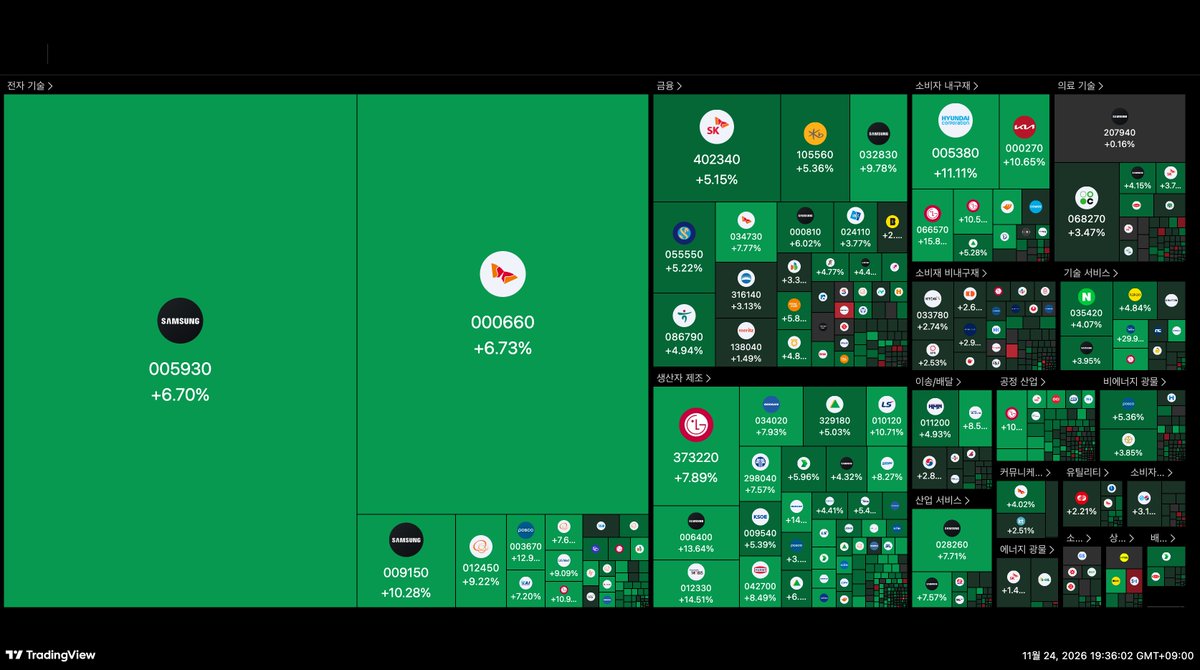
Nov 24, '26(KST)| KOSPI +6.32%
Jensen stepped down. Foreigners sold Korea.
Jensen came back. Foreigners bought Korea.
Btw,
SK hynix? Still selling. 9 sessions straight.
Foreign net buying was 57% below this year's daily average in either direction.
KOSPI trading volume was 53% below its daily average this year.
Jensen is back. Foreign buyers are back.
So
what's holding them back?
2026 isn’t over yet. And as it happens, the KOSPI has been on sale throughout the second half of the year. 🤗
Curious whether the KOSPI is really worth buying? Come check out today’s KOSPI analysis after 8 PM ET! 🇰🇷
Look at the KOSPI yesterday vs. today!!! 🔴🟢
Thanks, @JensenHuang .
I haven’t done my analysis yet, but I’m convinced you’re behind all that green. You’re the King of Green. 👑
Today’s LoRosha KOSPI breakdown drops after 8 a.m. ET.
Figuring out what to focus on always takes me the longest. Today I spent about 5 hours trying to make sense of the market moves, and Jensen Huang’s comeback was the only explanation I could find, haha.😂
Once I’ve settled on a topic, writing Section 1 usually takes me about 30 minutes to an hour.
In the November 23, 2026, session in South Korea, Samsung Electronics fell 2.52% and SK hynix fell 3.06%, while semiconductor equipment stocks rose.
I attributed the gains in equipment stocks to signs of AI demand in South Korea’s November 23 trade data, and the declines in memory stocks to a Goldman Sachs report.
According to Korean media, Goldman Sachs cut its Samsung target from 500,000 won to 350,000 won, a 30% reduction, and cut its SK Hynix target from 3.5 million won to 2 million won, about 43%.
Both ratings stayed at BUY and Goldman even said the recent selloff looked excessive.
The bank is not giving up on 2027 because it still sees conventional DRAM undersupplied by 5.1% next year, which it describes as one of the tightest shortages in more than 15 years.
The revision is about 2028 and Goldman now expects regular DRAM prices at SK Hynix to fall 19% that year, compared with a 5% drop in its old forecast, while lifting its HBM market outlook to $200 billion next year from $60 billion this year.
Nobody is really arguing anymore about whether this memory cycle is real.
The argument is about how long the tightness lasts and I think HBM is what keeps this cycle running longer than people expect. $MU
Nov 23, '26(ET)| SOX +14.03%
Every day I publish a US market read in two parts. Section 1 is the one logic I can find in that day's tape. Section 2 is what actually happened.
I always write Section 2 first, then Section 1. I finished Section 2, then spent hours on Section 1. Wrote it. Deleted it. Wrote it again.
In the end only one logic was worth keeping.
Jensen Huang is back at Nvidia.
As of November 24, Samsung Electronics accounted for 28.29% of the KOSPI’s total market capitalization excluding treasury shares, and SK hynix accounted for 21.28%.
South Korea’s Kospi benchmark jumped more than 6%, with Samsung Electronics and SK Hynix — key suppliers of AI memory chips — accounting for roughly half of Kospi's market capitalisation https://t.co/fvL1XJdqAl
@hrrana@LoRoshaDesk LOL. I want this market to last for at least an hour so that all the dip buyers turn their account to zero! No other way people will understand the lessons.
Just after noon in Seoul on November 24, foreign investors are net buyers of KOSPI-listed stocks. They were net sellers for seven consecutive sessions, from November 13, the first Korean trading session after Nvidia announced Jensen Huang’s resignation, through November 23. If their purchases still exceed their sales at the 3:30 p.m. close, foreign investors will record their first net buying session in eight trading days.