"I love these fans. I love this city," said Luka Doncic to his former home crowd as the Lakers exited the American Airlines Center for potentially the final time this season.
Read all about Luka's Night, here: https://t.co/xDjGiLjVrt
#LoadedCoverage
Utah sent an undercover agent to place about $115 in sports bets on Kalshi. Now the two people who started Kalshi are charged with 13 felonies, and the top charge alone carries up to 15 years in prison.
The day after the charges came down, investors gave Kalshi $1 billion.
Here's how the sting worked. In September, a special agent with the Utah attorney general's office opened a Kalshi account with a Utah address, a Utah phone number and a Utah debit card. Before his first bet, $10 on the Cowboys against the Giants, the app asked him to confirm his location. He told it he was in Utah, and it took his money. He did that 12 times over 11 days, on games like Utah vs. Utah State and a Real Salt Lake match.
Kalshi's cut on each bet was somewhere between 3 and 78 cents. So the company made less than $10 off the bets Utah is now using to go after its CEO and COO personally. And that top charge comes from Utah's racketeering law, the same kind of statute prosecutors use on organized crime.
The obvious question is why Kalshi didn't just shut off Utah. It clearly knows how. It already blocks Nevada and Washington because a settlement and a court order made it. DraftKings pulled its sports and politics markets out of Utah the same night the charges were filed, FanDuel did it the next day, and Fanatics shut down everything there on November 4.
Kalshi stayed because of how the company is built. DraftKings runs on licenses from gambling regulators in more than 20 states, so when one state comes after you with criminal charges, you get out fast and protect the rest. Kalshi has exactly one license, from a federal agency called the CFTC. Its whole $40 billion valuation depends on the idea that this one federal license overrides state gambling laws, and quietly walking away from Utah would cut against that argument everywhere else.
The federal government is backing Kalshi on this, and pretty aggressively. The CFTC and the Justice Department sued Utah two days before the charges. Their complaint says that if Kalshi turned away Utah residents, it would be breaking a federal "impartial access" rule that requires exchanges to serve everyone.
So the founders are stuck. Utah wants them to stop taking bets from Utahns or face prison, and the federal government is in court saying they aren't allowed to stop.
This goes way past Utah, too. The CFTC has sued 10 states since April. On the other side, 37 states signed a brief backing Utah in its appeal.
Sequoia and Wellington, who co-led the $1 billion round, are betting on one legal question, whether federal commodities law beats state gambling law. If the courts say yes, Utah's criminal case could fall apart along with every state lawsuit against Kalshi. A federal judge in Utah already said no back in August. The 10th Circuit is up next, and this looks like it's headed to the Supreme Court.
Kind of fitting for a company that lets you bet on almost anything that its biggest investors now have $1 billion riding on how a court case turns out.
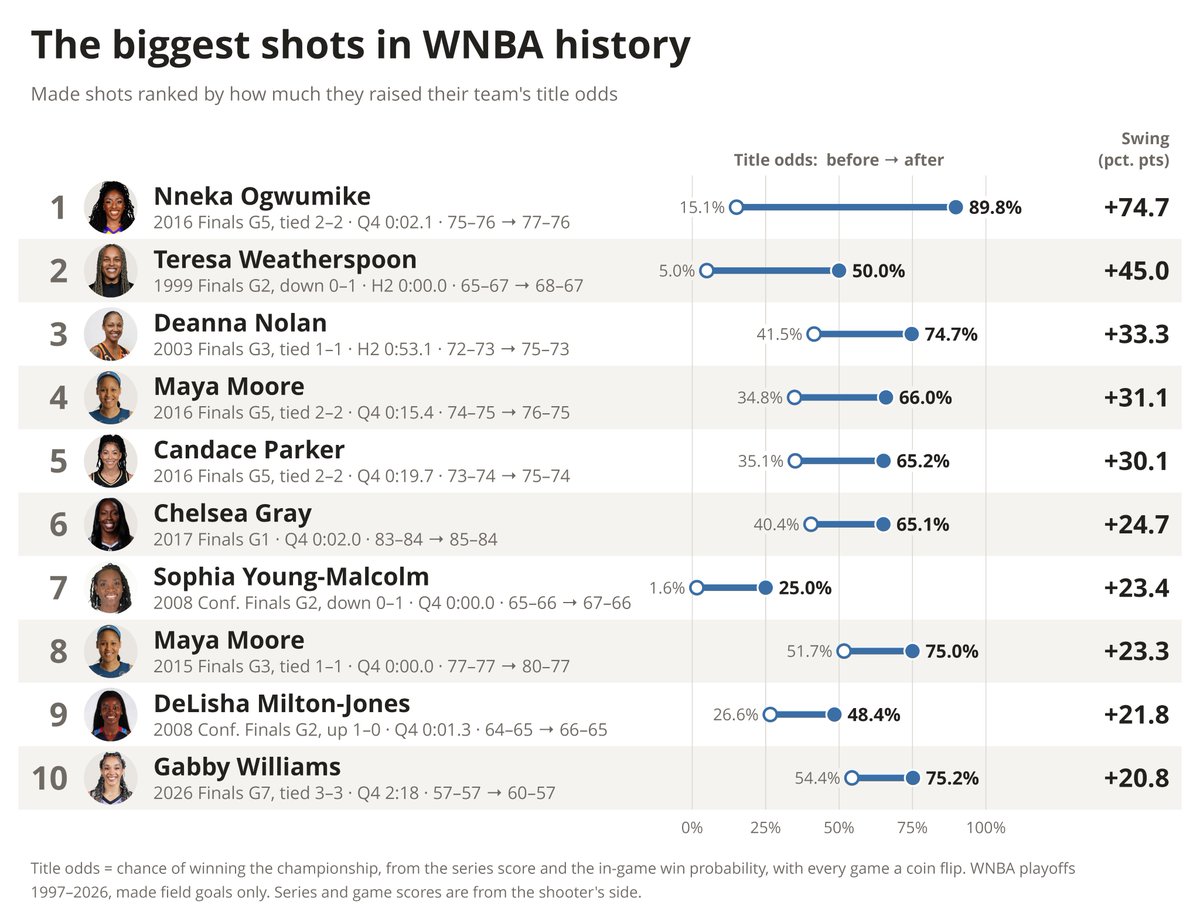
Gabby Williams hit a 31 foot three pointer to put the Valkyries up 3 with 2:18 left. It increased their title chances from 54% to 75%.
It was the 10th biggest shot in WNBA history, as measured by impact to championship probability (+21%).
“yo dude this game is fun you should play it”
“not until I check the metacritic score, steam charts, budget rumors, earnings per share as of last fiscal quarter”
In this era of artificial intelligence, it is becoming urgent to distinguish human art from what machines produce. There is an ontological difference, even before an aesthetic one, between art and what a machine can generate through statistical calculation based on millions of images created by others. Algorithms lack the spark of humanity. For this reason, the Church wishes to renew an alliance with artists and cultural institutions to safeguard our humanity.
@MarathonTheGame Hi, avid player and enjoyer of your game here.
I just finished Lab 6 this weekend and have a bunch of DNA Access Cards to burn before the season ends. It would be glorious and appreciated if you kept Cryo Archive open until the Season reset, thank you ❤️
For my Los Angeles Clippers followers
This has been a very difficult time for everybody associated with the Clippers, and for that, I have sincere regrets. I want to apologize to our fans, employees, and my fellow NBA team owners for the distraction and distress this matter has caused, for which I accept responsibility as principal owner.
We are committing to put this chapter behind us. We have communicated to the NBA that we are complying with the penalties assessed by the league, have paid the fine, and are moving forward. While there are still disagreements concerning the findings in the report, this is not where I want to focus. Team owners should support, not distract.
The challenges ahead of us are significant, but so is our resolve. We will continue to build our team and invest in our community. The confidence of our fans is our priority. With our talented roster, outstanding staff and clear vision, I am certain that we will compete at the highest level and be an organization our fans can be proud of.
P.S. To process the Kawhi trade, the NBA first needs to approve the Clippers' temp governor.
Ballmer and one of his alternates, Gillian Zucker, are both banned. Ballmer's other alternate?
Clippers co-owner — and Aspiration investor — Dennis Wong. But would the NBA approve that?
Quotes from Brian Windhorst, Tim MacMahon, Zach Lowe, Chris Mannix, and Jon Krawczynski describing how Clippers acted and lied personally to the media during the investigation. Krawczynski: It was a "behind the scenes, ferocious defense that was accusatory to anyone who dared question them."
Transcript of key quotes:
Windhorst: "I had friends [who worked for the Clippers] swear to me that this was bunk."
MacMahon: "I've talked to Clippers people too who lied to my face. I mean, I don't know what to tell you."
Lowe: "Kirk, I'm sure you can attest this too. They've been adamant that they did nothing wrong. I've had relationships sort of sour, if not splinter entirely, simply by asking questions. They were so offended that anyone would even impugn them with questions."
Mannix: "I'm looking forward to not hearing anything from some Clippers people that, you know. Yeah, there was a lot going on, Rachel. I think Jon Krawczynski had a good tweet about this during the day." He then finds, reads, and endorses the following quote:
Krawczynski via social media: "One thing about the saga stands out to me: the Clips, both publicly and also behind the scenes, launched a ferocious defense that was accusatory to anyone who dared question them. Today’s punishment is severe on its own, but also a very bad look for the spinsters in house."
Clipped via:
https://t.co/Ma4EU4nFXh
In 2019, Ramona Shelburne famously said Rob Pelinka forgot how the salary cap worked when trading for Anthony Davis.
She was wrong. It turns out Steve Ballmer and Lawrence Frank did not know how the cap worked.
Via @espn
Clip via:
https://t.co/s1tuiWqapR
Clearly, Ramona Shelburne is in Steve Ballmer’s payroll. Now the dudes in ESPN need to have credibility assessment.
“For a year, the Clippers, through their personal relationships with media, with crisis PR people, with compliant outlets, have tried to sell a story in which I and we have been lying about this the whole time. And what those media sources should have known a lot earlier than yesterday was that it was the opposite.”
(Via @DanLeBatardShow) https://t.co/pwLy6AzvzR