So, on August I've found clickjacking on google worth 7,500$ , This is the write up : https://t.co/88F70Mzlpr Thanks to all of the community who teach me a lot for finding a bug. Specially for indonesia bug hunter community. 🙏
In the last few months, I developed some new AI hacking techniques involving data compression and gadgets found within linguistics. I presented this work for the first time during Prompt2Pwn, but I've written it up here for you to read ->
https://t.co/72PUvjLE0l
An OAuth flow validates the redirect URL hostname but ignores the scheme. Is that enough? It's not. In my new post I cover two ways to hijack the authorization code, plus some interesting parser quirks 👀
https://t.co/NkG8NiTfaZ
We've now paid out more than $1M in @muse bug bounties. That includes $300,000 to a security researcher who found the most critical bug we've seen in Muse. https://t.co/1PATDTtA6o
OpenEMR is the most popular open source electronic health record systems.
My favorite finding affecting < v8.5.0 is file disclosure via user-controlled PDF https://t.co/GSr8q4n1Ks (reachable from patient/staff).
It uses a trick that GPT-5.6-sol needed a hint to figure out.
Healthcare software is critical infrastructure, and the growing capabilities of AI in vulnerability research introduce new security risks.
@fariskhi used GPT-5.6-sol to discover more than 40 vulnerabilities in OpenEMR versions prior to 8.5.0, including local file disclosure, SQL injection, access control flaws, patient portal takeover, and an exploit chain enabling administrator API impersonation.
OpenEMR is one of the most widely used open source electronic health record and medical practice management systems, reportedly used by over 100,000 medical providers serving more than 100 million patients across countries including the United States, India, and Indonesia. 🏥 🌎
https://t.co/L74C4PIbwY
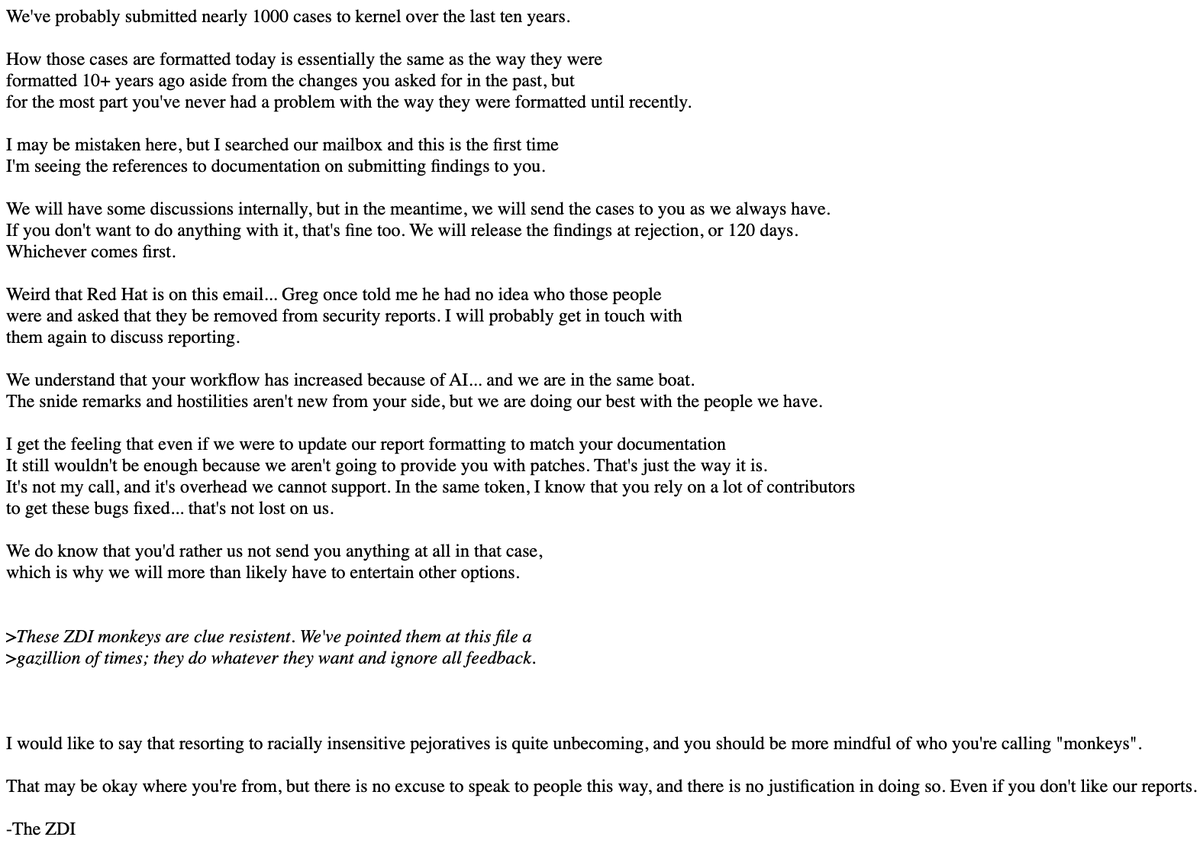
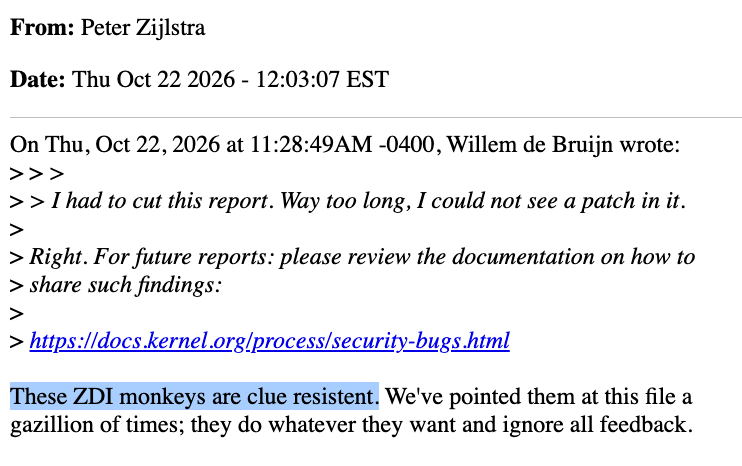
next time you're thinking about researching the linux kernel (@linuxfoundation), remember that someone on the receiving end of your report might talk about you like this:
in one of the threads, kernel maintainer "Peter Zijlstra" decides to call the ZDI team "monkeys"
there's a longer argument about how ZDI submits reports, whether they should include patches, and how fixes get tested. fair enough, have that discussion
but how does insulting the people reporting vulnerabilities help?
i thought the kernel's code of conduct was something everyone on these lists was expected to follow
sad to see people spoken to like this while trying to help improve linux security.
crime scene:
https://t.co/4Ud7JUz10M
https://t.co/vXiHlvyZGi
My non-hacking buddy asked me how much the person who found the php2shell made. Then he made a good observation:
Hack a small company, make a little. Hack a big company, make a lot. Hack 70% of the world, make nothing.
New Google VRP writeup "Confused Deputy: Google IdP Universal Account Takeover via Device Code Flow Hijacking" for a bounty of $13,337 by Mohamed Benchikh:
https://t.co/qzy3yPWseq